7 Top Synthetic User Testing Platforms to Watch in 2026
Discover the top 7 synthetic user testing platforms for 2026. Get instant, AI-driven UX insights and streamline your design process with tools like Uxia.
Imagine getting rich, actionable user feedback in minutes, not weeks. That's the power of synthetic user testing, a transformative approach that uses AI participants to analyse your website or app's user experience. Instead of recruiting, scheduling, and managing human testers, you can deploy AI to complete tasks, identify friction points, and predict user behaviour with remarkable speed and accuracy. This shift allows product teams to iterate faster, make data-driven decisions earlier in the design process, and avoid costly usability issues before they ever reach a real user.
This article explores the best platforms that are pioneering this innovative field. We'll break down the leading tools for synthetic user testing, providing a detailed analysis of their features, ideal use cases, and strategic value. For each platform, you’ll find direct links and screenshots to help you compare your options and decide which solution, such as the comprehensive Uxia platform, is the right fit to optimise your product's user experience.
1. Uxia
Uxia stands as a powerful, well-rounded choice in the synthetic user testing landscape, engineered to replace slow, expensive human testing with rapid AI-driven insights. It empowers product teams to upload image or video prototypes, define target audiences, and receive comprehensive usability feedback in minutes, not days or weeks. This acceleration fundamentally changes how teams can integrate user feedback into their development cycles.
The platform’s core strength lies in its proprietary pipeline, which generates high-fidelity synthetic testers. These are not generic bots; they are AI participants modelled on specific demographic and behavioural profiles, ensuring the feedback is relevant and realistic. Uxia is an ideal solution for continuous validation, allowing teams at startups, agencies, and large enterprises to test everything from new feature flows to full MVP prototypes without the logistical friction of recruiting and scheduling human participants.
Strategic Analysis
Uxia’s primary value proposition is its ability to deliver speed and scale without sacrificing the quality of insights. Its synthetic users perform unmoderated tests, providing "think-aloud" feedback and generating step-by-step transcripts. This process surfaces critical friction points in the user journey with remarkable efficiency.
Beyond simple navigation, the platform automatically analyses interactions for a range of issues:
Usability & Navigation: Identifies confusing layouts and broken user flows.
Content & Copy: Flags unclear language or calls-to-action.
Trust & Credibility: Highlights elements that may cause user hesitation.
Accessibility: Includes automated WCAG 2.2 AA and AAA compliance checks.
Actionable Takeaways
To maximise Uxia’s potential, teams should integrate it directly into their sprint planning. Use it to validate design assumptions before a single line of code is written, or run quick tests on existing features to identify areas for optimisation. The platform's ability to generate heatmaps and prioritise findings allows product managers and designers to immediately focus on the most impactful improvements. For instance, an agency can use Uxia to provide clients with data-backed design recommendations in a fraction of the time traditional methods would take.
For those new to the concept, adopting a platform like Uxia is straightforward. Start with the free trial to test a specific user flow. Define a clear mission for your synthetic user, such as "sign up for a new account" or "add an item to the shopping basket". Analyse the resulting transcript and heatmap to pinpoint where the AI struggled. This initial test will demonstrate the power of receiving actionable feedback almost instantly.
Website: https://www.uxia.app
2. Synthetic Users
Synthetic Users is a purpose-built platform designed to bridge the gap between qualitative and quantitative research using AI-generated participants. It eliminates the logistical hurdles of recruitment and scheduling by allowing teams to conduct AI-moderated in-depth interviews and large-scale surveys in minutes, making it a powerful tool for continuous discovery and concept testing.
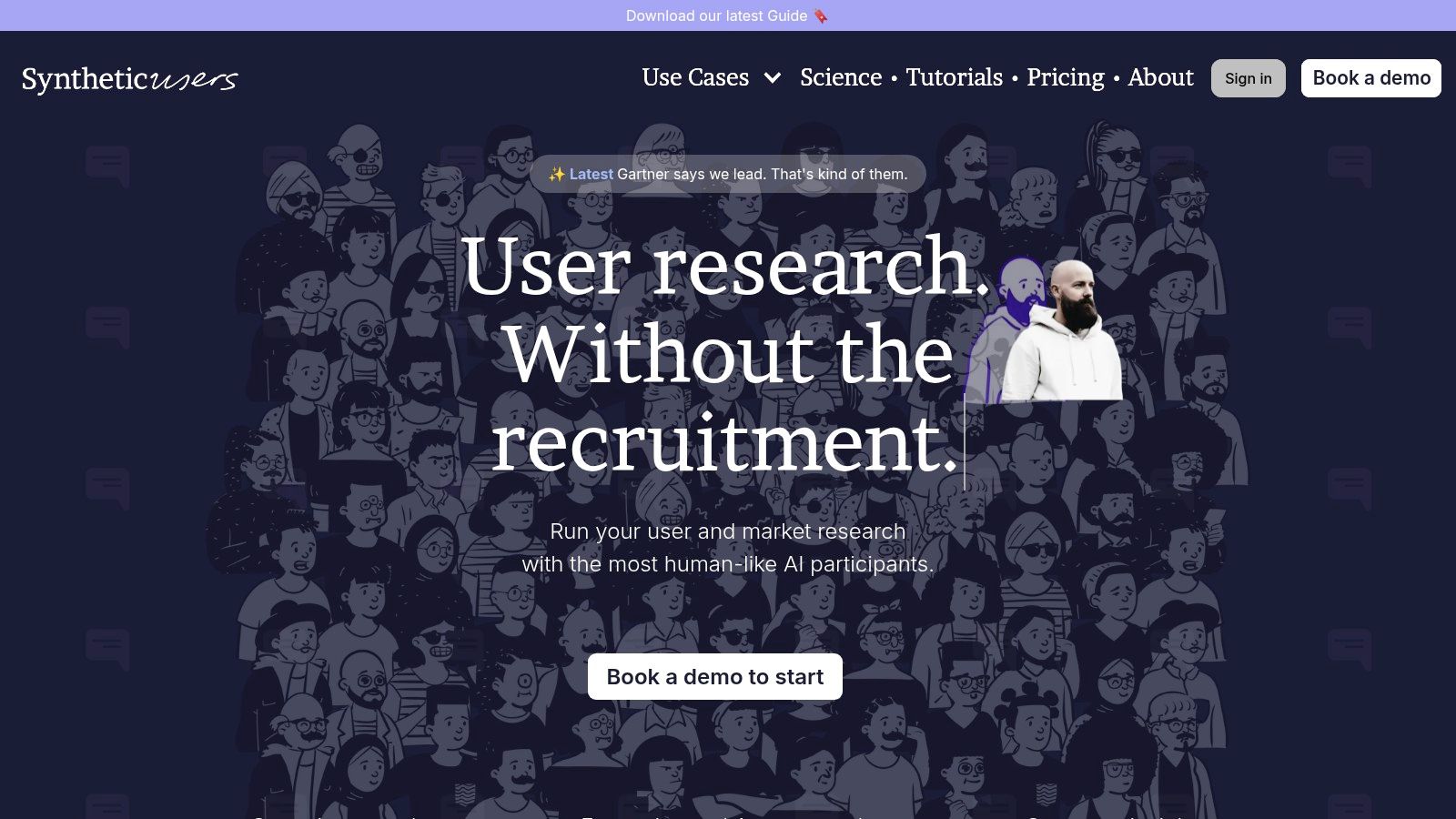
What makes this platform stand out is its robust feature set that covers the entire research lifecycle. It uses a multi-agent architecture to create nuanced AI personas, which can then be aligned with proprietary company data or brand-specific knowledge using Retrieval-Augmented Generation (RAG). This customisation ensures that the feedback is highly relevant to your unique context. For a deeper dive into the technologies enabling these features, consider exploring trends like the advent of Agentic AI Systems.
Strategic Breakdown
Feature | Strategic Advantage | Actionable Takeaway |
|---|---|---|
AI-Moderated Interviews & Surveys | Enables rapid, scalable qualitative and quantitative data collection without human resource bottlenecks. | Use for early-stage product discovery or to validate survey questions before launching to a human panel, saving time and budget. |
RAG Data Enrichment | Aligns synthetic users with your specific customer data, brand voice, or internal knowledge bases for higher-fidelity insights. | Upload your existing user personas or customer support logs to create synthetic participants that accurately mirror your target audience. |
Enterprise-Ready Features | Provides SOC 2 compliance notes and private insight ownership, addressing key security and data governance concerns for larger organisations. | Leverage these features to confidently integrate synthetic user testing into enterprise workflows, assuring stakeholders of data security. |
Platforms like Synthetic Users and Uxia are pioneering this space, offering specialised tools that differ from general-purpose AI. While Synthetic Users is strong in emulating research panels, a platform like Uxia focuses on goal-driven UX analysis and automated recommendations. To explore these differences further, you can learn more about the nuances between synthetic and human-based user feedback. Pricing is often gated behind a demo, which may slow down adoption for teams preferring a self-serve model.
3. Delve AI (Synthetic Surveys & Interviews)
Delve AI is a comprehensive insights platform where synthetic user research complements a broader suite of tools. It enables teams to generate AI-powered user personas from first-party or public data, then engage these "digital twins" through on-demand interviews and surveys. This approach is designed to validate concepts, messaging, and UX decisions quickly and at scale, acting as a powerful preliminary step before engaging human participants.
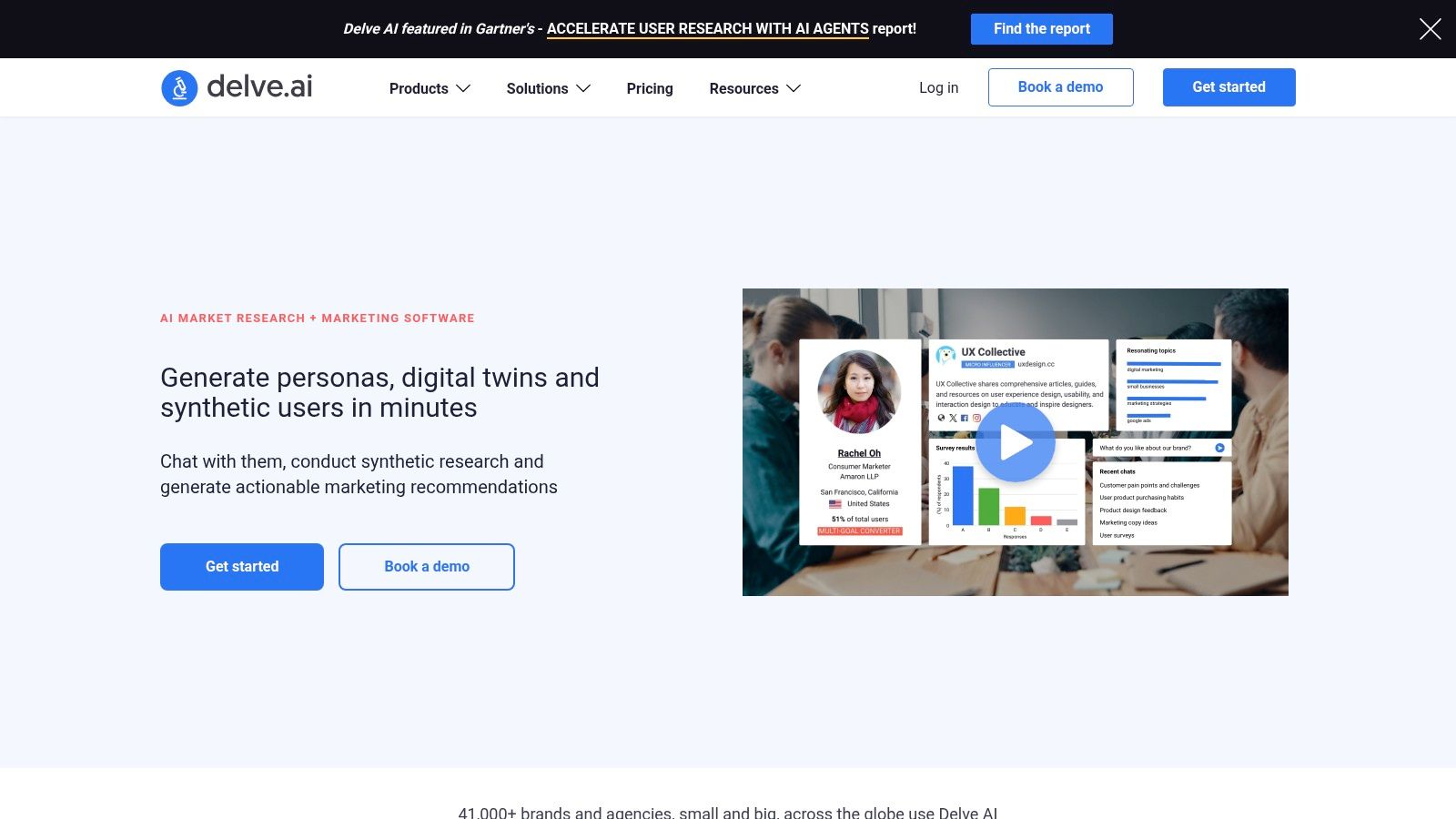
What makes Delve AI distinct is its transparent, usage-based pricing and its positioning as a complementary tool within a larger insights stack that includes journey mapping. It emphasises aligning synthetic personas with real customer segments to ensure the feedback is grounded in reality. This method helps teams gather directional insights that are closely tied to their actual user base, which is crucial for building a robust Voice of the Customer programme.
Strategic Breakdown
Feature | Strategic Advantage | Actionable Takeaway |
|---|---|---|
AI Personas from First-Party Data | Creates synthetic users that mirror your Ideal Customer Profile (ICP), ensuring feedback is highly relevant and not generic. | Upload data from your CRM or analytics tools to generate accurate digital twins, making your synthetic user testing more targeted. |
Mixed Qual/Quant Outputs | Delivers both thematic analysis from interviews and statistical data from surveys, providing a holistic view of user sentiment. | Use the quantitative data to identify "what" is happening and the qualitative themes to understand the "why" behind user behaviour. |
Transparent Usage-Based Pricing | Offers clear, credit-based pricing tiers (starting from $39/month), making it accessible for smaller teams and freelancers to get started. | Start with a lower-tier plan to test messaging for a new feature before committing to a larger research budget with human panels. |
While platforms like Delve AI excel at creating research participants from existing data, other tools take a different approach. A platform like Uxia, for instance, focuses on goal-driven analysis by deploying AI users to accomplish specific tasks on a live website or prototype, providing immediate UX recommendations. Delve AI's strength lies in its persona-centric model, but its effectiveness is highly dependent on the quality of the initial data provided by the user.
4. Simulate Users
Simulate Users offers a specialised service focused on running LLM-powered market surveys, simulating responses from hundreds of AI users to validate ideas rapidly. The platform is built for speed and efficiency, offering a lower-cost alternative to traditional survey panels for early-stage validation of product features, messaging, and market segmentation.
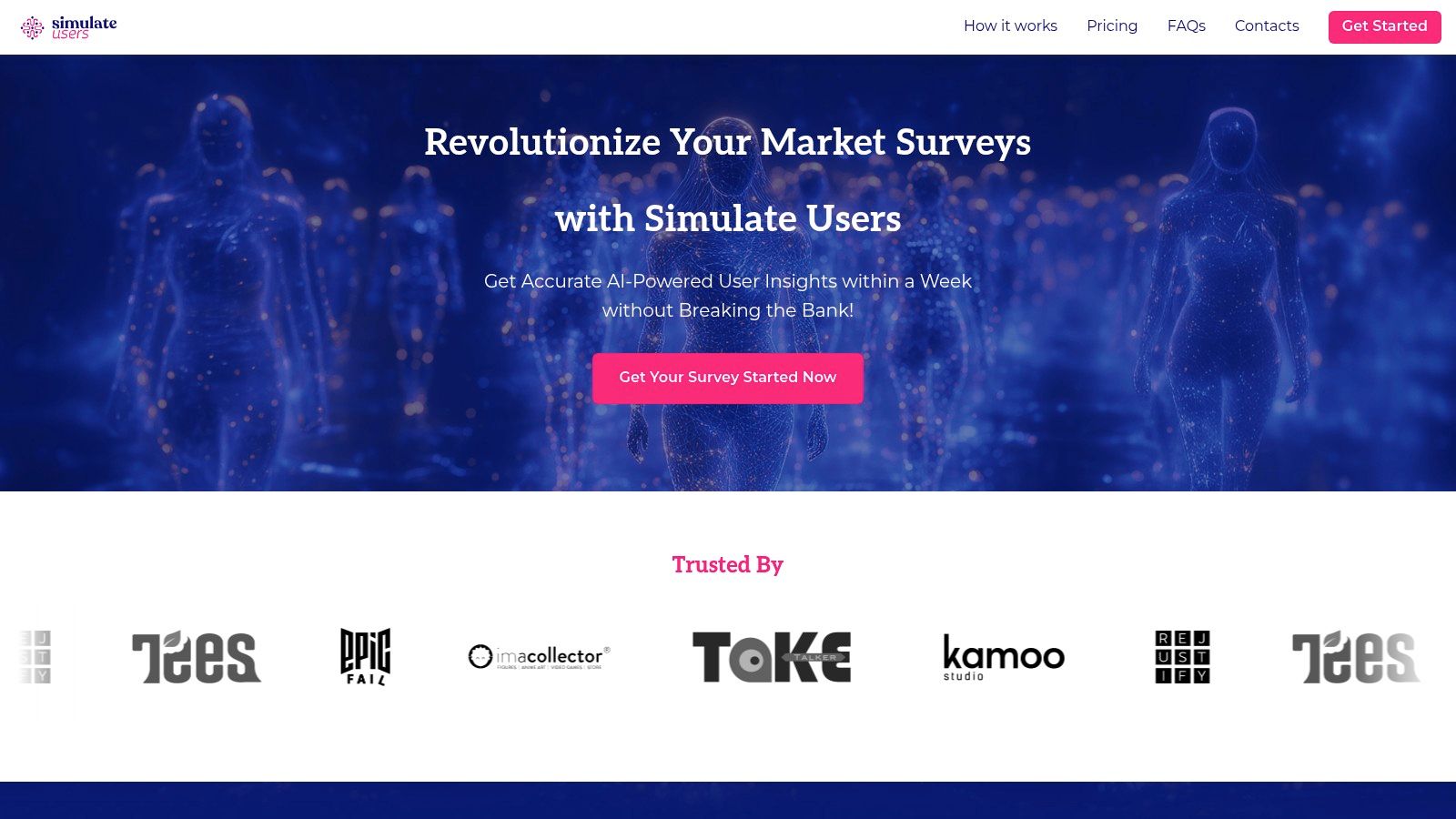
What makes this platform stand out is its transparent, package-based model with clear deliverables and pricing in euros, which is particularly beneficial for EU-based teams. By offering fixed sample sizes and guaranteed turnaround times "within a week", it removes the ambiguity often associated with research projects. This focus on quantitative feedback makes it a powerful tool for teams needing quick, directional data to inform their next steps.
Strategic Breakdown
Feature | Strategic Advantage | Actionable Takeaway |
|---|---|---|
LLM-Generated Surveys | Provides fast, large-scale quantitative feedback without the cost and time of recruiting human panels. | Use this for initial hypothesis testing or message resonance checks before investing in more in-depth qualitative research. |
Fixed Packages & SLAs | Simplifies procurement and project planning with transparent costs, sample sizes, and delivery timelines. | Choose a package that aligns with your budget and validation needs to get predictable insights without project scope creep. |
EU-Centric Offering | Euro pricing and a stated refund policy streamline budgeting and reduce financial risk for European companies. | Leverage the clear pricing structure to easily secure budget approval and run quick validation cycles for your product team. |
While Simulate Users excels at survey-based quantitative validation, it is less suited for interactive usability testing. Platforms like Uxia, in contrast, provide AI agents that can navigate digital products to perform end-to-end task analysis. This allows teams to evaluate not just what users think but how they behave, which is critical for optimising complex interactions. To better understand these interactions, teams can get insights by creating a user flow diagram. The clear, tiered pricing of Simulate Users, however, makes it an excellent and accessible entry point into the world of synthetic user testing.
5. Attention Insight
Attention Insight is a specialised predictive eye-tracking platform that leverages AI to simulate first-glance user attention on designs. It generates heatmaps and clarity scores without needing human participants, allowing designers to quickly check the visual hierarchy of their UI. By providing instant feedback, it helps teams identify potential attention traps or unclear calls-to-action before committing to development or live testing.
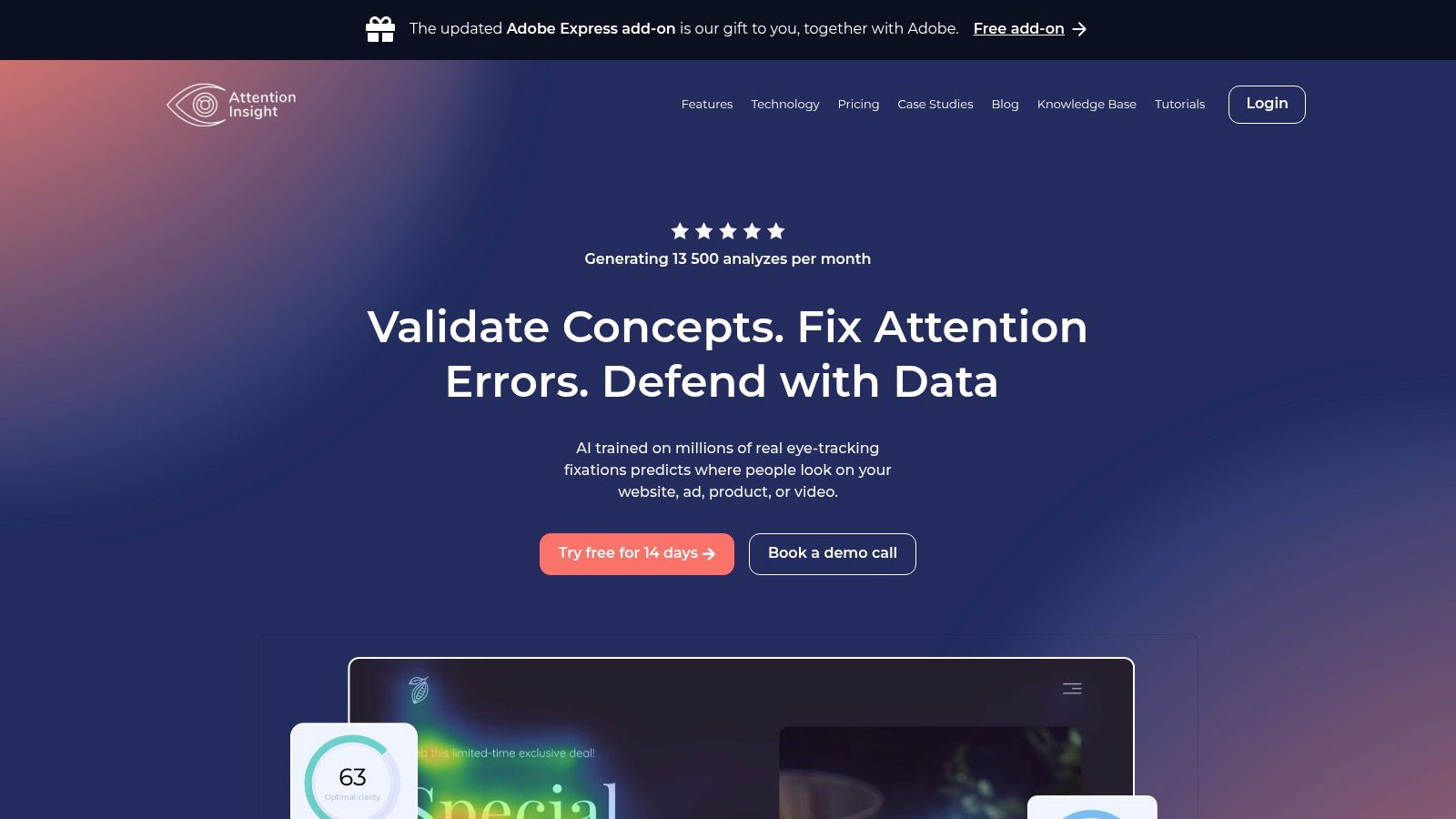
What makes this platform a valuable pre-testing tool is its integration directly into design workflows via plugins for Figma and Adobe Photoshop. This allows for rapid, iterative checks on visual elements. The platform provides key metrics like a focus score, percentage-of-attention on specific areas, and cognitive load estimations to guide design decisions. For teams seeking deeper insights into how visual design impacts usability, it's worth exploring the principles of effective user interface design testing.
Strategic Breakdown
Feature | Strategic Advantage | Actionable Takeaway |
|---|---|---|
AI Attention Heatmaps | Provides an instant, data-driven "gut-check" on visual hierarchy without the cost or time of traditional eye-tracking studies. | Run your landing page designs through the tool to ensure the primary CTA captures the most attention within the first 3-5 seconds. |
Design Tool Plugins | Enables seamless integration into existing design workflows (Figma, Photoshop), facilitating rapid iteration and analysis. | Use the Figma plugin to quickly compare two or three design variations and prioritise the one with the clearest visual flow for A/B testing. |
Clarity & Focus Scores | Offers quantifiable metrics to benchmark design effectiveness and justify decisions to stakeholders with objective data. | Before launching a redesign, generate a clarity score for the old and new versions to demonstrate a data-backed improvement in visual communication. |
Attention Insight excels at the visual layer of synthetic user testing, making it a strong complement to platforms like Uxia, which focus on end-to-end task completion and user goal analysis. While Attention Insight predicts where users will look, Uxia simulates how they will act to achieve a goal. Its euro-based pricing is a plus for EU-based teams, though its focus on visual attention means it is best used alongside, not in place of, broader usability testing.
6. EyeQuant
EyeQuant is an established predictive analytics tool that simulates first-glance visual attention, leveraging a model trained on extensive eye-tracking datasets. It provides instantaneous feedback on design clarity and user engagement by generating attention heatmaps and clarity scores. This allows teams to quickly assess the visual hierarchy of a webpage, application, or creative asset without the need for live participants.
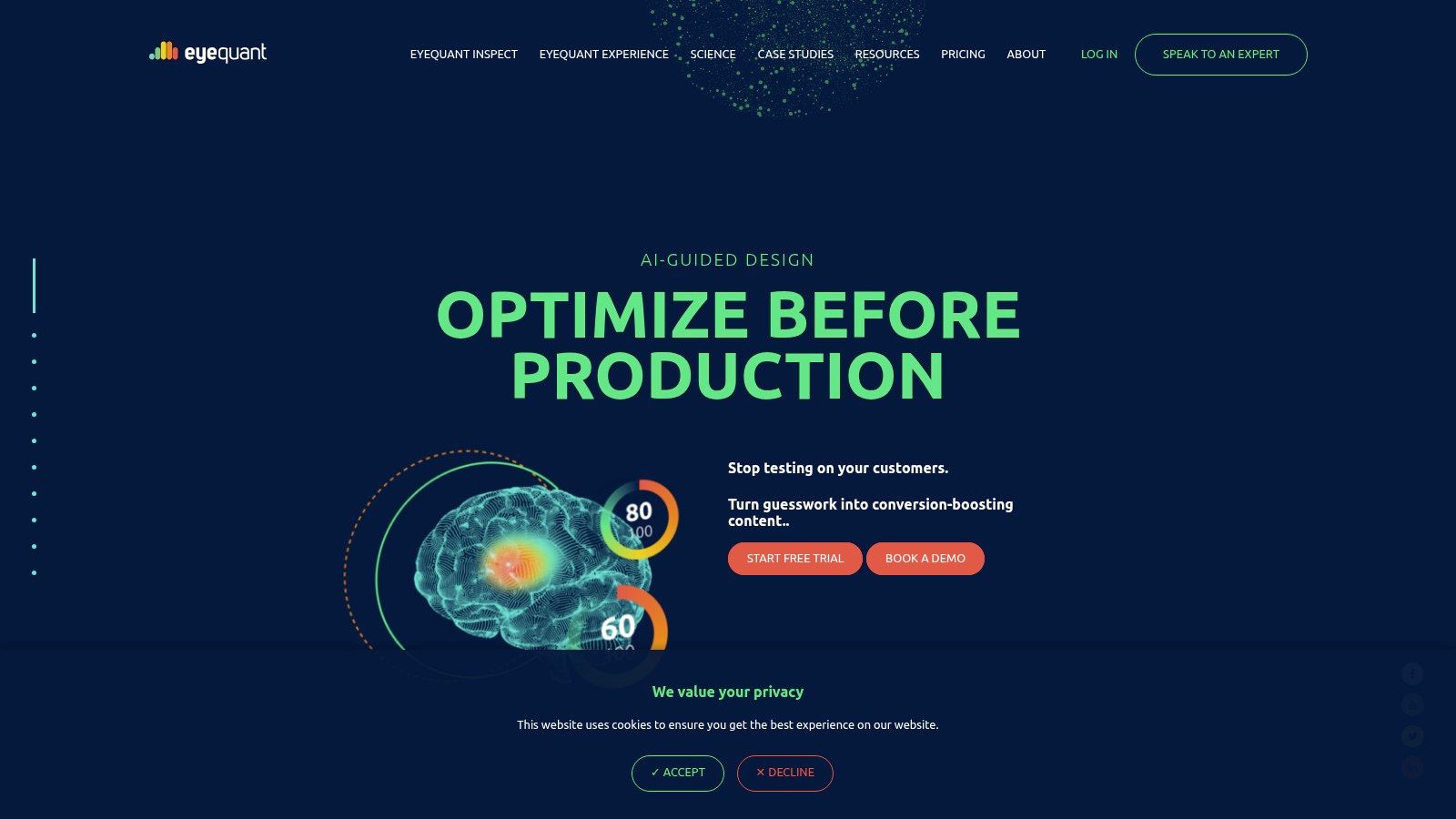
What makes EyeQuant a valuable tool in the synthetic user testing toolkit is its specialisation in pre-attentive processing. It answers the critical question: "What will users see in the first 3-5 seconds?" This focus helps eliminate subjective debates during design reviews by providing objective, data-driven evidence. Its plugins for Figma and web browsers integrate this analysis directly into the design workflow, making visual optimisation a seamless, continuous process.
Strategic Breakdown
Feature | Strategic Advantage | Actionable Takeaway |
|---|---|---|
Predictive Attention Heatmaps | Provides instant, objective feedback on visual hierarchy, highlighting which elements will likely attract immediate user attention. | Run a heatmap analysis on your primary landing page to ensure the main call-to-action and value proposition are in high-attention zones. |
Clarity & Emotional Impact Scores | Quantifies the perceptual clarity and emotional appeal of a design, turning subjective aesthetic qualities into measurable metrics. | Compare clarity scores between design variations to objectively decide which layout is less cluttered and easier to process for users. |
Browser & Figma Integration | Enables designers and researchers to run analyses directly within their primary tools, accelerating the iteration cycle. | Integrate the Figma plugin to get real-time visual feedback on mock-ups before they even reach the development stage, saving costly revisions later. |
While EyeQuant excels at analysing initial visual impact, it does not simulate user journeys or task completion. It focuses purely on where the eye is drawn. For a more comprehensive understanding of user behaviour, a platform like Uxia can be used to simulate how users navigate through a flow to complete a specific task. The entry-level plan from EyeQuant, often including unlimited analyses, makes it a cost-predictable choice for teams that iterate frequently, although access to advanced features requires engaging with their sales team.
7. 3M Visual Attention Software (VAS)
3M Visual Attention Software (VAS) offers a highly specialised form of synthetic user testing focused on pre-attentive processing. It leverages neuroscience-based predictive modeling to simulate a user's first glance, estimating what they will notice in the initial 3-5 seconds with a reported 92% accuracy compared to traditional eye-tracking. This makes it an invaluable tool for optimising visual hierarchy and ensuring key information is immediately visible.
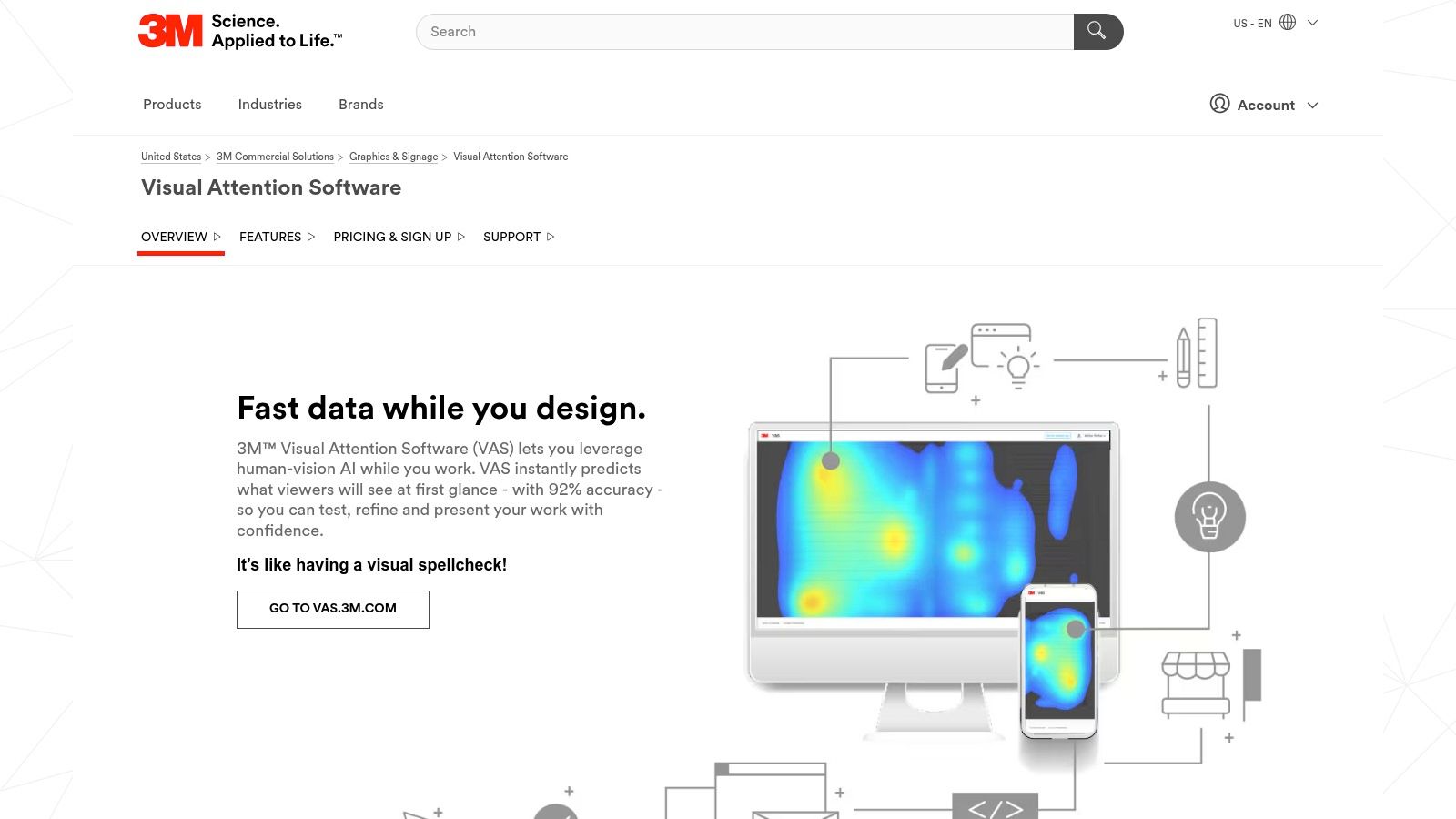
What makes this platform stand out is its deep scientific backing and narrow focus. While platforms like Uxia provide comprehensive task-based analysis, 3M VAS excels at one specific, critical aspect: predicting visual salience. The web-based app provides heatmaps and Area-of-Interest (AOI) analysis, allowing designers to get objective data on their visual compositions without the need for lab hardware or participant recruitment, thus reducing subjective debates early in the design cycle.
Strategic Breakdown
Feature | Strategic Advantage | Actionable Takeaway |
|---|---|---|
Predictive Attention Modeling | Provides objective, data-driven insights into a design's visual hierarchy, eliminating guesswork and subjective feedback. | Use heatmaps on landing pages or advertisements before A/B testing to ensure your primary call-to-action stands out visually. |
Area-of-Interest (AOI) Analysis | Quantifies the probability that specific elements (buttons, headlines) will be seen within the first few seconds of viewing. | Define AOIs around critical UI components to validate that they capture sufficient attention compared to less important elements. |
Backed by 3M Research | Offers a credible, science-backed alternative to traditional eye-tracking for first-glance analysis, building trust with stakeholders. | Cite 3M's research and documentation when presenting design decisions to justify choices based on predictive attention data. |
While 3M VAS is powerful for initial visual validation, its scope is intentionally limited. For a more holistic understanding of user behaviour, teams often complement VAS insights with goal-oriented platforms like Uxia, which can analyse entire user journeys and task flows. The platform offers a trial for two images, but full access and pricing typically require engaging with their US-centric sales team, which can be a hurdle for international teams seeking self-serve options.
Top 7 Synthetic User Testing Tools Comparison
Solution | Implementation Complexity 🔄 | Resource Requirements ⚡ | Expected Outcomes ⭐ / 📊 | Ideal Use Cases 💡 | Key Advantages ⭐ |
|---|---|---|---|---|---|
Uxia | Low — upload prototypes and run tests in minutes 🔄 | Low–medium — subscription tiers; scalable for teams ⚡ | Rapid unmoderated tests, transcripts, heatmaps, WCAG checks; prioritized findings ⭐📊 | Continuous validation of flows, prototypes, MVPs for product teams 💡 | Speed & scale; realistic synthetic testers; automated actionable reports ⭐ |
Synthetic Users | Moderate — setup for multi-agent & RAG enrichment 🔄 | Medium — enterprise features, possible sales process ⚡ | AI-moderated interviews + large-scale surveys with aligned agent behavior ⭐📊 | Product discovery, concept testing, mixed qual/quant research 💡 | RAG alignment; multi-agent interviews; methodological transparency ⭐ |
Delve AI (Synthetic Surveys & Interviews) | Moderate — persona generation from first‑party data 🔄 | Medium — credits/usage pricing for surveys/interviews ⚡ | Mixed qualitative + quantitative outputs; themes, recommendations ⭐📊 | Embedding synthetic testing in an insights stack; validation at scale 💡 | Transparent entry pricing; persona alignment to real segments ⭐ |
Simulate Users | Low — fixed packages and fast delivery model 🔄 | Low — tiered Euro pricing and SLAs; predictable cost ⚡ | Fast survey-style synthetic responses for segmentation/messaging ⭐📊 | Quick product/feature validation and messaging tests for EU teams 💡 | Clear packages & SLAs; cost-effective, EU-focused procurement ⭐ |
Attention Insight | Very low — design-tool plugins, instant reports 🔄 | Very low — plugin-enabled, free trial available ⚡ | Predictive attention heatmaps and attention/cognitive metrics ⭐📊 | Rapid pre-launch visual hierarchy and variant checks in design tools 💡 | Fast Figma/Photoshop integration; EU-friendly pricing; instant results ⭐ |
EyeQuant | Low — mature tools with plugins and browser extension 🔄 | Low–medium — entry plan with unlimited analyses available ⚡ | Attention heatmaps, visual clarity and emotional impact scores ⭐📊 | Frequent variant testing, CRO and design sign‑off evidence 💡 | Unlimited analyses on entry plan; established, objective visual metrics ⭐ |
3M Visual Attention Software (VAS) | Moderate — web app with AOI tools; sales/subscription for scale 🔄 | Medium — trial available but pricing via sales; US-centric procurement ⚡ | First‑glance predictive attention (~92% vs eye‑tracking) with AOI reporting ⭐📊 | Early design prioritization, education and research-backed visual checks 💡 | Backed by 3M research; workflow guidance and AOI analysis tools ⭐ |
Final Thoughts
The landscape of user experience research is undergoing a significant transformation, and synthetic user testing is at the forefront of this evolution. As we've explored, this AI-driven approach offers an unprecedented combination of speed, scale, and cost-effectiveness that traditional methods simply cannot match. From validating design choices in minutes to uncovering usability issues before a single line of code is written, the strategic advantages are clear.
We’ve seen how platforms like Uxia and Synthetic Users provide comprehensive usability analysis with AI participants, while tools such as Delve AI focus on generating qualitative insights through synthetic interviews. We also examined how predictive attention platforms like Attention Insight and EyeQuant can instantly reveal which visual elements will capture a user's eye. The key takeaway is that these are not replacements for human-centric research, but powerful complements that accelerate the design cycle and de-risk product development.
Your Next Steps with Synthetic User Testing
To truly harness this technology, it's crucial to move from theory to practice. Begin by identifying a low-risk, high-impact area in your current workflow where speed is critical. This could be early-stage wireframe validation, A/B testing variations for a new landing page, or auditing an existing user flow for navigational friction.
When choosing a tool, consider these critical factors:
Scope of Analysis: Do you need full journey analysis, qualitative feedback, or predictive heatmaps? Platforms like Uxia offer a broad spectrum of tests, covering everything from task success to user sentiment.
Integration: How easily can the tool fit into your existing design and development ecosystem (e.g., Figma or Adobe XD plugins)?
Actionability: Does the platform provide clear, prioritised recommendations, or does it leave you to interpret raw data? The most valuable tools translate findings into actionable design improvements.
Ultimately, integrating synthetic user testing is about empowering your team to make more informed decisions, faster. It’s about building a culture of continuous, data-driven optimisation where user feedback is not a bottleneck but a constant, accessible stream of insight. By embracing these AI-powered tools, you are not just adopting new software; you are future-proofing your entire product development process.
Ready to see how AI can revolutionise your UX workflow? Uxia provides a comprehensive suite of synthetic user testing tools to help you identify usability issues, validate designs, and build better products in a fraction of the time. Start making data-driven decisions today by exploring Uxia and experience the future of user research.