A Guide to Mastering Voice of the Customer Programs
Unlock growth by mastering the voice of the customer. Our guide covers how to collect, analyze, and act on feedback to build a truly customer-centric business.

Let's be honest, trying to build a product or run a business without truly understanding your customers is like trying to navigate a maze with a blindfold on. You might stumble your way to the exit eventually, but it's going to be slow, painful, and full of wrong turns.
This is where the Voice of the Customer (VoC) comes in. It's the guide that takes off the blindfold and shows you the clearest path forward.
What Is Voice of the Customer and Why It Matters Now
At its core, Voice of the Customer is a systematic way of listening to what your customers are really saying. It’s about capturing their expectations, what they love, and—just as importantly—what drives them crazy. It gives you direct, unfiltered insight into their experience with your brand.

This isn't just about collecting survey responses. A proper VoC programme pulls together feedback from every single place customers interact with you—from social media comments and angry support tickets to five-star reviews and casual mentions. It then weaves all those threads into a single, coherent story about what your customers actually want and need from you.
The goal here isn't to create another report that sits unread in a shared drive. A real VoC programme is an active listening engine that should be fuelling every single part of your business, from product development and marketing messages to the way your support team talks to users.
Beyond Surveys and Satisfaction Scores
A lot of companies think sending out an annual Net Promoter Score (NPS) survey means they're "doing VoC." And while NPS is a useful snapshot, it's just one piece of a much larger puzzle. It tells you the "what," but a true Voice of the Customer programme is obsessed with uncovering the "why" behind that score.
Voice of the Customer is not a one-off project; it’s a cultural shift. It moves an organisation from making assumptions about customers to making decisions based on direct customer evidence. This is the foundation of genuine customer-centricity.
A well-oiled VoC programme helps you answer the tough questions that a simple metric can't:
Which specific feature is causing the most frustration for new users?
What's that one pain point in our onboarding that’s making people churn in their first week?
How do people really see our brand compared to our biggest competitor?
Is there an unmet need we could solve that would open up a whole new market?
The Growing Importance of VoC
In today’s market, knowing your customer isn't just a nice-to-have; it's a matter of survival. That's why we're seeing a huge surge in investment in VoC platforms and strategies. It's become a core part of business strategy.
This trend is particularly strong in Europe, where the market for VoC tools is booming. The global VoC software market was valued at USD 2,130 million in 2023 and is projected to jump to USD 2,455.89 million in 2024. European businesses are a huge driver of this growth, signalling a clear commitment to building loyalty and staying ahead of the competition. You can discover more insights about the VoC market's growth and see for yourself.
This is where the next evolution of VoC comes in. Platforms like Uxia are changing the game, allowing teams to move from just reacting to old feedback to proactively testing new ideas. By using synthetic users, you can anticipate customer needs before you've even written a line of code. It's this proactive stance that separates the market leaders from everyone else, turning customer insight into a reliable engine for growth.
Building a solid VoC programme from scratch involves several key moving parts. Each component plays a vital role in ensuring you not only collect feedback but also turn it into meaningful action.
Core Components of a Voice of the Customer Program
Component | Description | Key Objective |
|---|---|---|
Data Collection | Gathering raw feedback from multiple sources like surveys, reviews, social media, and support interactions. | Capture a wide and representative sample of customer opinions across all touchpoints. |
Data Analysis | Processing and interpreting the collected feedback to identify trends, patterns, and root causes. | Transform unstructured comments and scores into actionable, prioritised insights. |
Action & Implementation | Sharing insights with the relevant teams (product, marketing, support) to drive specific changes. | Close the feedback loop by making tangible improvements based on what customers have said. |
Monitoring & Iteration | Tracking the impact of changes and continuously refining the VoC process itself. | Ensure the programme remains effective and adapts to evolving customer needs and business goals. |
Ultimately, these four pillars work together to create a continuous cycle of listening, understanding, and improving. When implemented correctly, they form the backbone of a truly customer-centric organisation.
How to Collect Authentic Customer Feedback
Understanding your customers starts with one simple act: listening. But in a world flooded with digital noise, your customers are talking everywhere. A successful VoC programme needs a smart, organised way to capture this feedback, making sure you hear the full range of experiences, not just the loudest voices.

The trick is to tap into two very different types of feedback channels. Each one gives you a unique piece of the puzzle. When you combine them, you get a complete, three-dimensional view of your customer’s world.
Direct Feedback: Asking for Opinions
Direct feedback is what you get when you actively ask for it. Think of it as inviting your customers for a chat. You set the topic and ask the questions, which gives you structured data that’s much easier to measure and track over time.
These methods are fantastic for getting specific answers about things you already know you need to investigate. They help you measure satisfaction, test a new idea, and see how you stack up against your goals.
Common ways to get direct feedback include:
Surveys: Tools like Net Promoter Score (NPS), Customer Satisfaction (CSAT), and Customer Effort Score (CES) surveys give you quick, numerical snapshots of how customers feel at key moments.
In-depth Interviews: One-on-one conversations let you dig deep into a customer’s real motivations, frustrations, and experiences. They provide the rich, human context that surveys just can’t capture.
Focus Groups: Getting a small group of customers together for a guided discussion can uncover shared opinions and spark ideas that might never come up in individual interviews.
Practical Recommendation: When you write survey questions, keep them neutral. Instead of asking, “How much do you love our new feature?” try, “On a scale of 1 to 5, how would you rate your experience with our new feature?” Neutrality gets you more honest, reliable answers.
Indirect Feedback: Listening to Unsolicited Chatter
While direct feedback is powerful, some of the most honest insights come from what customers say when you’re not asking. This is the unsolicited, unfiltered stuff they share on their own terms. It’s what they tell their friends, post on social media, or mention to a support agent when they think no one else is listening.
This is where you find the raw, emotional truth about your brand. Sure, it’s often messy and unstructured, but it’s an absolute goldmine of genuine customer sentiment. To truly hear the voice of your customer, you have to tune into these conversations.
For a deeper dive into effective feedback gathering, you can learn how to collect customer feedback smarter and build a more powerful listening system.
Here’s where you’ll find valuable indirect feedback:
Social Media Mentions: Keep an eye on platforms where people are talking about your brand, your competitors, and your industry.
Online Reviews: Check sites like G2, Capterra, or Trustpilot regularly for detailed user stories.
Support Tickets & Live Chats: Your customer service logs are a real-time record of what’s confusing or frustrating your users.
Sales Call Transcripts: Listen to these conversations to understand what prospects are asking for, what their objections are, and what their first impressions are.
Integrating Proactive Testing into Your Feedback Loop
Most feedback collection is reactive; it tells you what customers thought about something you’ve already shipped. But what if you could get that feedback before you even launched? That’s where proactive methods come in.
Modern tools like Uxia let you test designs and prototypes with AI-powered synthetic users. This approach simulates how your target audience would react to a new feature or workflow, giving you high-quality feedback at lightning speed. By spotting friction points early, you can fix them before they ever annoy a real customer.
This proactive layer is the perfect partner to your traditional VoC efforts. For example, imagine your support tickets (indirect feedback) show that users find your checkout process confusing. You could design three new versions, test them all with Uxia, and instantly see which one is the most intuitive—all before a developer writes a single line of code.
To see just how game-changing this early-stage feedback can be, you can learn more about the importance of user testing in our detailed guide. When you combine reactive listening with proactive testing, you create a powerful, non-stop cycle of improvement.
How to Analyse VoC Data for Actionable Insights
Collecting feedback is just the start. The real magic of a Voice of the Customer programme happens when you turn that mountain of raw data—think thousands of survey comments, support chats, and online reviews—into a clear roadmap for action. This is what separates the data hoarders from the industry leaders.
Transforming all that customer chatter into strategic assets requires a structured approach. Instead of getting lost in individual comments, your goal is to spot the big patterns, emotions, and critical issues hiding in the noise. This is where a few tried-and-true analysis frameworks come in handy.
Moving from Raw Data to Clear Themes
The first step is almost always thematic analysis. Imagine sifting through a giant pile of Lego bricks. Thematic analysis is like sorting them by colour and shape, putting all the red 2x4s together and all the blue flat pieces in another pile. You’re not just looking at one brick; you’re looking for clusters.
In VoC, this means reading through feedback and tagging recurring topics. Are multiple customers mentioning a "confusing checkout process"? That’s a theme. Is "slow delivery time" popping up again and again? That's another one.
Understanding the Emotion Behind the Words
Once you have your themes, the next layer is sentiment analysis. This framework helps you measure the emotional tone behind the feedback. It answers the question: how are customers feeling about these themes? A theme like "new user interface" could be overwhelmingly positive, negative, or a mixed bag.
Knowing the sentiment is crucial for prioritisation. A theme with intensely negative sentiment, even if mentioned less often, might be doing more damage to your brand than a mildly annoying but common issue. This helps you focus your resources where they’ll make the biggest difference to customer happiness.
The key takeaway here is that analysis isn't just about counting mentions; it's about weighing emotional impact. A single, furious review detailing a critical flaw can be more important than a dozen minor suggestions for improvement.
Digging Deeper with Root Cause Analysis
Identifying themes and sentiment tells you what is happening and how customers feel about it. But the final, most important step is root cause analysis, which uncovers why it's happening. If customers find the checkout process confusing, is it because of a poorly labelled button, a slow-loading payment gateway, or something else entirely?
This deeper investigation stops you from just treating symptoms. Fixing the root cause ensures the problem doesn’t just pop up again later, leading to real, lasting improvements.
Here are the common analysis frameworks in a nutshell:
Thematic Analysis: Grouping unstructured feedback into common topics or categories to spot recurring issues.
Sentiment Analysis: Automatically classifying feedback as positive, negative, or neutral to gauge the overall emotional tone.
Root Cause Analysis: Using techniques like the "5 Whys" to drill down from a surface-level complaint to its foundational cause.
The global landscape for VoC shows a clear trend toward these advanced methods. In Central and Eastern Europe (CEE), for instance, market analyses forecast a 15% CAGR for VoC platforms from 2025 to 2033. This growth is driven by high adoption in retail and financial services, where businesses using AI-integrated feedback systems report up to 20% improvements in satisfaction scores. You can learn more about these regional VoC trends and market forecasts.
The Role of AI in Modern VoC Analysis
Manually applying these frameworks to thousands of data points is incredibly time-consuming and prone to human bias. This is where AI-powered tools become essential. To really get a handle on extracting meaningful patterns from open-ended responses and interviews, exploring the Top 10 Qualitative Data Analysis Methods can give you a solid foundation.
Modern platforms can automate thematic and sentiment analysis in minutes, not weeks, giving you a clear dashboard of your top issues. This frees up your team to focus on the high-value work: root cause analysis and strategic decision-making. More importantly, platforms like Uxia help you proactively validate your solutions. Once your VoC analysis points to a problem, you can use Uxia’s synthetic users to test potential fixes and ensure your proposed solution actually solves the root cause before you sink any development time into it.
Building Your VoC Program From the Ground Up
Turning a messy pile of customer comments into a strategic asset doesn't happen by accident. It requires a proper structure. Building a formal Voice of the Customer (VoC) programme isn't about buying fancy software; it’s about creating a repeatable process that weaves customer insights into the very fabric of your company.
This means you have to move beyond just sending the occasional survey. It’s about creating a continuous, actionable rhythm of listening, analysing, and acting.
It all starts with clear objectives. What are you actually trying to achieve? Do you want to stop customers from leaving, make your product easier to use, or just boost overall satisfaction? Nailing down your primary goals right from the start keeps your efforts focused and makes it much easier to show real business value later on.
Getting leadership on board is the next make-or-break step. For a VoC initiative to have any real teeth, it needs resources, cooperation between departments, and a clear mandate to drive change. When you make your pitch, frame it around business outcomes, not fluffy "customer happiness" metrics. Show them exactly how listening to the voice of the customer will directly impact revenue, retention, and how efficiently you operate.
Setting the Foundation for Success
Once you have your goals and the green light from leadership, it's time to get the right people and tools in place. A VoC programme should never be stuck in one department like marketing or support. Its real power comes from collaboration across the entire organisation.
Your technology should support your goals, not dictate them. While a big, expensive VoC platform can be powerful, you don't need to start there. The most important thing is having one central place to gather, analyse, and share all that feedback. As your programme grows, you can always add more advanced tools.
Think about these core building blocks:
Cross-Functional Team: Pull together a team with people from product, marketing, sales, and customer support. This is the only way to ensure insights get shared and acted upon by the people who can actually make the changes.
Technology Stack: Pick your tools for collecting data (like surveys or review monitoring) and making sense of it. This is also where platforms like Uxia can fit in, allowing you to proactively test potential solutions that come out of your VoC data.
Defined Workflows: You need a clear map. How will feedback be collected? Who is responsible for analysing it? And how do those insights get to the right teams so they can take action?
This structured approach is catching on fast. In Western Europe, the VoC software market is expected to rocket from USD 2,130 million in 2023 to a massive USD 7,700 million by 2032. This explosion shows a clear strategic pivot towards integrating feedback from every channel to keep up with what customers expect. You can discover more insights about the European VoC software market here.
Creating a Closed-Loop Feedback System
The number one reason VoC programmes fizzle out? A lack of action. This is where a ‘closed-loop’ system saves the day. It simply means having a formal process for following up on feedback—both with your internal teams and, crucially, with your customers.
When a customer takes the time to give you feedback, they deserve to know it was heard and what you plan to do about it. This doesn't mean you have to implement every single suggestion. But simply acknowledging their input and sharing your plans builds an incredible amount of trust and loyalty.
This flow diagram shows the simple but powerful process at the core of any good VoC programme. It’s all about moving from collection to action.
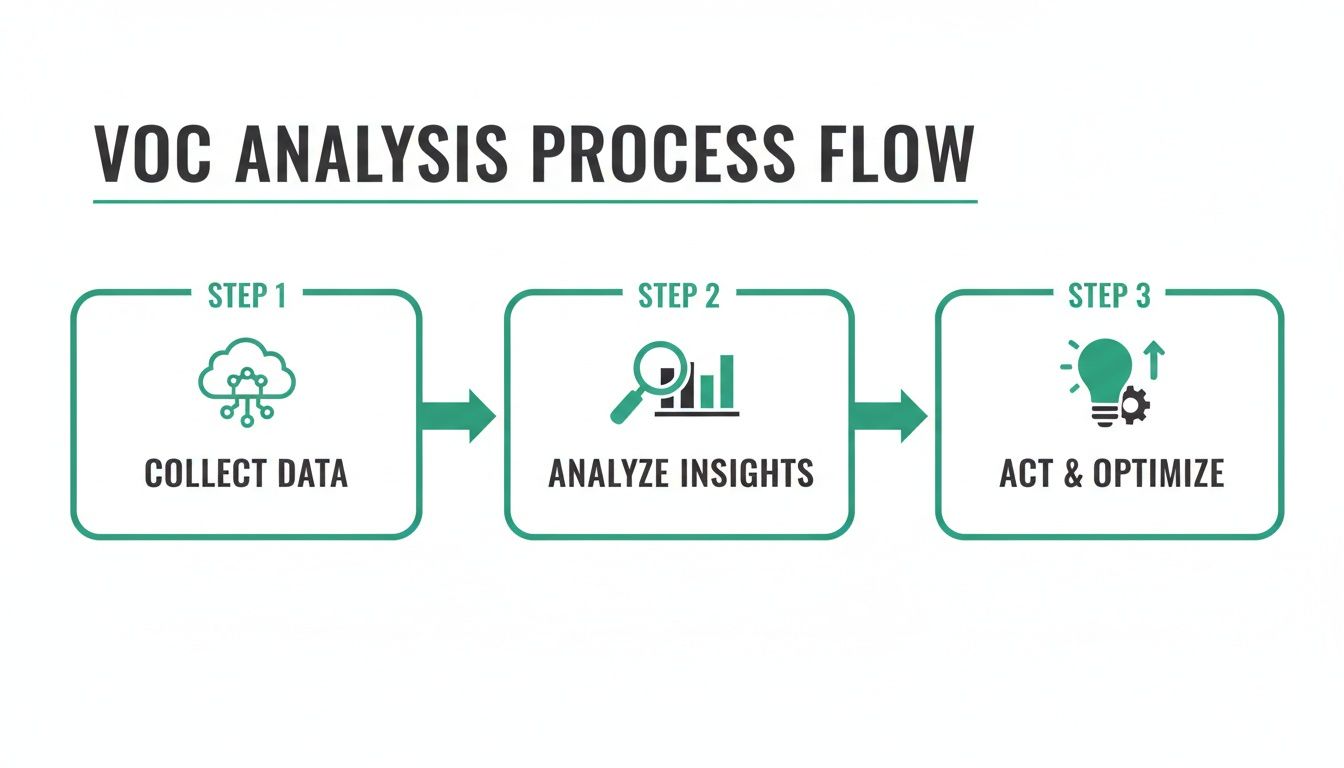
As the visual makes clear, data is just noise until you analyse it for insights. And those insights are useless until they’re used to drive real, meaningful change.
Practical Recommendation: Start small with closing the loop. For every piece of negative feedback your support team logs, create a simple workflow that automatically notifies the relevant product manager. Even a basic, manual process is infinitely better than letting valuable insights vanish into a black hole.
Your VoC Program Implementation Checklist
To help you get started, here’s a straightforward checklist that breaks down the key actions and success metrics for each stage of building your programme.
Stage | Key Action | Success Metric |
|---|---|---|
1. Define & Align | Set clear business objectives for the VoC programme (e.g., reduce churn by 10%). | Executive sponsorship secured; budget approved. |
Secure buy-in from key leadership stakeholders. | Objectives are tied to company-wide KPIs. | |
2. Build the Foundation | Assemble a cross-functional VoC team. | Representatives from Product, Mktg, Sales, & Support are active. |
Select and implement your initial tech stack for collection & analysis. | Central feedback repository is established and in use. | |
3. Collect & Listen | Launch initial feedback collection channels (e.g., NPS surveys, support tickets). | Consistent flow of feedback data is being received. |
Map out the customer journey to identify key listening posts. | Feedback is collected from at least 3 distinct touchpoints. | |
4. Analyse & Understand | Establish a regular cadence for analysing feedback (e.g., weekly, bi-weekly). | Key themes and root causes are identified and documented. |
Use a framework (like Kano or MoSCoW) to prioritise issues. | Prioritised list of actionable insights is shared with teams. | |
5. Act & Close the Loop | Create a workflow to assign insights to the correct teams for action. | 75%+ of high-priority insights are assigned within 48 hours. |
Communicate back to customers about changes made based on their feedback. | Public changelog or direct customer follow-ups are implemented. | |
6. Measure & Optimise | Track VoC metrics (NPS, CSAT, CES) over time. | Positive trends in key VoC metrics are visible quarter-over-quarter. |
Share success stories and ROI with the wider company and leadership. | VoC programme's impact on business goals is clearly demonstrated. |
Following this checklist ensures you cover all your bases, transforming your VoC initiative from a simple idea into a dynamic, responsive engine for improvement. It guarantees that customer feedback fuels real change, proving to both your customers and your team that their voices truly matter.
See how one fintech company applied these very principles by checking out our case study on using customer insights to improve financial products.
Testing Ideas Proactively with Synthetic Users
Your traditional Voice of the Customer (VoC) programme is brilliant at one thing: telling you what went wrong yesterday. It digs through past experiences—support tickets, scathing reviews, survey feedback—to help you patch up existing problems. But what if you could figure out how customers will react to a new feature before you even build it?
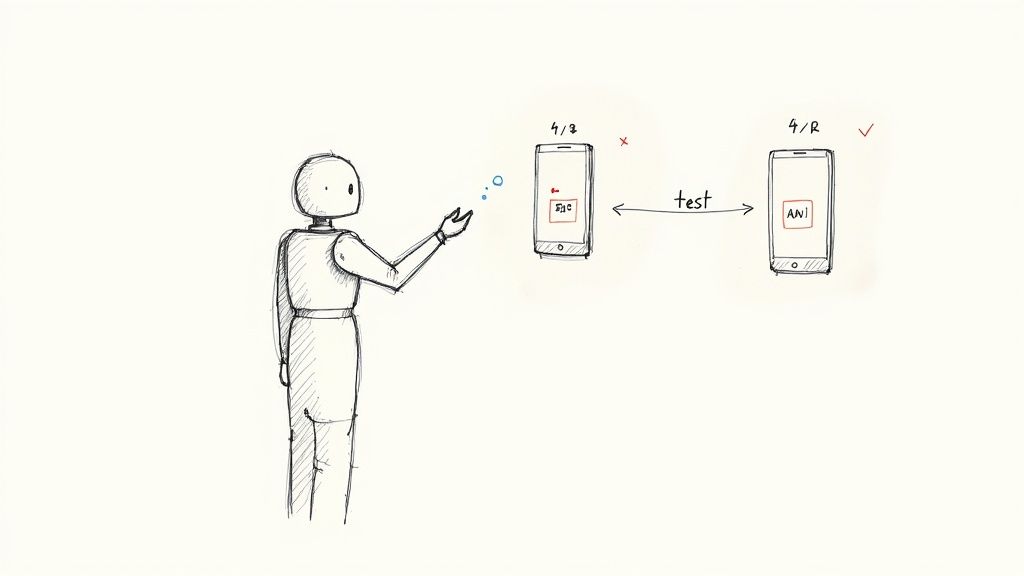
This is the jump from a reactive VoC strategy to a proactive one. Instead of just waiting for feedback to roll in on a live product, you can anticipate what users need and validate ideas while they're still just concepts. It completely flips the product development lifecycle on its head, turning customer insight from a rear-view mirror into a crystal ball.
The Power of AI-Powered User Simulation
This proactive leap is powered by new technology that makes rapid, scalable user testing possible without the headache of recruiting human participants. Platforms like Uxia use AI-powered synthetic users to simulate exactly how real people would interact with your designs, prototypes, and concepts.
These aren't just dumb bots. Synthetic users are built to mirror the behaviours, preferences, and cognitive quirks of your specific target audiences. You can test a new checkout flow with AI personas that act like first-time buyers or see how a new feature lands with personas that mimic your most loyal power users. They generate rich, qualitative feedback, complete with "think-aloud" transcripts that explain their thought process step-by-step.
This means you get instant insights on:
Usability: Where do users get stuck or confused in a new workflow?
Clarity: Is the copy on a button or a new feature announcement actually understandable?
Trust: Does the design inspire confidence, especially during critical moments like payment?
By testing ideas before a single line of code is written, you de-risk innovation. You can focus your engineering team on building features you already know will resonate with users, which means faster time-to-market and way less costly rework down the line.
Creating a Proactive Feedback Cycle
Here's the thing: integrating proactive testing doesn't replace your traditional VoC work; it supercharges it. It creates a powerful feedback loop that connects yesterday's problems to tomorrow's solutions.
Let's say your reactive VoC data (like support tickets) shows that tons of users think your new reporting dashboard is a confusing mess. That's your problem signal. Instead of just guessing at a fix, you can use a proactive tool to find the best path forward.
Here’s how the cycle works:
Identify the Problem: Your existing VoC channels flag a user pain point (e.g., "The dashboard is too cluttered").
Develop Multiple Solutions: Your design team mocks up three different, simplified dashboard prototypes.
Test Proactively with Uxia: You run all three prototypes through Uxia, testing them against synthetic users that match your real customer profile.
Validate the Best Option: Within minutes, you get back detailed feedback showing which design is the most intuitive and actually solves the original problem.
This process transforms reactive complaints into a data-driven innovation engine. You start shipping products with confidence, knowing they’ve already been validated against user expectations.
For teams wanting to dig into the details, our article on comparing synthetic user testing vs. human user testing offers a full breakdown. This strategy makes sure the voice of the customer isn't just an afterthought—it's baked into your creative process from day one.
Where VoC Programmes Go Wrong (And How to Keep Yours on Track)
Let's be honest. Even with the best intentions, a lot of Voice of the Customer programmes don't deliver. They often kick off with a huge burst of energy—new surveys get launched, dashboards are built, and reports are circulated—but then they just… fizzle out.
This usually happens when they don’t lead to any real, tangible improvements for the business. The good news is that this failure is almost always due to a few common, and entirely avoidable, traps.
Knowing what these pitfalls look like is the first step to building a VoC programme that actually drives impact, not just vanity metrics. By sidestepping these common mistakes, you can make sure your efforts lead to a better customer experience and a healthier bottom line.
Mistake 1: Collecting Data for Data’s Sake
This is the classic, number-one mistake. Teams get so wrapped up in gathering feedback from every possible channel that they treat data collection as the end goal. Before you know it, you’re sitting on a mountain of data with no clear idea of what to do with it.
This is what’s known as "analysis paralysis." Insights get buried, and the teams who could actually use them never see them.
How to fix it: Before you even think about launching a new survey or feedback form, define what success looks like. Ask yourself one simple question: "What specific business decision will this data help us make?" This forces you to tie every single feedback initiative to a real outcome, ensuring you only collect data you're actually prepared to act on.
Mistake 2: Burning Out Your Customers with Surveys
Bombarding your customers with constant requests for feedback is a guaranteed way to annoy them. When you ask too often, or the surveys are too long and irrelevant, people just stop answering.
This doesn't just skew your data; it actively damages the relationship you’re trying to improve in the first place.
A customer's willingness to give feedback is a privilege, not a right. Abusing that privilege with excessive surveys shows a lack of respect for their time and quickly leads to them tuning you out completely.
How to fix it: Be strategic and respectful. Use behavioural triggers to ask for feedback at the right moments—like immediately after a support ticket is resolved or a purchase is completed. Always keep your surveys short, focused, and tell people how their input will be used to make their experience better.
Mistake 3: Hoarding Insights in Silos
VoC insights are completely worthless if they stay locked up in one department. When the product team has no idea what the support team is hearing, or marketing doesn't understand the friction points the sales team faces every day, you're leaving money on the table.
This is where the momentum of a great VoC programme comes to a screeching halt.
How to fix it: Create a central, cross-functional team responsible for getting insights into the right hands. Set up a simple, regular communication channel—like a monthly insights email or a dedicated Slack channel—to share key findings.
For example, when your analysis with Uxia uncovers a critical usability flaw in a new prototype, that insight needs to be shared immediately with both the design and development teams. This prevents a costly mistake before it ever goes live and turns VoC from a side project into a shared, company-wide asset.
Frequently Asked Questions About VoC
As you start building out a Voice of the Customer programme, you're going to hit some tricky questions. Everyone does. Getting through these common hurdles is what separates a programme that just collects feedback from one that actually drives growth. Here are some straight answers to help you navigate them.
How Do We Prioritise Which Customer Feedback to Act On?
If you try to act on every piece of feedback, you'll drown. Not all feedback carries the same weight, so the trick is to prioritise with ruthless clarity.
A dead-simple but powerful tool for this is the impact-effort matrix. Just map out each bit of feedback: how much impact would fixing it have versus how much effort would it take? You’ll instantly see where your focus should go.
Start with the high-impact, low-effort stuff. These are your quick wins, the changes that make customers happy without derailing your roadmap. After that, tie everything back to your main business goals. If churn is your number one problem right now, any feedback about why people are cancelling should shoot straight to the top of your list.
What Is the Difference Between VoC and Market Research?
This is a common point of confusion, but the difference is actually pretty clear. They both involve listening, but they're looking in completely different directions.
Think of it like this: market research is like using a telescope to scan the entire galaxy. It's focused on the big picture—broad market trends, what competitors are doing, and who your potential customers might be. It helps you figure out what people might want down the road.
Voice of the Customer (VoC), on the other hand, is like using a microscope. It’s zoomed in on your own ecosystem, looking specifically at your existing customers and their direct experiences with your product or service. It's an ongoing conversation to understand their immediate pains, needs, and delights.
In short:
Market Research: Explores the "what" of the wider market.
VoC: Uncovers the "why" behind your current customers' behaviour.
How Can Small Businesses Implement VoC on a Budget?
You absolutely do not need a massive budget to build a killer VoC programme. In fact, you can get started with tools you probably already have.
The goal isn't to buy complex software from day one. It's to build a consistent habit of listening, discussing, and acting on the feedback you're already getting.
Here are a few ways to get started without spending a penny:
Use Free Survey Tools: Something as simple as Google Forms is perfect for sending out quick feedback surveys.
Monitor Socials Manually: Block out a bit of time each week to check mentions of your brand on social media and look at reviews. You’ll be surprised what you find.
Treat Your Inbox as a Goldmine: Your support inbox is a treasure trove of feedback. Create a simple tagging system or a shared spreadsheet to keep a running tally of recurring issues.
And when you do uncover problems, you don't need a big budget to solve them either. Instead of guessing at solutions, you can validate your ideas fast with a tool like Uxia. This ensures your limited development time is spent on fixes that you know will actually work.
Ready to move from reacting to customer feedback to proactively testing your ideas? Uxia helps you get rich, qualitative insights from AI-powered synthetic users in minutes, not weeks. Discover how Uxia can de-risk your product decisions today.
Article created using Outrank