A Complete Guide to User Experience Research
Discover the essential methods and practices of user experience research. This comprehensive guide covers everything from study design to modern AI tools.

User experience research is about one thing: understanding people. It’s the only way to build products that solve real problems and feel natural to use. Think of it as the crucial step that turns your team's best guesses into solid facts, making sure you build something people actually want. This guide will provide practical recommendations you can apply immediately to improve your research process.
Why Guessing Is So Expensive
Imagine a top chef creating a new dish. They wouldn't just throw ingredients in a pot and hope for the best, right? Of course not. They’d taste everything—the spices, the sauces, the core components—to understand how they all work together before it ever reaches a customer's plate.
UX research is the product team's version of tasting the ingredients.
It’s the process of systematically digging into who your users are and what they need, bringing real context to the design process. It moves your team from a shaky "we think users want this" to a confident, evidence-backed "we know this is what users need."
Without that deep understanding, companies end up building products based on their own internal biases and hunches. This is a recipe for disaster, leading to expensive mistakes like:
Building the wrong features: Engineering teams waste months on functionality that users either don’t care about or can’t figure out how to use.
Creating confusing interfaces: People get frustrated and leave because the navigation makes no sense or the design feels completely unnatural.
Misunderstanding what drives users: The product flops because it fails to connect with its audience on a meaningful level and doesn't solve a genuine problem.
The Real Cost of Building Blind
Ignoring UX research isn't just a design problem; it's a huge business risk. All the time and money spent building a product nobody wants is a sunk cost. That investment could have gone into features that drive growth and build a loyal customer base.
Ultimately, the goal of UX research is to perfectly align what the business wants with what the user needs. It ensures the product you build is not only good for the company's bottom line but also genuinely valuable to your customers.
This alignment is more critical than ever. The Europe User Experience (UX) market hit USD 1,875.36 million in 2024 and is expected to grow at a massive 15.5% annually through 2031. Businesses are pouring money into UX because they know it's the key to winning over customers. You can learn more about the accelerating UX market in Europe, but the takeaway is simple: falling behind is no longer an option.
Modernising the Research Process
Let's be honest: traditional research can be a slog. It often involves long recruitment cycles, scheduling nightmares, and hours spent manually sifting through data. But modern tools are completely changing the game.
"User research is the process of understanding the impact of a design on an audience." — Mike Kuniavsky, Author and UX Researcher
Platforms like Uxia are built to accelerate this entire cycle by using AI-driven synthetic testers. Instead of waiting weeks for feedback, teams get actionable insights in minutes.
This speed makes continuous validation possible. It embeds user understanding directly into fast-paced development sprints, turning research from a clunky, standalone project into a quick, daily habit. This guide will walk you through the core methods of UX research, from the classic techniques to this new frontier of AI-powered insights, with practical recommendations at every step.
The Two Pillars of User Experience Research Methods
To do user experience research well, you need to get your head around its two foundational approaches: qualitative and quantitative methods.
Think of them as two different lenses for looking at your users. One gives you a rich, detailed close-up of their world, while the other pulls back to offer a wide-angle shot of the bigger picture.
Qualitative vs. Quantitative: The Why and the What
Qualitative research is all about the 'Why'. It's where you dive deep into what motivates people, how they feel, and what their experiences are actually like. It’s the difference between knowing someone abandoned their shopping basket and understanding the precise moment of frustration or confusion that made them give up.
On the flip side, quantitative research zeroes in on the 'What' and 'How Many'. It gives you hard numbers that you can measure and analyse. This is how you figure out the scale of a problem—like how many users are hitting a specific bug—and track how things are changing over time.
Generative vs. Evaluative Research
Within those two big buckets, research activities also have a specific purpose. Are you trying to come up with new ideas, or are you testing something that already exists?
Generative Research: This is all about exploration. You use it early on to really get to grips with user problems, spot unmet needs, and uncover opportunities for something new. It helps you figure out what you should be building in the first place.
Evaluative Research: This is about checking your work. You use it to see how well a specific design or feature is actually performing. It helps you pinpoint usability issues and measure if your solution is hitting the mark. It's about making sure the thing you built is any good.
So, running in-depth interviews to understand how people plan their holidays is generative qualitative research. Sending out a survey to see what percentage of people prefer booking flights on a mobile versus a desktop is evaluative quantitative research. A powerful platform like Uxia helps with both, letting you explore broad user problems with AI personas or quickly evaluate specific design flows for friction.
At its core, user experience research is simple: you’re either trying to understand the problem space more deeply (generative) or testing how well your solution works (evaluative). The method you choose—qualitative or quantitative—depends entirely on the questions you need to answer.
This diagram shows how business goals and user needs have to line up perfectly to create a product that people actually want to use, which is the whole point of doing this research.
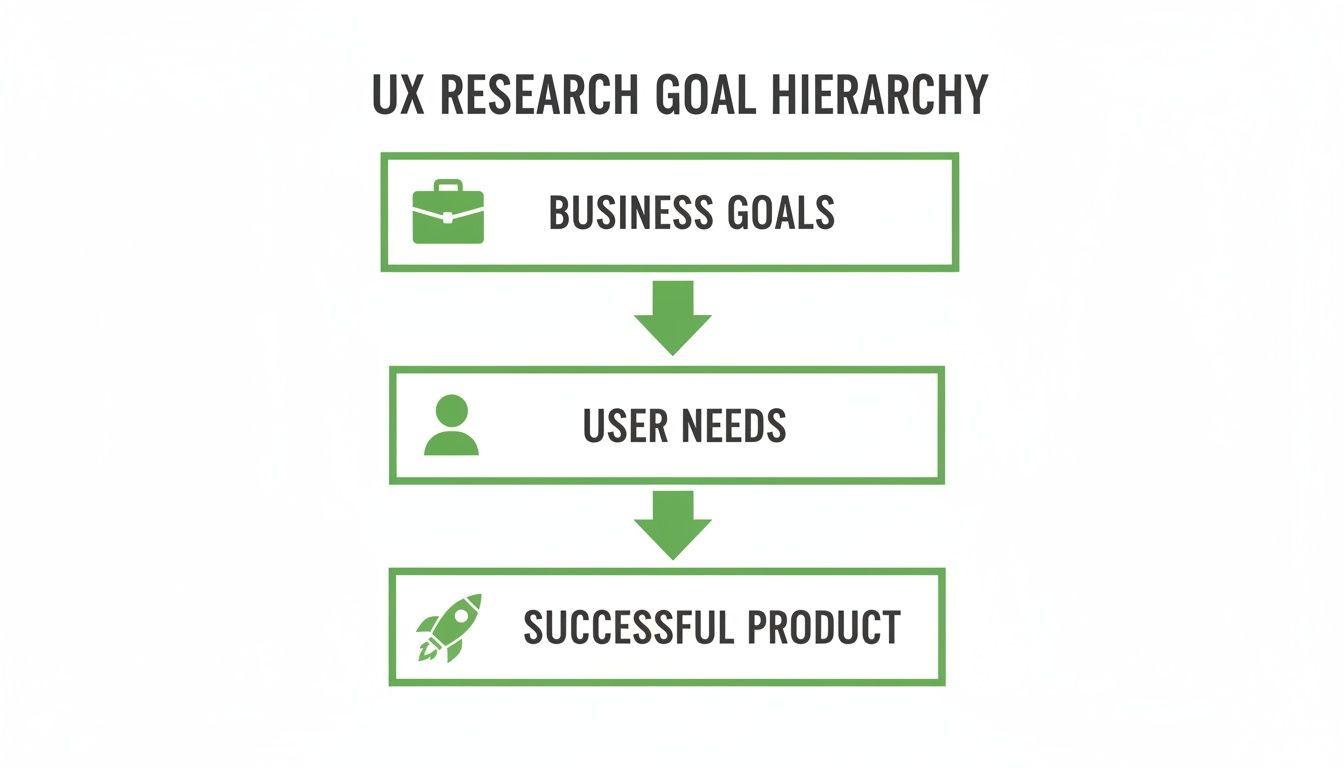
The flowchart makes it clear: a product's success isn't an accident. It’s the direct result of aligning what the company wants to achieve with a deep, evidence-based understanding of its users.
Choosing the Right User Experience Research Method
Picking the right research method is everything. Your choice hangs on your research question, where you are in the development cycle, and the resources you have. There's no single "best" method; the smartest approach is often a mix of qualitative and quantitative techniques. For a deeper look, check out our guide on how to combine qualitative and quantitative research.
Let's imagine you're designing a new mobile banking app. Here's how you might tackle it:
Generative (Qualitative): You could start with diary studies, asking people to document their current banking habits and frustrations. This helps you step into their world and spot opportunities.
Evaluative (Qualitative): Once you have a prototype, you can run usability tests. With a tool like Uxia, you could get instant feedback from AI-powered synthetic testers to find out if users can easily transfer money or check their balance.
Evaluative (Quantitative): After launch, you could send a survey to 5,000 users asking them to rate their satisfaction. This gives you measurable data on how people feel about the app overall.
To make this easier, the table below breaks down some common methods to help you decide which one fits your needs right now.
Method | Type | Primary Goal | Best For Answering |
|---|---|---|---|
User Interviews | Qualitative | To gain deep insights into a user's attitudes, beliefs, and experiences. | "Why do users feel a certain way about our product?" |
Usability Testing | Qualitative | To identify usability problems in a design or product. | "Where are users struggling to complete a task?" |
Surveys | Quantitative | To gather data from a large sample to understand trends and measure sentiment. | "What percentage of our users are satisfied with this new feature?" |
A/B Testing | Quantitative | To compare two versions of a design to see which one performs better. | "Which button colour leads to more clicks?" |
Card Sorting | Qualitative | To understand how users group information and concepts. | "How should we organise the navigation menu on our website?" |
Analytics Review | Quantitative | To analyse user behaviour data from a live product. | "What are the most common user paths and where do they drop off?" |
By understanding these two pillars and knowing when to use each method, you can build a solid research practice that consistently delivers insights you can actually use. This evidence-based approach takes the guesswork out of design and empowers your team to make decisions with real confidence.
Designing a User Research Study From Scratch
Alright, so you know what user research is. But how do you actually do it?
Going from theory to practice starts with a solid plan. Think of it like a blueprint for a house—without one, you’re just guessing where the walls go, and you'll end up with a wobbly structure. A good study design ensures every action you take is deliberate and leads to a reliable, useful outcome. Winging it just leads to confusing data that goes nowhere.
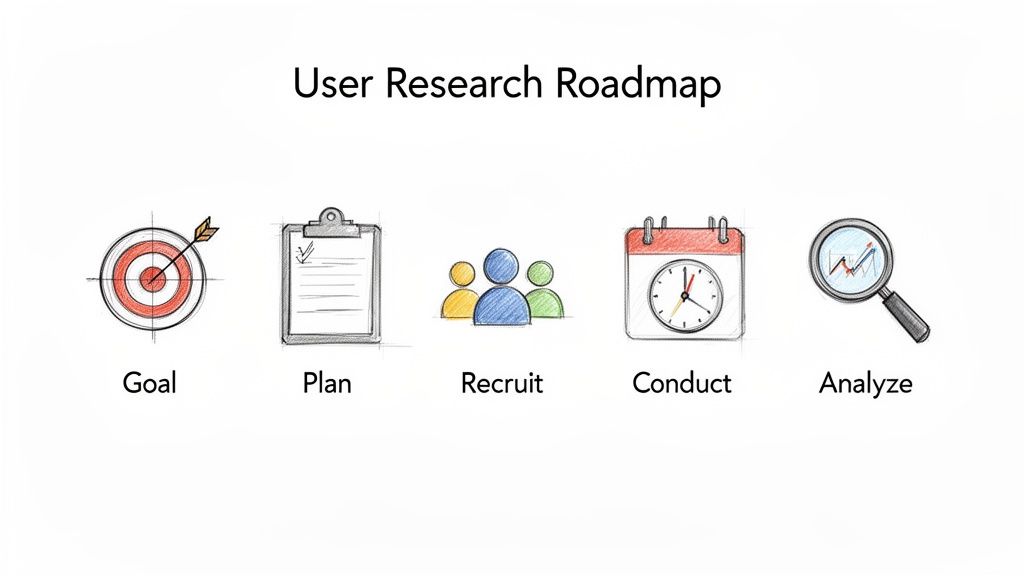
First thing's first: define your destination. What are you actually trying to learn? Vague goals like "find out what users think" are pretty much useless. You need to get specific and measurable.
Practical Recommendation: Frame your research goal as a specific, answerable question. Instead of "See if users like the new dashboard," try "Can users find and interpret their monthly performance report in under 30 seconds?" This clarity focuses your entire study.
Crafting Your Research Plan
Once you’ve nailed down your goals, it’s time to formalise everything in a research plan. This document is your single source of truth, keeping everyone on your team on the same page. It doesn't need to be a massive, 50-page dissertation, but it absolutely must cover the essentials.
A strong plan usually includes:
Background: A quick summary of why you’re doing this research. What’s the problem you're trying to crack?
Goals & Hypotheses: List those specific, measurable goals and any assumptions you want to put to the test.
Methodology: State which research method you've picked (e.g., moderated usability testing, survey) and give a brief justification for why it’s the right tool for the job.
Participants: Define the exact user profile you need. Who are you talking to? Be specific.
Timeline: Outline the key dates for finding people, running the sessions, and analysing the results.
This plan becomes your guide, keeping the study from drifting off course. And when it's time to actually run the sessions, it helps to know the practical ins and outs of how to conduct usability testing to make sure you get quality feedback.
Finding and Screening Participants
Here comes the hard part. Recruiting the right people is easily the most critical—and frustrating—part of traditional user research.
The quality of your insights is directly tied to the quality of your participants. Simple as that. If you test with the wrong people, you’ll get feedback that’s not just unhelpful, but actively misleading.
The process kicks off with a screener, which is a short survey designed to weed out anyone who doesn't fit your target profile. A good screener asks questions that confirm a user's real behaviours without giving away the "right" answers.
Practical Recommendation: Instead of asking a leading question like, "Do you use online banking apps?", you'd ask something like, "Which of these have you done on your phone in the past month?" and include "Banking" in a list of other plausible options. This behavioural question gives you a more accurate picture of their real-world actions.
Honestly, this whole step is a logistical nightmare. You have to find potential participants, screen them, schedule interviews, deal with the inevitable no-shows, and manage payments. It can stall a project for weeks.
This is exactly the pain point that modern tools are designed to eliminate. For example, Uxia completely removes the recruitment and scheduling headache by using AI-powered synthetic testers. Instead of spending weeks trying to find five real users, you get feedback from perfectly profiled AI participants in minutes.
This frees up your team to focus on what actually matters—the insights—not the logistics. It turns user feedback from a slow, laborious project phase into an instant, on-demand resource, massively accelerating the entire product development cycle.
From Data to Decisions: Turning Research Into Actionable Insights
Collecting feedback is just the first step. The real magic of user experience research happens when you transform a chaotic mess of notes, raw numbers, and interview transcripts into clear insights that actually drive product decisions.
Without this crucial step, research is just an interesting academic exercise—it doesn't help you build a better product.
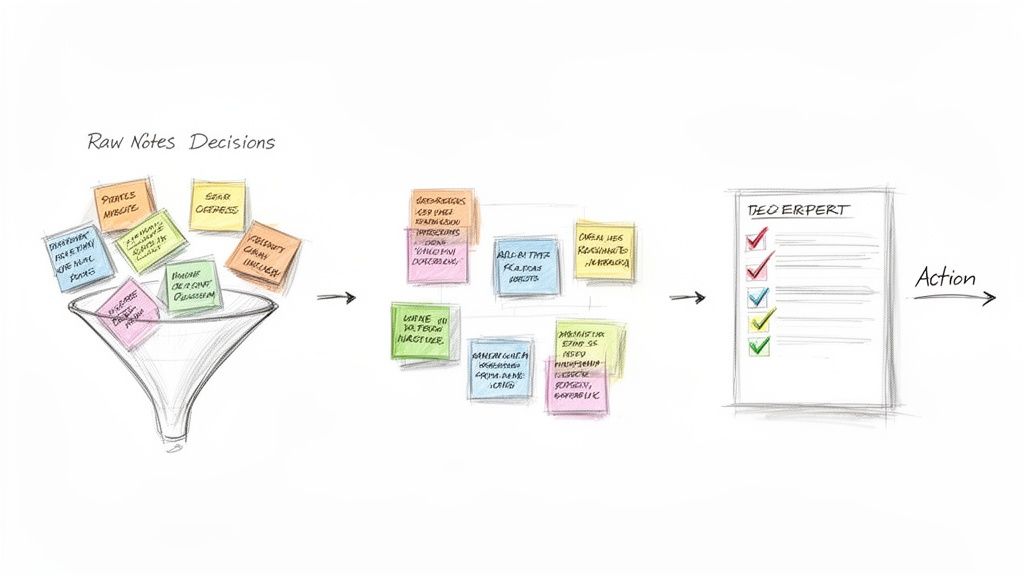
The process of making sense of all this information is called synthesis. It’s where you step back from the individual data points to finally see the bigger picture, connecting dots that weren't obvious at first glance.
Uncovering Themes in Qualitative Data
When you have qualitative data from interviews or usability tests, one of the most powerful synthesis methods is affinity mapping. Think of it like organising a sprawling collection of sticky notes into meaningful groups. Each note might hold a direct quote, a key observation, or a user's pain point.
You start by looking for connections and clustering related notes together. As you do this, powerful themes will naturally begin to surface. You might discover that multiple users mentioned feeling "confused" by your pricing page or "anxious" about the checkout process. These clusters are your gold—they become the core insights.
This manual process can be time-consuming, but it’s fantastic for digging into the patterns hidden within the noise. Modern tools, however, are changing the game. With Uxia, this entire synthesis process is automated. The platform instantly analyses transcripts from AI synthetic testers, automatically identifying recurring issues and organising them by theme. This saves your team hours of tedious manual work.
Analysing Quantitative Data
With quantitative data from surveys or A/B tests, your goal is completely different. You're hunting for statistical patterns, not personal stories. Here, you’re looking at measurable trends like completion rates, error rates, and satisfaction scores to pinpoint where the user experience is succeeding or failing at scale.
For instance, you might find that 75% of users are dropping off at a specific step in your sign-up flow. That number tells you what the problem is and just how big it is. When you combine this with qualitative insights, you can then figure out why it's happening, giving you the complete picture you need to make smart design changes.
The ultimate goal is to move from a mountain of raw data to a short, prioritised list of problems to solve. An insight isn't just an observation; it's an observation combined with a clear understanding of its impact on both the user and the business.
Crafting a Compelling Research Report
Once you've distilled your insights, you need to share them in a way that inspires action. A great research report doesn't just present data; it tells a compelling story. It needs to be clear, concise, and laser-focused on what matters most to your stakeholders. A deep commitment to data-driven design is what makes this story truly impactful.
An effective report usually includes:
Executive Summary: A one-page overview with the most critical findings and top recommendations. You have to assume your stakeholders might only read this part.
Key Findings: Present your top 3-5 insights, supported by powerful evidence like direct user quotes, video clips, or key statistics.
Actionable Recommendations: For each finding, provide a clear, specific, and practical recommendation. Don't just say "fix the checkout"; suggest a concrete solution your team can actually build and test.
Practical Recommendation: One of the biggest mistakes in reporting is simply presenting data without any interpretation. Telling your team that "five users clicked the wrong button" isn't helpful. Instead, frame it as an insight: "Users consistently misinterpret the 'Save' icon, leading to lost work and frustration." This framing makes the problem’s impact obvious and creates a sense of urgency.
The need for better digital experiences is everywhere. For example, Eurostat data from 2024 shows that only 38% of users across the EU had no issues with public authority websites. Technical problems were the top complaint at 16%, while 14% found the sites hard to use. For teams aiming to build superior products, these figures highlight a massive opportunity to stand out. Platforms like Uxia are built to find exactly these kinds of friction points, providing prioritised insights that help teams build better products, faster.
The New Frontier: Scaling UX Research with AI
For all its value, traditional user experience research has always been held back by one thing: speed. The classic process is full of bottlenecks that can grind an agile team’s momentum to a halt.
Finding the right participants can take weeks of screening and scheduling. Then you have to coordinate times, deal with no-shows, and manually pore over hours of session recordings. This friction means research often happens in slow, infrequent bursts, completely out of sync with modern development sprints.
The Problem with Old-School Research
The logistical hurdles of traditional methods don’t just slow things down; they limit their effectiveness in fast-moving environments. These roadblocks often force teams to make tough decisions without the user feedback they desperately need.
Common bottlenecks include:
Painfully Slow Recruitment: Finding, screening, and scheduling qualified participants is a time-consuming and expensive process that can delay projects by weeks.
Scheduling Nightmares: Juggling the schedules of researchers, observers, and participants across different time zones is a constant logistical headache.
The Bias Trap: Relying on professional testers or the same small pool of users can introduce serious bias, leading to skewed and unreliable feedback.
By the time you get the insights, the product team may have already moved on, rendering the findings obsolete. It's a frustrating cycle where research struggles to have a real impact.
Introducing AI-Powered Synthetic Testing
This is where a new frontier of UX research opens up: AI-powered synthetic testing. This approach is built from the ground up to obliterate the friction of traditional methods, making high-quality user feedback instantly accessible.
Platforms like Uxia are leading this shift. Instead of recruiting human testers, Uxia generates realistic AI participants tailored to your specific demographic and behavioural profiles. You can define your target audience—from "millennial online shoppers in Spain" to "boomer banking app users"—and the platform creates synthetic users that think, behave, and react just like them.
These AI participants then run unmoderated tests on your designs or prototypes, navigating your user flows and even thinking aloud as they go. The whole thing happens in minutes, not weeks, giving you on-demand feedback whenever you need it.
By 2025, the UX Research Service market in Europe is set to grow into a major part of a global $14.8 billion industry, expanding at a robust 15.9% rate. This growth is heavily driven by AI integration, which is reshaping how teams conduct studies. While traditional research gets bogged down in scheduling, synthetic AI testers deliver unmoderated sessions in minutes, offering a powerful alternative. Find out more about how AI is transforming the UX research market.
The Uxia Advantage: Speed, Scale, and Clarity
Integrating a tool like Uxia into your workflow brings immediate and profound benefits. It fundamentally changes the role of research from a slow, reactive process to a proactive, continuous source of insight.
Key advantages include:
Unmatched Speed: Get detailed user feedback in minutes. This lets you test ideas, validate designs, and iterate within a single sprint, ensuring every decision is backed by user insight.
Effortless Scale: Run tests continuously without the logistical overhead. You can test every new feature, design tweak, or copy change, weaving user feedback into the fabric of your daily workflow.
Reduced Bias: Sidestep the pitfalls of using professional testers or a limited user panel. Uxia’s synthetic testers provide fresh, unbiased perspectives every single time.
On top of that, Uxia automates the most tedious part of the research process: analysis and synthesis. The platform generates detailed think-aloud transcripts, automatically flags usability issues, and summarises findings into clear, visual reports. For researchers dealing with lots of video, exploring AI-powered video transcription guides can also dramatically speed up the analysis of usability tests and other video-based studies.
This combination of speed and automated reporting makes Uxia a must-have for any modern product team. It empowers you to build with confidence, knowing that user understanding is at the heart of every decision you make. You can learn more about how to get started with synthetic user testing in our detailed article.
Got Questions About User Experience Research? We've Got Answers
Even after you've got the basics down, a few questions always seem to pop up when teams try to fit user experience research into their day-to-day work. Let's tackle some of the most common ones to give you clear, practical advice you can use right away.
How Often Should We Be Doing This?
Think of user experience research less like a one-time check-up and more like a continuous conversation that happens throughout your product's life. The ideal frequency really boils down to how fast your team moves and how mature your product is.
Practical Recommendation: If you're in the early stages, you should be researching constantly—maybe even weekly or bi-weekly—to make sure your core ideas actually work for people. For a more established product, you might run research for each new feature or on a quarterly basis to hunt for new opportunities. The real goal is to move away from big, scary, infrequent studies and towards smaller, ongoing research activities.
This "always-on" rhythm, which is now totally possible with rapid testing tools like Uxia, lets you take the risk out of your decisions on a daily basis. Instead of a distinct "research phase," it becomes a steady pulse of feedback that keeps your product in sync with what users actually need.
What's the Difference Between UX Research and Market Research?
This is a big one. While both are about understanding people, they're asking fundamentally different questions. Market research is all about sizing up markets and customer groups to see if an idea is commercially viable. It answers questions like, “Who might buy this?” or “How big is the potential market for our product?”
User experience research, on the other hand, zooms in on understanding how people behave, what they need, and what motivates them while they're actually using something. It answers questions like, “Can someone figure out how to complete this task?” or “Why is everyone giving up at this specific step?”
Market research helps you figure out what to build and who to build it for. UX research helps you understand how to build it so it's actually usable, useful, and maybe even a little delightful. They’re two sides of the same coin, and using them together gives you a massive advantage.
Can I Actually Do This on a Small Budget?
Absolutely. You don't need a huge budget to get huge value. In fact, some of the most effective research methods are incredibly budget-friendly. Guerrilla testing, where you just ask people in a coffee shop for five minutes of their time, can be done for the price of a few flat whites. Simple surveys can also be run for free or very cheaply with tons of online tools.
But let's be honest—the biggest cost in traditional research isn't the software or the gift cards. It's the time you burn recruiting, scheduling, and wading through hours of recordings. This is where modern platforms completely change the game.
Practical Recommendation: Tools like Uxia, for instance, get rid of the recruitment headache and cost entirely by using AI synthetic testers. Suddenly, any team, with any budget, can get high-quality, actionable feedback in minutes. The key is to make research a regular habit—even if it's small—instead of waiting around for a big budget that might never show up.
How Many Users Do I Really Need to Test With?
The classic "it depends" answer definitely applies here, but we can get more specific. Your method and your goals dictate the number. For qualitative usability testing, the legendary Nielsen Norman Group showed that you can find about 85% of the usability problems with just five users. The goal isn't to get a statistically perfect result; it's to spot recurring patterns in behaviour. After about the fifth person, you just start seeing the same issues over and over.
Now, for quantitative research like surveys or A/B tests, you need a much bigger crowd to get numbers you can trust. We're often talking hundreds or even thousands of people, depending on how confident you need to be in the results.
This is another spot where AI-powered platforms like Uxia offer a pretty cool advantage. You can run tests with a large group of synthetic users, blending the "why" of qualitative feedback with the scale of quantitative data, all without the logistical nightmare of recruiting and managing dozens of real people.
Ready to stop guessing and start building with confidence? With Uxia, you can get actionable user feedback in minutes, not weeks. Ditch the slow recruitment process and start iterating faster with on-demand, AI-powered synthetic testing. See how top product teams are speeding up their work and making smarter decisions. Start testing with Uxia today.