Usability Testing Cost and Budget Guide
Discover the true usability testing cost across methods. Compare human vs AI testing, uncover hidden expenses, and build an accurate UX research budget.

Basic unmoderated usability testing costs between $150 and $750 per study, while the true all-in cost of traditional moderated research frequently exceeds $10,000 per round once recruitment, incentives, and researcher labor are factored in. The right usability testing cost depends less on the platform fee than on how much human time, participant management, and analysis your team must fund.
The popular advice is to compare subscription prices and pick the cheapest testing tool. That approach is incomplete. A low platform fee can still produce an expensive research round if a designer spends days recruiting, a researcher handles screening and scheduling, participants fail to attend, and the team waits too long for synthesis.
A useful budget answers a harder question: what does each actionable insight cost your team? That figure includes direct spend, internal labor, opportunity cost, and the cost of delaying a product decision. Uxia fits into this conversation as an option for rapid synthetic validation, but it shouldn't be treated as a universal replacement for human research. The practical answer is usually a deliberate mix of methods.
The True Price of Usability Testing
Teams often approve the visible line item and miss the larger bill. A platform fee, participant incentive, or agency quotation is easy to compare, yet none captures the work required to turn sessions into a decision-ready insight.
A five-person study shows why. Nielsen Norman Group reported average recruiting agency costs of $107 per participant in a 2003 study. Later summaries of that work identified 1.15 work hours per participant for recruitment and a 10.6% no-show rate. The figures appear in Nielsen Norman Group's participant recruitment guidance. These figures date from a 2003 NNGroup study, so they should not serve as a current 2026 benchmark. The underlying cost pattern still matters: teams need time for screening, replacement participants, scheduling, and coordination before the first session starts.
Platform price is only the starting point
Unmoderated testing can look inexpensive because a team launches task-based research without a live facilitator. The saving is real, but internal work remains. Someone must define the research mission, prepare the prototype, confirm participant fit, review findings, reconcile contradictory signals, and convert observations into product recommendations.
Moderated research adds facilitation and interpretation. A researcher writes the discussion guide, conducts sessions, manages recordings, identifies patterns, and explains implications to colleagues who were not present. Timing creates another cost. If findings arrive after a sprint decision, the team may pause development, repeat work, or proceed without evidence it already paid to collect.
Synthetic AI testing, including Uxia, can reduce the labor attached to rapid validation and make more frequent iteration practical. It does not answer every research question. Teams still need human studies when motivation, context, emotional response, or sensitive behavior requires direct participant evidence.
Practical rule: Budget for the work required to make research usable, not merely for the mechanism that collects responses.
Measure cost per actionable insight
Use cost per actionable insight as the core budgeting metric. Add external fees and internal hours, then count findings that change a design, reprioritize a flow, remove a feature, or clarify a product decision.
This exposes false savings. A low-cost test that generates observations without a priority or owner can cost more per useful decision than a smaller, targeted study. For continuous iteration, track time to insight as well. Evidence delivered after implementation begins has less practical value and may force expensive rework.
A better budgeting question is: how much will this decision cost if the team learns too late, and which method provides sufficient confidence soon enough?
Breaking Down Usability Testing Costs by Method
The platform fee is rarely the full cost of usability testing. What changes by method is the amount of human work behind the study. Unmoderated testing keeps facilitation light. Moderated research adds scheduling, session leadership, and interpretation. Agency work combines recruitment, project management, analysis, and reporting into one service.
Published estimates vary widely because scope and service models differ. The figures in Articos' user testing cost breakdown and CleverX's 2026 pricing guide provide useful reference points, but they are not interchangeable quotes. Treat the table as a comparison of common study formats, not as an all-in budget.
Testing Method | Typical Cost Range | Best Use Case |
|---|---|---|
Unmoderated usability testing | $150 to $750 for five respondents | Fast task validation and directional iteration |
Moderated usability sessions | About $950 to $1,200 fully loaded, or $3,000 to $10,000 for broader remote studies | Understanding hesitation, motivation, and the reasons behind behavior |
Full agency study | $5,000 to $25,000, with agency-led work commonly reaching $15,000 to $75,000 | Complex recruitment, multiple audiences, defensible stakeholder reporting |
These prices usually cover the study format itself. Participant sourcing, incentives, internal preparation, analysis, stakeholder workshops, and delays can sit outside the quote. A low sticker price can therefore produce a high cost per decision when the team must supply the missing labor.
Match the method to the question
Use unmoderated testing when the task is clear and the decision concerns navigation, comprehension, or completion. It suits prototype comparisons, label checks, and early identification of abandonment. The trade-off is limited context. You can see where a participant struggles, but you may not learn enough about why.
Choose moderated sessions when unexpected behavior needs investigation. A facilitator can ask why someone interpreted a message a certain way, examine trust concerns, and follow relevant context as it emerges. That depth costs more time per participant, so reserve it for questions that cannot be answered through task results alone.
Agency work fits specialized audiences, difficult recruitment, or formal deliverables that need external research management. For enterprise-scale consulting studies, see the cost discussion in the final section.
Teams planning a broader program can compare 10 essential methods of usability testing. Synthetic AI testing can also support frequent, lower-labor validation between human studies, helping teams test more design changes without treating every iteration as a full research project. Use human research when motivation, emotion, sensitive behavior, or real-world context requires participant evidence. Select the method that supplies enough confidence for the decision, then budget for the labor needed to act on the result.
The Hidden Expenses in Traditional User Research
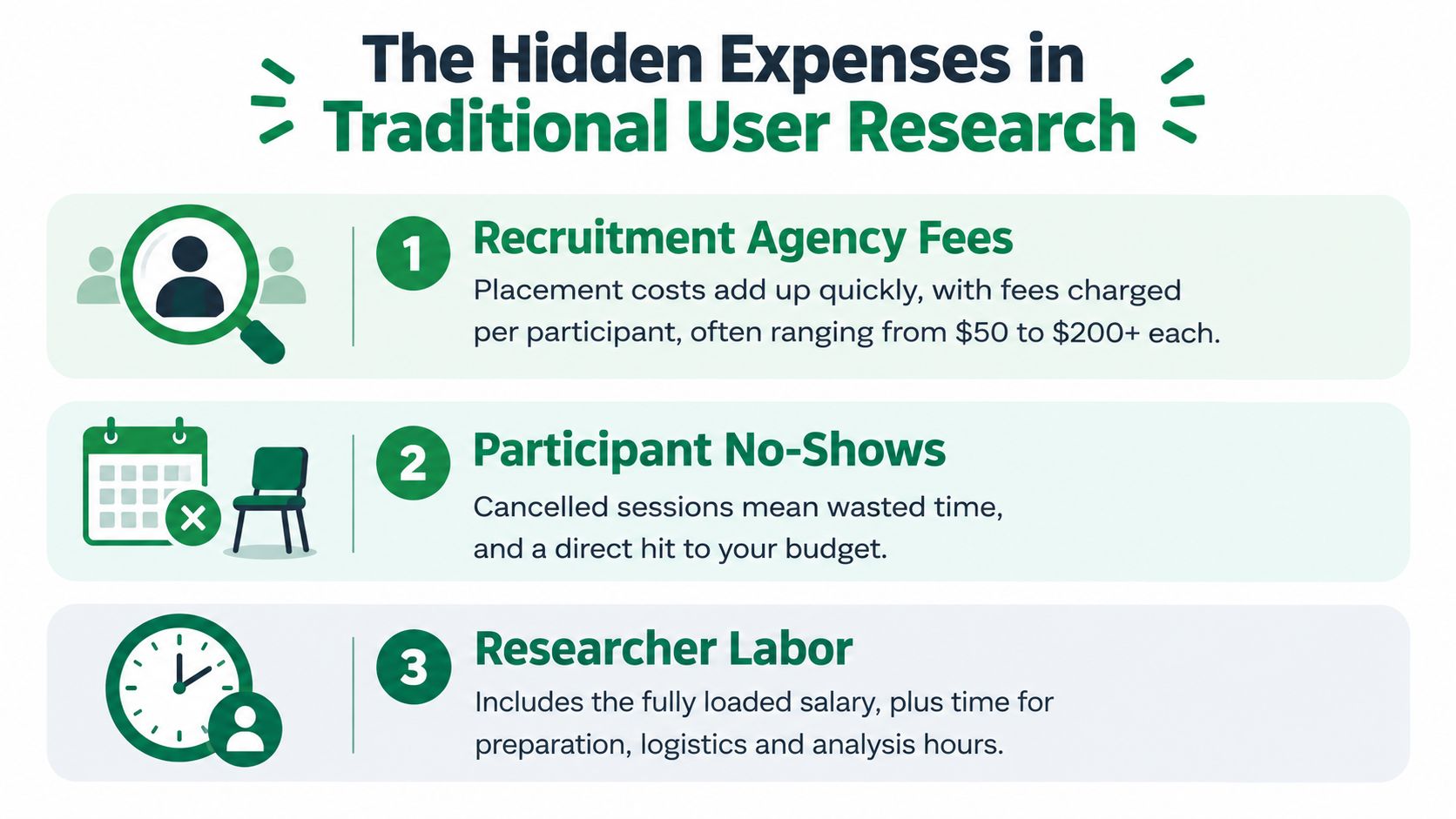
The biggest usability testing cost often appears nowhere on the software invoice. Recruitment, no-shows, researcher preparation, facilitation, analysis, and stakeholder coordination can consume more budget than the platform itself.
For specialist products, recruitment becomes especially difficult. A team testing an enterprise workflow can't assume that any available participant represents the intended audience. Screening takes time, qualified participants may require higher incentives, and a narrow audience creates more exposure to rescheduling and replacement work.
Recruitment multiplies the nominal price
One independent industry estimate places the cost of finding a qualified participant at $100 to $300, and estimates that a 20-participant moderated study with qualification requirements can total $12,000 to $15,000 for recruitment and honorariums alone. The figures appear in MeasuringU's usability cost analysis.
The important point isn't only the incentive. Narrow audiences require more screening, more outreach, larger buffers, and more project management. A specialist participant can therefore increase both direct and indirect spend.
No-shows create capacity waste
A no-show doesn't just waste an incentive. It also strands a booked researcher, delays synthesis, and can force the team to repeat the session. Nielsen Norman Group's recruitment figures show why teams need a buffer even for small studies.
Researcher labor adds another multiplier. A 2026 hiring benchmark estimates a mid-level UX researcher's fully loaded first-year cost at roughly $150,000 to $170,000, with recruiting adding $10,000 to $20,000 and 42 to 63 days to fill the role. These figures come from Koji's UX researcher hiring guide. The annual salary isn't the price of one study, but it makes internal capacity a real budget item.
A practical forecast should therefore separate:
External spend: Platform fees, recruitment, incentives, and transcription.
Research labor: Protocol design, screening, facilitation, analysis, and reporting.
Team opportunity cost: Design and product hours diverted from planned delivery.
Delay cost: Decisions postponed while the study is recruited, run, and synthesized.
If those lines aren't visible, the estimate is probably optimistic.
Human Studies vs Synthetic AI Testing
Human research and synthetic AI testing solve different problems. Human participants bring lived experience, emotional nuance, workarounds, and the ability to explain why an experience matters in their context. Synthetic testers provide rapid, repeatable feedback on designed flows without recruitment, scheduling, or no-show management.
Uxia's synthetic testing model is designed for teams that need frequent validation. Teams provide a prototype or product flow, define the mission and audience, and receive synthetic participants that interact with the experience, surface friction, and produce think-aloud feedback. That makes the economics materially different from a moderated round, particularly when the team wants feedback during every design iteration.
Four budget dimensions matter
Cost: One 2026 comparison frames synthetic AI research at $8 to $20, while the same comparison places five-respondent unmoderated testing at $150 to $750, moderated sessions at $950 to $1,200, and agency studies at $5,000 to $25,000. Those figures are listed in Articos' cost comparison. Synthetic research removes participant recruitment and incentive costs, but teams should still budget for interpretation and follow-up.
Speed: Synthetic testers are available on demand, so a team can evaluate a prototype inside a design cycle rather than waiting for participant sourcing. That speed matters when the alternative is delaying a decision or shipping an untested change.
Scale: A human panel is constrained by recruitment capacity, calendars, and researcher availability. Synthetic testing can repeat a structured mission across multiple flows and audience profiles, which supports broader iteration.
Insight quality: Synthetic feedback is strongest for directional questions, friction discovery, comprehension, navigation, and early validation. It isn't a substitute for human participants when the team must understand sensitive experiences, complex organizational politics, physical environments, or emotional consequences.
A detailed comparison of the trade-offs appears in synthetic users versus human users. The practical model is hybrid: use synthetic testing for frequent checks, then reserve moderated human work for high-risk decisions where probing and lived context justify the additional usability testing cost.
Building a Usability Testing Budget and ROI Model
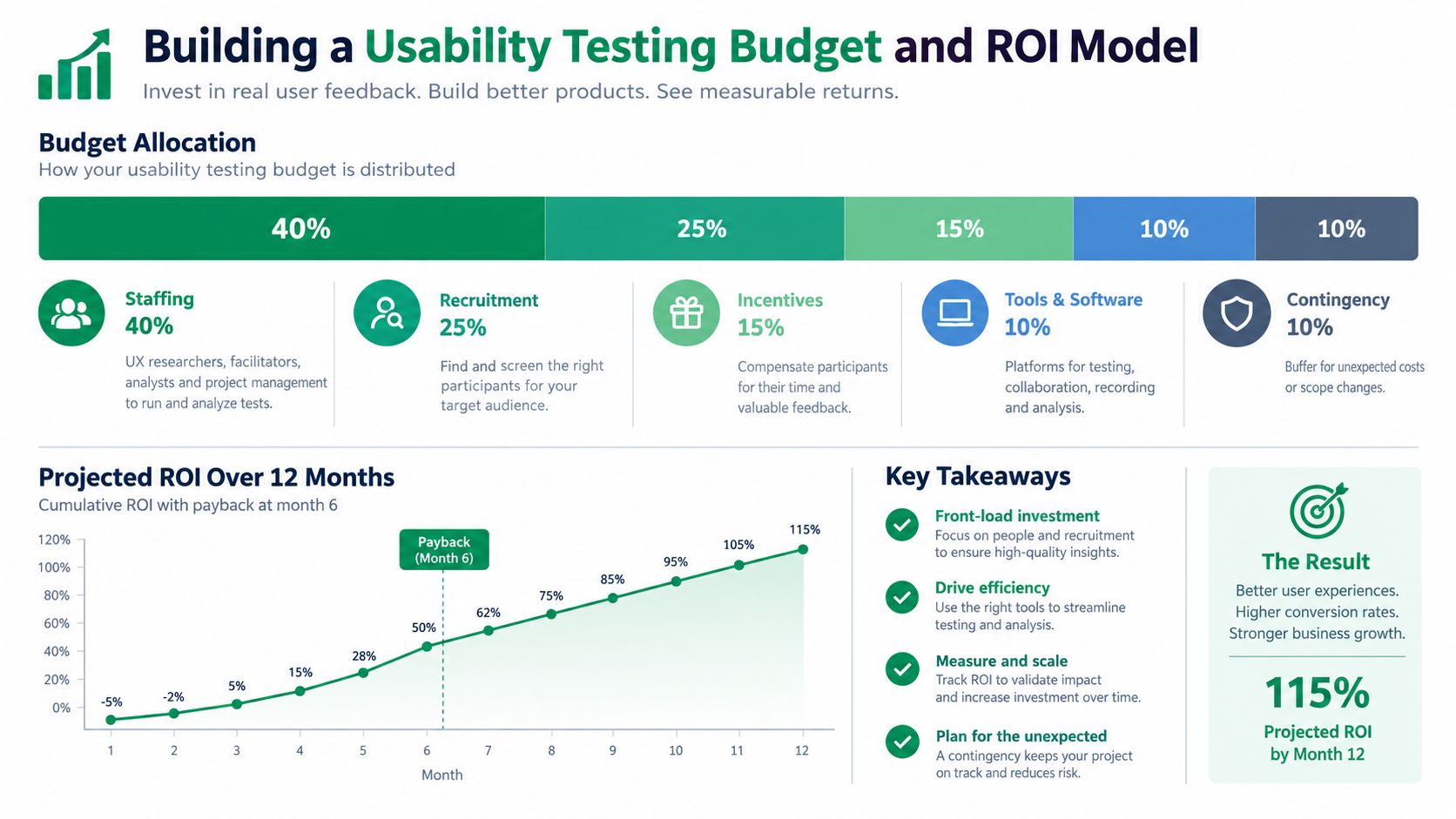
A low platform price can hide the largest line items. Build the budget around the decision the research must support, then account for the people, participants, tools, and follow-up work required to reach that decision.
Independent UX budgeting research reports that staffing represents 32% of the average research budget, recruitment and incentives 20%, and tools and platforms 19%. These figures appear in Userbrain's UX budget research. Use them as planning benchmarks rather than fixed rules. A study involving difficult-to-recruit participants will carry a different cost profile from an internal prototype review.
Use a simple allocation model
Forecast four cost layers:
Research production: Researcher, designer, and product time for planning, setup, facilitation, analysis, and readout.
Participant operations: Recruiting, screening, incentives, replacement participants, and scheduling.
Technology: Testing platform, recording, prototype access, transcription, and research repository costs.
Decision overhead: Stakeholder workshops, documentation, implementation changes, and roadmap delays caused by unresolved questions.
Calculate the efficiency of the study with:
Cost per actionable insight = total research cost ÷ findings that change a decision.
For ROI, connect the investment to measurable avoided waste:
Research ROI = (avoided rework value + avoided delivery waste + recovered opportunity value − research cost) ÷ research cost.
Keep the estimate tied to an actual decision. If testing leads the team to remove a feature, shorten a flow, or redirect engineering work, record the change and estimate the affected effort using internal delivery rates. Avoid assigning value to findings that produced no action.
Model at least three scenarios: a lean unmoderated round, a moderated study, and a synthetic validation cycle. Compare their total spend with time to insight, confidence in the evidence, and the consequence of proceeding without testing. Synthetic testing can make frequent validation affordable, while human research remains appropriate when probing, lived context, or sensitive experiences determines the decision.
Practical Strategies to Lower Testing Costs
The biggest savings usually come from removing avoidable work, not from cutting research. Narrow the decision, reuse the study infrastructure, and reserve expensive human sessions for questions that require live probing or contextual understanding. The budget allocation model from the previous section already showed that staffing and recruitment can dominate total spend.
Reduce waste before reducing rigor
Narrow the mission: Test one critical flow or decision rather than asking one round to assess the entire product.
Use existing participants: Customer advisory groups, support contacts, beta users, and sales prospects can reduce sourcing friction when they match the research question.
Choose unmoderated work deliberately: Use it for clear evaluative tasks where the team does not need live probing.
Reuse protocols: Keep task wording, success criteria, and reporting templates consistent so each round does not start from zero.
Automate reporting: Standardized tagging and summaries reduce analyst time. A researcher should still review the evidence before decisions are made.

Make frequency affordable
A continuous research program changes how teams allocate testing spend. Staffing, recruitment and incentives, and tools can each become major budget components, so reducing participant coordination and analyst workload often matters more than comparing platform sticker prices. Reusing protocols and automating first-pass synthesis helps, but human review remains necessary when findings will guide product decisions.
Lightweight or synthetic validation can catch obvious friction before the team commissions deeper research. Uxia supports rapid feedback on prototypes and flows without participant recruitment, making frequent checks practical between larger studies. See this guide to synthetic user testing for rapid UX insights with AI-driven workflows for a workflow focused on rapid iteration.
The five-user rule works as a starting point for qualitative research, not as a quota detached from the question. A small, focused round may expose severe navigation problems, while a complex enterprise workflow with multiple audiences may require separate validation. Match the method and sample to the decision, then stop when additional evidence is unlikely to change it.
Aim for validation frequent enough that major usability surprises do not accumulate between research rounds. Human studies still have a place when probing, lived context, or sensitive experiences determines the decision. Synthetic testing handles repeatable checks, while researchers can focus their time on the questions where interpretation carries the most value.
Choosing the Right Testing Approach for Your Team
The cheapest testing method is not always the lowest-cost decision. A bootstrapped startup should protect cash and decision speed by starting with tightly scoped prototype checks, customer conversations, and lightweight unmoderated or synthetic validation. Bring in moderated human sessions when task behavior cannot explain a consequential uncertainty, such as a trust barrier, a complex workflow, or a sensitive user context.
A scaleup faces a different constraint: frequent releases can turn recruitment and moderation into a research queue. Continuous unmoderated testing can cover routine flow checks, while targeted human sessions examine the reasons behind persistent friction. Set the budget against sprint velocity and decision risk, not vendor prestige.
Enterprise teams may need formal governance, specialist recruitment, and studies spanning several audiences or designs. As the method breakdown showed, enterprise consulting studies start around $40,000, so procurement, compliance, and stakeholder defensibility become legitimate parts of the cost. Teams comparing outside partners can also review best creative agencies, then require each provider to state assumptions for scope, participants, analysis, and reporting.
A practical decision matrix
Team situation | Default approach | Add human research when |
|---|---|---|
Early startup with limited cash | Prototype reviews, focused unmoderated checks, and synthetic validation | The decision affects the core product direction or a hard-to-reach audience |
Scaleup with frequent releases | Continuous lightweight validation plus targeted moderated rounds | Teams need explanations for recurring friction or segment-specific behavior |
Enterprise with multiple audiences | Governed mixed-method research and specialist recruitment | The initiative carries regulatory, revenue, accessibility, or organizational risk |
Agencies and freelancers should price research as part of the service rather than treating coordination and analysis as invisible goodwill. A clear proposal should separate participant costs, recruiting effort, moderation time, synthesis, and stakeholder readouts. That makes competing bids easier to evaluate and exposes where a lower platform fee may still produce a higher project total.
The strongest operating model is staged. Use synthetic or unmoderated testing while designs change quickly and the team needs repeated checks. Commission moderated human work when the decision depends on depth, empathy, or evidence from a specific real-world audience. Synthetic testing can reduce recruitment, scheduling, and moderation overhead, while researchers spend their time on questions that require probing and lived experience.
Uxia helps product teams test prototypes, live products, websites, apps, and complex flows with synthetic testers, without recruitment, scheduling, or moderation overhead. Use Uxia for rapid validation during design iterations, then reserve human research budget for decisions that require deeper probing and lived experience.