A Practical User Persona Template That Drives Real Results
Move beyond generic profiles with a user persona template designed for action. Learn how to build, validate, and use personas to make smarter product decisions.
A user persona template is essentially a structured framework you use to build out semi-fictional profiles of your ideal users. It’s the tool that transforms all that abstract research into a clear, actionable document, helping your entire team understand and design for your target audience with genuine empathy and precision.
Why Most User Personas Fail (And How a Template Fixes It)
Let’s be honest: a lot of user personas are created with the best intentions, only to die a slow death in a forgotten folder on a shared drive. They get rolled out during a project kickoff, presented once, and then… crickets.
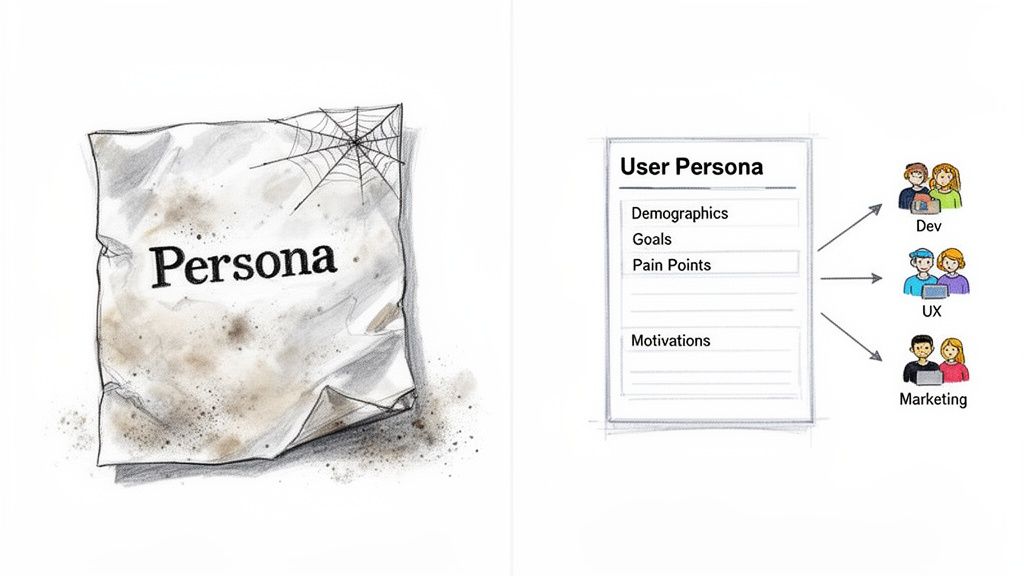
This happens because they’re often unstructured, built on assumptions instead of real data, and ultimately fail to create a shared understanding across different teams.
When a persona is just a mishmash of vague descriptions, it’s almost impossible for anyone—from developers to marketers—to use it for actual decision-making. The result? A document that doesn’t drive action and, pretty soon, gets ignored completely. It’s a classic failure point that wastes valuable research and leaves everyone misaligned.
Creating a Shared Language for Your Organisation
This is the exact problem a good user persona template is designed to solve. It provides a consistent framework that forces you to be clear and standardises how you capture and present user insights. Think of it less like a fill-in-the-blanks exercise and more as a tool for creating a shared language.
When every persona follows the same structure, it becomes instantly recognisable and useful for everyone. A developer can quickly find a user’s technical skills. A UX designer can pinpoint their core frustrations. A marketer can immediately grasp their motivations. This consistency turns a pile of abstract data into a tangible, actionable resource that actually gets used.
That shared understanding is absolutely crucial for keeping everyone on the same page. It guarantees that every department is building for and talking to the same person.
Practical Recommendation: To ensure your persona becomes a shared language, involve stakeholders from different departments (dev, marketing, sales) in the creation process. This builds early buy-in and ensures the final template is useful for everyone, not just the UX team.
Moving from Static Files to Living Assets
Another reason personas bite the dust is that they're treated as static, one-and-done documents. But users change, markets evolve, and your personas need to keep up. A template helps, but taking it a step further and centralising your work in a dedicated platform is the real game-changer.
Using a tool like Uxia, for example, lets you create, store, and update your personas all in one accessible place. This transforms them from isolated files into living assets that can be referenced and refined over time.
When your user persona template lives inside your workflow, it becomes an active part of your process, not a relic from a past project. This is how you build personas that are consistently used, valued, and genuinely useful.
Gathering Data That Gives Your Personas Life
A user persona template is a fantastic framework, but it's just an empty shell until you fill it with high-quality, real-world data. A persona built on assumptions is a caricature, not a tool. A persona built on solid research, on the other hand, becomes an indispensable guide for empathy and decision-making.
The goal here isn't just to collect facts and figures. It’s to uncover the story behind your users' behaviour. This means digging deeper than surface-level demographics. While knowing a user's age or job title gives you context, the real magic lies in understanding their motivations, their daily frustrations, and the "why" behind every click. Sourcing this data is what gives your personas authenticity and strategic power.
Blending Quantitative and Qualitative Insights
The most robust personas are built from a mix of two types of data: quantitative and qualitative. Think of it this way: quantitative data tells you what users are doing, while qualitative data reveals why they are doing it. If you only look at one, you're missing half the story.
Let's say your website analytics (quantitative data) show that 80% of users abandon their shopping cart at the payment page. That’s a critical piece of information, but it doesn't tell you why. Is the page confusing? Are there unexpected fees popping up? Do they simply not trust the payment options?
To get those answers, you need to turn to qualitative sources:
User Interviews: Nothing beats a direct conversation for uncovering emotional drivers and frustrations.
Support Tickets: This is a goldmine for finding common pain points, described in your users' own words.
Surveys and Feedback Forms: These can help you spot trends in user sentiment and satisfaction across a larger audience.
When you combine the "what" from your analytics with the "why" from direct feedback, you start building a persona that truly reflects both observed behaviour and underlying motivation.
Sourcing Actionable Data for Your Template
Gathering good data means looking in a few different places. The foundation of any rich user persona is a solid research plan, so it's worth exploring various essential research data collection methods to see what fits your project best. A great place to start is often right under your own roof.
Your internal data is usually the easiest to get your hands on. Dig into customer support logs and, more importantly, talk to your sales and customer service teams. These colleagues are on the front lines every single day, hearing directly from users about their goals and challenges. This kind of feedback is a powerful starting point.
Next, dive into your analytics platforms. Tools like Google Analytics can reveal demographic information, user flows, popular content, and where people are dropping off. This helps you sketch out a data-backed skeleton of user behaviour before you even speak to a single person.
Practical Recommendation: Create a shared repository (like a simple spreadsheet or a dedicated tool like Uxia) where your sales and support teams can log interesting customer quotes or common frustrations. This creates an ongoing stream of qualitative data you can pull from when building or updating personas.
Conducting Interviews That Uncover Deep Motivations
User interviews are arguably the most powerful source of qualitative data you can get. The key is to ask open-ended questions that encourage storytelling, not just "yes" or "no" answers. Instead of asking, "Is our checkout process easy?" try something like, "Can you walk me through the last time you bought something online? What was that experience like for you?"
This approach uncovers context and nuance you would otherwise miss. To get the most from these conversations, you need to capture not just what users say, but how they say it. This is where a platform like Uxia becomes a central hub for your research. By recording and transcribing user interactions, Uxia helps you capture direct quotes and emotional tones, which you can then link straight to your persona template.
These "voice of the customer" insights are what make a persona feel real and relatable. For a deeper look at collecting and using this type of qualitative feedback, check out our detailed guide on the voice of the customer. This synthesis of observation and direct feedback is what transforms scattered data points into a coherent, actionable story.
Building Your Actionable User Persona Template
Moving from a pile of raw data to a coherent persona isn't magic—it requires a solid framework. A great user persona template does more than just list facts. It weaves your insights into a story that guides strategy, informs design, and builds genuine empathy across your whole organisation.
Let's break down the essential components that turn a simple document into an actionable tool. Think of this as the anatomy of a persona that actually works.
Anatomy of an Effective User Persona Template
Before diving into the specifics, it's helpful to see what a good template structure looks like. This table breaks down the key sections, their purpose, and what separates useful information from vague fluff.
Component | Purpose | Example Data (Good) | Example Data (Poor) |
|---|---|---|---|
Photo & Name | Humanises the data, making the persona memorable and relatable. | "Marketing Manager Maria" + a realistic stock photo. | "User Segment B" or a celebrity photo. |
Demographics | Provides a quick, contextual snapshot to ground the persona in reality. | 28, Marketing Manager at a SaaS startup, BSc in Marketing, lives in Madrid. | Age: 25-35, works in an office. |
Biography/Story | Builds empathy by telling a short story about their daily life and challenges. | A "Day in the Life" paragraph describing her morning rush, key meetings, and after-work hobbies. | A simple list of job responsibilities. |
Goals | Defines what the user is trying to achieve, directly linking their needs to your product's value. | "Reduce time spent on weekly reporting by 50%." | "Be more productive." |
Frustrations | Pinpoints the specific obstacles and pain points your product is designed to solve. | "Current software lacks integration, forcing me to manually copy-paste data between tools." | "Software is hard to use." |
Motivations | Uncovers the underlying "why" behind their goals, informing your marketing and messaging. | Motivated by career advancement and earning recognition from her team for data-driven insights. | "Wants a promotion." |
Direct Quote | Adds authenticity and emotional weight using the user's own words from interviews. | "I spend the first hour of every Monday pulling data from three different systems, and it's soul-crushing." | A generic, made-up quote. |
This structure ensures you capture not just the "what," but the "why" behind your users' behaviours, which is where the real strategic value lies.
Starting with the Basics: Demographics and Biography
The first layer of any persona should offer a quick, humanising snapshot. This isn't about creating stereotypes; it's about grounding your persona in a believable context. These details help your team visualise a real person, which makes all the other data points feel much more relatable.
Key demographic info usually includes:
Name and Photo: Giving your persona a name like "Marketing Manager Maria" and a stock photo makes them instantly more memorable than "Segment B."
Role and Industry: What do they do for a living? This is crucial context, especially for B2B products.
Key Demographics: Details like age, education, and family status influence their needs, tech-savviness, and priorities.
This data gives you a foundational sketch. Knowing Maria is a 28-year-old marketing manager at a small startup immediately tells you she probably wears many hats, is budget-conscious, and needs tools that show a clear return on investment.
Diving Deeper into Psychographics and Behaviours
Once you have the basic sketch, it’s time to add personality. This is where you move from who the user is to how they think and act. Psychographics are the heart of your persona, revealing the attitudes, values, and motivations that actually drive their decisions.
This is where you weave in all that rich qualitative data from your interviews. What are their personality traits? Are they an early adopter or more cautious with new tech? What are their hobbies? These details help you get inside their head.
For instance, a persona who values efficiency will respond to messaging that highlights performance metrics. In contrast, one motivated by creativity will care more about features that support collaboration and innovative workflows.
Practical Recommendation: Instead of just listing job duties in the biography, write a short "Day in the Life" scenario. Describe their typical morning, their biggest work challenges, and what they do to unwind. This story-based approach makes their goals and frustrations feel much more tangible and memorable for your team.
The Core: Goals, Frustrations, and Motivations
This section is the strategic core of your user persona. It directly connects who your user is with what they need from your product. Every design decision and marketing campaign should be checked against this trio of insights.
First, define their goals. What are they actually trying to do? Be specific. Instead of a vague goal like "be more productive," a better one is "reduce the time spent on weekly reporting by 50%."
Next, pinpoint their frustrations. What’s standing in their way? These are the problems your product is built to solve. A frustration could be, "My current software lacks key integrations, forcing me into manual data entry."
Finally, uncover their motivations. What's the real driver? Are they motivated by career advancement, recognition, or just making their day less stressful? Understanding this helps you craft messaging that truly resonates.
Weaving in Direct Quotes and Scenarios
To make your persona truly come alive, use their own words. Pulling direct quotes from your interview transcripts is one of the most powerful ways to build an authentic profile.
A quote like, "I spend the first hour of every Monday manually pulling data from three different systems, and it's soul-crushing," is far more impactful than a bullet point that just says "Pain Point: Manual Data Entry." It adds an emotional layer that numbers can't convey.
You can manage this process easily within a platform like Uxia, which helps you capture, transcribe, and tag key moments from user interviews. Linking these verbatim insights to your template ensures your persona stays grounded in real feedback.
This practice is becoming more and more critical. In the ES region, particularly Spain, the use of user personas in digital marketing has surged, with a reported 67% increase in businesses using them by 2023. You can learn about the growth of persona adoption in digital strategy to see just how impactful this trend is.
This visual helps clarify how different data sources—from interviews to analytics—flow together to build a complete profile.
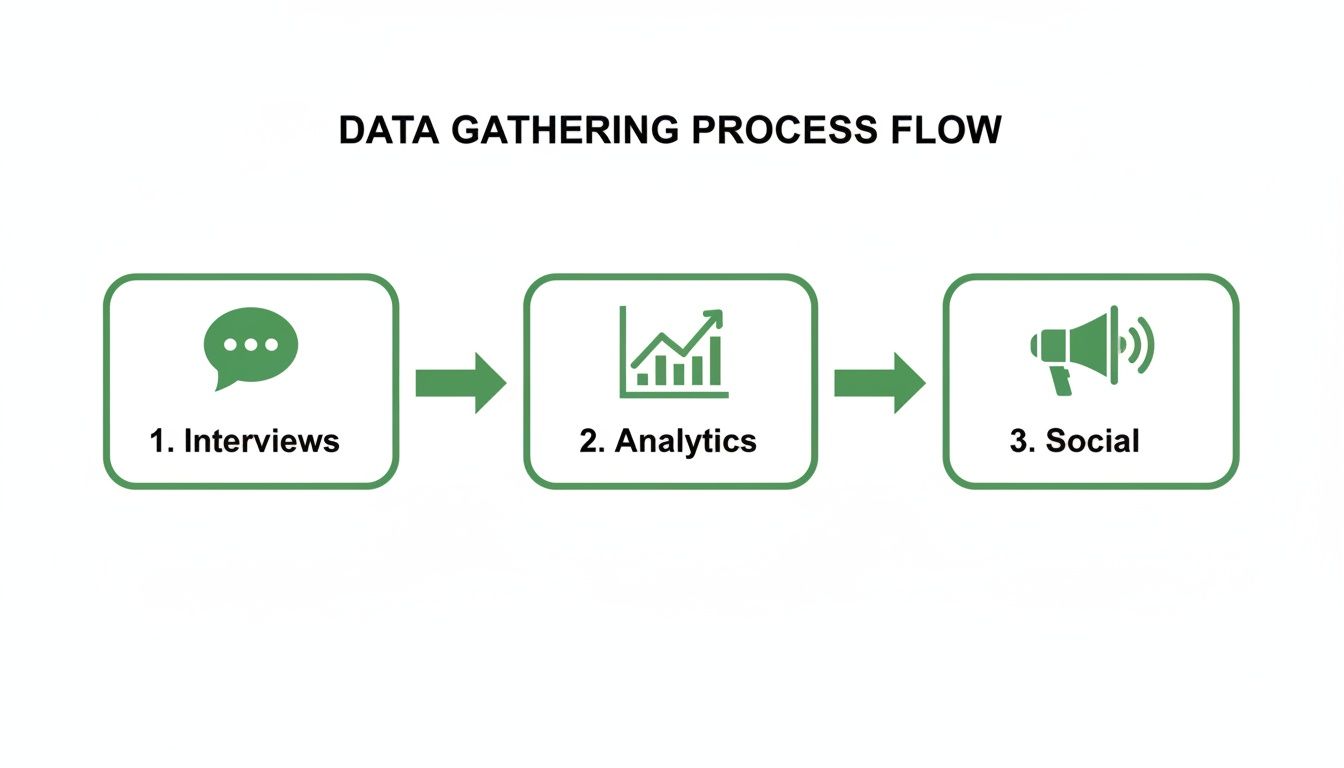
The key takeaway is that a robust persona isn't built from a single source. It's a synthesis of qualitative, quantitative, and observational data.
Putting Your Personas to Work in the Real World
A perfectly crafted user persona template is just a starting point. Its real power is only unleashed when it directly informs tangible decisions, bridging the gap between user research and product development. When applied correctly, a persona stops being a static document and becomes a dynamic guide for every choice you make.
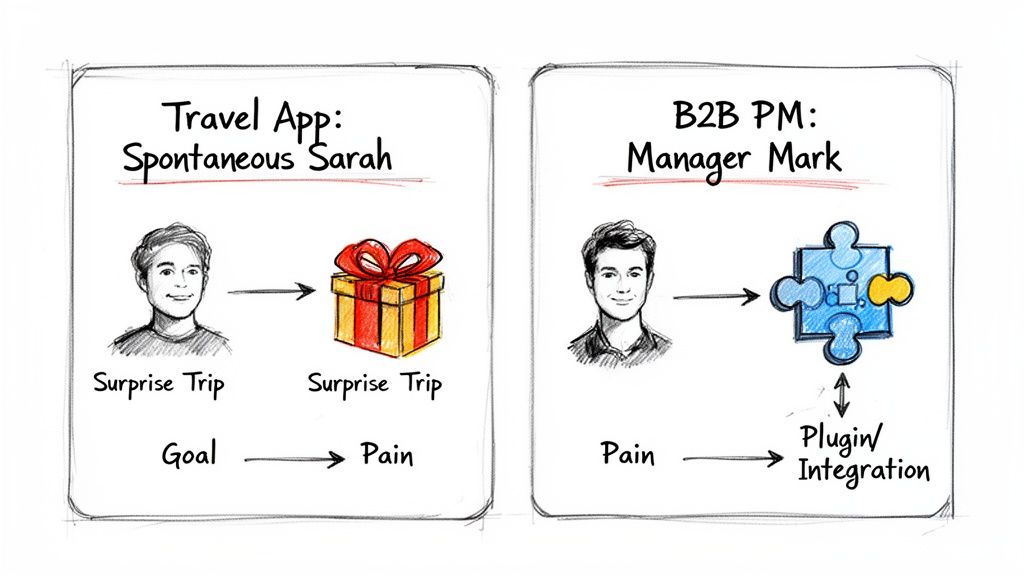
Let's move from theory to practice and see how this works with two real-world examples. We'll explore a B2C persona for a travel app and a B2B persona for a project management tool, showing exactly how their specific goals and frustrations lead to concrete product features.
B2C Example: From Insight to Feature
Imagine a travel app team has developed a persona named "Spontaneous Sofia." She's a 26-year-old graphic designer who loves weekend trips but is often too busy to plan them.
Her core details paint a clear picture:
Goal: To travel more without the stress of extensive planning.
Frustration: "I get decision fatigue looking at flights and hotels. By the time I find something, the weekend is already here."
Motivation: She values experiences and spontaneity over meticulously planned itineraries.
This isn't just flavour text; it's a direct mandate for the product team. Sofia's frustration with "decision fatigue" is the critical insight. The team can now ask, "How can we eliminate the friction of planning for someone like Sofia?"
The answer isn't another search filter. Instead, her desire for spontaneity inspires a brand-new feature: a "Surprise Trip" button. With one tap, the app could suggest a complete weekend getaway package—flights and a well-reviewed hotel included—based on her budget and past travel preferences. This feature directly solves her primary pain point and aligns perfectly with her core motivation.
B2B Example: Solving a Workflow Problem
Now, let's consider a B2B scenario for a project management tool. The team has created a persona called "Manager Mark," a 42-year-old engineering lead at a growing tech company.
Mark’s persona highlights key professional challenges:
Goal: To keep his cross-functional team aligned and reduce time spent in status update meetings.
Frustration: "My engineers live in our project tool, but the marketing team uses a separate platform. I waste hours every week just copying updates between systems."
Motivation: He is driven by efficiency and wants to empower his team by removing communication bottlenecks.
Mark’s frustration with "communication silos" is the central problem. He doesn't need more notification options; he needs seamless interoperability. This insight leads the product team to prioritise a new integration with the marketing platform his company uses.
By building this connection, the tool directly addresses Mark’s biggest frustration. Updates can flow automatically between systems, eliminating manual work and keeping everyone in sync. This decision isn't based on a competitor's feature set or an internal whim; it’s a direct response to a validated user need.
Practical Recommendation: When brainstorming features, start every meeting by reviewing the primary persona. Ask the question: "How does this feature help [Persona's Name] achieve their goal or overcome their frustration?" This simple habit keeps your development process user-centric.
Closing the Loop from Insight to Action
Seeing how personas influence features is powerful, but managing this connection at scale requires a structured process. This is where modern platforms make a significant difference. A tool like Uxia allows you to link your personas directly to specific user stories, feature tickets, and even design prototypes.
When a developer works on a new feature, they can see the persona it’s designed for right alongside the technical specifications. This constant visibility ensures that user-centric thinking is embedded throughout the entire development lifecycle, not just during the initial research phase.
The impact of this integrated approach is well-documented. Statistical analysis from the El País Digital Economy Report reveals that 73% of ES-based SaaS companies in the fintech sector employ user persona templates, leading to a 51% reduction in customer acquisition costs. You can discover more findings about persona adoption in SaaS and see the clear financial benefits.
This process ensures that the voice of the user is never lost. By connecting insights to actions, your personas become the backbone of a truly customer-focused product strategy. This is also where testing becomes crucial. Our guide on user interface design testing provides practical steps for validating that these new features actually meet the needs of personas like Sofia and Mark.
How to Validate and Evolve Your User Personas
Putting the finishing touches on your user persona template is a great first step, but the real work starts now. A persona's value is only as good as its connection to reality, and that connection fades over time. Markets change, products evolve, and user behaviours shift.
This means validation isn't a one-and-done task—it’s an ongoing process.
Think of your brand-new persona as a hypothesis. You've guessed that "Manager Mark" is frustrated by communication silos. Now you need to go out and test that theory. This validation loop is what keeps your personas sharp, relevant, and genuinely useful for making smart decisions.
Without it, even the most carefully researched personas quickly become outdated relics, leading your team down the wrong path with faulty assumptions.
Comparing Personas to Real User Actions
The most direct way to check your work is to watch real people. Usability testing is the perfect arena to see if a persona’s expected behaviour lines up with what actual users do when they interact with your product.
Let's say your persona "Spontaneous Sofia" is all about quick, seamless bookings. Put users who fit her profile in front of your checkout process and just watch. Do they fly through it like you predicted? Or do they get stuck, hesitate, and show clear signs of frustration?
Here’s a simple way to frame this comparison:
Recruit the Right Testers: Find people for your usability tests who mirror your persona's key demographic and psychographic traits.
Watch for Clues: During the test, pay close attention to moments where a user's actions either confirm or contradict the persona's goals and pain points.
Listen to What They Say: The feedback is gold. If several participants who match Sofia's profile complain about "unexpected fees," that's a huge signal that you need to update her frustrations.
This approach grounds your abstract persona in real, observable evidence. Uxia can accelerate this process by allowing you to test with AI-powered synthetic users that perfectly match your persona profiles, giving you rapid feedback without the logistical overhead of recruiting human testers. For a deeper look, check out our guide on the importance of user testing.
Establishing a Rhythm for Persona Reviews
Personas should be living documents, not dusty files buried in a forgotten folder. To keep them fresh, you have to build a regular review cadence. Stale personas are dangerous—they lead to misguided product decisions.
Practical Recommendation: Don't let your personas become "shelf-ware." Schedule recurring reviews—quarterly or after every major product launch—to assess their accuracy. Treat this as a non-negotiable part of your product cycle and add it as a recurring event in your team's calendar.
This doesn't have to be some monumental effort. A quarterly check-in can be as straightforward as looking through recent user feedback, analytics, and support tickets. Are new patterns emerging? Has a common frustration popped up? Have user goals shifted since you last checked?
A great way to make this stick is to integrate these reviews into your existing agile workflows. For example, you could set aside part of a sprint retrospective every quarter for a quick persona "health check." It’s a simple trick that keeps the user front-and-centre for your whole team.
Using a platform like Uxia makes this process much easier. When all your research and personas are in one central place, you can easily track changes over time and link new insights directly to existing profiles. This turns your user persona template from a static document into a dynamic asset that evolves right alongside your product and your audience.
Common Persona Pitfalls and How to Sidestep Them
Building a user persona template is a huge step forward. But even the best templates can end up gathering digital dust if you fall into a few common traps. Knowing what they are ahead of time is your best defence.
The "Persona Zoo"
One of the most common mistakes I see is creating a "persona zoo"—a collection of five, ten, or even more personas. It feels like you're being thorough, but it usually leads to decision paralysis. When you try to design for everyone, you end up designing for no one.
The fix? Instead of building a crowd, focus on a single primary persona. This is the one person whose problems you are absolutely committed to solving. Every major product decision should be filtered through their eyes first. It keeps your direction sharp and consistent.
Building Personas on Stereotypes Instead of Data
Another classic blunder is building personas from assumptions. A persona named "Tech-Savvy Timmy" based on a vague idea of a millennial isn't a persona; it's a caricature. This isn't just lazy—it's actively harmful, pushing your product in a direction based on pure fiction.
Every single detail in your persona, from their goals to their frustrations, must trace back to real research data. We're talking interviews, analytics, surveys—hard evidence.
Practical Recommendation: For every key trait in your persona (like a goal or frustration), add a "source" note that links back to the specific data point—an interview transcript, a survey result, or an analytics report. This forces accountability and ensures your persona is built on a foundation of truth. You can manage this traceability easily within a platform like Uxia.
This commitment to data-driven profiles makes a real difference. In fact, data showed that 82% of Spanish e-commerce platforms using user persona templates by mid-2023 saw a related 38% increase in sales from personalised recommendations. You can discover more insights about persona adoption and its impact on sales to see just how powerful this is.
Letting Your Personas Go Stale
The saddest pitfall is treating personas as a one-and-done project. You create them, share them in a big meeting, and then... they're forgotten. But your users, your product, and the market are always changing. A persona from last year might already be out of date.
To keep them useful, schedule regular check-ins to review and update them. A platform like Uxia is perfect for this, acting as a central hub where your personas can be living documents, easily tweaked with new research. You might also want to explore how traditional personas stack up against newer, AI-driven methods; our guide on synthetic vs human testing dives into that evolution. Keeping your personas current ensures they remain a reliable guide for your team, not a relic.
Common Questions About User Persona Templates
Got a few questions still rattling around? It's completely normal. Let's tackle some of the most common hurdles people face when building and using persona templates.
How Many Personas Should I Create?
It’s so tempting to create a persona for every single user segment you can think of. But that path almost always leads to a "persona zoo"—a collection so large and unwieldy that it dilutes everyone's focus.
For most projects, the best approach is to start with one primary persona. Nail that one first. This persona should represent the most critical user your product is designed for. Once that core persona feels solid, you can add one or two secondary personas to capture other vital user groups. The key is to prioritise, not overcomplicate.
How Often Should I Update My Personas?
A persona is not a static document you create once and frame on the wall. Think of it as a living asset. You should plan to revisit and refresh your personas at least once a year. It's also a good idea to update them after any big event, like a major product launch or a noticeable shift in market trends.
Regularly feeding your template fresh insights from analytics and user feedback is what keeps it relevant and accurate. This is where a platform like Uxia can make a real difference. It helps centralise your research and personas, allowing for continuous, small updates rather than sporadic, massive overhauls.
Practical Recommendation: Don't treat persona updates as a chore. Integrate them into your existing processes. For example, after every usability study or user feedback sprint, dedicate 30 minutes to review the findings and see if anything challenges or reinforces your current persona's profile.
What’s the Difference Between a User Persona and a Buyer Persona?
This distinction is simple but incredibly important. A user persona focuses squarely on the individual who will actually use the product day-to-day. It’s all about their goals, frustrations, and workflow within your product's context.
A buyer persona, on the other hand, centres on the person making the purchasing decision. This persona includes completely different factors, like budget constraints, the company's buying process, and their influence within the organisation. While they can sometimes be the same person, especially in B2C, they're often different people in B2B scenarios with very different motivations.
Ready to build personas that are dynamic, data-driven, and seamlessly integrated into your workflow? Uxia replaces slow, costly research with AI-powered synthetic testers, giving you the deep user insights you need in minutes, not weeks. Start creating more effective, user-centred products today by visiting https://www.uxia.app.