Comparing Synthetic and Human Testers
Discover how Uxia’s Synthetic Testers perform against Human Testers when both complete the same test under the same conditions. Provide your email to unlock the full report.



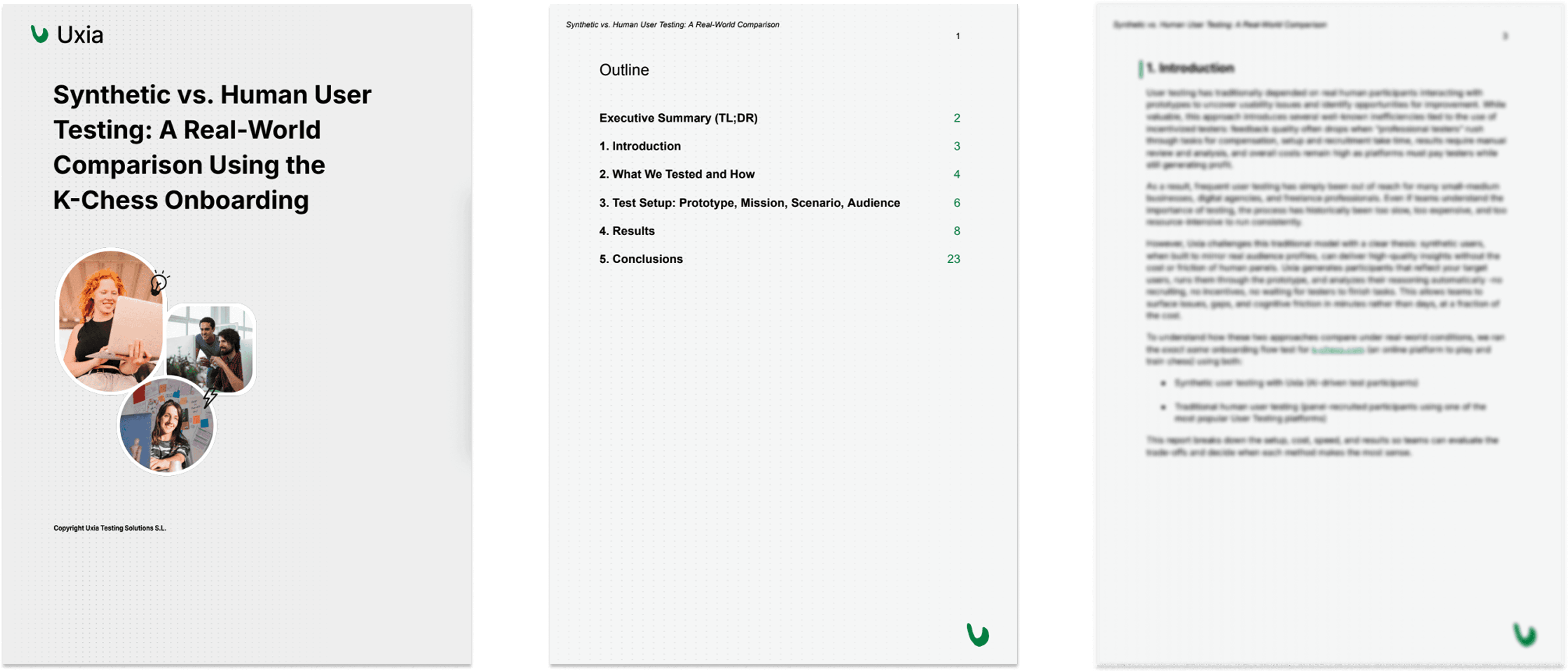
About the Report
Synthetic user testing can now match -and often outperform- traditional human panels. In this real-world comparison, we ran the exact same onboarding test for an online chess platform using 10 human participants and 10 Uxia synthetic testers, then evaluated speed, reliability, insight depth, and cost side-by-side.
Main Findings
Uxia delivers usability insights at the pace modern teams iterate.
The full testing cycle (setup, execution, and analysis) took 21 minutes with synthetic testers vs. 362 minutes with humans a 17× speed advantage. Even more important, synthetic participants were consistently reliable: 0% invalid tests vs. 40% invalid human tests, largely due to panel issues and not read instructions.
Richer insights with less effort.
Both methods caught the obvious friction points, but Uxia uncovered 3× more actionable insights. Synthetic testers flagged issues humans missed -like branding inconsistencies, mismatched copies, unclear progress indicators, and missing guidance on key elements. Human testers added some valuable emotional impressions (e.g., “modern UI,” “simple and intuitive”), but overall produced less detailed feedback.
Massive cost savings at scale.
Uxia provides unlimited tests for less than what a single human test costs. As testing frequency increases, savings compound quickly becoming a solution up to 22× more affordable for teams running continuous research.