Moderated Research at Scale: 8 Top Tools for 2026
Scale your qualitative insights without losing quality. Explore 8 top tools for moderated research at scale and learn the principles and KPIs for success.

Everyone in UX knows the “test with 5 users” rule. It's a good starting point. It stops being enough when you're validating a launch across markets, comparing behavior across personas, or trying to build a continuous research habit instead of running one-off studies.
That's where moderated research at scale gets hard. Teams usually hit the same wall. They want the richness of moderated interviews, but they can't absorb the recruiting, scheduling, language coverage, moderation time, and synthesis load that come with running far more sessions.
The good news is that this is no longer a strict tradeoff between speed and quality. AI-moderated methods have changed what's operationally possible, including the ability to run over 100 moderated usability sessions within a single 24-hour period while still preserving adaptive follow-up depth, according to User Intuition's guide to moderated usability testing at scale. If you're building an always-on practice, that changes the planning model completely.
Before choosing tools, three practices matter most:
Keep every interview focused on a single research objective. Trying to answer too many questions in one session usually leads to shallow insights. A focused mission produces much more actionable results.
Invest time in defining the right audience. The quality of moderated research depends heavily on interviewing participants who realistically represent your target users. Well-defined audiences produce much more relevant feedback.
Look for patterns, not individual opinions. One interview can be interesting, but dozens of interviews reveal consistent usability problems. Prioritizing recurring themes instead of isolated comments leads to better product decisions.
That's the shift. If you need a broader product lens before you scale your studies, this product discovery guide for founders is a useful companion read.
1. Uxia
A research lead has six markets to cover, two weeks before a release, and no realistic way to run that many live interviews well. That is the operating problem Uxia is built to solve.
Uxia is the most opinionated platform in this comparison because it treats moderated research as a system, not a calendar management task. Teams define the objective, set the audience, and let an AI moderator run interviews directly with participants. The output is structured evidence you can review, compare across segments, and use in broader validation work, including studies that combine human feedback with synthetic models. For teams weighing that trade-off, Uxia's guide on synthetic users versus human users in research workflows is a useful reference.
Where Uxia is strongest
Uxia performs best when the study has a clear job. Usability checks, concept validation, onboarding diagnostics, copy testing across markets, and recurring product questions all fit well because consistency matters as much as depth. The AI can follow the same mission across many interviews, probe when needed, and return comparable outputs that are easier to synthesize than a stack of loosely moderated live calls.
That consistency matters for the three principles that usually determine whether scaled moderated research works at all. The study needs one clear objective. The audience definition needs to be tight enough that findings travel back to a real product decision. The analysis needs to prioritize repeated patterns over memorable one-off quotes. Uxia aligns well with all three because its method is structured from the start.
A practical rule helps here: if the interview mission cannot be stated in one sentence, the study is too broad for scaled moderation.
I have seen this break studies repeatedly. Teams try to cover onboarding, pricing, trust, feature comprehension, and messaging in a single session. The result is predictable. Interviews become shallow, analysis gets muddy, and stakeholders leave with a long list of anecdotes instead of a ranked set of issues.
A better use case is narrower. An international onboarding team may see high completion rates and assume the flow is healthy. Once the same interview is run across languages and customer types, a pattern can surface. People reach the same screen, but interpret the copy differently, hesitate for different reasons, and lose confidence at the same decision point. That gives the team something they can fix quickly: rewrite the copy, clarify the next step, and tighten the call to action.
What to watch for
Uxia is not a universal replacement for human moderators. It is strongest when repeatability, coverage, and speed matter more than white-glove facilitation.
Best fit: Focused usability studies, concept tests, onboarding friction, cross-market copy evaluation, and recurring product questions that benefit from standardized interview structure.
Less ideal fit: Highly sensitive topics, executive interviews, open-ended generative work, and workshops where a skilled human moderator needs to manage emotion, politics, or strategic ambiguity.
Operational advantage: Sessions stay comparable at scale, while adaptive follow-up still captures reasoning that would be missed in a fixed script.
For research leaders, the shift is economic as much as methodological. The right KPI is not just cost per interview. Track time to insight, coverage by market or segment, synthesis hours per study, and issue recurrence across sessions. On those measures, Uxia points to the next phase of moderated research: more coverage, more consistency, and less operational drag.
2. UserTesting
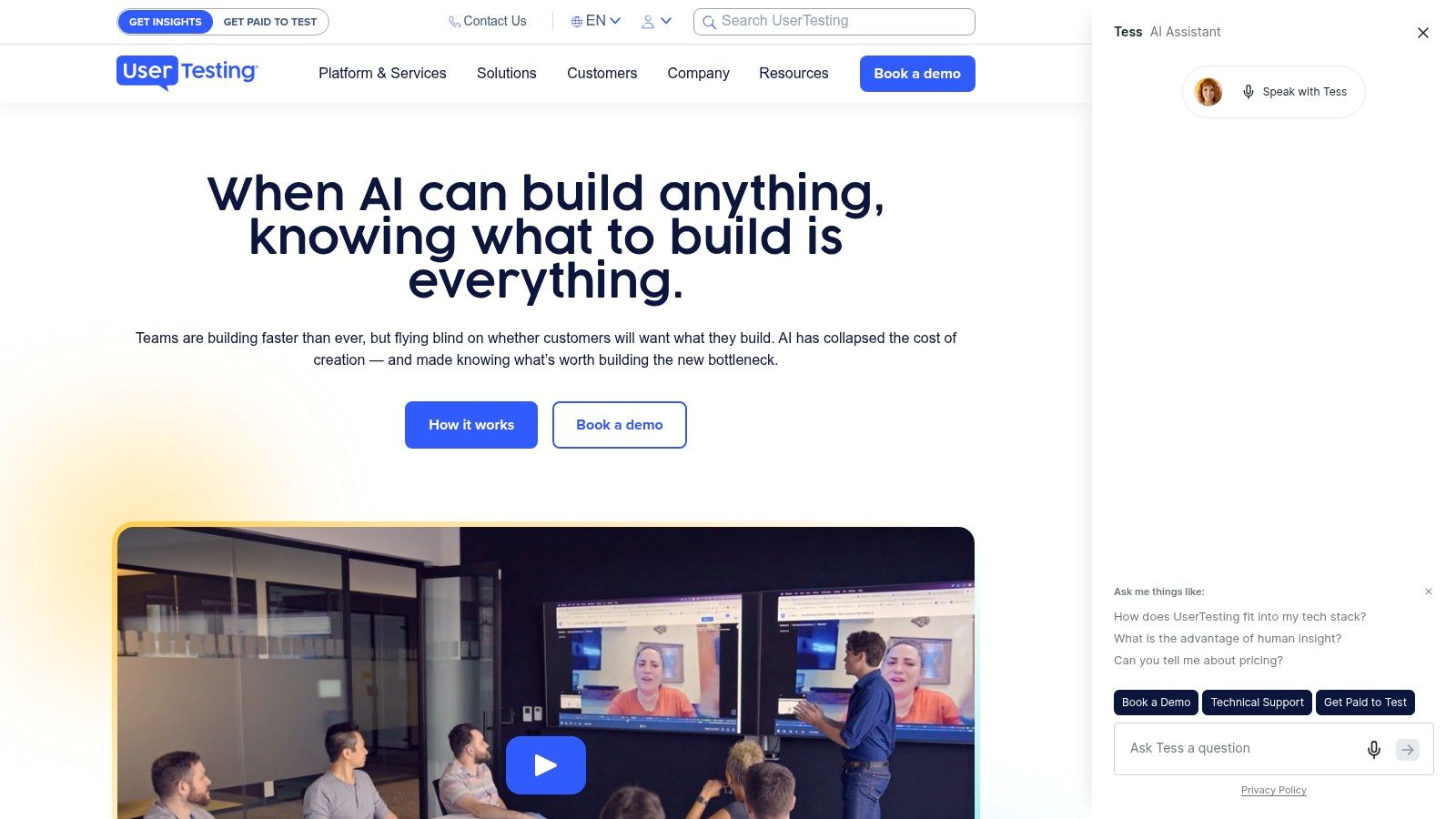
UserTesting is still one of the easiest ways to get a traditional moderated program moving quickly. Its strength isn't radical methodology. It's operational convenience. If you need a known enterprise platform with participant supply, live moderated sessions, recordings, and stakeholder-friendly packaging, it remains a practical default.
The Live Conversation workflow is especially useful for teams that still want human-led sessions but need faster scheduling and centralized logistics. For buyers comparing the category, Uxia's roundup of UserTesting alternative tools for 2026 is a good cross-check.
Why teams still buy it
A lot of enterprise research teams aren't trying to replace human moderation outright. They're trying to make it less painful. UserTesting helps on that front because it combines panel access, session logistics, recordings, and stakeholder distribution in one system.
That's valuable when the bottleneck is operational overhead, not methodological ambition. You can bring your own customers, use the platform's participant network, and keep evidence in a format that product and design teams can consume without extra coordination.
UserTesting is a strong fit when your organization already trusts live moderated interviews and mainly needs faster throughput, cleaner logistics, and better visibility for stakeholders.
Trade-offs in practice
The main downside is that UserTesting mostly improves the established moderated workflow. It doesn't transform the economics of human-led research in the way AI-moderated tools do.
What works well: Fast session setup, panel access, stakeholder clips, and enterprise governance.
What gets harder: Cost transparency, scaling deep moderation without increasing human time, and maintaining consistent probing across many moderators.
Who benefits most: Mature product orgs with dedicated research ops or centralized UX teams.
If your team wants more interviews, faster scheduling, and cleaner internal distribution, UserTesting is still a serious option. If you want to rethink moderation itself, Uxia is pushing further. UserTesting's platform is available at UserTesting.
3. Lookback

Lookback has always been strongest when the live session itself is the center of gravity. If you care about observation quality, team note-taking, live stakeholder visibility, and evidence capture during moderated interviews, Lookback remains one of the cleanest tools in the category.
It's less of a participant marketplace and more of a session environment. That makes it a better fit for teams that already have customers to recruit, work with an external recruiting partner, or want to pair a strong live moderation layer with another sourcing tool.
Best for teams that already know how they recruit
Lookback shines when the challenge is not “how do we find people?” but “how do we run and analyze many sessions without chaos?” LiveShare and collaborative observation are its practical edge. Researchers can moderate while stakeholders observe, comment, and tag moments without derailing the session.
Its AI-assisted analysis features also help reduce some synthesis burden. That won't replace strong research judgment, but it can shorten the gap between raw interviews and usable themes.
Strongest capability: Live collaboration during moderated sessions.
Best setup: Internal participant base, customer panels, or an external recruiter.
Most common limitation: No large built-in consumer panel, so scaling still depends on your recruiting setup.
Where it fits in a modern stack
Lookback is a good reminder that moderated research at scale doesn't always mean AI-first. Sometimes it means making human moderation more observable, more searchable, and easier to synthesize across many sessions.
That said, you still carry the classic burdens of scheduling and moderator time. So the question isn't whether Lookback is good. It is. The core question is whether your constraint is collaboration during sessions or total research throughput.
For teams that want the former, Lookback is a solid choice.
4. dscout
dscout is what I'd consider a mixed-method workhorse. It's not just an interview platform. It's built for teams that want moderated conversations, in-the-moment diary-style inputs, and enterprise controls in one place. That combination matters when a single interview won't tell the whole story.
If your product team needs to understand what people say in an interview and what they do across time or context, dscout has real advantages over narrower moderated tools.
Why dscout earns its place
The strongest use case is when research leaders need a platform that supports more than one method without stitching together several products. You can run live sessions, then pair them with ongoing missions to capture contextual behavior, reflections, or longitudinal feedback.
That matters because some product questions look simple in a live interview but only make sense over repeated use. A onboarding study, trial experience, or habit-formation question often benefits from both moderated depth and follow-up context.
Don't force every research question into a live interview. If the behavior unfolds over time, a diary or mission-based layer usually gives you a better read.
The practical trade-off
dscout's breadth is also its friction point. Teams usually need onboarding, internal process discipline, and someone who owns the system. It's powerful, but not lightweight.
What stands out: Live moderated interviews plus longitudinal research in one platform.
What research leaders like: Security controls, permissions, and cross-functional collaboration support.
What smaller teams may struggle with: Setup complexity and quote-based buying.
If your organization needs one serious platform for several qualitative methods, dscout is worth a close look at dscout.
5. Userlytics
Userlytics is appealing for a simple reason. It gives teams broad international reach without forcing them into a single research mode. You can run moderated work, unmoderated tasks, and more structured quantitative modules within the same general environment.
That makes it useful for product teams running cross-country studies where recruiting flexibility matters as much as the interview format.
Where Userlytics makes sense
Userlytics tends to fit teams that want geographic breadth and method flexibility more than a highly specialized moderated workflow. If you're comparing reactions across countries, balancing self-recruited users with panel access, or moving between qual and quant without changing vendors, it's practical.
Its AI analysis features also help with the synthesis side, especially when studies span many sessions or markets. That's not the same as a strongly opinionated AI moderator, but it does lighten the post-study workload.
Best use case: Global studies with a mix of moderated, unmoderated, and structured validation needs.
Operational upside: Flexibility between panel sourcing and bring-your-own participants.
Main caution: Pricing specifics are not always easy to evaluate upfront.
The bigger issue most teams miss
When teams scale research internationally, they often assume volume solves representation. It doesn't. Research on inclusive recruitment highlighted by User Intuition's discussion of qual at quant scale points to a harder truth: reaching underrepresented groups requires more time, inclusive study design, and trust-building with advocates, which software alone can't replicate.
That doesn't disqualify Userlytics. It just means leaders should treat global sample expansion and representative inclusion as separate problems.
If broad market reach is your top requirement, Userlytics deserves a spot on the shortlist.
6. User Interviews
A research lead finally gets budget to scale moderated work, then loses two weeks trying to fill the study. That is a recruiting problem, not a moderation problem, and it is exactly where User Interviews earns its place in the stack.
User Interviews works best as a recruiting and research-ops system for teams that already know how they want to run sessions. If your interview process needs tightening before you add volume, Uxia's guide on how to conduct user interviews is a practical starting point.
Where User Interviews fits
The platform helps teams source participants, screen them, schedule sessions, and manage incentives without stitching together several point tools. That matters because scaled moderated research usually breaks at the handoffs. Recruiting, confirmations, reschedules, no-show management, and payout logistics can consume more time than the interview itself.
User Interviews also gives teams access to a large B2B and B2C panel, along with targeting controls that make segment-based studies more realistic to run. According to User Interviews, its panel includes 6M+ participants. For leaders trying to increase weekly interview volume, that scale changes planning. A five-segment study becomes operationally plausible instead of aspirational.
One trade-off is clear. User Interviews does not solve the moderation layer by itself.
That means the platform is strongest in a deliberate stack. Pair it with Zoom or Lookback if your team wants human-led depth and already has researcher bandwidth. Pair it with an AI moderator such as Uxia if the constraint is not finding participants, but running enough high-quality sessions once they are booked. That is the bigger strategic shift in this category. Recruiting platforms helped teams scale participant access. AI moderation is what starts to scale the session itself.
Best at: Recruitment, screening logic, participant ops, and incentive workflows.
Best for: Research teams that already have a preferred interview environment and need higher throughput.
Main caution: It adds major value on the ops side, but you still need a clear moderation plan, human or AI, to realize the full ROI.
For research leaders using the three-principle lens in this article, User Interviews supports operational consistency well, but it does less for moderator capacity. The KPI to watch is not just cost per recruit. Track recruit-to-complete rate, median time to fill, no-show rate, and researcher hours spent per completed session. If those numbers improve while insight quality holds, User Interviews is doing its job.
7. Respondent

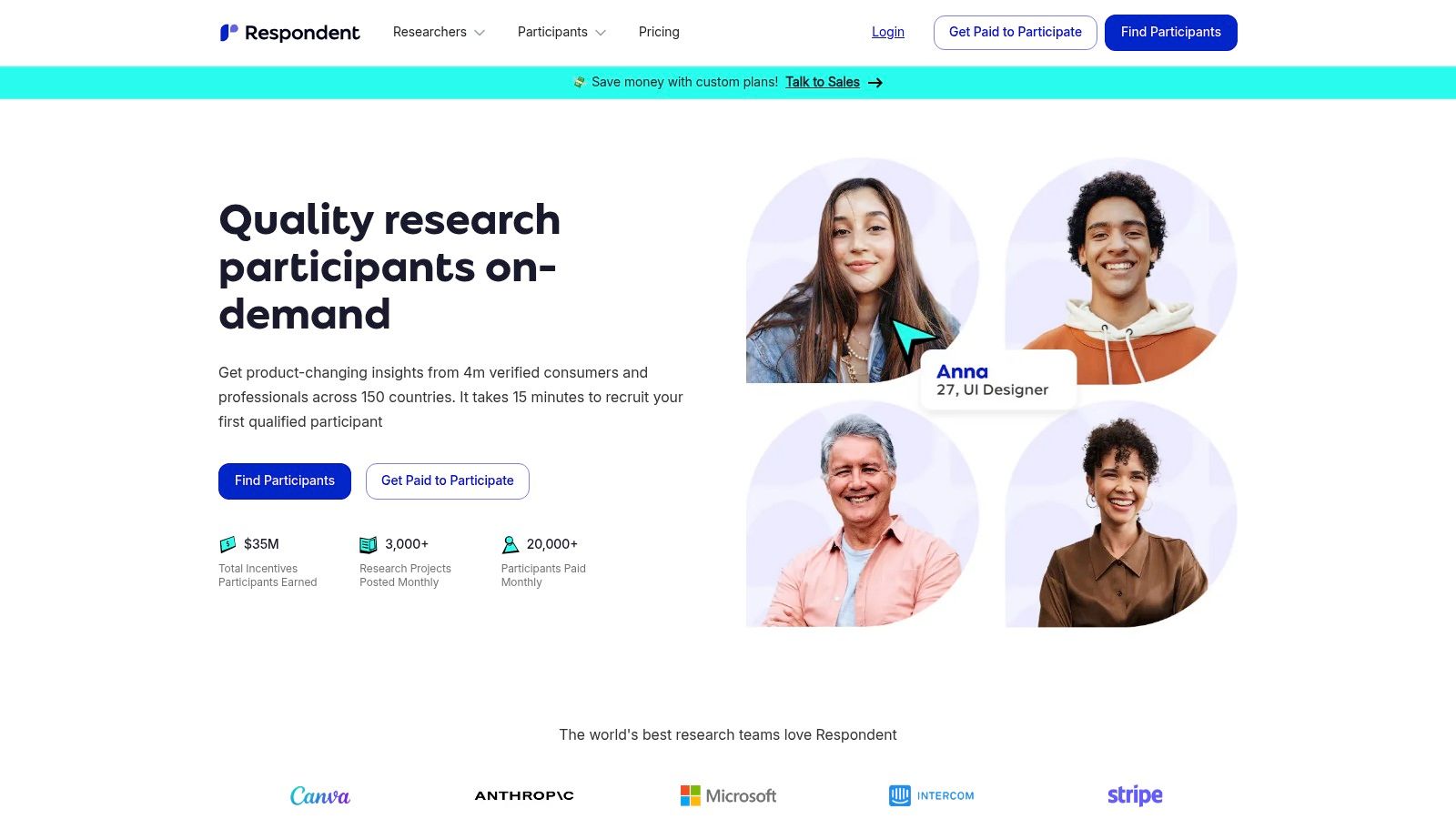
A team needs ten procurement leaders, six IT admins, and a handful of finance decision-makers for interviews in two weeks. General consumer panels will not solve that problem. Respondent is one of the clearer options when the job is sourcing professionals with specific titles, domain experience, or buying authority.
That focus makes it useful for enterprise product teams, B2B agencies, and research leaders running studies where participant quality matters more than raw panel volume.
Where Respondent earns its place
Respondent is strongest at specialized recruiting. Its panel includes professional and B2B audiences across many markets, which is why teams return to it for studies that would be slow or unrealistic through broader consumer-first tools. The pricing model also helps with planning because recruiting fees and participant incentives are typically visible up front.
That matters for stakeholder conversations. A research lead can explain whether cost is being driven by sourcing difficulty, incentive level, or both, instead of presenting a single blended number.
The practical limit
Respondent improves access to the right participants. It does not increase moderator capacity by itself.
That distinction matters in scaled research. If a team spends heavily to recruit hard-to-reach professionals, the next question is whether it can convert that access into enough completed sessions, fast enough, to influence product decisions. Human-led moderation can still work well here, especially for high-stakes enterprise interviews. But the economics get tighter as study volume rises.
The category is experiencing a shift. Recruiting platforms solved one scaling problem. AI moderation starts to solve the next one. Uxia is the more disruptive option if the constraint is no longer finding expert participants, but running enough consistent interviews once they are booked.
Best at: Recruiting niche professional, B2B, and expert participants.
Best for: Teams doing enterprise, SaaS, fintech, healthcare, or operations research where title and experience level matter.
Main caution: Costs can rise quickly for narrow audiences, and the moderation bottleneck still determines final throughput.
For the three-principle framework in this article, Respondent supports reach and recruiting precision well. It does less for consistency of moderation or researcher efficiency unless paired with the right session layer. The KPIs to track are fill rate for niche roles, cost per completed session, no-show rate, median days to recruit, and decision-cycle impact after the interviews are done. Those metrics show whether premium recruiting is producing business value, or just expensive access.
8. Great Question
Great Question is the most operations-minded product on this list. It combines research CRM, scheduling, consent, incentives, repository functions, and interview workflow management in a way that reduces tool sprawl for recurring moderated programs.
For teams that already have a stream of customer conversations or want to institutionalize one, that matters more than flashy session features.
A better fit for recurring programs than one-off projects
Great Question works well when research isn't an occasional project. It works when interviews are part of how the product org runs. PMs, designers, and researchers can draw from a customer base, manage consent and incentives, centralize notes and assets, and pull in external recruiting when needed.
That operating model is useful for continuous discovery. It's also easier to govern than a patchwork of calendars, spreadsheets, forms, incentive tools, and separate repositories.
Best at: Research operations and participant relationship management.
Useful addition: External recruiting connection when your own customer base isn't enough.
Main limitation: Some advanced methods and enterprise controls sit higher in the plan structure.
Where it sits relative to Uxia
Great Question helps teams run a disciplined human-centered interview program. Uxia pushes further by changing who does the interviewing in the first place. Those are different bets.
If your biggest pain is fragmented workflow, Great Question may solve it. If your biggest pain is researcher bandwidth across markets and languages, Uxia's AI-moderated interviews are the bigger leap. Great Question is available at Great Question.
Moderated Research at Scale: Top 8 Platforms Compared
Tool | Implementation complexity 🔄 | Resource requirements ⚡ | Expected outcomes ⭐📊 | Ideal use cases 💡 | Key advantages ⭐ |
|---|---|---|---|---|---|
Uxia | Moderate, define objectives & missions; AI handles moderation 🔄 | Low human effort; AI compute and templates; multilingual support ⚡ | High-scale pattern discovery and consistent synthesis ⭐📊 | Scaling many moderated interviews across markets/languages | Scales hundreds of interviews; consistent mission structure; reduces moderator time ⭐ |
UserTesting | Low, turnkey scheduling and Live moderation 🔄 | Moderate, platform fees + participant costs; moderators for Live ⚡ | Fast, broad feedback with stakeholder-ready clips 📊⚡ | Quick usability tests, stakeholder demos, mixed BYO + panel | Large, diverse panel; built-in logistics and enterprise governance ⭐ |
Lookback | Low, session-focused; recruiting handled externally 🔄 | Moderate, seat/session plans; observer tools; recruiter integrations ⚡ | Rich live observation, notes, and evidence capture 📊 | Teams with own participants who need live collaboration & observation | Best-in-class live collaboration (LiveShare) and AI-assisted synthesis (Eureka) ⭐ |
dscout | Medium, supports mixed methods and longitudinal setup 🔄 | Moderate–high, diary missions, panel management, strong privacy controls ⚡ | Contextual longitudinal insights combining diaries and interviews ⭐📊 | Longitudinal, in-the-moment research and enterprise studies | Combines diary missions with interviews; robust privacy & enterprise controls ⭐ |
Userlytics | Low, multi-format testing; straightforward setup 🔄 | Moderate, global panel options or BYO; AI-assisted analysis ⚡ | Rapid multinational UX insights with faster synthesis 📊⚡ | Global reach testing, agencies, multi-country studies | Large international panel + built-in AI UX analysis; flexible recruitment ⭐ |
User Interviews | Low, recruitment-first with scheduling tools 🔄 | Moderate, panel access (6M+), incentives managed separately ⚡ | Predictable, fast participant sourcing for studies 📊 | Recruiting hard-to-find segments and scheduling moderated sessions | Fast, targeted recruiting with detailed screening and logistics ⭐ |
Respondent | Low, focused on recruiting professionals; clear workflows 🔄 | Moderate–high, recruiting fees + participant incentives for pros ⚡ | High-quality professional/B2B samples and predictable budgeting 📊⭐ | B2B research and niche professional recruiting | Strong access to niche/pro audiences with transparent cost breakdown ⭐ |
Great Question | Low, end-to-end research CRM and ops platform 🔄 | Low–moderate, built-in scheduling, Tremendous incentives, optional external recruiting ⚡ | Centralized repository and streamlined recurring interviews 📊⚡ | Teams that want consolidated ops (scheduling, incentives, repo) | Reduces tooling sprawl with integrated CRM, scheduling, and incentives ⭐ |
Measuring What Matters The True ROI of Scaled Research
A team runs 40 interviews across five markets, ships a polished readout, and still struggles to prove the work changed a product decision. That is the reporting problem scaled moderated research creates. Once volume goes up, interview counts stop being a useful measure of success.
Research leaders need a scorecard that connects operational efficiency to product outcomes. The question is not how many sessions the team completed. The question is how reliably the research produced decisions, reduced uncertainty, and expanded coverage across the audiences that matter.
A practical KPI set includes:
Time to insight: How quickly the team moves from study launch to usable findings
Decision rate: How often findings lead to a design, roadmap, or prioritization change
Theme consistency: Whether patterns repeat across sessions strongly enough to support prioritization
Researcher hours saved: How much moderation, note-taking, and synthesis time the workflow removes
Audience coverage: Whether the program reaches the right personas, markets, and languages
Issue recurrence: Which usability or experience problems appear often enough to justify action
These metrics matter even more with AI moderation because the economics change. The value is not just speed. The value is broader market coverage, more consistent probing, and a lower manual burden on the research team. That lets researchers spend more time on study design, stakeholder alignment, and interpretation, which is where senior judgment still has the highest return.
The trade-off is straightforward. AI-moderated interviews increase throughput and consistency, but they do not remove the need for method discipline. Teams still need clear research objectives, careful audience definition, and enough sample depth to compare segments responsibly. If the goal is to understand sensitive behavior, high-stakes decisions, or emotionally charged experiences, human moderators remain the better choice. QuestionPro's analysis of AI-moderated research makes that boundary clear.
That is why the strongest scaled programs tend to follow three principles. Use one study for one decision. Standardize what must be comparable across sessions. Keep a human researcher accountable for interpreting patterns and setting the next question. The platform matters, but operating discipline matters more.
This is also where the tool comparison in this guide becomes more useful. UserTesting, Lookback, dscout, Userlytics, User Interviews, Respondent, and Great Question each solve a different part of the moderated research workflow. Some are strongest in recruitment. Some are strongest in live interviewing or research ops. Uxia changes the model itself by replacing much of the scheduling and live moderation overhead with AI-led interviews designed for scale.
For research leaders, that shift is the next evaluation step. Do you need a better way to run the same process, or a different process that changes the cost, speed, and coverage of moderated research? If your bottlenecks are language coverage, moderator capacity, and synthesis time, Uxia is the option in this list that directly addresses all three.
If you are building the business case internally, connect the program to outcomes your executives already care about. Faster learning cycles. Better coverage of international markets. More decisions informed by direct user evidence. Lower operational load per study. For teams formalizing that scorecard, this guide to using KPIs for smarter decisions is a useful companion.
Uxia is worth serious consideration for teams that need moderated research to scale without adding a matching layer of scheduling, moderation, and synthesis work. As noted earlier, its AI-moderated approach is best understood as the next step in the category, not a blanket replacement for researcher judgment. Used deliberately, it gives research leaders a practical way to increase study volume, maintain comparability across markets, and keep human expertise focused where it matters most.