AI is changing the way we design, research, and build products. But what does that actually mean for UX teams today?
That was the question at the center of “Designing the Future with AI: What Changes for UX, Research & Product Design?”, a roundtable Uxia hosted together with UX Hub, a community that brings UX professionals together through meetups, events, and workshops.
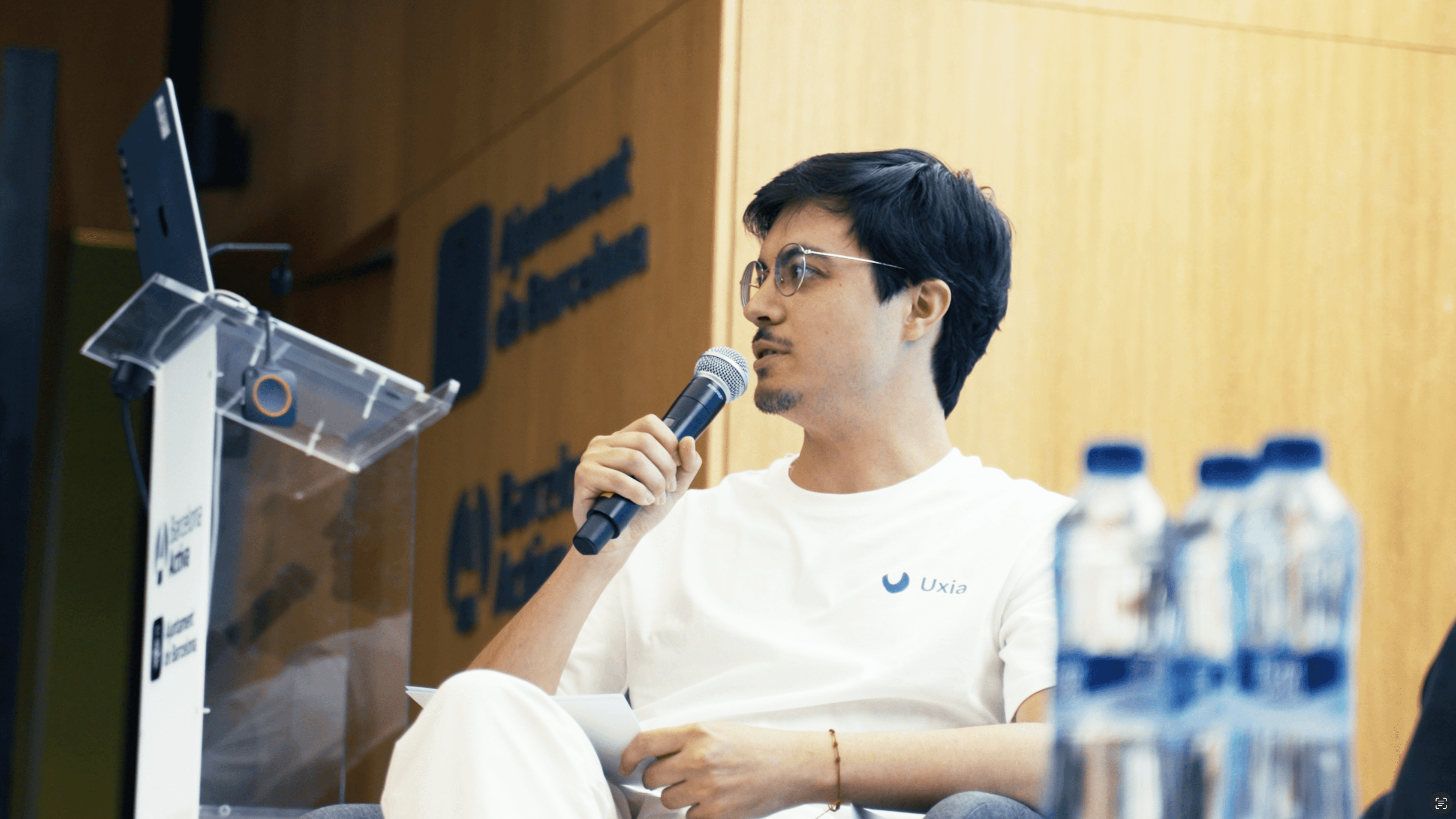
The Conversation
The panel brought together three perspectives from across the UX and product ecosystem:
Javier Darriba, founder of UserZoom (now UserTesting)
Eloy Rodríguez, Director of Design at Abacum
Iris Latour, Director of UX Researcher at THEFT Studio
The panel was moderated by Victor Perdiguer, co-founder of Uxia. They explored how AI is transforming UX from several angles: research, design operations, product strategy, collaboration, and decision-making.
Below you can find some of the takeaways:
1) AI is changing the speed of UX work
AI is making it easier for teams to move from questions to first answers faster.
Research plans, interview guides, survey drafts, usability test scenarios, competitive analysis, synthesis, and early design exploration can now be accelerated with AI tools such as Uxia. But the panel also emphasized an important point: speed is only useful when teams know what they are trying to learn.
AI can help teams move faster, but it does not replace the need for good research questions, clear product strategy, and strong judgment.
2) Research & Design teams are moving closer to product decisions
As AI reduces the time required for analysis and synthesis, research can become more continuous and more closely connected to product decisions.
Instead of waiting weeks to collect and organize insights, teams can start working with early signals much earlier in the process. That creates an opportunity for research and design to become less of a final validation step and more of a constant input into product direction.
3) Designers are becoming orchestrators and builders
One of the biggest themes of the evening was the changing role of designers.
In AI-native workflows, designers are not only creating screens, they are building products. They are defining problems, shaping prompts, curating prototypes, connecting user needs with business goals, and deciding what is worth building.
AI may generate more options, but designers still need to decide which direction is meaningful, usable, ethical, and strategically sound.
The future designer is not less important. The role becomes more strategic.
4) Product teams need new habits
AI introduces new opportunities, but also new responsibilities.
Teams need to learn how to:
Adapt to an always-changing ecosystem
Use AI to superpower their work
Use AI to support decisions, not replace them
Combine synthetic and human feedback
Keep user context visible in faster workflows
Build repeatable processes for research and design validation
Practical Opportunities Ahead
The conversation highlighted several opportunities for UX, research, and product teams:
Faster exploration
Teams can test more hypotheses, compare more alternatives, and identify obvious friction earlier in the process.
Better preparation
Researchers and designers can use AI to prepare discussion guides, map assumptions, summarize existing knowledge, and sharpen research goals.
More continuous validation
AI can help teams create shorter feedback loops, making validation more frequent and less dependent on large, slow research cycles.
Stronger cross-functional alignment
When insights are easier to produce and share, product, design, research, marketing, and leadership teams can align around evidence faster.
What We Took Away
The evening showed that the future of UX is not about AI replacing designers or researchers.
It is about teams learning how to work differently and more efficiently.
AI can help teams move faster, explore more possibilities, and bring user feedback earlier into the product process. But the value still depends on the humans guiding the work: the questions they ask, the context they bring, and the decisions they make.
For Uxia, this conversation reinforced the belief behind our work: product teams need faster ways to learn from users, validate decisions, and improve experiences without adding unnecessary complexity.
The future of UX will be shaped by teams that combine AI speed with human judgment.