Mastering Agile in Product Development
Master agile in product development. Learn core practices, sprint workflows, and integrate Uxia synthetic testing to shorten feedback loops, ship faster.
Most product teams don't fail at agile because they picked the wrong ceremony. They fail because feedback arrives after the sprint has already hardened into delivery. The team demos a polished feature, stakeholders approve the craft, and then a late usability insight lands that should have changed the flow days earlier. By then, the work is already coded, queued, or released.
That's the gap nobody likes to admit. Agile gives teams short cycles, but short cycles only matter if learning moves at the same speed. If research takes longer than design decisions, the sprint becomes a packaging exercise for assumptions. Stand-ups still happen. Backlogs stay groomed. Reviews look organized. But the team is moving quickly through the wrong decisions.
That's why agile in product development still breaks down inside otherwise capable teams. The rituals are easy to copy. The hard part is building a system where evidence shows up early enough to affect what gets built. Once a team fixes that, velocity becomes more than task throughput. It becomes the ability to make better calls while the work is still in motion.
Introduction The Agile Promise and The Feedback Problem
Agile was supposed to solve the old release model where teams disappeared for months and surfaced with a big launch. In practice, it did solve a lot. Teams started working in shorter cycles, shipping in smaller increments, and adjusting based on what they learned instead of betting everything on one plan.
But many teams only fixed the planning problem. They didn't fix the learning problem.
A sprint can be perfectly run and still produce weak product decisions if user feedback comes too late, comes from the wrong audience, or never arrives in a form the team can act on. That's the bottleneck. In healthy agile in product development, delivery speed and learning speed rise together. In weak implementations, delivery gets faster while feedback stays slow.
Where the promise breaks
The trouble usually shows up in familiar ways:
Research gets pushed out of sprint scope. Teams say they'll validate later, usually after handoff or after release.
Design reviews become proxy user testing. Internal opinions fill the gap because real signals aren't available.
Sprint reviews surface regret instead of insight. The team learns what should have been caught mid-sprint.
Backlog refinement turns into debate. Without evidence, prioritization becomes a negotiation among the loudest stakeholders.
Agile doesn't break first in planning. It breaks first in feedback.
The strongest teams treat validation as part of the sprint, not as a separate lane that trails behind product and design. That shift sounds small, but it changes everything. It reduces rework, cuts argument, and makes sprint commitments more credible because the team is reacting to evidence rather than defending assumptions.
What Is Agile Product Development Really
Agile product development became a formal movement in 2001, when 17 software developers published the Agile Manifesto. Its core idea was simple: deliver value through short iterations, frequent feedback, and the ability to respond quickly to change instead of waiting for one end-of-project release, as outlined in Maze's overview of agile product development.
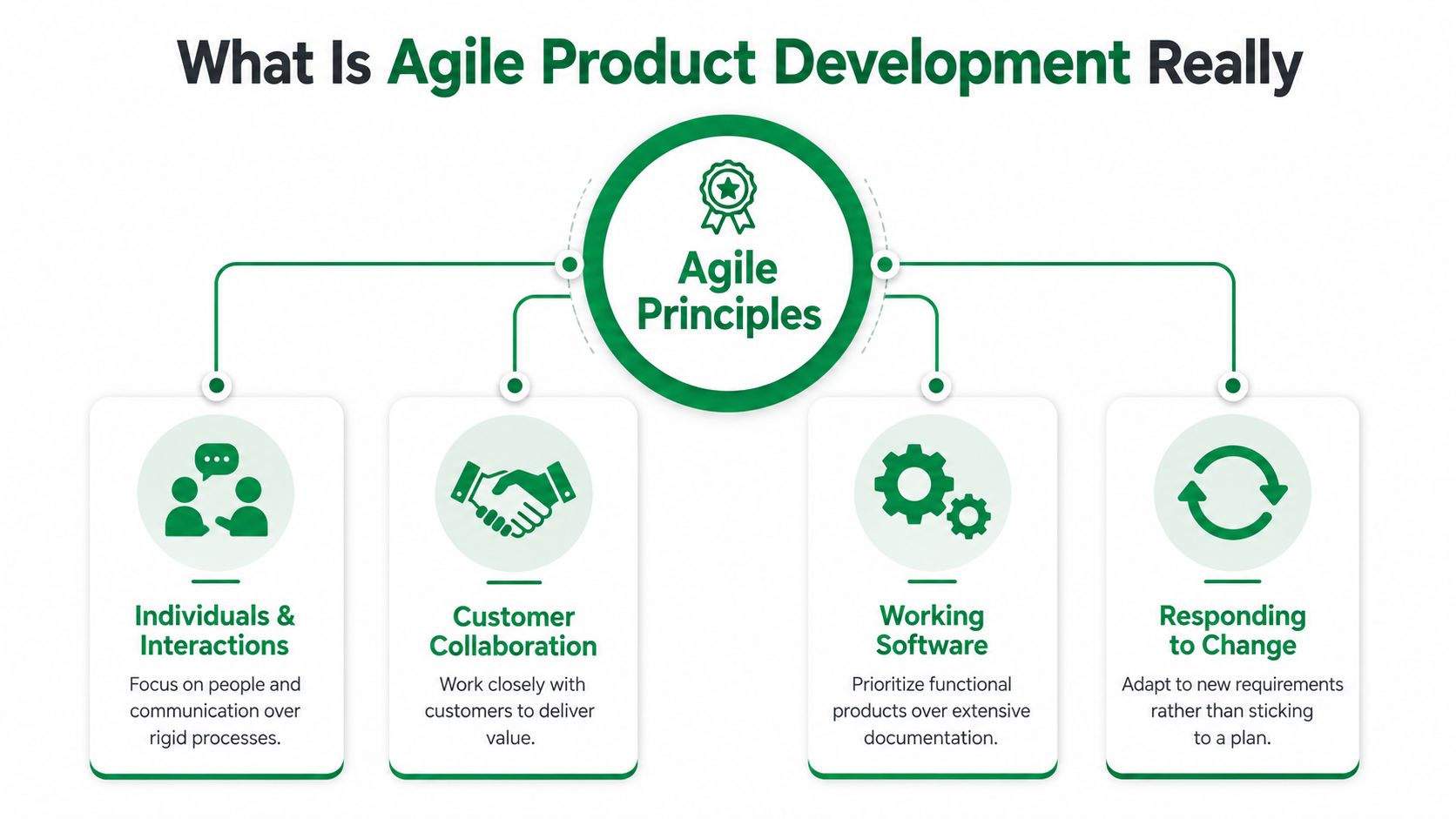
Many teams say they're agile because they run sprints. That's not enough. Agile is a product operating model built around learning in small increments. The mechanics matter, but the philosophy matters more. If a team follows the ceremonies while resisting change, it isn't practicing agility. It's running a tighter version of waterfall.
The mindset behind the method
In strong teams, agile in product development means a few things are always true:
Work is broken into smaller bets. Teams avoid oversized releases that hide risk until late.
Progress is judged by usable output. Slide decks and status reports don't count for much if the product still hasn't been tested in a meaningful way.
Change is expected. Plans aren't sacred. They're provisional until the team gets new evidence.
Collaboration stays close to the work. Product, design, and engineering don't work as isolated functions passing documents between each other.
That's why sprint length matters less than sprint intent. The same Maze reference notes that agile teams typically use sprints averaging around two weeks. The point of that cadence isn't speed for its own sake. It's to create a recurring moment where the team can build something, inspect it, and decide what to change.
What teams often get wrong
Agile gets diluted when teams reduce it to process compliance. You can see the symptoms quickly:
Misread Agile | Actual Agile |
|---|---|
Follow the plan strictly | Adjust when evidence changes |
Finish every scoped item | Deliver the most valuable increment |
Separate discovery from delivery | Let learning shape delivery continuously |
Treat ceremonies as proof of agility | Treat adaptation as proof of agility |
Practical rule: If the team can't change direction inside the sprint or immediately after it, the process may be structured, but it isn't agile.
The original promise still holds. Short cycles work. Frequent feedback works. But only when the team uses those cycles to learn, not just to schedule work.
The Core Components of an Agile Workflow
A workable agile system creates a rhythm for deciding, building, reviewing, and improving. In most product organizations, that rhythm is easiest to see through Scrum. The labels vary by company, but the core components stay recognizable.
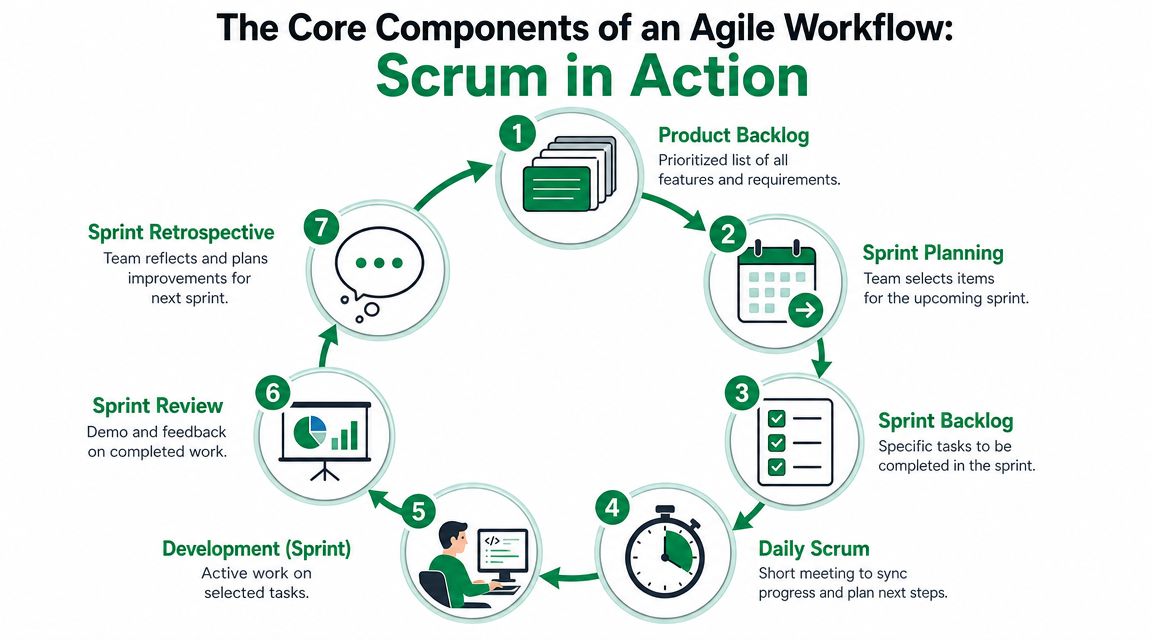
The value of the workflow isn't ceremony for ceremony's sake. It's discipline. Teams need a shared cadence so decisions don't drift and work doesn't pile up into vague progress.
The parts that matter
A typical sprint system includes roles, artifacts, and events that each serve a specific purpose.
Product backlog. This is the ordered list of opportunities, problems, fixes, and features the team may tackle.
Sprint planning. The team selects what it can take on in the next time box and clarifies what “done” means.
Sprint backlog. This becomes the active commitment for the sprint.
Daily scrum. A short synchronization point to surface blockers and keep progress visible.
Sprint review. The team presents completed work and gathers reactions.
Retrospective. The team inspects how it worked and decides what to improve next.
A useful pattern is to keep user stories narrow enough that they can be tested, discussed, and completed inside one sprint. Teams that struggle here usually write stories that describe output but not the user outcome. If your team needs a cleaner structure, this guide to writing better user stories in agile for product teams is a practical reference.
Agile product development improves decision quality because these loops are short. Sprint cadences typically run about 1 to 4 weeks, and teams review deliverables at the end of each sprint, adjust the backlog, and re-plan based on stakeholder or user feedback. That earlier feedback reduces requirement uncertainty and shifts rework from late-stage integration into lower-cost iteration, as explained in Railsware's breakdown of agile product development.
Here's a quick walkthrough of the cadence in action:
What a healthy sprint feels like
The difference between a healthy agile workflow and a performative one usually comes down to clarity.
Component | Healthy signal | Failure signal |
|---|---|---|
Backlog | Ordered by risk and value | Packed with stakeholder requests |
Planning | Scope is explicit and testable | Scope is vague and optimistic |
Daily scrum | Surfaces decisions and blockers | Becomes a status recital |
Review | Produces learning | Becomes a demo theater |
Retrospective | Changes team behavior | Ends as a complaint session |
When these components work together, the sprint becomes a compact loop for building and learning. When they don't, the team keeps motion without gaining insight.
Common Challenges That Derail Agile Teams
Most agile failures don't come from lack of effort. They come from friction that the process never accounted for. Teams can be disciplined, collaborative, and technically strong, then still lose sprint momentum because dependencies outside the squad move slower than the sprint itself.
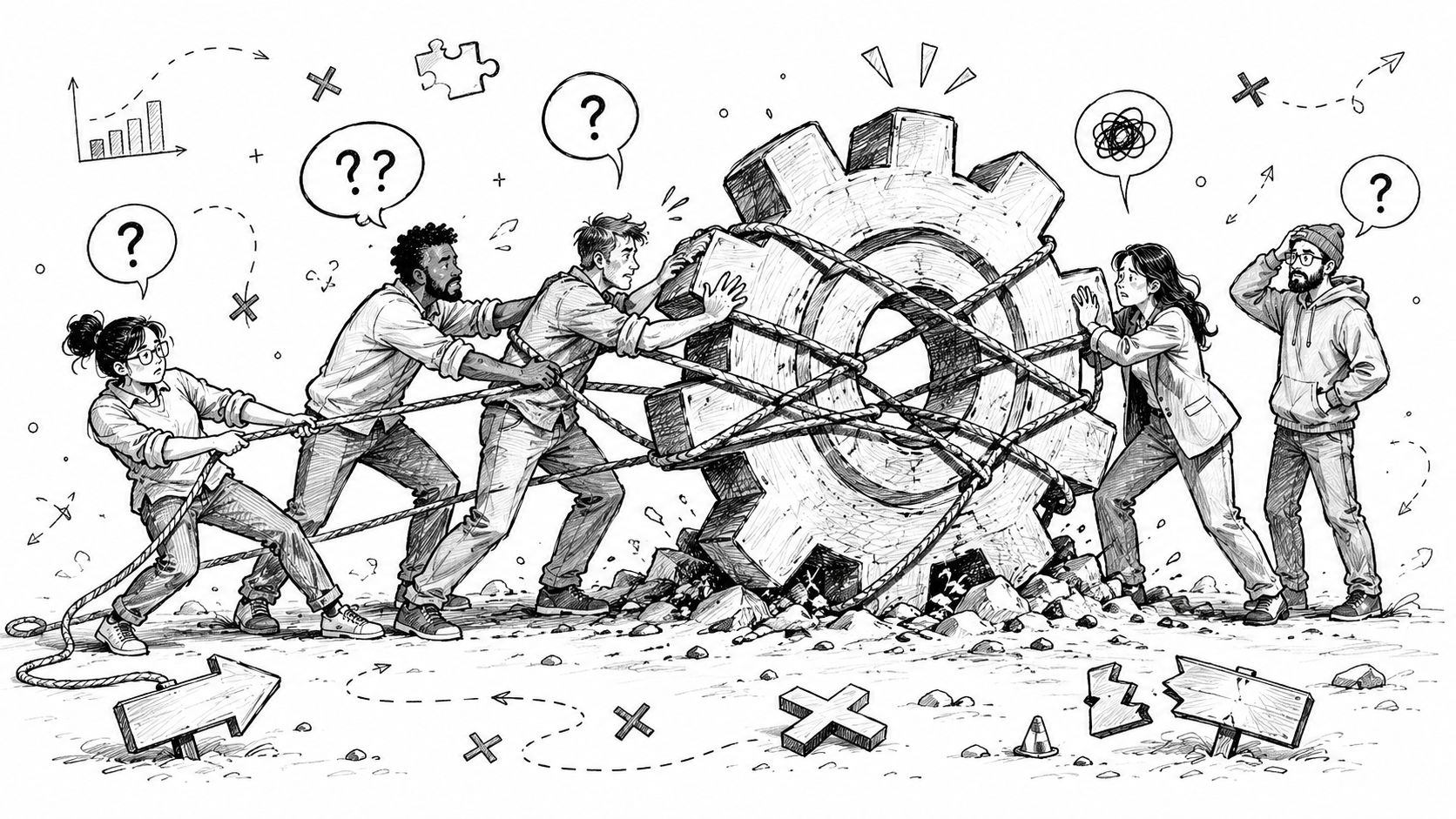
That's why agile in product development often looks fine on paper and weak in operation. The sprint board is active. The rituals happen on time. But decisions still wait on legal, compliance, procurement, leadership review, external research, or another team's approval.
Guidance from the public-sector agile context captures the issue well: agile product development often breaks down in regulated or hardware-heavy environments because many guides assume fast feedback loops are easy, while teams are really asking how to keep agile moving when approval chains, documentation, and cross-department dependencies slow every sprint, as discussed in TechFAR Hub's agile overview.
The patterns that create fake agility
A few failure modes show up repeatedly.
Scope keeps leaking into the sprint. Stakeholders add “small” requests that aren't small once design and engineering touch them.
Technical debt never gets product airtime. The backlog gets crowded with visible requests while reliability work stays underfunded.
The team confuses movement with learning. Features get shipped, but nobody can say whether the assumptions behind them were sound.
User feedback arrives out of phase. Research timelines don't match sprint timelines, so validation becomes either rushed or irrelevant.
Teams rarely abandon agile outright. They keep the rituals and quietly give up on the learning loop.
Why the feedback problem hurts the most
The damage caused by slow feedback is often underestimated because it distorts everything around it. Prioritization gets noisier. Sprint review becomes less useful. Product managers start relying on stakeholder certainty instead of user evidence. Designers over-polish before they validate. Engineers implement flows that should have changed earlier.
This is the Achilles' heel. If feedback can't keep pace with the sprint, the team isn't iterating. It's just sequencing assumptions in smaller batches.
Supercharging Sprints with In-Cycle Synthetic Validation
The fastest way to improve agile in product development is to close the validation gap inside the sprint. Don't treat user testing as a separate research phase that starts after design feels polished. Put it in the middle of the sprint while the work is still flexible.
That's the operating change that finally works for many teams. Validation becomes part of execution, not an optional checkpoint after the fact.
The two-round rhythm inside a two-week sprint
A practical sprint pattern is simple.
Start with one hypothesis. At sprint kickoff, define the key flow, the target user profile, and the questions that matter.
Run a first validation round mid-sprint. Test the early prototype before design has become expensive to change.
Revise quickly. Use the findings to fix friction, copy confusion, trust issues, or navigation problems.
Run a second, faster validation round before sprint review. Confirm whether the changes improved the experience enough to support the next decision.
The discipline here is focus. Don't test the whole product. Test one critical flow, one audience, and a short set of questions tied to the sprint's riskiest assumption.
A sprint test should answer the question most likely to invalidate the work, not every question the team happens to have.
That's where synthetic validation fits well. Teams that use AI-driven synthetic user testing workflows for rapid UX insights can run lightweight rounds without waiting on recruiting, scheduling, live moderation, and manual synthesis. Uxia is one example of this model. Teams upload prototypes or Figma designs, define a mission and audience, and use synthetic testers to generate structured qualitative feedback, quantitative signals, and usability observations during the sprint itself.
What this changes in practice
This approach doesn't make agile “more research-heavy.” It makes research usable at sprint speed.
Instead of waiting several days to recruit participants, brief them, run sessions, and summarize notes, a team can validate while the prototype is evolving. That matters because the best time to learn isn't after the sprint review. It's while design and product still have room to respond.
A strong benchmark from internal Uxia materials makes the point concrete. In its Amsterdam public transport app comparison, the full cycle took 25 minutes with synthetic testing versus 748 minutes for human testing, making it a 30× faster process. The same comparison surfaced 17 usability issues versus 4 from human testers, plus 5 prototype-specific observations. In sprint terms, that means the team can identify friction, revise the design, and validate again while the sprint is still active.
Comparing validation methods in a two-week sprint
Stage | Traditional Human Testing | Uxia Synthetic Testing |
|---|---|---|
Early prototype check | Recruiting and scheduling often delay the start of validation | Can be run as soon as the prototype and mission are ready |
Mid-sprint findings | Notes usually need synthesis before the team can act | Structured feedback is available quickly enough to inform iteration |
Follow-up test after changes | Often skipped because the sprint is nearly over | A second round can fit before sprint review |
Use in backlog refinement | Insights may arrive after prioritization decisions were made | Evidence can feed directly into prioritization while decisions are still open |
Team impact | Design and product debate assumptions longer | Teams spend more time fixing issues that are already visible |
What works and what doesn't
Teams get the most value when they keep the workflow tight.
Works well when the scope is narrow. A checkout step, onboarding path, pricing page interaction, or settings flow is ideal.
Works well when the question is specific. “Why are users hesitating before payment?” is useful. “What do people think of the product?” isn't.
Fails when teams overload the test. Too many flows and too many questions create noisy findings.
Fails when validation is treated as a rubber stamp. The point isn't to confirm the team's preferred answer. It's to find what breaks before code hardens around it.
This is the missing layer in a lot of agile systems. Teams have delivery cadence. They don't have validation cadence. Once both run together, sprint speed starts to mean something.
Measuring the Impact on Velocity and Confidence
The reason to fix the feedback loop isn't just speed. It's decision quality. Agile has already become a mainstream operating model, with 71% of companies using it in their software development lifecycle, 86% of software developers worldwide employing its practices, and Agile projects reported at a 75.4% success rate, according to these agile development statistics. At that level of adoption, the primary advantage no longer comes from saying your team is agile. It comes from running the model better.
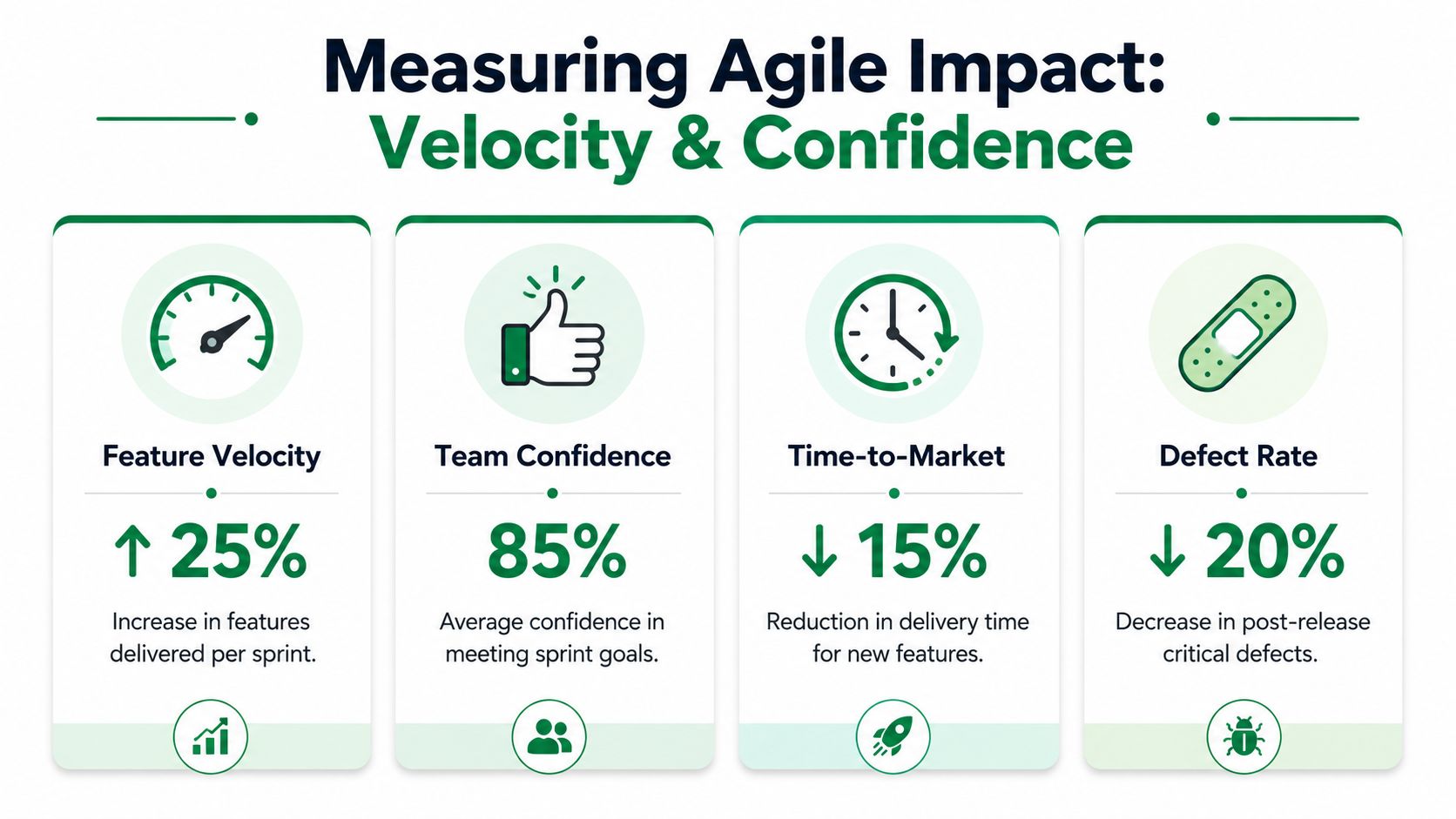
Velocity improves when the team reduces the time between a design decision and the evidence needed to support or reject it. That's a more useful definition than story points completed. If product, design, and engineering spend less time arguing over assumptions, they can spend more time fixing the issues that matter.
What changes when evidence arrives sooner
In practice, the gains show up in a few places:
Design reviews get sharper. The conversation shifts from opinion to observed friction.
Backlog refinement gets easier. Teams can rank issues based on what users struggled with, not what stakeholders fear.
Sprint reviews become more credible. The team isn't just showing completed work. It's showing work that has already been challenged.
Confidence rises without false certainty. The squad still sees risk, but it sees the right risk.
For teams trying to build a stronger evidence culture, this kind of data-driven design workflow is usually a better upgrade than adding more process overhead.
Faster feedback doesn't make teams reckless. It gives them fewer excuses to delay clear decisions.
Velocity is only half the story
There's also a morale effect that experienced teams recognize immediately. Sprint momentum is easier to protect when testing isn't a handoff. Product managers don't need to stall prioritization waiting for a separate study. Designers don't have to defend choices with taste alone. Engineers aren't asked to rebuild flows after avoidable late discoveries.
That's why confidence matters as much as throughput. A team moves better when it trusts that evidence can appear in time to matter. Not perfect evidence. Timely evidence.
A Practical Framework for Rapid Validation
Teams don't need a bigger agile transformation. They need a repeatable validation rhythm they can run every sprint.
The useful standard is straightforward. Start with the riskiest assumption in the sprint. Test one critical flow for one target segment. Run an initial validation round when the prototype is directionally ready, then run a second round after the main design fixes. The first round is for finding friction, confusion, and missed expectations. The second is for checking whether the changes improved the experience.
That approach matters because one of the biggest gaps in agile coverage is deciding what evidence is enough to move from iteration to commitment. Many teams still equate Agile with shipping faster rather than learning faster, while teams really need scalable, repeated validation when user feedback is slow or noisy, as discussed in UserVoice's perspective on agile product development.
A simple operating checklist
Pick the highest-risk flow. Don't spread the sprint across multiple validation targets.
Define the audience tightly. Broad audiences create vague findings.
Write a short test brief. Focus on the questions that can change a decision now.
Use the first round to discover. Look for friction, hesitation, trust gaps, and unclear copy.
Use the second round to confirm. Don't assume the fix worked just because the design looks cleaner.
Keep validation small enough to fit the sprint and sharp enough to change the backlog.
That's what finally makes agile in product development work in practice. The team doesn't just ship in short cycles. It learns in short cycles too.
If your team wants to shorten the gap between prototype decisions and usable feedback, Uxia is built for that workflow. It lets product teams test images, videos, and prototype flows with synthetic users, surface usability issues quickly, and bring structured evidence into sprint reviews, backlog refinement, and design iteration without waiting on traditional study timelines.