Enterprise UX Research: Build & Scale Programs
Build & scale effective enterprise UX research. This guide covers governance, ROI, tooling, and practical playbooks for continuous validation.
Research is usually the first thing leaders say they want more of and the first thing product teams say is slowing them down. One team is waiting on recruitment. Another has findings in a slide deck nobody can find. A third is running a study with a different audience definition and calling the result “validation,” even though nobody can compare it with anything that came before.
That pattern breaks down fast in large organizations. Enterprise UX research can't rely on heroic researchers, one-off studies, or a patchwork of tools and habits. It needs an operating system. The teams that scale well treat research like a repeatable business capability with governance, shared methods, visible metrics, and room for teams to move quickly inside a common frame.
That's the shift that matters. Not more studies. Better system design for how studies are commissioned, run, shared, and turned into decisions.
Why Traditional UX Research Fails at Enterprise Scale
Traditional UX research works well when one product team has one roadmap, one stakeholder group, and a manageable stream of questions. Enterprise environments don't look like that. They have multiple products, overlapping user roles, compliance constraints, procurement reviews, regional differences, and engineering timelines that won't pause because recruitment is stuck.
The old model usually fails in three places. First, research intake becomes chaotic. Teams ask for support late, often after design decisions are half-made. Second, methods drift. One researcher runs interviews, another runs a usability study, a third uses analytics alone, and the output isn't comparable. Third, insights disappear into local folders, decks, and chat threads.
The bottleneck isn't effort
Most enterprise research teams aren't failing because they lack talent. They're failing because they rely on project-based research mechanics for portfolio-level problems.
When a team treats every request as custom work, speed collapses. The researcher becomes the workflow. If that person is overloaded, blocked by recruitment, or pulled into stakeholder meetings all week, the whole system stalls.
Practical rule: If research quality depends on individual heroics, you don't have a research program. You have a queue.
The downstream effect is predictable:
Product teams bypass research: Designers and PMs make assumptions because waiting feels worse than being wrong.
Stakeholders lose confidence: They see research as slow and expensive rather than decisive.
Evidence gets fragmented: Findings from one domain never inform another, even when the workflow problems are identical.
Enterprise needs a different operating logic
A scalable approach starts with a harder truth. Enterprise UX research isn't just a service function. It's infrastructure for product decision-making.
That means standardizing how teams define a research question, who qualifies as the audience, what success looks like, and where findings live. It also means accepting that not every study should be handcrafted. Some should be templatized. Some should be automated. Some should be embedded directly into delivery rhythms.
Continuous validation is what replaces the stop-start pattern. The strongest programs build regular feedback loops into roadmaps, release cycles, and design reviews. They don't wait for a quarterly “big study” to discover workflow friction that a team could have caught earlier.
This is why modern enterprise teams are moving toward operating models and platforms built for parallel execution, shared visibility, and faster synthesis. The work gets better because the system gets better.
From Ad-Hoc Studies to a Strategic Research Program
Team-level research answers a product question. Enterprise UX research builds organizational intelligence. That distinction sounds subtle, but it changes everything from methods to governance to the way leadership evaluates impact.
In a mature program, research doesn't sit at the end of design as validation theater. It establishes baselines, exposes recurring friction across products, and gives leaders evidence they can use across roadmap, operations, and investment decisions.
Team-Level vs. Enterprise UX Research
Dimension | Team-Level Research | Enterprise UX Research |
|---|---|---|
Scope | One feature, workflow, or release | Multiple products, journeys, and business units |
Goals | Answer a local product question | Create reusable evidence and decision support across the organization |
Stakeholders | PM, designer, engineering lead | Product leadership, design, engineering, operations, compliance, support |
Cadence | Intermittent and project-based | Continuous and operationalized |
Complexity | Limited user contexts | Multiple roles, systems, constraints, and dependencies |
That shift requires a different standard of evidence. Opinions and isolated observations rarely survive executive scrutiny in enterprise settings. Teams need baseline metrics that can show whether a change improved the experience or moved friction elsewhere.
Benchmark before you optimize
A strong enterprise program starts by benchmarking. A foundational protocol calls for unmoderated usability studies with 20+ professional users to establish baseline metrics such as task completion rates, time-to-completion, and System Usability Scale scores, which then become the reference point for evaluating design iterations and feature changes, as described in this benchmarking discussion for enterprise workflows.
Without that baseline, teams can describe problems, but they can't prove movement.
That matters because enterprise products often live or die on workflow efficiency. Saving time on a repeated task, reducing errors in a handoff, or making system states clearer may look small in a prototype review. In daily operations, those changes can alter adoption, support burden, and stakeholder confidence.
Enterprise research gets strategic the moment it can answer a leadership question with evidence that is consistent across teams.
What maturity looks like in practice
A mature program usually shares a few traits:
Common definitions: Teams agree on audience segments, critical tasks, and success criteria.
Standard outputs: Findings are reported in a format leaders can compare across products.
Visible baselines: Benchmarks exist before redesign work begins.
Repository discipline: Insights can be found, reused, and challenged.
The key mindset change is simple. Stop thinking of research as a sequence of studies. Start treating it as a managed system for producing trustworthy evidence at scale.
Navigating Common Enterprise Research Hurdles
The biggest enterprise research problems aren't methodological. They're operational. Teams usually know how to run a solid interview or usability test. What they struggle with is maintaining research quality when access is restricted, approvals are slow, and every product group has its own way of working.
In B2B settings, those constraints get sharper. Practitioners often deal with NDAs, IP concerns, and expensive user recruitment, which pushes teams toward methods like requirements analysis, task flow mapping through job postings, and service blueprinting before they attempt direct usability testing with external users, as noted in this B2B and enterprise UX research discussion.
Where the system starts to crack
The friction usually shows up in five recurring areas.
Governance overload: Legal, security, compliance, and procurement each have legitimate concerns. Without a clear path through them, research requests sit idle.
Recruitment drag: Specialized users are hard to source, expensive to access, and often unavailable on sprint timelines.
Tool fragmentation: Session recordings, notes, metrics, and reports live in separate systems, so synthesis becomes manual and inconsistent.
Method drift: Different teams answer similar questions with incompatible methods, which destroys comparability.
Speed pressure: Product teams still need answers quickly, even when the domain is complex and the consequences are significant.
These aren't isolated inconveniences. They compound. Slow recruitment doesn't just delay a study. It changes roadmap sequencing, weakens stakeholder trust, and pushes teams toward shipping with less evidence.
Security and privacy constraints are real
Enterprise research also runs into a practical issue many teams underestimate. Sensitive flows often involve internal documents, unreleased product states, customer data structures, or partner material. If your research operations don't account for secure handling of those files, legal review will slow you down every time.
Teams working through that problem often benefit from tighter operational practices around document sharing and storage. This guide to offline file security for businesses is a useful reference when your research process touches sensitive artifacts that shouldn't circulate loosely across cloud folders and chat threads.
The best enterprise research teams don't treat legal and security review as blockers. They design workflows that make review easier.
What actually works
When direct user access is limited, smart teams widen the definition of who can contribute evidence. Customer success, implementation teams, trainers, sales engineers, and internal domain experts often understand the workflows in detail. They aren't substitutes for users in every case, but they're valuable participants in early task mapping, service blueprinting, and concept review.
What doesn't work is pretending enterprise research should look like consumer app research with a few extra approval steps. The context is different. The operating model has to reflect that.
Building a Scalable Research Operating Model
The most reliable enterprise model is federated. Product teams own their own research execution, but they work inside a shared framework that standardizes how studies are defined, run, and reported. That structure preserves speed without sacrificing comparability.
One proven approach assigns ownership of research to individual product teams while maintaining a common operating framework with dedicated workspaces and standardized audience definitions, so teams can run research in parallel and still produce consistent evidence, as described in this enterprise UX research operating model example.
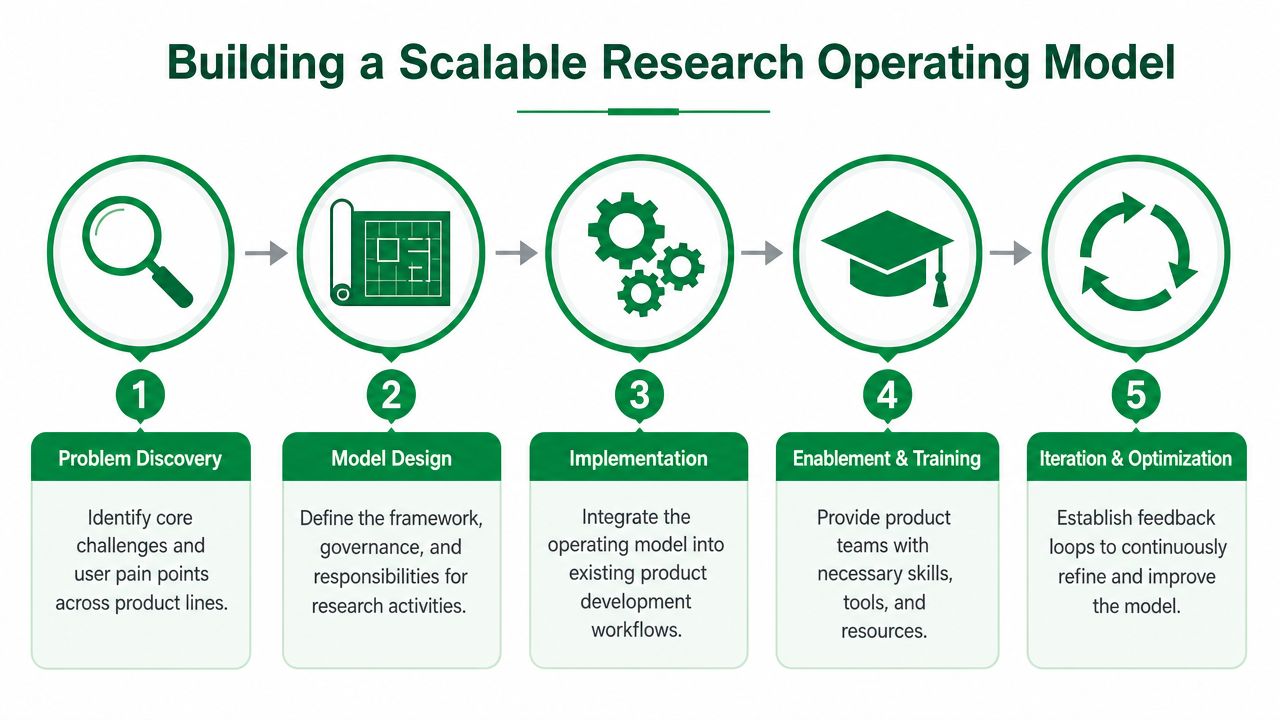
Give teams autonomy inside a shared frame
This is the model I trust most at scale because it respects how product organizations operate. Centralized research teams often become a bottleneck. Fully decentralized models drift into inconsistency. A federated model avoids both failures.
Each team should be able to initiate and own studies in its domain. But every study should follow the same minimum structure:
Objective: What decision is this study meant to inform?
Audience: Which user role or segment qualifies?
Scenario: What real-world context frames the task?
Success criteria: What outcome tells us the design is working?
That common scaffold gives leaders a way to compare findings across product lines. It also makes onboarding easier because teams don't need to invent the workflow from scratch.
Standardize the parts that shouldn't vary
Governance shouldn't mean rigid scripts. It should mean consistent building blocks.
A practical operating model usually includes:
Reusable audience profiles that define roles, behaviors, and inclusion criteria.
Dedicated team workspaces for study execution, review, and internal sharing.
Standard reporting templates that rank findings by user impact, business impact, frequency, and confidence.
Cross-functional review rituals where recurring themes are discussed and prioritized.
Portfolio-level visibility so leaders can see where evidence is strong and where it is thin.
Teams that want stronger repository discipline should also study patterns for moving from raw storage to actual reuse. This overview of research repositories from storage to action is useful because it focuses on operational retrieval, not just documentation hygiene.
Shared methodology matters more than centralized control. The goal is comparable evidence, not bureaucratic permission.
Enable the system, don't just document it
Most operating models fail at enablement. A team gets a template and a kickoff workshop, then everyone returns to old habits.
The fix is straightforward. Build repeatable support into the model itself:
Short training on study design and evidence quality
Clear decision rights for PMs, designers, and researchers
Review cadences that surface recurring issues across teams
Tooling that makes standardized execution feel faster, not heavier
If your teams are using AI in planning or synthesis, governance should cover prompt quality too. Poor prompts create poor outputs. This resource on managing business AI prompts is helpful for teams formalizing how AI-assisted work gets used inside research operations.
A good operating model doesn't make research feel more controlled. It makes high-quality research easier to run repeatedly.
Selecting Methods and Tools for Speed and Scale
Once the operating model is in place, the next challenge is execution speed, a common stumbling block for many enterprise programs. They standardize governance but keep a toolset designed for slower, handcrafted research. The result is still delay, just with better templates.
The method mix has to change. So does the way teams evaluate tooling.
Industry adoption shows why. AI-assisted workflows in UX research have surged by 32%, with 74% of researchers using AI to analyze data, 58% for transcribing responses, and 50% for planning and drafting studies, according to LogRocket's UX research trends for 2026. In that same source, 69% of participants reported using AI in at least some research projects, with use concentrated in analysis, transcription, and question generation. That's a practical signal. Teams are using AI because enterprise timelines demand faster turnaround.
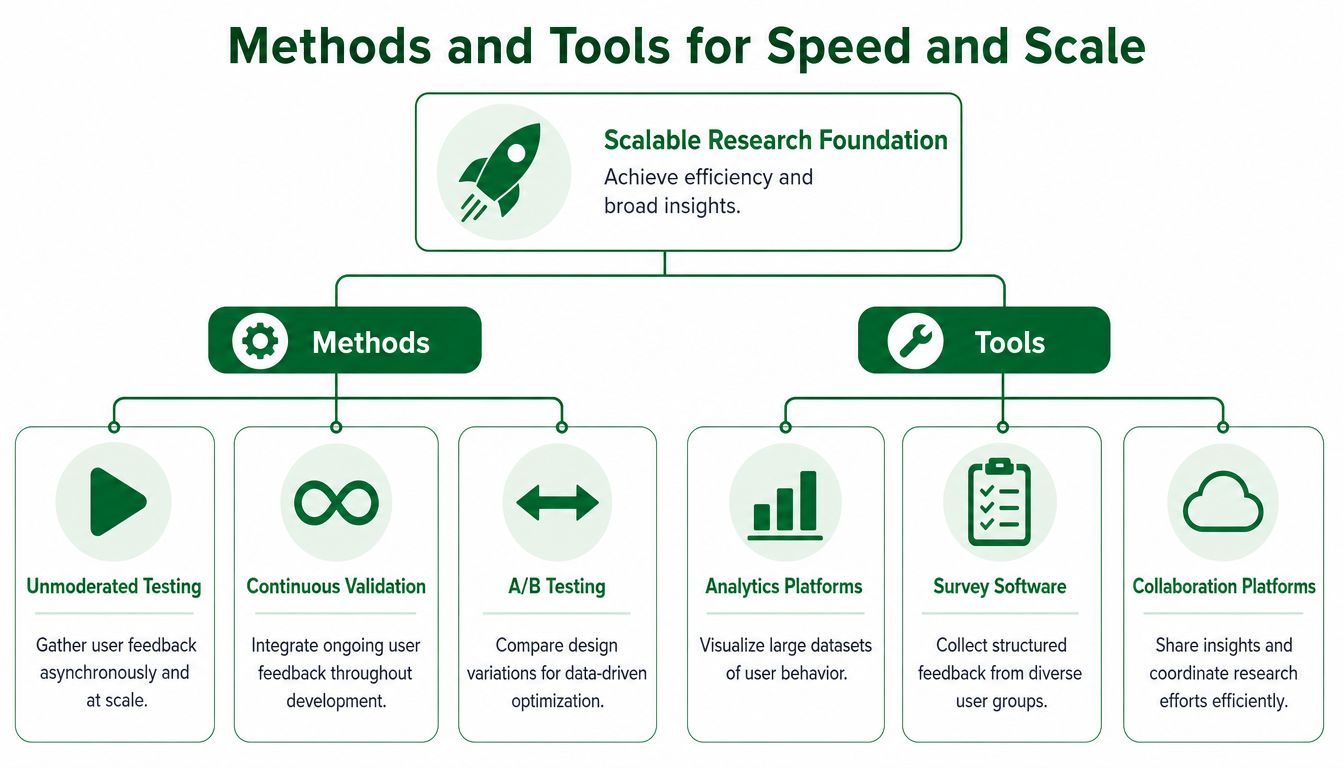
Choose methods that survive enterprise timelines
The strongest enterprise programs don't rely on one method. They build a layered system.
Unmoderated testing: Best for repeatable task-based validation when speed matters.
Continuous validation: Useful when design changes land frequently and teams need regular evidence.
A/B testing: Appropriate when the decision can be instrumented and compared in production contexts.
Targeted moderated sessions: Reserve these for ambiguous, high-risk, or politically sensitive questions.
Survey and analytics review: Best when you need breadth, trend signals, or segmentation support.
A practical starting point is to ask which methods scale across teams without making researchers the bottleneck. That usually means pushing more discovery and validation into asynchronous formats where possible, then reserving high-touch methods for the decisions that need them.
Evaluate tools like infrastructure
Tool selection should be stricter in enterprise environments. A flashy feature isn't enough. The stack needs to reduce friction across the full workflow, from setup to synthesis to reporting.
I usually evaluate research tooling against these criteria:
Criteria | What to look for |
|---|---|
Collaboration | Shared workspaces, role-based access, visible reviews |
Scalability | Parallel study execution across teams and products |
Time to insight | Fast analysis, synthesis support, usable reporting outputs |
Standardization | Templates, audience reuse, comparable outputs |
Reporting | Executive-ready summaries and recurring theme visibility |
For teams refining their process, this roundup of Noota's UX research strategies is a useful companion because it grounds speed in concrete workflow choices rather than generic tool shopping.
The AI layer matters too, but only when it reduces operational drag. If a tool generates summaries nobody trusts, you've created review debt, not efficiency. If it helps teams move from raw evidence to a credible first synthesis quickly, it earns its place.
For a closer look at how AI can compress analysis workflows inside modern UX operations, this piece on generative UX research and AI-driven insights offers a practical view of where acceleration is useful and where human judgment still matters most.
Measuring Research Impact and Proving ROI
Stakeholders don't fund research because they like the craft. They fund it when they can see risk reduction, better decisions, and less waste. If you want durable budget, you need a reporting model that translates research into operational and business language.
The strongest baseline for that conversation is financial. Every $1 invested in UX design yields a return of $100, or 9,900% ROI, according to Maze's UX statistics roundup. The same source notes that organizations investing in continuous UX testing can improve revenue retention by up to 10.8% over three years. Those figures are broad, but they give leaders a frame. UX research isn't decoration. It's part of how companies avoid expensive mistakes and protect revenue.
A useful way to present impact is to separate adoption metrics from outcome metrics.
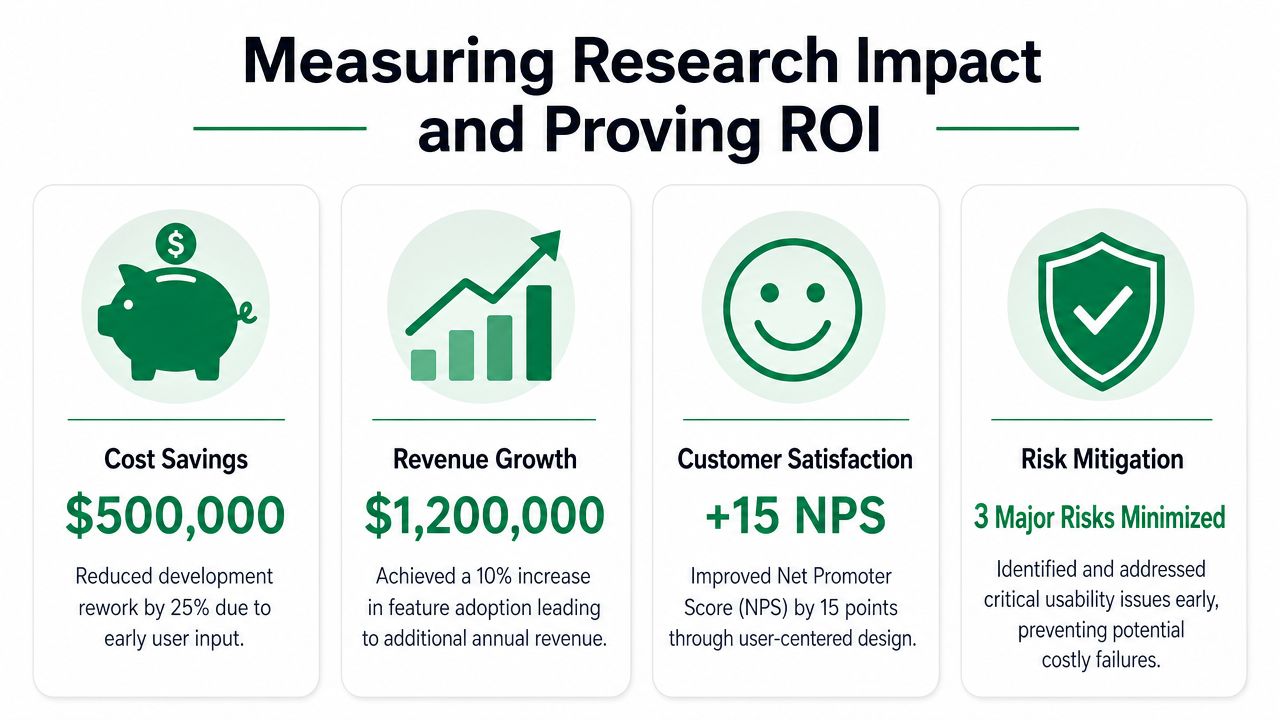
Track adoption to show program health
Adoption metrics tell you whether the research system is being used.
Active users and workspaces: Are product teams engaging with the program?
Testing frequency: Is research happening regularly or only when a release is in trouble?
Studies completed: Are teams increasing throughput without lowering standards?
Participation across product teams: Is adoption broad or concentrated in a few motivated groups?
These indicators matter because a research program with low adoption won't provide organizational advantage, no matter how good the individual studies are.
Track outcomes to show business value
Outcome metrics tell you whether research is influencing product quality and decisions.
I look for patterns such as recurring UX issues, issue severity, accessibility findings, user satisfaction signals, and the number of product decisions visibly influenced by research. In executive settings, I pair those with short qualitative evidence. A representative quote, a clear workflow failure, or a before-and-after decision trail usually lands better than an oversized report.
Leaders approve budgets when they can see what research prevented, not just what research discovered.
This is also the point where operational gains matter. Faster validation cycles, more studies completed, lower recruitment burden, and reduced rework all belong in the ROI story. Research should be framed as a mechanism for reducing product risk and increasing decision confidence.
A short explainer can help align non-research stakeholders on that mindset before dashboard reviews.
Build dashboards executives will actually read
Most executive dashboards fail because they over-index on activity and under-explain consequence.
A strong dashboard should combine:
Program adoption indicators such as active users, workspaces, and testing cadence
Issue trends that show recurring friction across products
Decision impact tied to roadmap, design, or release choices
Short evidence snippets that make the risk or opportunity concrete
If the dashboard only proves that researchers were busy, it won't secure budget. If it shows that research changed decisions earlier and reduced downstream waste, it usually will.
Embedding Research into Your Enterprise DNA
Enterprise UX research becomes durable when it stops behaving like a specialist service and starts functioning like a company capability. That shift isn't only about methods. It's about operating design, governance, and making evidence available where product decisions happen.
The organizations that do this well don't chase maturity through bigger reports. They standardize the basics, give teams a common workflow, and create visible feedback loops across product lines. Research becomes part of how roadmap choices are made, how design risk is managed, and how recurring workflow problems get surfaced before they turn into expensive rework.
Start smaller than you think
Many teams don't need a grand transformation plan. They need one reliable part of the system that works every time.
That might be:
A shared study template with objective, audience, scenario, and success criteria
A common reporting format so findings can be compared across teams
A recurring review ritual where leaders see patterns, not just isolated observations
A voice-of-customer loop that keeps product teams close to recurring user pain points, supported by practices like those outlined in this voice of the customer guide
Get one of those working. Then expand.
Research maturity grows when teams can repeat the right behaviors under pressure.
The goal isn't to make every product team behave like a research department. The goal is to make sound evidence generation feel normal, expected, and fast enough to fit the business.
If you're building a scalable enterprise UX research system and need a faster way to validate flows, analyze patterns, and support distributed product teams, take a look at Uxia. It's built for teams that want continuous validation without the delays of traditional research operations.