Companies Hiring UX Researchers: Top Teams Open Now
Find companies hiring UX researchers. Get insider tips on roles at Descript, Suno, and Wikimedia to land your next job in 2026.
Big Tech still shapes how many teams think about UX research hiring. That is exactly why it is the wrong place to stop your analysis.
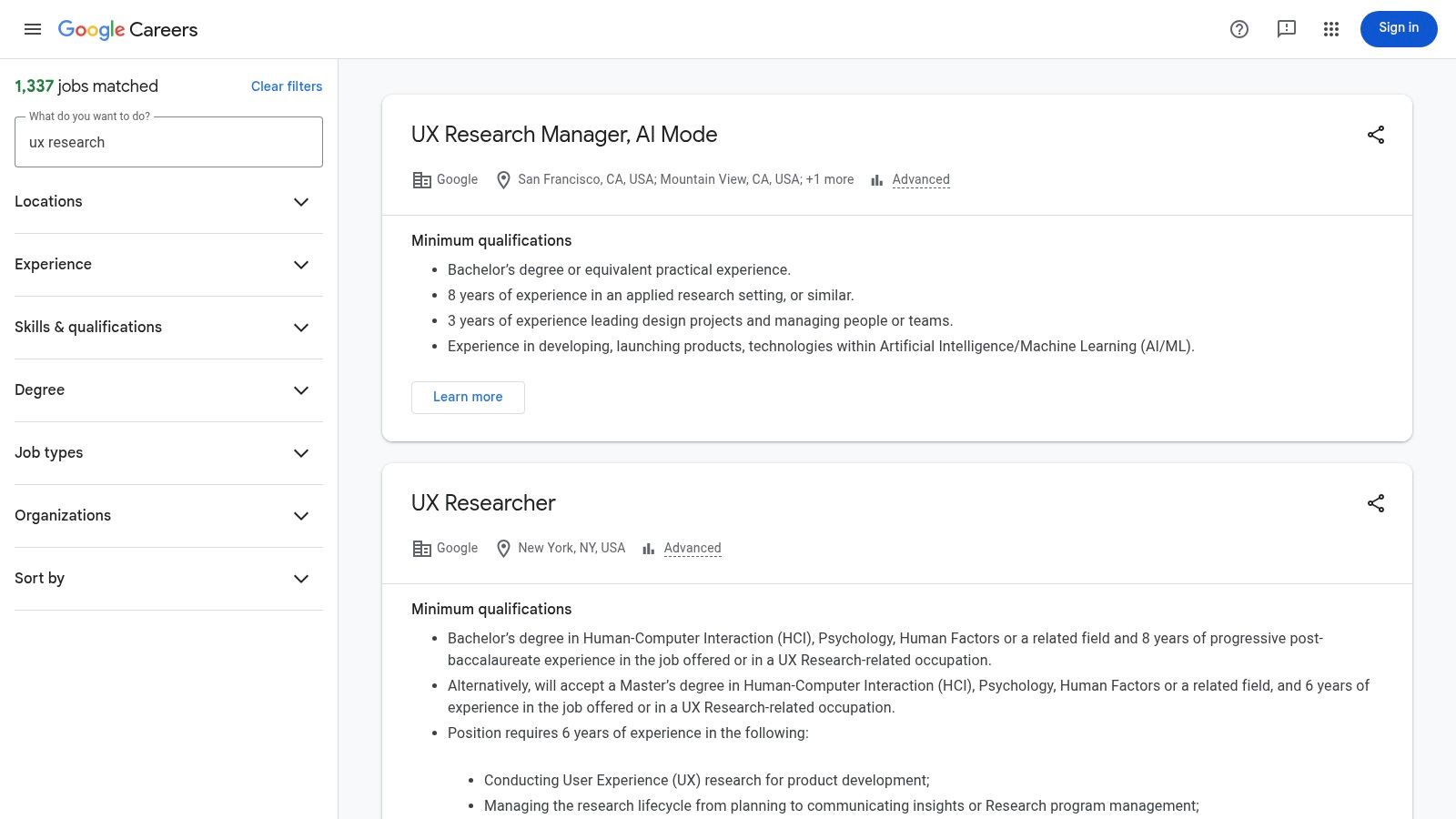
In the U.S., large product companies have historically dominated formal UX Researcher hiring. Visa Bulletin's filing analysis shows how concentrated that demand has been, with Google LLC, Facebook, and other major employers appearing repeatedly in sponsored-role data (Visa Bulletin UX Researcher analysis). That history matters, but it can also distort what candidates prepare for. It pushes people toward polished case studies and method fluency, even as newer postings ask for something broader.
The stronger signal in the current job market sits outside the usual FAANG roundup. Recent openings at AI-native startups, scale-ups, enterprise consultancies, and mission-driven organizations are asking researchers to do more than plan studies and present findings. They want people who can build research operations, coach PMs and designers, work comfortably with product analytics, shape AI adoption decisions, and raise the quality of decision-making across a company.
That shift changes how candidates should read job descriptions.
A posting is no longer just a list of methods. It often reveals the company's bottleneck. Sometimes the business problem behind the posting is weak research habits across teams. Sometimes it is low confidence in product bets, poor feedback loops, or too much manual usability work in fast release cycles. The best candidates spot that gap early and show they can fix it.
If you're scanning a remote job board for UX professionals, these seven openings show where the role is heading, and what hiring teams now value beyond classic UXR craft.
1. Descript The Researcher as Coach and Culture Builder
Descript's careers page stood out because the Lead UX Researcher role isn't just about running studies. It asks the researcher to scale the practice itself. That includes coaching PMs and designers, improving how research gets done across the company, and creating rituals that keep teams close to users.
The “Insight Safari” detail matters. A company that builds recurring, shared exposure to research footage is telling you something important. They don't want a researcher who disappears into a repository and returns with slides. They want someone who changes how the organization learns.
What makes this role different
This is the kind of role many candidates underestimate. The hard part isn't choosing methods. The hard part is getting a company to produce better research when more of that work is distributed across product, design, and leadership.
Best fit: Researchers who've already mentored others, built templates, or improved intake and synthesis workflows.
Watch out for: Candidates who only present polished findings and never show how they built repeatable practice.
Real upside: You get influence beyond one squad or one release cycle.
Practical rule: If you're applying to jobs like this, show one case study where you improved how research happened, not just what research found.
Descript also signals something broader about companies hiring UX researchers right now. They're not only buying craft. They're buying strategic impact. If you've used tools like Uxia to speed up tactical validation, frame that as increased efficiency too. The point isn't “I used AI.” The point is “I protected time for higher-value research by reducing manual testing overhead.”
2. Wikimedia Foundation Quant Rigor in an Open Community
Wikimedia Foundation's jobs page is a good reminder that not every strong UXR role sits inside venture-backed product software. Their Senior UX Researcher contract combines quant-heavy work with the social complexity of an open, volunteer-driven ecosystem.
The methods mix is unusually broad for a short-term role. Surveys, large-scale unmoderated testing, diary studies, benchmarking, and statistical analysis all show up together. So does a preference for people who understand open-source or volunteer communities.
Why this posting matters
A lot of researchers say they can do mixed methods. Far fewer can handle mixed methods in a setting where the user base also includes contributors, maintainers, and community stakeholders with their own norms and motivations.
This role also has a concrete scheduling constraint. It's remote, but it requires synchronous availability between 15:00 and 19:00 UTC. That sounds minor until you realize how many applicants pitch themselves as “fully remote ready” without showing they can work inside a distributed collaboration window.
Open communities reward rigor, but they punish clumsy stakeholder handling.
That's the core trade-off here. You get meaningful work on a product with global reach, but you need to be comfortable working where community trust is part of the research environment itself.
For candidates, the best move is to show evidence that you can balance methodological precision with sensitivity to context. A polished usability portfolio alone won't carry you here. Include examples of survey design, benchmark interpretation, or research done in communities where governance and participation shaped the work.
3. ConnectWise The Ops-Heavy, Analytics-Driven Researcher
ConnectWise's careers site reflects a pattern I'm seeing more often. Some companies don't want a pure researcher. They want a researcher who can operate inside a mature product system with process expectations, analytics tools, and internal documentation discipline.
This posting calls for a stack that goes well beyond classic interview and usability skills. Jira, Confluence, Excel Pivot Tables, PowerBI, Marvin, Maze, and Pendo all point in the same direction. The company expects the researcher to connect qualitative insight with product behavior data and to do it in a way that fits established workflows.
Who wins in this kind of role
Researchers who can move between evidence types tend to stand out fast. If you can explain what users said, what they did, where the friction showed up in product signals, and how the team should operationalize that insight, you become much harder to replace.
That's also why this role has real downside for some applicants. If you dislike process, tooling, and taxonomy work, this can feel heavy. You may spend less time in interviews than you expected and more time making insight systems usable by other teams.
A practical way to frame this skill set is through data-driven design practice. The point isn't that analytics replaces research. It's that product teams trust researchers more when they can connect observed behavior, attitudinal insight, and delivery constraints in one narrative.
Strong signal in your portfolio: A project where you combined interviews or testing with behavioral product data.
Weak signal: A report that ends at themes and personas with no operational follow-through.
Good tool story: Explain why you used each system, not just that you know the name.
4. Suno and Lovable The AI-Native Product Researcher
Suno's careers page and Lovable's hiring direction point to a category that's getting more distinct. These teams aren't just using AI in the workflow. They're researching products where generative AI is the experience.
That changes the job. At Suno, the role focuses on power users and professional creators in AI music creation. The preference for experience with tools like Ableton, Logic Pro, or Pro Tools tells you this isn't a generalist posting dressed up with AI language. Domain fluency matters because the user expectations are specialized.
Why AI-native UXR feels different
Lovable is interesting for a different reason. The role includes testing AI concepts and experimenting with AI-assisted recruiting, analysis, and synthesis. That's a strong signal that the team expects the researcher to help define the process, not just execute within it.
If you want these jobs, stop presenting AI work as a novelty. Treat it as an interaction model with unstable expectations, shifting trust boundaries, and blurry task ownership between system and user.
The best AI product researchers don't just ask whether a feature works. They ask whether users understand what the system is doing, when they trust it, and where they take back control.
That's also where synthetic user testing becomes useful in practice. For fast-moving AI teams, Uxia can help pressure-test flows and surface friction quickly between releases. It won't replace foundational research with real users in specialized domains, but it can help teams validate interaction patterns while researchers focus on ambiguity, trust, and behavioral edge cases.
The trade-off is obvious. These roles are exciting, but they're less structured. You won't always inherit mature methods or stable norms. Some researchers love that. Others burn out on it.
5. Unity Advisory The Enterprise AI Adoption Strategist
Unity Advisory's careers page shows one of the clearest examples of a role that is explicitly broader than traditional UXR. The position is framed around internal AI platform adoption, not just interface quality.
That distinction matters. Many enterprise teams don't fail because users can't click through a workflow. They fail because employees don't trust the system, don't understand where it fits, or never reach a clear first value moment.
The real business problem behind the posting
This job combines research with onboarding design, feedback loops, change management, stakeholder workshops, and AI explainability. In practical terms, the researcher is helping the organization answer a harder question than usability alone can solve. Will people adopt this thing in real workflows?
That's a specialized brief, and not everyone should chase it. If your strength is deep exploratory work on consumer products, this may feel too organizational. But if you like service design, internal tools, and behavior change, it's a strong lane.
A good application here should show that you can map friction beyond screens.
Show workflow observation: Demonstrate how you studied what people do, not just what they say in an interview.
Show adoption thinking: Include examples of onboarding, handoff points, trust barriers, or repeated-use patterns.
Show stakeholder fluency: Explain how you worked with leadership, enablement, or operations teams.
This is also where Uxia can support the broader system. For enterprise teams iterating on internal AI interfaces, fast synthetic testing can help evaluate first-run experiences and messaging clarity before researchers spend time on the more difficult work of trust, rollout design, and organizational fit.
6. Prosper and Brooklinen Strategic UXR in High-Stakes Verticals
Prosper's careers page and Brooklinen's role signal a category that often gets overlooked in discussions about companies hiring UX researchers. These aren't “cool startup” jobs built around novelty. They're strategic research roles attached to user journeys that directly affect revenue, trust, and conversion.
Prosper's posting is notable because it prefers financial-services experience and expects the researcher to present work at Town Hall and All Tech meetings. That's a visible, strategy-adjacent role. Brooklinen's opening is different in tone, but equally revealing. The focus isn't just shopping behavior on a screen. It's understanding how customers make purchase decisions in the context of daily life across navigation, product pages, cart, checkout, and search.
What these roles tell you about hiring now
Employers increasingly want researchers who can do more than identify usability flaws. Built In's remote UX researcher listings include Staff, Senior, and Contract roles that expect researchers to lead discovery, shape product definition, and translate findings into product specifications, with compensation ranges in postings that commonly run from roughly $85k to $264.6k depending on scope, market, and remote eligibility (Built In remote UX researcher listings).
That lines up with what these two roles imply. In high-stakes verticals, the researcher often sits closer to product strategy than candidates expect.
Prosper fit: Strong for researchers who can work in regulated or trust-sensitive decision environments.
Brooklinen fit: Strong for researchers who understand ecommerce behavior, merchandising friction, and decision context.
Shared requirement: You need to communicate clearly to senior stakeholders, not just to design peers.
If you want to break into this tier, tailor your portfolio around consequential journeys. Show where user confusion, hesitation, comparison behavior, or trust concerns changed product direction.
7. How to Stand Out Application and Portfolio Tips
Most candidates still apply to companies hiring UX researchers with portfolios built for an older version of the role. They show methods, polished slides, and tidy findings. That's not enough for the jobs above.
Hiring teams are screening for researchers who can run continuous, mixed-method validation loops and synthesize decision-ready insight for leadership and cross-functional teams. Indeed listings in Florida and Tampa commonly require 3+ years of applied research experience and direct proficiency in interviews, surveys, and usability testing, plus the ability to communicate insights clearly across teams (Indeed UX research jobs in Florida).
What to change in your application
Your portfolio should prove that you can do three things: drive decisions, scale your impact, and work at speed.
Lead with strategic effect: Show how your research influenced roadmap choices, product definition, or internal process.
Include operating detail: Name the tools, workflows, and collaboration patterns you used so hiring managers can picture you inside their system.
Show modern speed: If you've used platforms like Uxia for fast concept checks or usability validation, explain what work that freed you to do.
A useful model is to frame one case study around capability-building, not just findings. Another can focus on a difficult domain or stakeholder environment. If you need a sharper template, this guide on the UX researcher job market and positioning is a good starting point.
Your portfolio should answer “Why hire you into this system?” not just “Can you run a study?”
One caution. Don't force fake precision into your resume or case studies. Use measurable business impact only when you have it. Otherwise, describe the decision, the shift in team behavior, or the product change qualitatively and clearly. That reads as more credible than padded metrics.
7-Company UX Researcher Role Comparison
Role / Item | Implementation Complexity 🔄 | Resource Requirements & Speed ⚡ | Expected Outcomes 📊 | Ideal Use Cases 💡 | Effectiveness ⭐ |
|---|---|---|---|---|---|
Descript: The Researcher as Coach and Culture Builder | High, org change, mentorship, process design | Moderate, AI tools, training time, stakeholder buy-in; scalable over time | Company-wide research adoption; improved study quality and rituals | Scaling research practice and embedding research culture in growth-stage companies | ⭐⭐⭐⭐ |
Wikimedia Foundation: Quant Rigor in an Open Community | Medium–High, large-scale methods + community dynamics | High, survey/analytics platforms, statistical expertise, synchronous hours | Robust, generalizable quantitative insights for global volunteers | Large-scale surveys, benchmarking, research in volunteer/open-source contexts | ⭐⭐⭐⭐ |
ConnectWise: The Ops-Heavy, Analytics-Driven Researcher | Medium, heavy process and tool integration | High, analytics stack (PowerBI, Pendo), Jira/Confluence, research ops time | Actionable links between qualitative insights and product/business metrics | Mature product orgs that require operationalized research and analytics alignment | ⭐⭐⭐⭐ |
Suno & Lovable: The AI-Native Product Researcher | High, emergent methods; domain expertise required (e.g., music) | Moderate, AI tooling, rapid testing, domain experts; fast iteration pace | Foundational insights into generative AI UX; novel interaction patterns | Researching generative AI products and creative power users in startups | ⭐⭐⭐⭐ |
Unity Advisory: The Enterprise AI Adoption Strategist | High, change management, stakeholder alignment, org behavior change | High, cross-functional programs, onboarding design, measurement systems | Increased adoption and trust in enterprise AI; strategic business value | Enterprise AI adoption, onboarding journeys, and first-value design | ⭐⭐⭐ |
Prosper & Brooklinen: Strategic UXR in High-Stakes Verticals | Medium, domain-specific complexity and high visibility | Moderate, mixed-methods, domain knowledge, executive communication | Measurable impact on core business metrics (conversion, applications) | High-stakes verticals (FinTech, E‑commerce) where research ties to revenue | ⭐⭐⭐⭐ |
How to Stand Out: Application and Portfolio Tips | Low–Medium, reframing existing work and documenting impact | Low, case studies, metrics, rapid-testing examples; time investment needed | Stronger candidate positioning; clearer evidence of strategic impact | Applicants pursuing modern UXR roles that prioritize impact and ops | ⭐⭐⭐ |
Your Next Move in the Evolving UXR Landscape
UX research jobs still exist. The bar just moved.
Broader salary data suggests the field remains well-paid across major markets. User Interviews' 2026 UX Salary Report, based on salary data collected from 2023 to 2025, shows strong compensation for researchers in the U.S., Canada, and ANZ (User Interviews UX salary report). The hiring market is tighter than it was a few years ago, but serious teams still invest in research when they believe it changes product decisions.
That belief now depends on range, not just craft. The strongest postings ask researchers to do the core work well, then extend beyond it: coach PMs and designers, build lightweight ops, connect qualitative findings to behavioral data, and help teams make sense of AI-driven products or AI adoption inside the business. That shift came through clearly in the roles covered here. This is no longer just a list of big-name employers hiring researchers. It is a read on where the role is heading.
A narrow portfolio struggles in that market, even if the moderation and synthesis work is strong.
The practical response is a T-shaped profile with proof. Keep depth in research design, interviewing, analysis, and judgment. Add visible strength in one or two adjacent areas that hiring managers now screen for early, such as quant fluency, research ops, experimentation, domain expertise, or internal coaching. The candidates who stand out are usually the ones who can say, with evidence, “I improved decision quality here,” not just “I ran studies here.”
Speed matters too, but speed alone is not the point. Teams want faster validation loops without flooding the roadmap with weak evidence. Tools like Uxia can help product teams run rapid UX and UI validation with AI synthetic testers, which frees researchers to spend more time on ambiguous questions, synthesis across signals, and stakeholder work that actually changes direction.
If you're applying now, tighten your materials around that reality. Show one project where you changed how a team works. Show another where the work touched revenue, risk, activation, trust, or adoption. If you've used modern validation tools, explain the trade-off clearly: what got faster, what still required human judgment, and how your role became more strategic as a result.
The best roles at companies hiring UX researchers are often the ones with the clearest mandate, not the loudest brand. Look for teams that treat research as decision infrastructure. That is where the work gets more interesting, and where your career can compound fastest.
If you want to move faster without lowering the quality bar, Uxia is worth considering. It helps product teams run rapid UX and UI validation with AI synthetic testers, so researchers can spend less time waiting on recruitment and more time on strategy, synthesis, and the higher-value work these newer UXR roles increasingly demand.