Your Guide to Landing a UX Researcher Job in 2026
Unlock your career in UX research. This guide covers the skills, portfolio, and interview strategies you need to land a top UX researcher job in 2026.
At its heart, a UX researcher’s job is to be the voice of the customer. But not just any voice—it's the voice that answers the most important question in product development: why?
They figure out why users get stuck, what makes them click away, and what truly makes an experience feel effortless. They are the essential link between the people using a product and the team building it, making sure every decision is based on solid evidence, not just guesswork.
What Does a UX Researcher Actually Do?

Think of a UX researcher as a strategist who uses human behaviour as their primary data source. Their entire mission is to swap out risky assumptions for cold, hard facts about what users actually need and want.
Instead of a team hoping a new feature will land well, the researcher provides concrete proof. This is a massive advantage, as it stops companies from wasting time and money building things nobody will ever use.
It’s a common mistake to think UX research is just about asking people if they like a button’s colour. That’s a tiny piece of the puzzle. The role is far more strategic and involves a rigorous cycle of asking the right questions, analysing the results, and telling a compelling story with the data.
This work is closely related to, but very different from, a UI designer’s job. While the researcher finds the why, the designer creates the what. You can dive deeper into these differences in our guide on UX vs UI design.
The Daily Life of a UX Researcher
The day-to-day work is a mix of deep thinking and hands-on investigation. It’s a loop: plan the research, run the study, find the insights, and repeat. While no two days are identical, the rhythm is consistent.
It all kicks off with a business problem. A product manager might ask, "Why is our signup conversion so low?" or "Would customers actually pay for an AI assistant?" The researcher's first task is to take that broad question and turn it into a focused, testable research plan.
This involves:
Defining Objectives: What, exactly, do we need to learn? Practical Recommendation: Always start by writing your objectives as clear, answerable questions. For example, instead of "Test the new homepage," use "Can new users successfully find our pricing page from the homepage in under 30 seconds?"
Choosing the Right Method: Is a one-on-one interview, a large-scale survey, or a usability test the best way to get answers? Practical Recommendation: For quick validation on design prototypes, consider using AI-powered tools like Uxia to get feedback in minutes without the logistical overhead of recruiting human participants.
Recruiting Participants: Finding the right people who truly represent the target audience for the product.
A UX researcher’s real job is to transform business uncertainty into clear, actionable insights. They deliver the "why" behind the analytics, giving teams the confidence to either build a feature or go back to the drawing board.
To get a clearer picture, let's break down the core tasks.
A UX Researcher's Daily Mission
This table shows how a researcher's daily activities connect directly to strategic business goals, especially when supported by modern tools.
Activity | Strategic Goal | Modern Tool Example |
|---|---|---|
Planning Research Studies | Align with business goals; define clear, answerable questions. | Creating test scenarios in a platform like Uxia. |
Recruiting Participants | Ensure feedback comes from the correct target audience. | Generating AI-powered synthetic users that match specific personas with Uxia. |
Conducting Usability Tests | Observe real user behaviour to find friction points and bugs. | Running automated tests on prototypes with Uxia for instant feedback. |
Analysing Data | Identify patterns, themes, and root causes from raw data. | Reviewing AI-generated reports from Uxia that summarise key findings. |
Presenting Findings | Translate insights into a compelling story for stakeholders. | Sharing auto-generated highlight reels and qualitative summaries from Uxia. |
Each step is about moving from a vague question to a confident, evidence-backed product decision.
From Data Collection to Strategic Impact
Once the plan is set, the researcher gets to work collecting data. This might mean spending a day conducting user interviews, launching a survey to thousands of people, or watching users navigate a prototype. This is where the real insights emerge—from listening to frustrations, noticing small hesitations, and spotting opportunities others might miss.
But raw data—like hours of interview recordings or a spreadsheet of survey answers—is messy. The final, and most critical, step is synthesis. A great researcher organises this chaos into a clear story, finding the patterns that matter. They build reports, presentations, and personas that make the user’s experience impossible for the product team to ignore.
A Modern Approach with Uxia
In the past, a huge chunk of a researcher’s time was eaten up by logistics—finding participants, scheduling sessions, and managing incentives. Today, that’s changing fast.
Platforms like Uxia allow researchers to use AI-powered synthetic users for rapid testing. This is a game-changer.
Instead of waiting weeks to recruit and test with humans, a researcher can get high-quality feedback on a design in a matter of minutes. This frees them up to focus on what really matters: analysing results, thinking strategically, and driving product decisions. Showing you’re skilled with these modern tools is one of the best ways to prove your value in today's job market.
Mastering the Skills for a Modern UX Role
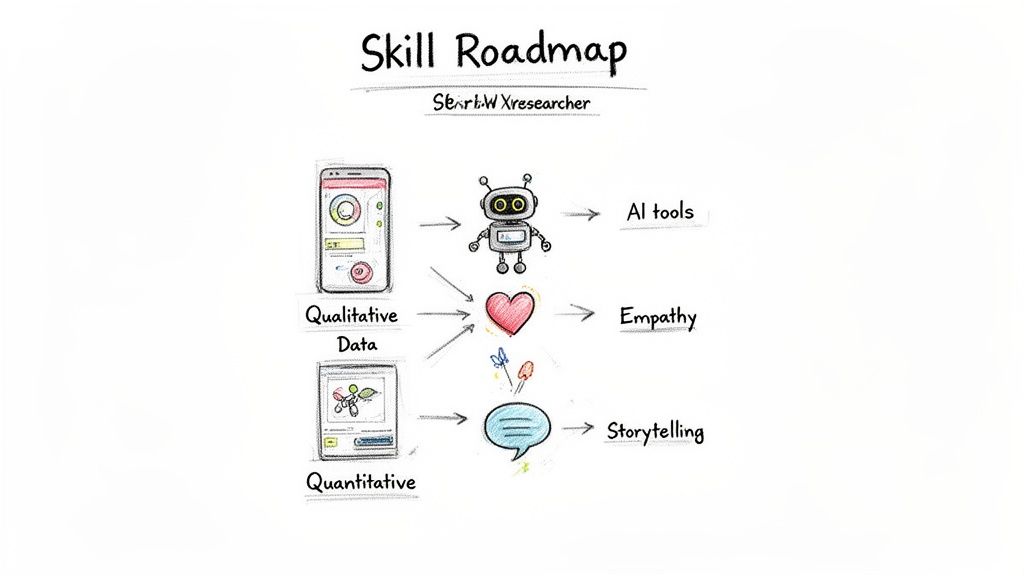
To land a greatUX researcher job, you need a skill set that sits right at the intersection of human psychology and technical know-how. Think of yourself as a detective for digital products. You need the empathy to understand people's motives (the soft skills) and the forensic tools to analyse the evidence (the hard skills).
In this role, you’re not just a data collector; you're a strategic partner. This means having a solid grasp of traditional research methods while also embracing the new technologies that are changing how product teams build things.
Let's break down exactly what skills you'll need to really shine.
Essential Hard Skills for UX Researchers
Hard skills are your bread and butter—the practical, demonstrable abilities that let you plan, run, and analyse research. These are the skills hiring managers scan for on a CV first, as they prove you can do the core work.
Your most critical hard skill is knowing your research methods inside and out. You have to know when a one-on-one interview is the right tool to dig into complex feelings, and when a large-scale survey is needed to get statistically solid numbers.
This dual fluency in both qualitative and quantitative research is non-negotiable. If you want to dive deeper into this, we have a fantastic article breaking down the differences between qualitative and quantitative research.
What truly separates a good researcher from a great one is knowing which method to pick under pressure to deliver the biggest insights with the least amount of time and budget.
To build a strong foundation, concentrate on these specific hard skills:
Research Design and Planning: This is about more than just picking a method. It's defining sharp, clear research questions and creating a structured plan that directly ties back to what the business needs to achieve.
Data Analysis: You need to be comfortable swimming in both seas of data: qualitative (interview notes, user quotes) and quantitative (survey results, analytics). This means finding themes, spotting behavioural patterns, and backing up every claim with solid evidence.
Proficiency with Modern Tools: Showing you can use current research software is a must. This covers everything from survey platforms and participant recruitment tools to newer AI-driven testing solutions like Uxia.
The Power of AI Tools in Your Skill Set
One of the most valuable skills you can list on your CV today is proficiency with AI-powered research platforms like Uxia. Honestly, these tools give you an almost unfair advantage in the job market.
For instance, instead of spending weeks trying to find and schedule users for interviews, you can use Uxia to run unmoderated tests with AI synthetic users in just a few minutes. This lets you validate designs, test new copy, and find usability problems at incredible speed.
Highlighting this skill shows a hiring manager that you can deliver insights efficiently—a quality that is pure gold in any fast-moving company. Practical Recommendation: Add a "Technical Skills" or "Tools" section to your CV and explicitly list platforms like Uxia, noting your proficiency (e.g., "Proficient in AI-powered usability testing with Uxia").
The Soft Skills That Set You Apart
While your hard skills will get you an interview, it's your soft skills that will make you a truly effective and influential member of the team. These are the human skills that turn raw data into real product changes.
The single most important soft skill for any UX researcher job is empathy. It's your ability to genuinely see the world through your users' eyes, feel their frustrations, and fight for their needs—even when those needs clash with what the team thinks is right.
Other vital soft skills include:
Storytelling: A spreadsheet full of data rarely inspires anyone. A great researcher knows how to weave findings into a powerful story that helps stakeholders connect with the user and feel compelled to take action.
Collaboration: You’ll be working side-by-side with designers, product managers, and engineers. Your ability to communicate clearly, listen, and build trust is what ensures your research actually gets used.
Curiosity: The best researchers are relentlessly curious. They’re always asking "why?"—digging deeper past the surface to uncover the truly profound insights that drive innovation.
To make sure your skills are presented in the best possible light, check out this guide on what skills to put on your CV. It’s a brilliant resource for framing your abilities in a way that gets you noticed. When you combine these technical and people skills, you position yourself as a strategic leader, not just someone who runs tests.
Building a Portfolio That Gets You Hired
Your CV might get your foot in the door, but your portfolio is what seals the deal for a UX researcher job. Think of it less as a gallery of finished work and more as your professional story, in action. It’s your best chance to show you can go beyond theory and deliver genuine business value.
A rookie mistake is building a portfolio that looks like a design showcase—all polished visuals but no substance. For a researcher, the story is everything. Hiring managers are digging for your thought process, the methods you chose, and the real-world impact of your findings.
The best way to do this is by framing each project as a compelling case study. You’re not just showing what you did; you're telling a story about a problem you tackled, how you investigated it, and how your insights drove a positive change.
Structuring Your Case Studies With the STAR Method
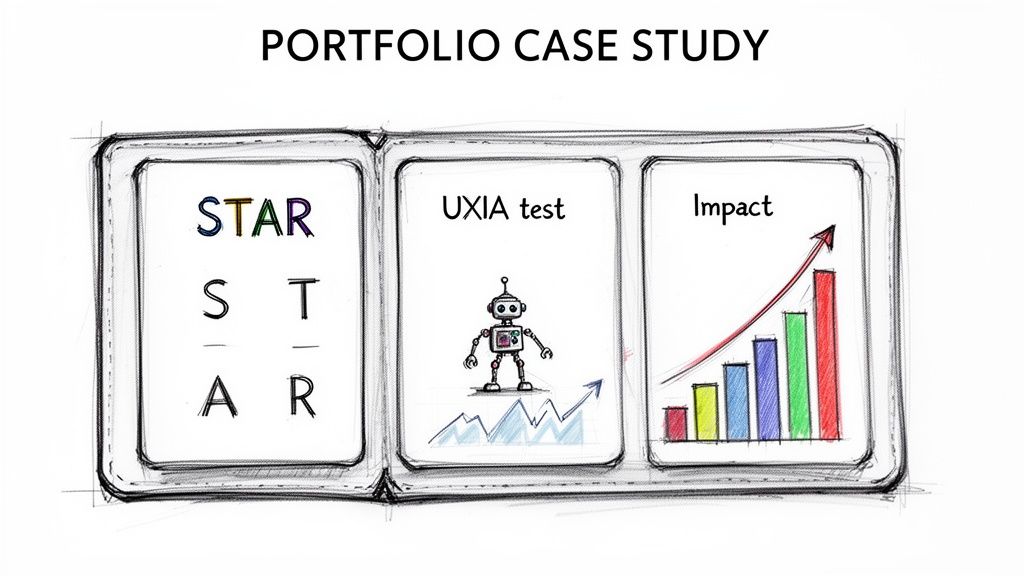
One of the most effective ways to structure a research case study is the STAR method. It’s a simple framework that forces you to tell a clear, logical story that a busy hiring manager can understand in minutes.
It breaks your project narrative into four critical parts:
Situation: Set the scene, quickly. What was the context? What product was it, and what was the core challenge or opportunity the team was facing?
Task: Get specific about your role. What was the central research question you were tasked with answering? What was the ultimate goal of your work?
Action: This is the core of your story. Detail the exact steps you took. What methods did you choose, and—crucially—why did you choose them?
Result: Connect your work to the outcome. What did you learn? How did your insights actually influence the product or the business? Always tie your findings back to a measurable impact.
Using this structure proves you can think strategically and link your day-to-day research directly to business goals. That’s a non-negotiable skill for any serious UX researcher.
Telling a Compelling Research Story
Your portfolio shouldn't just be a final report. It needs to walk the reader through the entire journey, mess and all. Show them your process and highlight the key decisions and pivots you made along the way.
Start by framing the problem from a business angle. Instead of a flat "I was asked to test the checkout flow," try something with teeth: "The business was seeing a 25% drop-off in the checkout funnel, and my task was to find out where and why." This instantly shows you're thinking about the bottom line.
Then, justify your methodology. Don't just state that you ran interviews. Explain why interviews were the right call over, say, a survey. Did you need to uncover deep-seated user motivations? Was the journey too complex for simple quantitative data?
Practical Recommendation: In your portfolio, don't just state the method. Add a "Methodology Rationale" subsection to explain why you chose a specific approach, what alternatives you considered, and why you rejected them. This showcases your strategic thinking.
This approach turns a simple project summary into a powerful story about your problem-solving skills. To see how this plays out in a real project, take a look at our fintech case study and how the research directly shaped product strategy.
Showcasing Modern Tools Like Uxia
In today’s product world, speed is a massive advantage. Hiring managers are desperate for researchers who can deliver solid insights without grinding development to a halt. This is where showing your fluency with modern tools gives you a serious edge.
When you write a case study, create a specific section that highlights how you used advanced platforms to work faster and smarter. You could even title a section "Accelerating Insights with AI" to make it pop.
Here’s exactly how you could frame it in your portfolio:
Project Example Using Uxia
Situation: A startup needed to validate three different onboarding flows for its new app. The catch? They had a one-week sprint deadline and zero users to test with.
Task: My job was to deliver data-backed proof on which flow was the most intuitive and trustworthy for new users—all before the development sprint ended.
Action: With no time for traditional recruiting, I turned to Uxia. I ran unmoderated tests on all three prototypes using AI-powered synthetic users that perfectly matched our target persona. In a few hours, I had full transcripts, heatmaps, and a clear summary of usability issues for each flow.
Result: The Uxia tests flagged a critical friction point in Flow A that would have tripped up real users. The AI-generated report proved that Flow C performed 40% better on key usability metrics. I presented these findings, the team confidently moved forward with Flow C, and we saved an entire sprint’s worth of development on a broken design.
This example does more than just name-drop a tool. It shows you know how to pick the right tool to solve a real-world business constraint (time) and deliver immediate, measurable value. That’s precisely what companies are looking for in a modern UX researcher job candidate.
Acing the Interview for a UX Researcher Job
Landing a UX researcher job is less about acing a test and more about navigating a series of strategic conversations. Think of it as your first research project: the company is the user, and your goal is to understand their needs and show how you're the solution.
From the first screening call to the final whiteboard challenge, each step is designed to see how you think. This is your chance to put your user-first mindset on full display and prove you can turn messy human problems into clear, actionable insights.
The process is a marathon, not a sprint. It usually starts with a recruiter chat and ends with deep-dives with the team you'd be working with. Your story needs to be consistent from start to finish, so get your research philosophy straight and be ready to tell it.
And since so much of this happens remotely now, getting comfortable on camera is non-negotiable. Knowing How to Prepare for a Video Interview is a skill in itself and crucial for making a solid first impression.
Answering Common Behavioural Questions
Hiring managers live in the real world, and they need to know how you’ll handle its challenges. They use behavioural questions to get past the resumé and understand your problem-solving process, how you collaborate, and if you can handle the heat.
One question you’re almost guaranteed to get is: "Tell me about a time you had to deliver difficult findings to stakeholders."
They're not just looking for a story about data. They want to see your communication chops and your ability to steer the ship, even when you’re delivering bad news. Practical Recommendation: Use the STAR method to structure your answer. This keeps your story concise and impactful, demonstrating clear thinking under pressure. Explain the situation, your task, the action you took (e.g., framing the insights constructively), and the positive result.
Get ready for these questions too:
"Describe a time your research contradicted a stakeholder's core belief. What did you do?"
"Walk me through a research project you're really proud of. What was the actual impact?"
"How do you decide which research method to use for a particular problem?"
The Portfolio Presentation
This is the main event. The portfolio presentation is where you stop telling them you're a great researcher and start showing them. It’s your chance to weave a compelling story backed by evidence.
Please, don't just click through your case studies. Pick one or two projects that scream "I am perfect for this role" and present them with a clear narrative arc. This is a strategic presentation, not just a show-and-tell.
Practical Recommendation: Your real goal in a portfolio presentation is to make your thinking visible. The final report is just an artefact. The why behind your decisions is where the magic is. Why that method? Why that user segment? Why did that insight matter? That’s what sells your expertise.
Structure your presentation like you would a research report. Start with the business problem, explain how you framed your research questions, walk them through your methodology, and—most importantly—tie your findings directly back to product and business impact.
Strategically Mentioning Modern Tools like Uxia
In a crowded job market, showing you’re efficient is a massive differentiator. Companies don't just want great insights; they want them fast. This is where mentioning your experience with modern tools like Uxia gives you a serious edge.
You don’t need a separate slide dedicated to tools. Instead, weave them naturally into your project stories. Show, don't just tell. Explain how a specific tool helped you solve a real-world constraint.
For example, when discussing a project with a crazy deadline, you could say:
"The team needed to validate a new flow in just three days, so traditional recruiting was off the table. I used Uxia to run unmoderated tests with AI-powered synthetic users to meet the deadline. Within a few hours, I’d found three critical usability blockers, which gave the team enough time to iterate before the sprint ended."
This short example does three things at once:
It shows you’re proactive: You saw a business problem (a tight deadline) and found a smart solution.
It demonstrates efficiency: You delivered real value in hours, not weeks.
It highlights modern skills: You're comfortable with AI-powered tools like Uxia that accelerate the research cycle.
A small mention like this positions you as a forward-thinking researcher who delivers results with speed and precision. For any UX researcher job today, that’s an incredibly valuable combination.
UX Researcher Salary and Career Paths in Spain
Let's talk about what really matters when you're considering a UX researcher job: your salary and where the career can take you. In Spain, the demand for sharp researchers is on the rise, and that’s good news for your wallet and your professional growth.
Your earning potential and career ladder are tied directly to your experience, the city you work in, and the specialised skills you bring to the table. While the entry point is solid, the real rewards come once you've got a few years of experience under your belt.
UX Researcher Salary Expectations in Spain
Experience is, without a doubt, the biggest factor driving your salary. As of 2025, the average salary for a UX Researcher in Spain hovers around €39,957. But that number is just a starting point, blending salaries from juniors to seniors across the country.
Let's break it down:
An early-career researcher with one to four years of experience can expect to earn around €39,304.
Once you hit that mid-career mark (five to nine years), the average jumps significantly to €66,000.
This trend shows just how critical a UX researcher job has become for companies in Spain. If you want to dig deeper into the numbers, you can check out the full salary findings from PayScale.
The leap from a sub-€40k starting salary to over €65k in your mid-career is a powerful incentive. It shows that constantly levelling up your skills pays off, especially as you master high-demand areas in Spain’s fast-moving UX market.
Location is another huge piece of the puzzle. Tech hubs are salary hotspots, and Madrid is the epicentre. In the capital, the average compensation for a UX researcher climbs to €54,584, making it a top destination for anyone serious about their career.
The Typical Career Trajectory
Your career as a UX researcher isn't just a straight line—it’s a ladder with some exciting rungs to climb. Most people follow a pretty standard progression, moving from hands-on execution roles to positions where they lead strategy.
This visual gives you a sense of the interview stages you'll face as you move up.
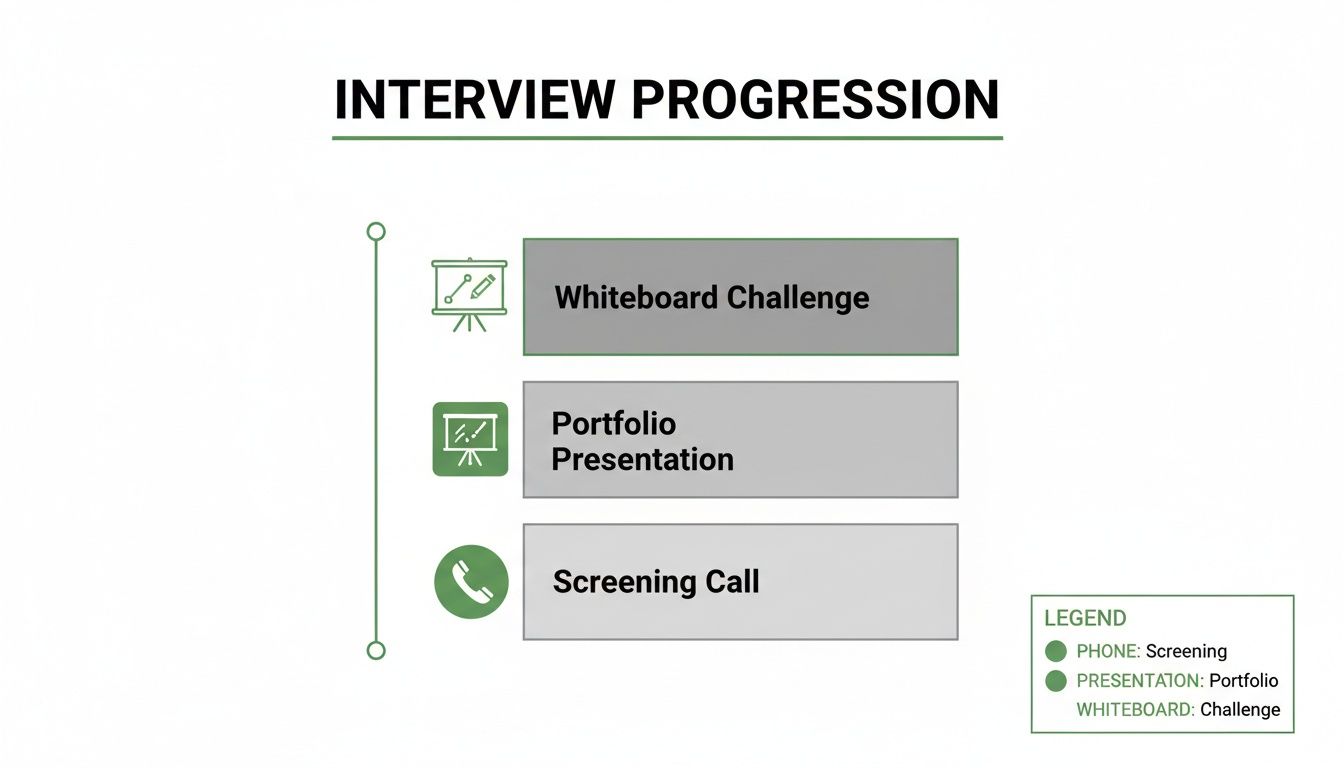
From the first screening call to the whiteboard challenge, each step is designed to test the skills you'll need for the next level of your career.
Here’s what that progression typically looks like:
Junior UX Researcher: Your main job is to execute. You'll run interviews, conduct usability tests, and help analyse data based on research plans created by senior team members.
UX Researcher (Mid-Level): This is where you start to own projects. You're creating the research plans, picking the right methods, and presenting your findings directly to stakeholders.
Senior UX Researcher: You become a strategic partner. You're not just running research; you're tackling complex, ambiguous business problems, mentoring junior researchers, and directly influencing product strategy.
Research Lead or Manager: At this stage, you're managing a team. You set the research vision for an entire product area and ensure your team's work aligns with the company's biggest goals.
Practical Recommendations for Increasing Your Earning Potential
Moving up the career and salary ladder doesn’t just happen—you have to make it happen. Here are a few practical steps to accelerate your growth:
Specialise in High-Demand Skills: Quantitative analysis is always valuable, but proficiency with modern, AI-powered tools is what will set you apart. Showing you can use platforms like Uxia to deliver fast, data-backed insights makes you a much more compelling hire.
Become a Great Storyteller: The difference between a junior and a senior researcher often comes down to storytelling. You need to translate messy data into a clear, compelling narrative that gets stakeholders to act.
Target High-Growth Tech Hubs: If you have the flexibility, aim for jobs in cities like Madrid or Barcelona. The concentration of tech companies drives salaries up.
Document Your Impact: This is crucial. In your portfolio and interviews, don't just list your activities. Connect your research to real business outcomes—like a 10% increase in conversions or a 20% drop in support tickets. Prove your value.
Frequently Asked Questions About UX Researcher Jobs
Got questions about breaking into UX research? You're not alone. Let's clear up a few of the most common ones we hear from people trying to land their first role.
Can I Get Into UX Research from Another Field?
Yes, and you absolutely should. Some of the sharpest researchers I know came from backgrounds in psychology, marketing, journalism, and even customer support. It's not about your job title; it's about your skills.
These fields build the exact muscles you need: empathy, sharp communication, and an analytical mind.
The trick is to reframe your experience. Practical Recommendation: Don't just say you were a "customer support agent." Instead, show how you "analysed user feedback to spot recurring pain points and reported them to the product team." That's UX research, right there.
To make the switch, focus on:
Connecting the Dots: Pinpoint exactly where you've studied human behaviour or used data to drive a decision.
Closing Your Gaps: Take courses or spin up personal projects to get fluent in formal research methods and tools. A great way to start is by testing an existing app you use with a tool like Uxia and creating a case study from the results.
Building Your Portfolio: Turn your past work or new projects into case studies that walk through your research process from start to finish.
Do I Need a Specific Degree for a UX Researcher Job?
No, a specific degree is not a requirement. While backgrounds in Human-Computer Interaction (HCI), psychology, or anthropology are helpful, hiring managers care much more about what you can do.
Your portfolio is your proof. It's far more important than your diploma.
A strong portfolio showing you can run research, analyse the findings, and deliver real insights will always beat a specific degree on a CV. Many of the best researchers are self-taught or pivoted from completely unrelated fields.
How Is AI Changing UX Research?
AI isn't replacing UX researchers—it's making them better and faster. AI-powered tools are taking over the most repetitive, time-sucking parts of the job.
This frees you up to focus on strategy, impact, and the 'so what' behind the data. Understanding and using these tools is no longer a 'nice-to-have'; it's essential.
Here’s what that looks like in practice on a platform like Uxia.
This screenshot shows how you can set up a complete usability test with AI-powered synthetic users in minutes. You define your audience and mission, and the platform does the rest. It completely removes the slow, expensive process of recruiting human participants, giving you insights almost instantly.
Platforms like Uxia handle tasks like:
Instant Recruiting: Generating synthetic users that match your target demographic perfectly.
Automated Moderation: Running unmoderated usability tests on autopilot.
Effortless Synthesis: Analysing session data and creating summary reports with key findings.
When you can use these tools, you're telling employers you deliver value with speed and efficiency. That makes you a much more compelling candidate.
How Much Can I Expect to Earn in Spain?
Let's talk numbers. Spain's tech scene is growing, and salaries reflect that. For UX researchers, the financial incentive is clear, especially in major hubs.
Madrid has become the country's salary epicentre for UX talent.
The median total compensation for a UX researcher job in the city is €54,584. This figure often includes bonuses on top of the base salary and sits well above the national average. As Spain's economy continues to digitise, companies are prioritising roles that can deliver insights quickly—making skills with AI testing tools like Uxia a huge advantage in competitive markets like Madrid.
You can see more data on Madrid's UX researcher salary landscape at Levels.fyi.
Ready to speed up your research and build a portfolio that gets you noticed? With Uxia, you can run usability tests in minutes, not weeks. Get data-backed insights from AI-powered synthetic users and deliver impact faster than ever. Start testing with Uxia today.