Audience and Sample: A Guide to Smarter UX Research
Define your audience and sample size for better UX insights. Learn how to prioritize accuracy over numbers and optimize research with platforms like Uxia.

Many teams still ask the wrong first question in UX research. They ask, “How many testers do we need?” when the sharper question is, “Are we testing with the right audience at all?”
That mistake gets more expensive in AI-powered research because speed removes an old excuse. When recruiting no longer slows you down, you can stop treating audience and sample as a compromise between rigor and practicality. You can define tighter audiences, run separate studies, and make decisions from cleaner signals instead of averaging everything into noise.
Audience and sample strategy works best when you stop chasing volume and start designing for relevance. In practice, that means a smaller, better-defined set of participants will usually outperform a larger, generic group for usability work.
The Problem with Chasing Big Numbers in UX Research
Big sample sizes sound safe. They look rigorous in a slide deck. They also hide a common failure mode: teams recruit broadly, blend incompatible users together, and end up with findings that are technically plentiful but strategically weak.
That happens all the time in product work. A team needs answers before the next sprint, so they cast a wide net. They test “consumers,” “mobile users,” or “frequent buyers” instead of the actual people who matter for the task. The result is familiar. Feedback gets diluted, priorities get fuzzy, and design decisions get justified by volume rather than relevance.
Why bigger often creates blur
A mixed audience can flatten meaningful differences. First-time users behave differently from returning users. Budget-conscious buyers evaluate trust differently from premium buyers. B2B admins use a workflow in a different way than frontline operators. If you force those groups into one large sample, you often get averages that no real user represents.
Practical rule: If the audience definition is vague, a larger sample usually gives you more confidence in the wrong conclusion.
This matters even more in synthetic testing. Some teams worry that AI introduces bias, but a recent industry analysis found that 74% of UX researchers remain skeptical about AI replacing human testers due to unresolved concerns about bias and lack of transparency, while the same analysis notes that the largest source of bias is often a poorly defined audience rather than the testing method itself, as discussed in this industry analysis on underserved market research questions.
The real cost of oversized studies
The waste isn't only statistical. It shows up in delivery.
Broader audiences create muddier findings. Teams spend more time debating whether an issue matters for core users.
Large mixed samples slow prioritization. You get more comments, but fewer clear patterns tied to a specific segment.
Over-recruiting can replace thinking. Instead of sharpening the research question, teams try to buy certainty with volume.
For qualitative usability research, “more” isn't the safest default. Precision is.
When I review weak studies, the issue is rarely that the sample was too small in absolute terms. It's that the audience was too loose for the decision the team needed to make.
Why Audience Accuracy Beats Sample Size
The strongest rule of thumb in audience and sample planning is simple: prioritize audience accuracy over audience size. A small group that closely matches your target users will usually produce more useful insight than a large group of loosely relevant participants.
That's not a philosophical preference. It's a practical one. If you're testing a checkout flow for first-time riders in a transit app, feedback from experienced commuters can sound valid while still missing the problem. They already know the language. They already understand the steps. Their familiarity masks friction.

Targeting the right pond
A good audience strategy is like fishing in the right pond instead of dragging a net across the whole coastline. You don't need more fish. You need the species you are studying.
Empirical data from over 200,000 hours of UX research supports the efficiency of small samples and shows that core usability issues are typically uncovered within the first testing sessions when the audience is well defined, as summarized in this review of UX sample size schools of thought.
That finding matches what experienced researchers see in practice. The early participants reveal the dominant friction points if they closely resemble the intended users. If they don't, you can run twenty more and still miss the issue that matters.
What this changes in AI-powered testing
Synthetic testing removes much of the old recruitment burden. That changes how smart teams should work.
Instead of asking one broad audience to stand in for everyone, run separate tests for distinct segments. Compare first-time users with experienced users. Compare one geography with another. Compare buyers with evaluators. The question becomes strategic: which audience definition gives you the clearest signal for the decision in front of you?
A few rules of thumb help:
Start narrow. Define the audience around the exact decision you need to make.
Split segments instead of blending them. Separate tests usually beat one mixed sample.
Treat representativeness as a design choice. Good sampling starts before the first test runs.
A generic audience gives generic answers. Specific audiences reveal why people struggle.
That's the central shift in modern audience and sample work. It's no longer constrained mainly by recruiting logistics. It's constrained by how clearly the team defines who the product is for.
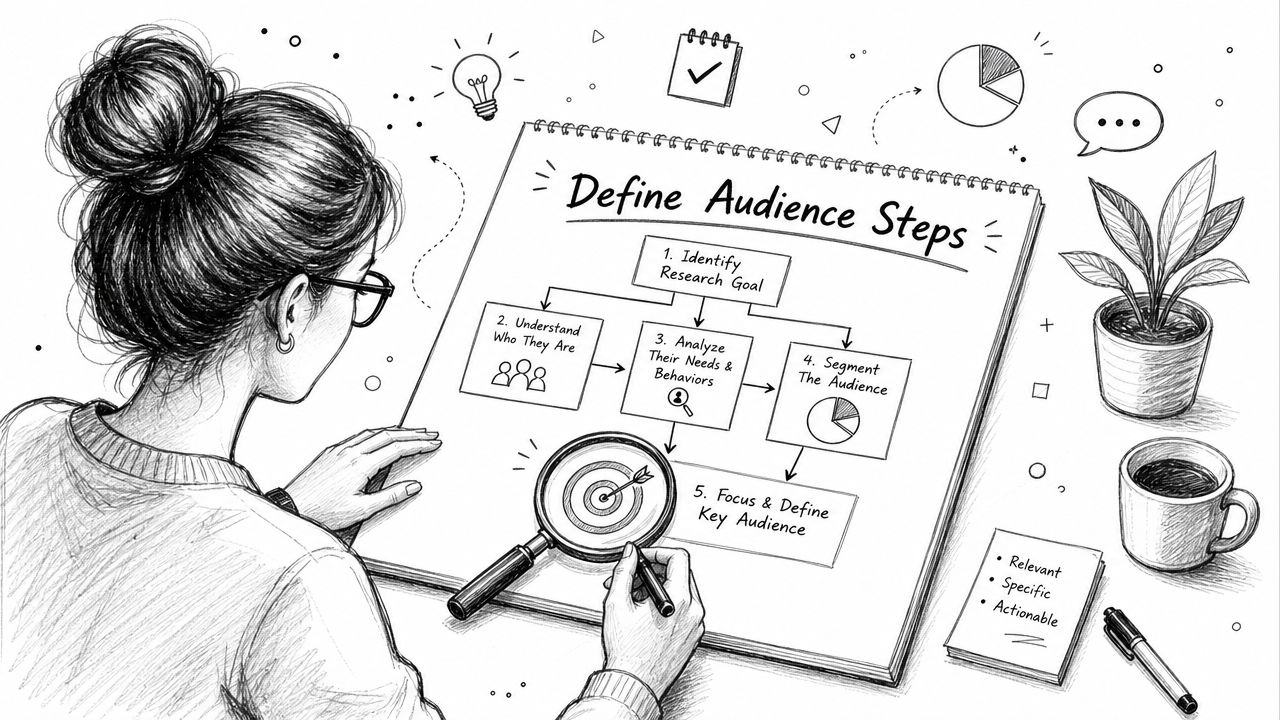
How to Define Your Research Audience
A useful audience definition has to do more than sound plausible. It needs to map to the behavior you're trying to observe. The strongest starting point is still the target user's demographic and psychographic profile, because that's what makes the sample representative enough to produce valid insight, as explained in this guide to target audiences in user research.
Start with the job, not the population
Many teams begin with broad descriptors like age, country, or industry. Those can matter, but they shouldn't be the first filter. Start with the job the user is trying to do in the moment you're testing.
For a consumer product, that often means combining demographics with behavioral context. For a B2B workflow, role and domain knowledge usually matter more than age or gender. An operations manager evaluating reporting permissions is not interchangeable with an end user entering daily data, even if both work at the same company.
Use this sequence when defining your audience:
Name the decision you need the research to support.
Describe the user in context. Include familiarity level, intent, constraints, and environment.
Add segmentation traits only if they change behavior. Geography, device habits, accessibility needs, company size, or domain expertise can all matter when they affect the experience.
Exclude lookalikes. A user who seems adjacent to the target audience can still produce misleading feedback.
Write the audience as a testable profile, not a marketing persona headline.
If you need a structured way to document that setup before launching a study, these research plan templates for publishers are a useful reference because they force clarity on audience, method, and decision criteria.
Adjust the audience by product stage
Early-stage research benefits from a tighter audience. You want a smaller group of highly representative users who can expose major friction quickly. As launch gets closer, you widen coverage to include more segments, more experience levels, and more edge cases.
Here's a practical reference point.
Context | Primary Focus | Example |
|---|---|---|
Early-stage consumer concept | Core behavior and motivation | First-time mobile shoppers comparing products on a phone |
Pre-launch consumer validation | Segment coverage and edge cases | New and returning users across different experience levels |
Early-stage B2B workflow | Role and domain expertise | Finance admins reviewing approval logic |
Pre-launch B2B rollout | Organizational variation | Users by company size, product familiarity, and team function |
A clear audience definition also improves persona work later. If your team is refining target segments, this guide to creating a user persona strategy for 2026 is a practical companion because it connects audience inputs to decision-ready personas.
Later in the process, a short walkthrough can help teams align on what belongs in scope and what doesn't.
What changes between B2C and B2B
The mistake in B2C is usually oversimplification. Teams define users by age band and location, then ignore intent, habits, or trust expectations.
The mistake in B2B is the reverse. Teams describe the company and forget the person doing the work.
For consumer products, prioritize behavior, device context, familiarity, and motivation.
For B2B tools, prioritize role, permissions, expertise, company environment, and product familiarity.
For late-stage testing, expand to include accessibility needs and segment differences that could affect launch readiness.
The audience should feel almost uncomfortably specific. That's usually a sign you're close.
Determining Your Optimal Sample Size with Confidence
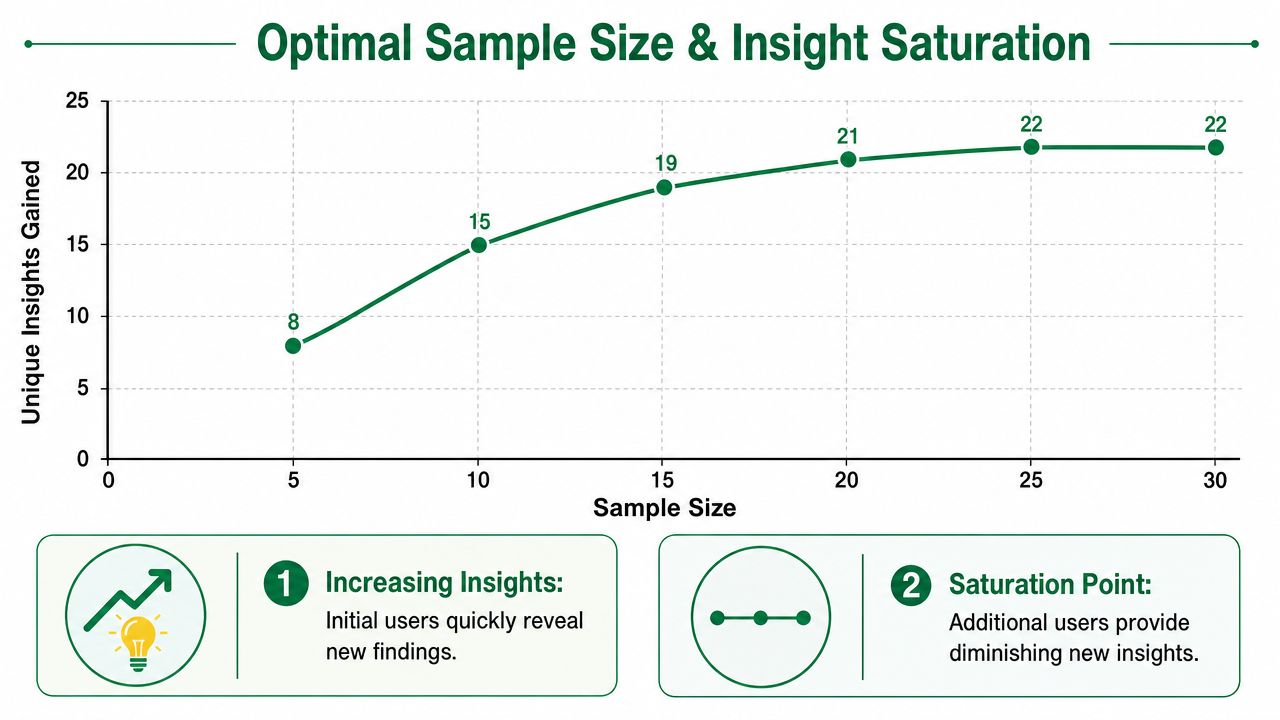
Once the audience is right, the sample-size question becomes easier. The best operational answer isn't “as many as possible.” It's until you reach insight saturation.
Insight saturation is the point where additional testers stop surfacing meaningfully new usability problems. That's the signal I trust most. If the next participants keep confirming the same friction points, your sample is probably doing its job. If every new tester reveals a different class of issue, the audience definition may be too broad or the sample may still be too small.
A practical starting point
For most usability studies, starting with 10 synthetic testers is a strong default. Based on the Nielsen Norman Group mathematical model, testing with 10 synthetic testers on the Uxia platform allows teams to uncover approximately 97 to 98% of usability issues, compared with about 85% with 5 human users, as described in Uxia's explanation of the model and issue detection coverage.
That's a better way to think about sample size than treating every study as if it needs a survey-scale headcount. In qualitative UX work, the point is to reveal the main breakdowns in comprehension, trust, navigation, and task completion. A compact, well-matched audience is often enough to do that.
When to add more testers
Don't add participants because the number feels small. Add them because the evidence says you need them.
Use these checks:
Consistency of findings. Are multiple testers independently hitting the same friction point?
Confidence of issues. Do the observed problems look clear enough to support a design decision?
Segment complexity. Are you testing one audience or comparing distinct user groups?
Saturation. Are new testers still surfacing new categories of breakdown?
When findings repeat across testers and new sessions mostly confirm what you already know, you've likely hit a useful sample.
If you're comparing markets or user types, do not inflate one mixed sample. Run separate studies per audience. That gives you cleaner signal and avoids one segment drowning out another. If your team wants a broader methodology for planning those studies, this guide to faster user research methodology is a helpful companion.
How the Right Audience Uncovers Hidden Flaws
One of the clearest examples came from testing a public transportation app. On the surface, it looked straightforward. Existing users moved through the flow with little visible strain because they already understood the system. If we had stopped there, the team might have concluded the experience was in good shape.
Then the audience changed. Instead of regular commuters, the study focused on first-time visitors.
What the new audience revealed
The first-time audience struggled in three places.
Terminology confusion. Labels that regular riders treated as obvious were unclear to newcomers.
Payment expectations. New users didn't always understand when payment happened, what options were accepted, or what they needed before starting.
Ticket flow comprehension. The purchase path assumed background knowledge that first-time visitors didn't have.
Those are not minor usability polish issues. They affect confidence, progression, and whether someone completes the task at all.
Why experienced users missed it
Regular commuters had already learned the product's language. They had adapted to the flow and built expectations from repeated use. That made them useful for some questions, but the wrong audience for evaluating initial clarity.
Consequently, synthetic testing becomes strategically valuable. You can define an audience around “first-time visitor” behavior instead of relying only on whoever is easiest to recruit. That lets researchers isolate the exact perspective they need to test.
If your team is weighing where synthetic participants help most and where human testing still matters, this comparison of synthetic users vs human users is worth reading.
Changing the audience can completely change the insights. The interface didn't change. The user lens did.
That's why audience and sample decisions should happen before anyone debates sample size. A perfectly sized study with the wrong audience still produces the wrong lesson.
The ROI of Optimized Audience and Sample Strategy
The highest-return research program is rarely the one with the biggest sample. It is the one that gets the right audience in front of the right question at the right stage.
That changes the economics of UX work.
Poor audience and sample choices create two costs. The first is obvious: time spent running a study that should have been narrower. The second is more expensive: teams act on findings that do not transfer cleanly to the users or moments that matter. That leads to avoidable redesign work, low-confidence decisions, and another round of testing to sort out what was correct.
Better audience choices cut rework
A design team pays for weak sampling twice. It pays during fieldwork, then again after the study when broad, mixed signals force the team to debate severity, relevance, and priority instead of fixing the problem.
A tighter audience definition shortens that path. Findings are easier to interpret. Patterns are easier to trust. Product teams can connect observed issues to roadmap decisions without spending a week arguing about whether the sample matched the user they were trying to serve.
AI-generated participants change the math here. Recruitment used to be the hard constraint, so teams often widened the audience just to get enough people through the study. Synthetic testing removes much of that pressure. Researchers can test a narrow segment early, learn faster, and reserve human recruitment for the questions that need it.
Research from Stanford and Google reported that LLM-based simulated respondents matched human response patterns on many survey measures, with correlations often above 0.8 in the tested scenarios, as summarized in this report on algorithmic fidelity in synthetic audiences. That is useful for directional work, concept screening, and early usability triage. It is not a substitute for every study.
What strong ROI looks like
Strong ROI comes from sequencing methods instead of treating every study like a full human-recruitment exercise.
Use synthetic participants early for first-pass usability checks, message comprehension, and comparing design routes.
Keep audiences narrow on purpose so the findings map to a real decision, not a blended average.
Use human participants for critical validations such as accessibility validation, emotionally sensitive journeys, trust-heavy flows, or evidence needed for formal sign-off.
This approach improves speed and accuracy at the same time. Teams learn sooner which problems are obvious, which segments react differently, and which questions deserve the cost of live recruitment.
Used well, synthetic research does not replace human research. It protects it. It keeps human sessions focused on nuance, edge cases, and decisions where lived experience matters most.
The business case is simple. Better audience targeting produces findings that are more relevant. Smaller, better-chosen samples reduce wasted effort. Faster rounds of synthetic testing help teams fix basic flaws before development hardens them into expensive product debt.
Audience and sample strategy is not a setup detail. It is one of the clearest ways to improve research ROI.