
A Guide to Creating User Persona Strategy for 2026
Learn how creating user persona insights can transform your product strategy. Use our guide on research and validation with Uxia AI testers.
Many organizations don't have a persona problem. They have an alignment problem.
Product is prioritizing one kind of user. Design is solving for another. Marketing is writing to a third. Sales is feeding back requests from the loudest prospects, and support is sitting on the clearest evidence of what's broken. Creating user persona work matters because it gives those teams a shared model of the customer they're building for, not a pile of disconnected opinions.
The catch is that most personas never become operational. They get made during a workshop, exported to slides, and ignored the moment roadmap pressure kicks in. The teams that get value out of personas treat them as living decision tools, then validate and refresh them as the product and market change.
Why Most Personas Fail and How to Avoid It
A persona fails when it's decorative. You can spot it quickly. It has a stock photo, a first name, a few demographics, and no clear connection to product decisions, messaging choices, or research evidence.
That kind of artifact doesn't survive contact with sprint planning.
The business case for doing this properly is strong. 71% of companies that exceed revenue and lead goals have formally documented personas, and those high-performing companies are seven times more likely to keep them updated according to Delve AI's buyer persona statistics roundup. The signal isn't just “make a persona.” It's “document it, use it, maintain it.”
What failure usually looks like
Three patterns show up again and again:
Teams invent the user from internal opinion. Sales describes the buyer. Product describes the power user. Marketing describes the ideal account. Nobody resolves the differences.
The persona is too broad to guide trade-offs. “Busy professional” won't help a designer decide what to simplify or help a PM decide what to ship first.
Nobody owns maintenance. Even a well-researched persona degrades when customer behavior, product scope, or market conditions shift.
Personas should reduce debate, not add another artifact to debate about.
What works in practice
A persona becomes useful when it answers the questions teams face during delivery:
Team | Decision they need help with | What the persona must clarify |
|---|---|---|
Product | What problem matters most | Primary goals, urgency, constraints |
Design | What to simplify or emphasize | Behaviors, friction points, mental models |
Marketing | How to frame value | Buying triggers, trust needs, language cues |
Sales | How to qualify fit | Decision style, objections, evaluation context |
The practical rule is simple. Build personas that can survive a planning meeting. If a persona can't shape backlog priority, copy direction, onboarding choices, or test audience setup, it isn't finished.
That's also where a living workflow matters. Static documents decay. Teams need a way to check whether the persona still matches what they're seeing in interviews, support logs, analytics, and usability feedback.
Laying the Foundation with Quality Research
If you're creating user persona profiles from assumptions, you're not doing research. You're casting characters.
The most common mistake is trying to move too fast into profile writing before collecting enough signal. Personas built without data have a 68% failure rate in guiding decisions, and as few as 5 interviews per target persona can yield up to 70% pattern detection according to Mural's guide to creating user personas.
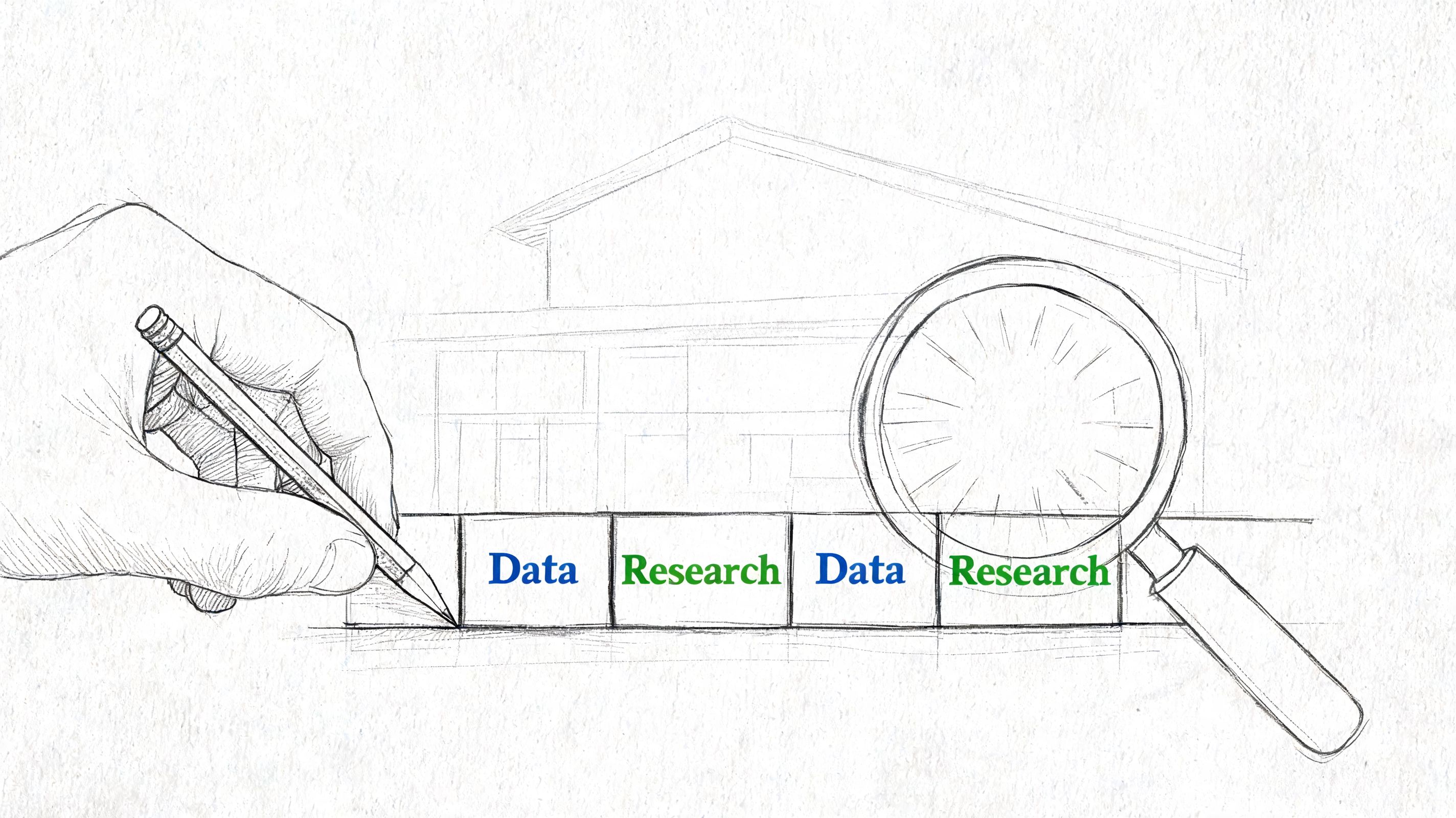
Start with sources that show real behavior
You need both qualitative and quantitative inputs. One tells you what people do and struggle with. The other helps you judge how often patterns appear and where they show up.
A solid input mix usually includes:
User interviews for motivations, language, workarounds, and decision criteria
Support tickets and chat logs for recurring friction and misunderstood features
Product analytics for task frequency, drop-off points, and usage patterns
Survey responses for self-reported goals, satisfaction, and comparative feedback
CRM and account context where relevant, especially for B2B buying roles
Existing segmentation work if marketing or customer success already has useful clustering
Language and demographic filters when geography, role, or literacy context affects product use
For interview planning, weak questions produce weak personas. A practical prompt bank like the Humantext.pro research questions article helps sharpen the difference between surface-level questions and prompts that uncover motivations, constraints, and task context.
What to capture in the research itself
Interview notes should not just say what users “like” or “don't like.” Capture the operating context.
Look for:
Trigger moments. What starts the task or buying journey?
Success definition. What does “done” or “good enough” mean to this user?
Failure cost. What happens if they choose wrong, get blocked, or waste time?
Decision style. Fast and intuitive, or cautious and evidence-heavy?
Tool familiarity. Are they experts comparing fine details, or newcomers trying not to make mistakes?
Trust expectations. What makes the product feel credible, clear, or risky?
Practical rule: Don't ask only what users want. Ask what they're trying to avoid.
If your team needs a sharper process for gathering interview evidence before synthesis, this guide on how to conduct user interviews is a useful reference for tightening scripts, follow-ups, and note structure.
Research also improves AI-generated audiences
Modern persona workflows don't stop at manual documents. The same research base can define synthetic audiences for testing and validation.
The strongest audience setups use layered inputs. Start with demographic and language filters. Add product context. Then enrich with prior interviews, survey findings, internal customer knowledge, or niche domain constraints when the audience is specialized. That's especially important for products with narrow user groups, such as financial buyers, regulated industries, or tools for expert operators.
The quality of the persona always depends on the quality of the source material. Better inputs create cleaner segments. Cleaner segments create better decisions.
From Raw Data to Coherent Persona Profiles
Research creates noise before it creates clarity. That's normal.
You'll have interview transcripts, survey exports, usage notes, support themes, and stakeholder observations that don't line up neatly at first. The job isn't to summarize everything. It's to identify stable patterns that matter for product and design decisions.
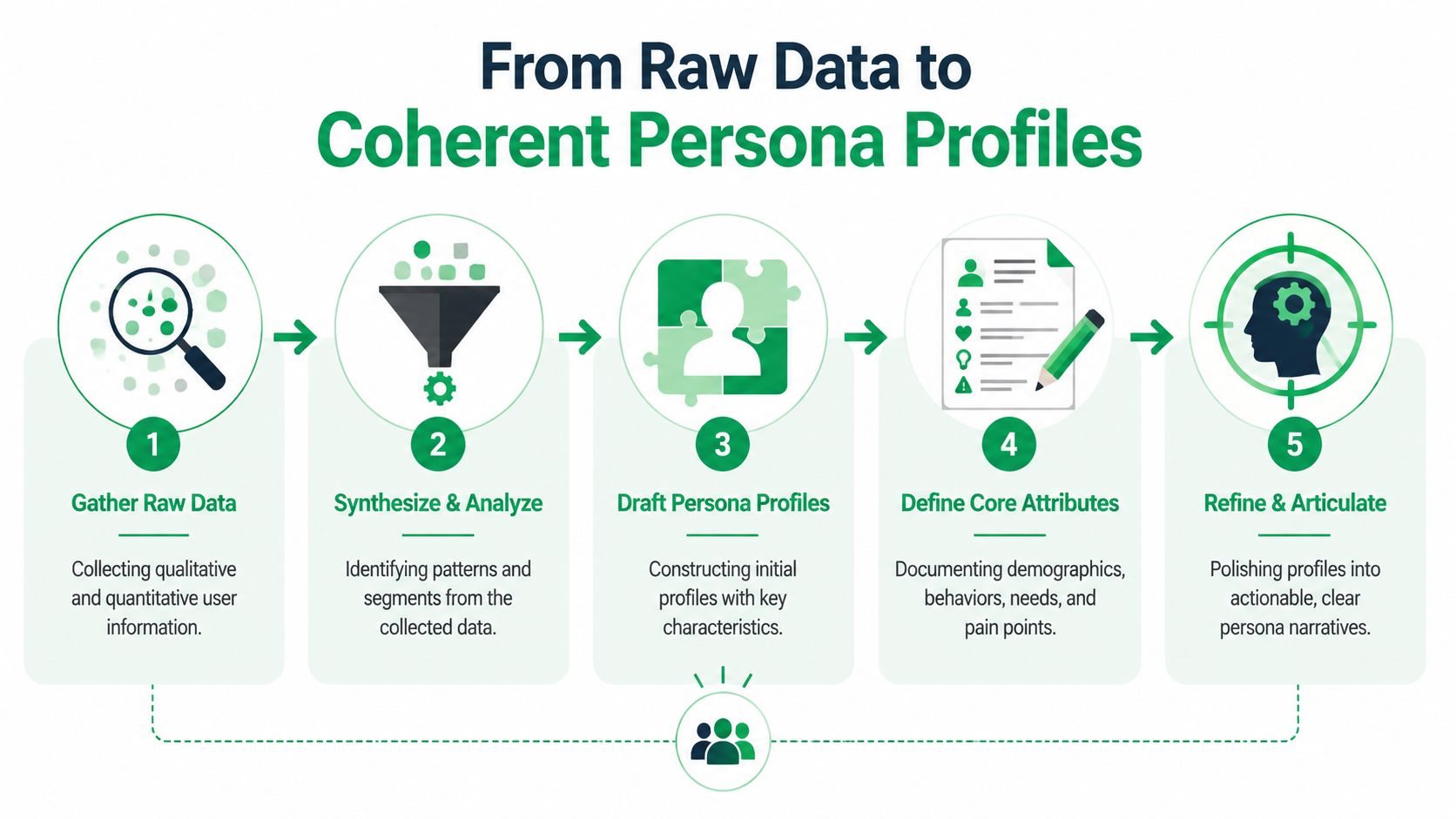
Find patterns in behavior, not biography
Start by grouping observations into clusters such as goals, barriers, trust signals, workflow habits, decision speed, and product familiarity. Affinity mapping works well here because it forces the team to externalize what it thinks it heard, then compare overlaps and contradictions.
If your team wants a stronger synthesis method, this guide to qualitative analysis techniques for researchers is useful for tightening coding, theme development, and comparison across interviews.
Then pressure-test each cluster with a simple question: does this difference change what we build, how we present it, or how we test it? If the answer is no, it probably doesn't deserve to define a persona.
Use a small set of core personas
Teams usually overproduce here. They try to preserve every edge case in the main persona set and end up with profiles nobody remembers.
The practical range is 3 to 5 core personas, and cognitive load research supports that because people struggle to hold more than 5 to 9 distinct items in working memory according to QCRI's analysis of how many personas to create. That range is enough to represent meaningful variation without overwhelming the people who need to use the personas every week.
A useful split often looks like this:
Persona type | What distinguishes it | Why it matters |
|---|---|---|
Primary persona | Most important recurring use case | Shapes core roadmap and UX choices |
Secondary persona | Different workflow or constraints | Prevents overfitting to one user type |
Influencer or evaluator | Reviews, approves, or validates | Affects trust, proof, and buying friction |
Edge or accessibility profile | Important but not universal needs | Informs specific scenarios and safeguards |
Draft the profile from evidence
Once the clusters are stable, write the persona as an archetype, not a biography. Give it enough detail to be memorable, but only include traits that help teams act.
Good synthesis usually means:
Name the role or pattern clearly rather than writing a clever label
Lead with goals and constraints instead of age and hobbies
Include behavior signals such as comparison habits, urgency, and trust sensitivity
Add representative context from research language without inventing quotes
Separate core personas from niche variants so the main set stays usable
If two personas have the same goals, same blockers, and same decision style, they're probably one persona with different demographics.
A coherent persona set is small, distinct, and tied to the choices your team has to make.
Crafting a Persona Template That Drives Action
Most persona templates are overloaded with low-value fields. Age, city, family status, favorite brands, and a made-up quote might make the slide look complete, but they rarely help a team ship better work.
That's why demographic-heavy personas underperform. 52% of personas underperform because they overemphasize demographics, while a 60/40 behavior-to-demographic split produces more actionable insight for product teams. That's the standard worth following here.
Build around behavior and operating context
A useful template answers four things fast: what this user is trying to do, what gets in the way, how they make decisions, and what they need to trust the experience.
For specialist products, domain familiarity matters just as much as role. A senior finance leader evaluating software behaves differently from a junior generalist, even if both work in the same company. The finance leader will usually care about workflow efficiency, precision, clarity, and risk exposure. They'll have low tolerance for ambiguity and a strong expectation that the product behaves like other enterprise tools they already know.
That's the difference between a persona that sounds realistic and one that drives action.
If you need a working starting point, this user persona template is a practical structure to adapt rather than inventing fields from scratch.
Actionable Persona Template Fields
Section | Key Fields | Example (Finance Leader Persona) |
|---|---|---|
Snapshot | Role, product context, core job to be done | Senior finance leader evaluating software for workflow efficiency |
Goals | Primary outcomes, success definition, urgency | Reduce friction, maintain accuracy, make decisions confidently |
Frictions | Recurring blockers, failure risks, trust gaps | Low tolerance for unclear copy, hidden logic, or vague workflows |
Behavior | Task frequency, comparison habits, research depth | Evaluates carefully, expects structured information, checks for consistency |
Decision style | Risk tolerance, approval habits, proof needs | Cautious, detail-oriented, wants clarity and credible signals |
Context | Domain familiarity, environment, constraints | Familiar with enterprise tools, working in high-stakes operational context |
Messaging cues | Language that resonates or backfires | Responds to precision, transparency, and time-saving proof |
Cut anything your team won't use
This is a good test. If a field won't help a PM prioritize, a designer simplify, a writer frame value, or a researcher recruit the right audience, remove it.
A useful analogy comes from brand work. A strong professional identity isn't built from random facts. It's built from attributes that signal how someone operates and why others trust them. That same principle shows up in this guide for professionals on personal branding, and it maps well to persona design: the useful details are the ones that affect perception and decisions.
The persona card should be concise enough to scan in a meeting and specific enough to shape an actual trade-off.
Validating and Refining Personas with AI-Powered Testing
A persona is still a hypothesis after synthesis. It becomes credible when the patterns in the profile keep showing up in testing.
That validation loop used to be slow. Teams would create personas, run separate studies months later, and discover too late that the profile was too broad, too polished, or already outdated.
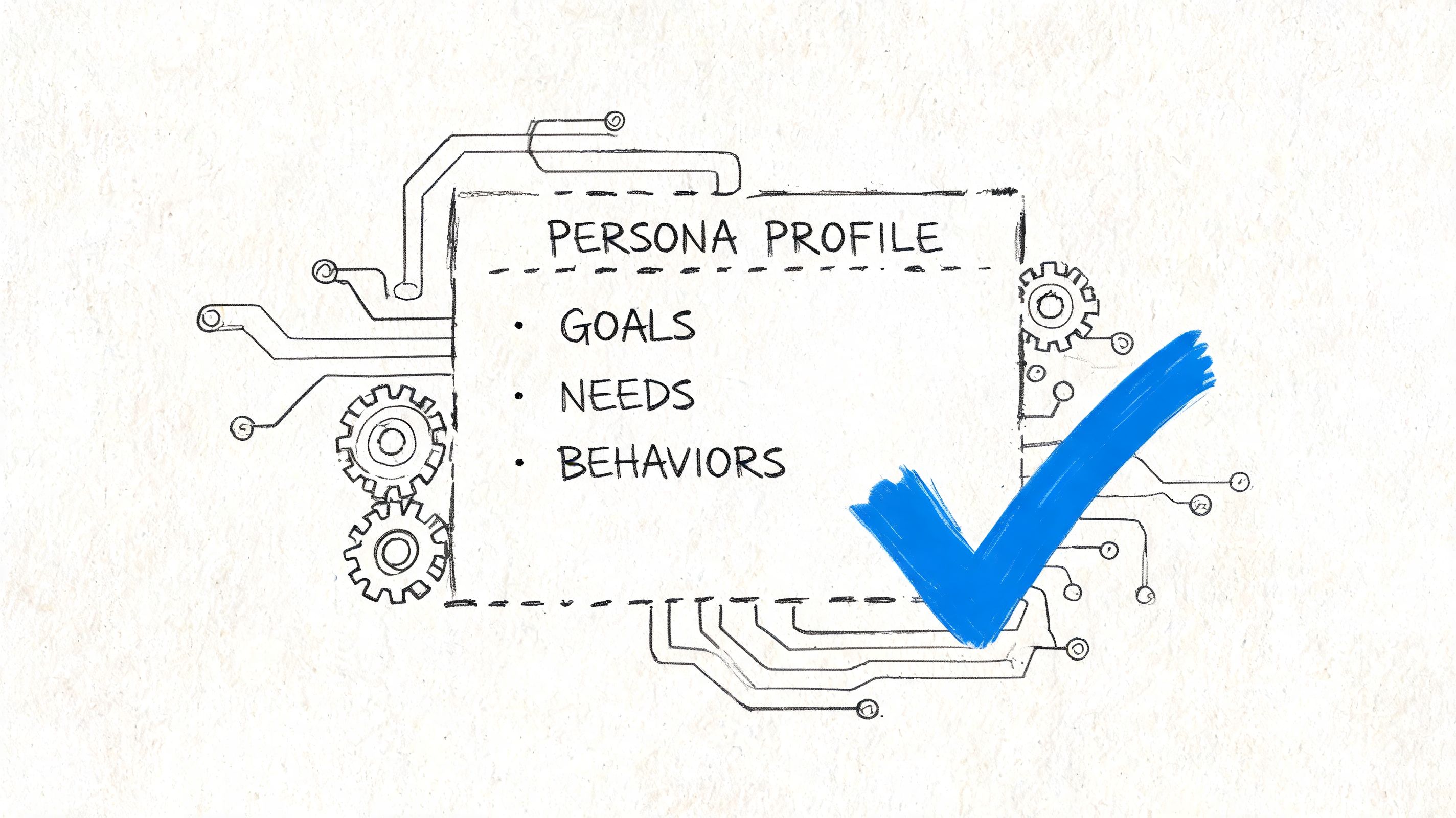
Modern AI tools change the cadence. AI platforms can analyze test transcripts for behavioral patterns, and Uxia's internal metrics show an 85% pattern match between insights from its synthetic testers and traditional human tests according to UX Design's accessibility persona article. That makes persona validation far more practical as an ongoing workflow instead of a heavyweight project.
A simple validation loop that teams can sustain
Use this sequence:
Ground the persona in existing research Start with the evidence you already trust. Interviews, support data, surveys, and product context come first.
Define a test audience from the persona Translate the persona into behavioral and contextual filters. Include domain knowledge, decision style, urgency, and clarity expectations where relevant.
Run focused usability tasks Test the flows where that persona should behave differently from others. Onboarding, pricing evaluation, dashboard interpretation, form completion, and approval workflows are common examples.
Compare output with known patterns Check whether the same friction points, trust concerns, and comprehension gaps show up that you've already seen in real research.
Refine the persona If the evidence doesn't match, fix the profile. Don't defend it.
One practical way to do this is with synthetic user testing workflows, where teams define an audience, run targeted tasks, and review structured transcripts for repeat patterns.
What to enrich in the audience definition
The strongest synthetic persona setup is layered, not generic.
Add:
Prior user research so the audience reflects known behaviors
Demographic and language filters when these affect comprehension or expectations
Product context so testers react to the right workflow and stakes
Client-specific knowledge such as CRM patterns or existing segmentation
Niche enrichment for specialist users, like senior finance buyers or expert operators
Here's a useful walkthrough of how AI-generated user personas fit into product work:
Validation gets easier when the output is traceable. Transcripts, task-level friction, and summarized patterns are more useful than a black-box score.
Treat personas as versioned assets
The strongest teams don't ask whether the persona is “done.” They ask whether it still matches current evidence.
That shifts persona work from a one-time workshop to a living system. The profile informs audience setup. Testing produces new evidence. The evidence sharpens the profile. That cycle is what keeps personas relevant enough to use.
Putting Your Personas to Work Across the Organization
A persona has no value in storage. It has value in use.
The fastest way to kill adoption is to make personas feel like UX documentation that other teams are expected to respect but never touch. The opposite works better. Put personas inside the workflows people already use.
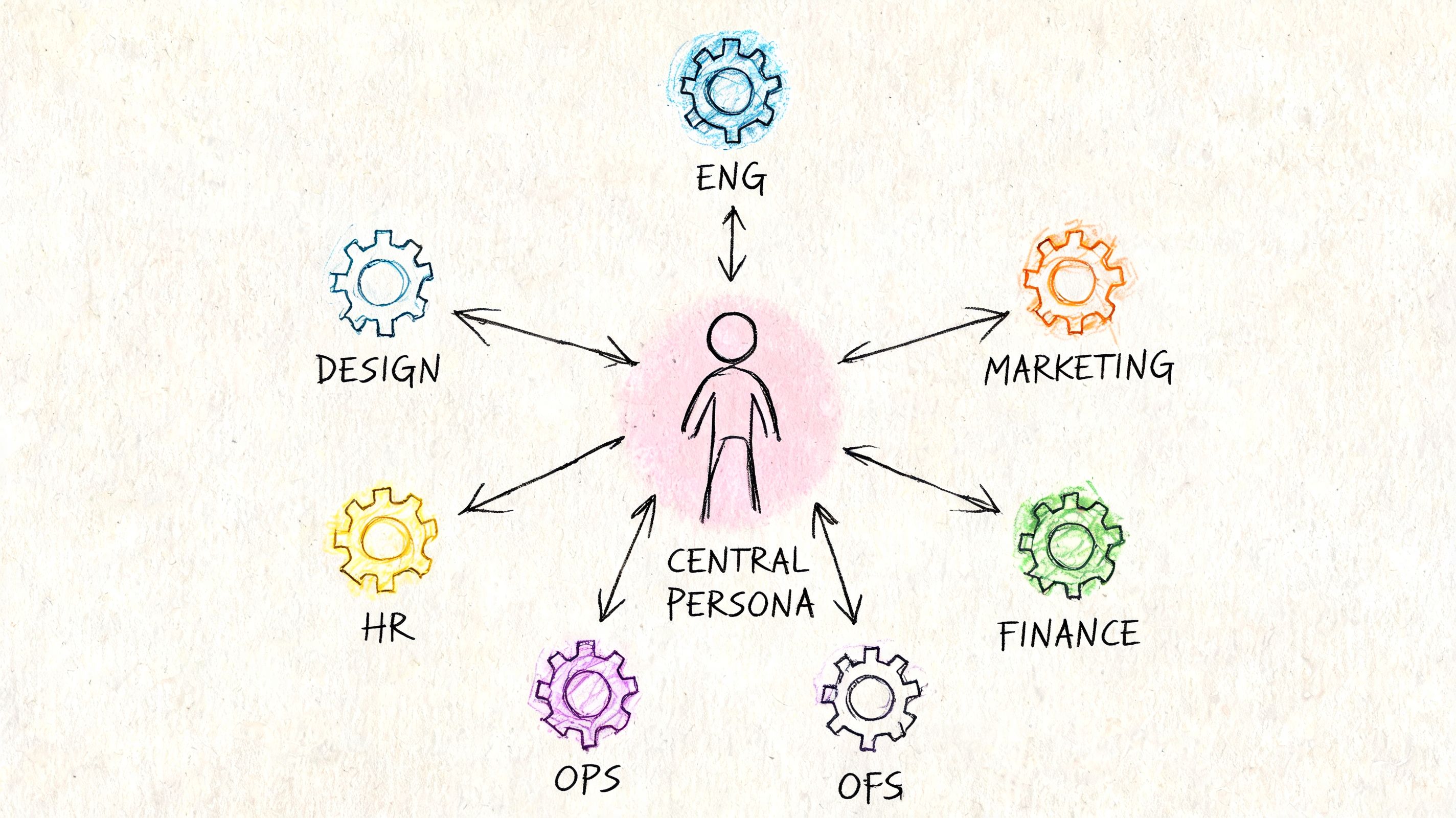
When that happens, the business impact shows up in the numbers. B2B companies using user personas generate 97% more website-generated leads and 124% higher website-generated sales than companies that don't according to the same Delve AI source cited earlier.
How different teams should use them
Don't ask every function to use personas the same way. That's where adoption stalls.
Product managers should use personas when shaping problem statements, prioritizing user stories, and deciding which constraints matter most.
Designers should reference them in critiques and reviews. Not as a ritual, but as a check on whether the interface fits the target user's mental model.
Marketing teams should use them to sharpen message framing, trust signals, and landing page structure.
Sales and success teams should use them to distinguish fit, objection patterns, and expectations during onboarding.
A simple operating model works well:
Workflow | How the persona appears |
|---|---|
User stories | “As a [persona], I need…” grounded in real constraints |
Design review | “Would this make sense to our cautious evaluator?” |
Copy review | “Does this language reduce ambiguity for this audience?” |
Testing setup | “Which persona should run through this flow first?” |
Build rituals, not just documents
Adoption comes from repetition.
Use a few lightweight habits:
Add the persona name to planning artifacts so the audience is visible when trade-offs are made
Tie every major flow to a primary persona and a secondary one where needed
Bring persona evidence into critiques using clips, support excerpts, or transcript snippets
Review persona fit after launches so the profile evolves with actual behavior
The best persona is the one people reference without being told to.
This matters even more in fast-moving product teams because speed creates drift. New features pull the product into adjacent segments. New stakeholders bring in new assumptions. Without a shared persona system, the product slowly starts serving whichever voice was most recent or most forceful.
Operational personas prevent that. They create continuity across discovery, design, testing, messaging, and iteration. They also make specialized testing more efficient, because teams can define audiences consistently instead of rebuilding them from scratch every time.
Creating user persona work is worth the effort when the result is living, testable, and embedded in daily decisions. That's when it stops being a UX exercise and starts acting like product infrastructure.
If your team wants to move from static persona slides to continuous validation, Uxia gives you a practical way to define synthetic audiences, test flows against them, and compare structured findings with your existing research so personas stay current and usable.