AI Interviews at Scale a Guide to 10x Faster Research
Learn how to run AI interviews at scale. Our guide covers benefits, implementation, and how Uxia's AI moderation delivers insights 17x faster.

Many organizations get the order wrong. They spend their time polishing interview guides, then wonder why large-scale AI interviews produce shallow or misleading output.
The critical element is the audience. That's especially true now that AI interviewing has moved from niche experimentation into mainstream operations. In hiring, 45% of companies now use AI interviewers for screening and interviewing candidates at scale, according to this roundup of AI interview statistics. In UX and product research, the same operational shift is underway. Teams aren't only asking whether AI can ask questions. They're asking whether it can run a serious research program across markets, languages, and segments without drowning the team in scheduling and synthesis.
That's where AI interviews at scale become useful. Not as a novelty. As an operating model.
What Exactly Are AI Interviews at Scale
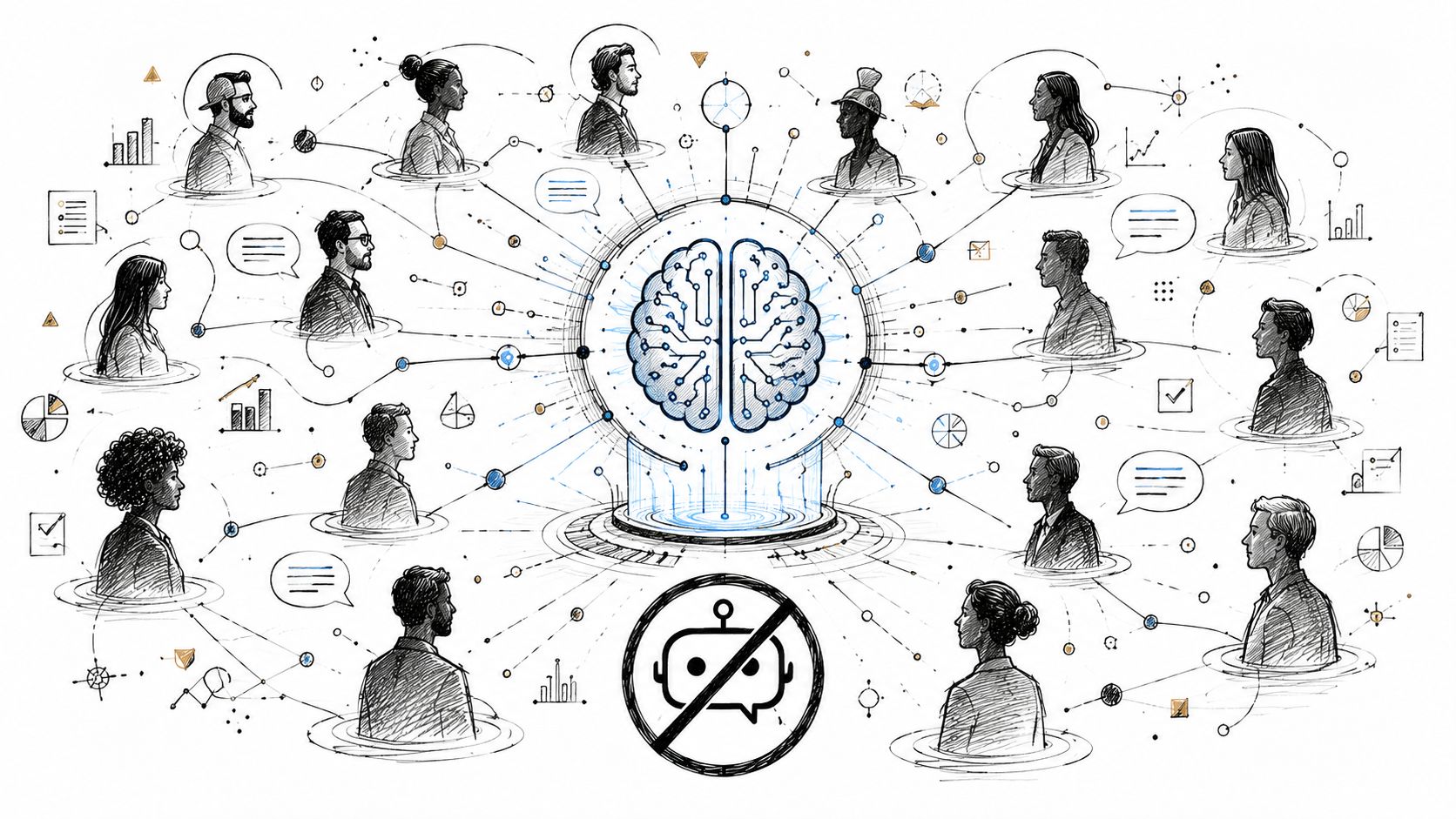
AI interviews at scale aren't just chatbots with nicer prompts. They're a structured research system for running many interviews in parallel, under a defined framework, with outputs that can be compared across participants.
In practical terms, the shift is operational. Instead of a researcher moderating one session at a time, an AI agent conducts many sessions simultaneously, captures the responses, structures the evidence, and returns a usable body of data. In hiring contexts, this model already allows hundreds or thousands of candidates to complete structured interviews without scheduling coordination or interviewer involvement, acting as a first-round filter that turns raw applications into a manageable queue, as described in this explanation of AI interviews for high-volume hiring.
What makes them interviews rather than surveys
The difference is the follow-up logic.
A survey records answers to predetermined fields. An AI interview works more like a structured moderator. It asks the core questions, interprets what the participant said, and then follows up within the bounds of the framework you set. That distinction matters because product teams usually aren't trying to collect only ratings. They need language, reasoning, hesitation, and context.
The systems behind this generally work through a combination of data inputs, language models, training processes, and fairness filters. In hiring use cases, this guide to AI-powered interviews explains that NLP models analyze responses against predefined competency rubrics and generate structured scores from verbal input and metadata such as timing or tone. The same core logic applies in research. You define the dimensions that matter, the model interprets responses against those dimensions, and the output becomes comparable across a large set of interviews.
What the word scale actually changes
Scale isn't just about doing more sessions. It changes what you can learn.
With manual interviewing, teams often rely on a small batch of conversations and then spend more time debating confidence than deciding what to fix. With AI interviews at scale, you can run broad batches across segments, languages, or markets and inspect which themes recur consistently.
That's why these systems work best when the interview has a known structure. Nielsen Norman Group's discussion of AI interviewers makes this point clearly. AI-moderated interviews are especially useful for multilingual interviews without translators and for product feedback scenarios where the question framework is already known.
AI interviews at scale are strongest when the team already knows the decision space and needs structured evidence from many participants.
That also explains why product teams should separate use cases. Discovery research that depends on spontaneous reframing is one thing. Structured validation across many audiences is another.
If you're evaluating the tooling options, it helps to compare specialized products rather than generic AI wrappers. For hiring workflows, Flaex.ai's AI interview solution is one example of a focused implementation built around interview automation rather than broad HR software.
The Transformative Benefits of Scaling Research with AI
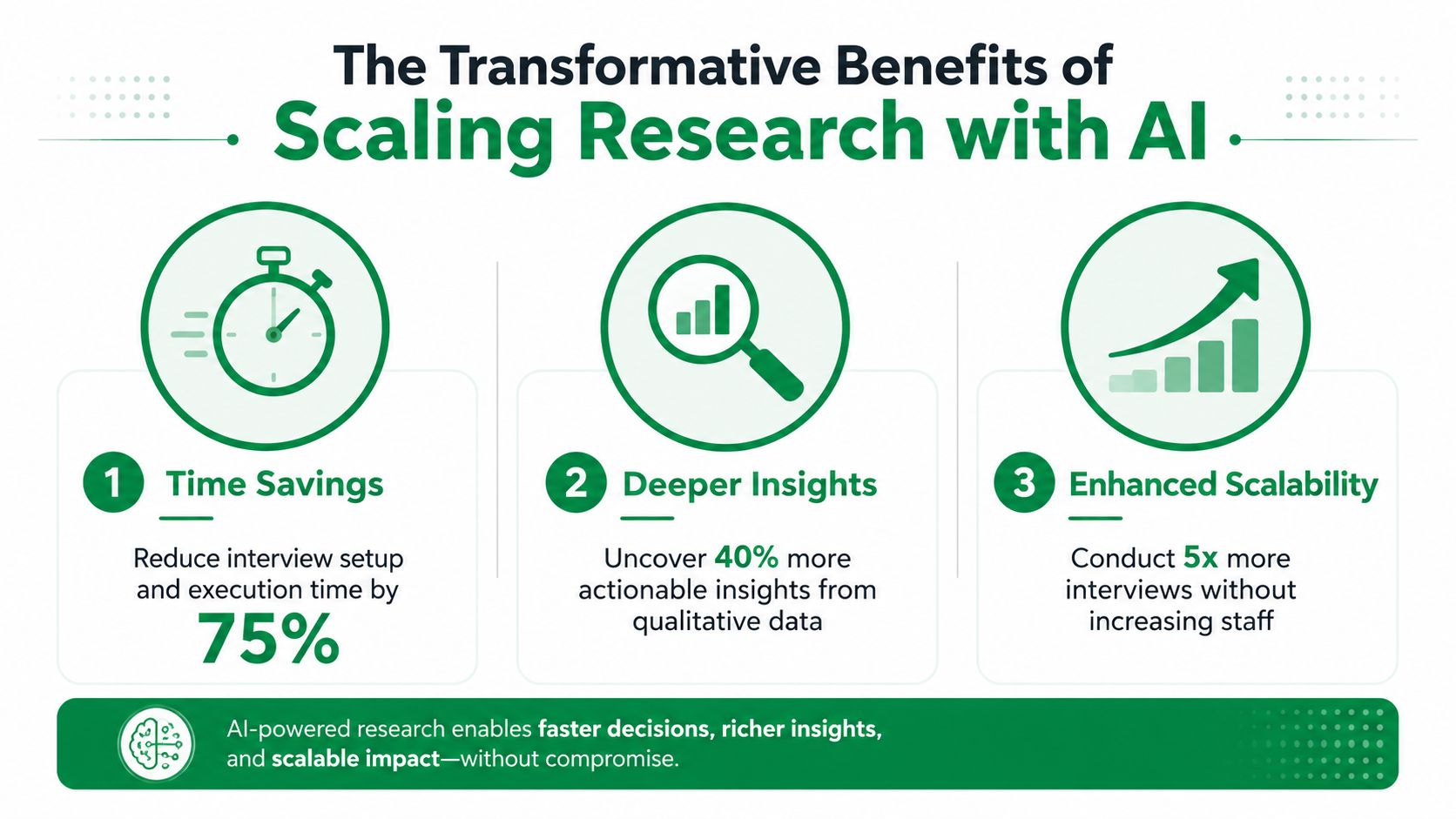
The obvious benefit is speed. The more important benefit is that research stops being a gated event.
When teams can run interviews quickly and repeatedly, user feedback moves closer to the design cycle. Research stops happening only at the end of a project, after the risky decisions have already been made.
What changes in the workflow
The clearest documented improvements I've seen come from the overall research cycle rather than any single interview moment.
In Uxia's comparison between synthetic and traditional user testing, the complete research cycle dropped from 362 minutes to 21 minutes, making the process approximately 17× faster. The synthetic study had 0% failed sessions, compared with 40% in the human-panel study. Running research continuously also became approximately 5× more cost-effective than repeated human panel studies. Those results are discussed in Uxia's write-up on generative UX research and faster AI insights.
That matters because the bottleneck in research usually isn't analysis alone. It's the entire chain: recruit, schedule, moderate, reschedule, chase no-shows, clean transcripts, summarize findings, then socialize the result after the sprint has already moved on.
Why speed isn't the full story
Fast research is only valuable if it produces evidence the team can use.
That's where many AI claims need some discipline. Authoritative UX research sources note that current AI interviewers “stick to your script” and can't pursue unexpected insights, reframe weak questions, or adapt in real time like a strong human moderator, as explained in this analysis of AI interviews in UX research. In practice, AI-moderated interviews work best as a complement to human moderation, not a universal replacement.
So the benefit isn't “AI does all research now.” The benefit is narrower and more useful.
Validation gets cheaper: Teams can test known hypotheses repeatedly instead of postponing research until a major milestone.
Cross-market work gets practical: A single study can run across multiple audiences without the team coordinating separate moderation logistics.
Patterns get easier to trust: When the same concern appears across many representative participants, it's harder to dismiss as anecdotal.
Researchers spend their time differently: Less time goes into operations. More time goes into scoping, interpretation, and prioritization.
Operational shift: The biggest win isn't replacing researchers. It's removing the manual overhead that keeps good research from happening often enough.
Where the payoff shows up
Once teams can run structured interviews continuously, they stop treating research as a scarce resource. Designers can test language before launch. PMs can validate assumptions mid-sprint. Agencies can sanity-check concepts across segments without opening a recruiting project every time.
That's a profound transformation. AI interviews at scale don't just accelerate an old process. They support a different habit: making product decisions with fresh evidence instead of waiting for the next major study.
The Uxia Approach to AI Moderated Interviews
Scale breaks research long before volume does. The primary failure point is audience control.
If the wrong people enter the study, faster interviewing just produces cleaner noise. That is why Uxia's approach starts from the participant model and then uses AI moderation to run a consistent interview process across that audience. For teams trying to quantify how common a problem is across segments, that sequence matters more than writing a clever discussion guide.
How the feature fits the method
Uxia's AI-moderated interview feature runs as an interviewing agent. It speaks with testers, captures structured responses, and returns research material the team can compare across markets and segments. It can also enrich synthetic testers with grounded interview input, which is useful when teams want future simulations to reflect what real participants said.
That setup changes the job the interview is doing. In many product teams, the goal is not finding one more surprising quote. The goal is checking whether a known concern shows up consistently in the audiences that matter. Uxia supports that kind of work well because the system is built around repeatable interviewing against a defined audience, not ad hoc conversations.
The trade-off is straightforward. Teams gain consistency, multilingual coverage, and operational speed. They still need human judgment to define the target audience, frame the research objective, and interpret what the patterns mean for product decisions.
What teams hand off and what they keep
Good AI interviewing systems do not replace research leadership. They take over the interviewing workload that is expensive to run manually at high frequency.
Researchers and product teams still own the parts that determine whether the study will be useful:
Audience definition: who should be included, excluded, and compared
Study intent: what decision the research needs to inform
Interview boundaries: which topics the agent should probe and where it should stay structured
Interpretation: how findings translate into design, roadmap, or market choices
The AI agent owns the repetitive execution. It conducts interviews consistently, handles the mechanics across languages and time zones, and keeps the format stable enough for segment comparison.
That division of labor looks similar to how other teams host and manage AI employees. The operating question is the same. Which tasks benefit from consistency and scale, and which ones still require human judgment because the stakes are strategic?
A quick product walkthrough helps make that shift concrete:
Where this approach is strongest
Uxia works best in research programs that already know which audiences they need to hear from and need reliable coverage across them. That includes multilingual studies, concept validation across customer types, and recurring product feedback where the team wants comparable evidence over time.
It is also a good fit for organizations that want to scale moderated research without rebuilding the operational stack for every study. Teams comparing platforms for that model can review other tools for moderated research at scale to see how workflow assumptions differ.
The practical advantage is not that AI suddenly makes research insightful. Insight still depends on audience quality, study design, and interpretation. The advantage is that a well-defined audience can now be interviewed repeatedly enough to show which issues are isolated, which ones are common, and which segments carry the highest product risk.
How to Implement AI Interviews The Right Way
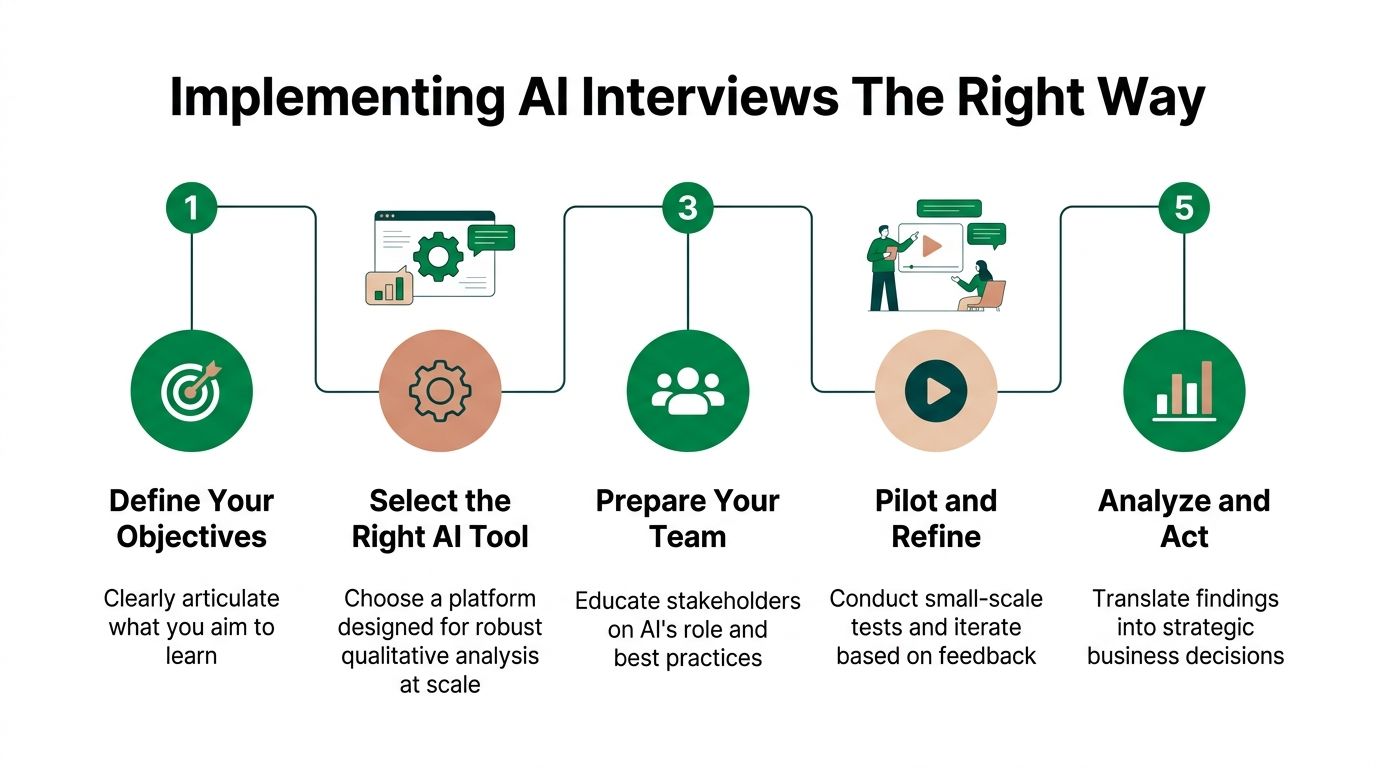
The first step isn't writing questions. It's defining the audience.
That sounds backwards to teams that are used to traditional research planning, but it's the decision that most affects the quality of the output. If the participants don't resemble the users you're designing for, scaling the study only scales the wrong feedback.
Start with audience definition
The core rule is simple. Define the audience as precisely as possible before you draft the interview. A source on scaling interviews makes the same point directly: the first critical step is specifying demographics, behavioral traits, digital proficiency, and personality characteristics before writing questions, because audience quality has a larger effect on insight quality than question quality in isolation, as discussed in this article on AI interviews.
In practice, that means building the participant model with more discipline than many teams use in conventional studies.
A strong audience definition usually includes:
Who they are: demographics, role context, market, and relevant constraints.
How they behave: habits, workflows, adoption patterns, and motivations.
How they use technology: digital proficiency, device behavior, confidence level, and tool familiarity.
How they think: decision style, skepticism, tolerance for complexity, and communication patterns.
If you have proprietary material, add it. Customer personas, help center content, onboarding docs, product knowledge, and domain terminology all improve the realism of the audience.
Practical rule: If your participants don't think like your real users, a larger sample won't rescue the study.
Define the objective after the audience
Once the audience is credible, define the research objective in plain language.
Don't start with “What can we ask?” Start with “What product decision needs better evidence?” That usually produces tighter interview guides and cleaner outputs.
Good objectives tend to fall into a few categories:
Objective type | Good fit for AI interviews at scale | Watch out for |
|---|---|---|
Concept validation | Comparing reactions across segments | Vague prompts that invite generic opinions |
Flow evaluation | Testing known tasks with structured follow-up | Overloading one session with too many tasks |
Messaging and terminology | Identifying repeated confusion or trust concerns | Using an audience that lacks the relevant context |
Cross-market comparison | Gathering consistent input across languages | Assuming direct equivalence without reviewing segment differences |
For teams evaluating tooling options around moderated workflows, this roundup of moderated research tools is a useful reference point because it forces a practical question: do you need broad discovery, or do you need structured, repeatable evidence?
Write prompts for depth, not performance
Once the objective is clear, write a guide that gives the AI room to probe without turning the interview into a script recital.
A few patterns work well:
Open with situational context. Ask participants to describe what they're trying to do, not whether they “like” the design.
Use role-relevant language. If the audience is specialized, generic prompts will flatten the responses.
Design for branching. The base question should be stable, but follow-ups should react to what the participant says.
Cut anything ornamental. If a question won't influence a decision, remove it.
Teams often make these studies too long. In AI-moderated interview programs, completion rates drop sharply once sessions move past the 20-minute threshold, according to this playbook for AI-moderated interviews at scale. That's a practical constraint, not a theoretical one. If the study is overloaded, the data gets weaker because fewer participants finish.
Build in review and quality control
At scale, quality assurance can't be optional.
For structured AI interview programs, the same CleverX playbook recommends a 10 to 20% manual review protocol to check cross-session reliability in larger batches. That's the right mindset. Don't trust automation blindly. Sample transcripts, inspect response quality, and verify that the prompts are eliciting the evidence you thought they would.
A good implementation rhythm looks like this:
Pilot first: Run a smaller batch and inspect the interviews manually.
Check the audience realism: Make sure the responses sound like the people you intended to model.
Review transcript quality: Look for shallow loops, repetitive follow-ups, or obvious prompt failure.
Refine before expanding: Scale only after the first batch produces believable and decision-relevant output.
The implementation mistake I see most often is over-focusing on prompt wording and under-investing in participant fidelity. Prompt tuning matters. Audience fidelity matters more.
From Raw Data to Actionable Insights at Scale
The value of AI interviews at scale doesn't come from producing a giant pile of transcripts. It comes from turning repeated signals into decision-ready evidence.
That requires a mindset shift. Small-sample research often revolves around discovery. Scaled interview programs are often more useful for confidence. They help teams understand whether a concern is isolated, segment-specific, or widespread enough to justify product attention.
What to look for in the output
A strong analysis layer should make three things visible:
Recurring themes: terminology confusion, trust signals, navigation friction, workflow mismatch.
Segment contrast: which patterns appear broadly and which ones are concentrated in a specific audience.
Decision relevance: what should change in the design, copy, architecture, or flow.
That's why structured AI interviews work well as a standardized first-pass or mid-funnel layer. They collect consistent evidence and surface the top subset for human review, rather than replacing all later interpretation. In hiring, this article on structured AI interviews describes using transparent dimensions such as Communication, Depth, and Relevance. Product teams can apply the same principle. Choose explicit dimensions, then review findings through those lenses.
How large batches change prioritization
The practical advantage of larger batches isn't that they magically reveal issues no one has ever seen before. It's that they make patterns harder to ignore.
Teams often hear the same concerns in manual studies but hesitate to act because the sample feels thin. When similar complaints recur across dozens or hundreds of representative participants, prioritization gets easier. Terminology problems stop looking like edge cases. Trust concerns stop sounding anecdotal. Navigation issues stop being “something a few users mentioned.”
That's where analysis discipline matters. If you need a simple framework for handling large volumes of structured information, this guide to big data analysis for small businesses is useful because it focuses on operational filtering rather than abstract data ambition.
Don't ask scaled interview data to do everything. Ask it to show which patterns are recurring, where they appear, and what deserves a human decision next.
Turn patterns into actions
The best teams don't stop at summaries. They document the insight trail so product changes are traceable.
A practical output structure looks like this:
Evidence layer | What it should answer |
|---|---|
Theme summary | What issue keeps recurring |
Segment view | Who is most affected |
Representative excerpts | Why the issue is happening |
Product implication | What should change |
Open questions | What still needs human follow-up |
That final step is where many repositories fail. Findings need to connect to work. Teams that want a cleaner handoff from synthesis to implementation should think in terms of documentation, not just reporting. This piece on research documentation and bridging insight to action is a good reminder that evidence only matters once someone can act on it.
Real World Impact A Specialized Audience Example
A useful example comes from a B2B financial software product aimed at CFOs.
When the audience model was broad, the feedback looked familiar. Participants commented on navigation, interface clarity, and general usability. None of that was wrong. It just wasn't the level of critique the product team needed.
The study became far more useful when the audience was enriched with accounting terminology, finance-domain knowledge, and customer-specific documentation. Once the participants reflected the expertise of real finance professionals, the feedback shifted.
What changed in the responses
The general audience focused on the visible surface of the product.
The finance-oriented audience spent much more time questioning terminology, workflow assumptions, and whether the product matched real accounting processes. That difference changed the team's priorities. Instead of refining visual details first, they focused on information architecture, domain language, and workflow alignment.
Realistic audience modeling often matters more than increasing participant count. If the audience is wrong, scale only gives you more confidence in the wrong conclusion.
Why this example matters
This is the strongest argument for audience-first implementation.
AI interviews at scale are often framed as a way to discover more issues faster. In practice, the bigger advantage is usually different. They help teams understand how widespread an issue is across the right audience segments. That only works if the audience itself is credible.
Specialized products make this especially obvious. A general user can tell you whether something looks confusing. A domain expert can tell you whether the product reflects the practical logic of the job.
Those are not interchangeable forms of feedback. For many teams, that's the difference between improving the interface and improving the product itself.
Conclusion Building with Confidence at Scale
AI interviews at scale are changing research because they remove the manual constraints that kept interviewing slow, episodic, and hard to repeat. The payoff isn't just faster sessions. It's a different research cadence.
When the method is applied well, teams can run structured interviews across markets, compare signals across segments, and build confidence around which issues deserve action. But scale by itself doesn't guarantee good insight. The strongest studies start with the audience, not the script.
That's the practical lesson worth keeping. If you define the wrong participants, the wrong patterns get validated. If you define the right participants, AI can help you quantify recurring concerns with much more confidence than a small manual batch allows.
AI moderation also has limits. It works best when the framework is known, the objective is clear, and the team still applies human judgment to interpretation and prioritization. Used that way, it's not a gimmick. It's a strong operational layer for continuous product learning.
If you want to put that audience-first approach into practice, Uxia gives product teams a way to run AI-moderated interviews with structured synthetic audiences, gather feedback across markets, and turn repeated signals into usable research without the usual scheduling and panel overhead.