Research Participant Quality: How to Evaluate It
Learn how to evaluate research participant quality before trusting a study. Ensure reliable insights with our expert guide on participant screening.

39.2% of respondents failed an instructed attention check in one experimental setting, so a completed session isn't automatically valid evidence. Research participant quality must be judged from several independent signals, not from completion alone or one pass/fail question.
That finding is uncomfortable because product teams often treat finished sessions as clean inputs. A participant can reach the final screen, answer every prompt, and still fail to process the instructions, prototype, or interaction context. The result is a study that looks complete while its task-success rates, preference signals, trust ratings, and usability findings remain unstable.
The Hidden Risk of Unvalidated Research Participants
Nearly two-fifths of respondents failed an explicit attention instruction in a 2024 experimental setting. The study found that only 60.8% complied with an instructed-manipulation check, meaning 39.2% did not follow the required instruction (the 2024 study on attention to experimental text lengths). The authors connect insufficient attention with lower-quality data, measurement error, reduced statistical power, and effects being masked among attentive participants.
That isn't a minor nuisance reserved for survey researchers. In UX work, inattentive participants can click through a prototype without understanding the mission, choose an answer without reading the available options, or offer a confident explanation that doesn't match what they really did. A completed session proves that the workflow reached an endpoint. It doesn't prove that the participant engaged with the evidence-producing parts of the task.
Speed makes the problem harder, not easier. An unusually fast completion time can flag careless behavior, but a slow participant may be distracted, confused, or only methodical. Conversely, a fast participant may already understand the interface or the task. Time alone is an exclusion signal, not a verdict.
Practical rule: Treat completion as a prerequisite for analysis, not as proof that analysis is justified.
A defensible review checks whether the participant understood the instructions, followed them, behaved consistently, and supplied substantive explanations. Product teams should also record why a response was retained or excluded. A transparent decision trail is more useful than an unexamined “clean” dataset.
The same logic applies before recruitment begins. A focused screener can test eligibility, experience, and behavioral fit before a session consumes researcher time. Teams building that first filter can use this user research screener template as a starting point, then adapt it to the study's actual risks. If the research depends on verified contact records or participant identity workflows, an Email Validation API can support that operational layer, but it won't replace behavioral quality checks inside the study.
Five Key Dimensions of Research Participant Quality
Research participant quality is best understood as a multi-dimensional classification problem. A participant isn't “good” or “bad” because of one answer. Quality depends on whether the person is attentive, relevant to the target audience, behaviorally credible, honest in reporting, and technically able to complete the task.

Attention and context comprehension
Attention means more than spotting an instruction-check item. Did the participant understand the mission, notice the relevant interface state, and respond to the context presented? A participant who selects the right answer by accident isn't equivalent to one who can explain why it fits.
Representativeness
A technically attentive participant can still be the wrong participant. Representativeness asks whether the person's needs, experience, language, access conditions, and behavior fit the audience the product decision concerns. A polished session from an irrelevant audience may be internally consistent and strategically useless.
Task fidelity
Task fidelity compares what participants say with what they do. If someone claims that checkout was effortless but repeatedly searches, backtracks, or misses the primary action, the behavior deserves more weight than the retrospective label. This is especially important in unmoderated usability testing, where no researcher can immediately clarify a contradiction.
Honesty and technical compatibility
Honesty concerns truthful reporting, not writing style. Technical compatibility concerns whether device, browser, accessibility setup, connection, or platform friction prevents a fair attempt. A participant who cannot interact with a required prototype element shouldn't be classified the same way as someone who ignores it.
Fluent text is a particularly weak shortcut. A 2024 study reported that 34% of surveyed research participants used large language models to answer open-ended questions, and simulations found those responses were more homogeneous and positive than human responses (the study of AI-assisted open-ended answers). Detailed prose can therefore coexist with low engagement or artificial consensus. Length, grammar, and speed are clues, not quality measures.
Uxia's useful operational model is to score independent behavioral dimensions such as task completion, path exploration, response coherence, transcript specificity, and time-on-task. Teams looking at how audience definition affects research decisions can also consult this guide to audience and sample design. The point is not to produce a magical participant score. It's to make the classification explainable and resistant to one misleading signal.
Human Versus Synthetic Participant Quality in UX Testing
Human and synthetic participants solve different validity problems. Human participants provide ecological validity, personal history, physical constraints, and the unpredictability of real product use. They also bring recruitment noise, panel conditioning, inconsistent effort, scheduling friction, and demographic coverage gaps.
Strict recruitment filters don't eliminate those risks. One comparative study required participants to meet prior-performance thresholds before testing attention, comprehension, honesty, and reliability. Even after those filters, only 69% of participants in the study's Prolific sample passed both attention checks in its first study (the comparative evaluation of online recruitment platforms).
A separate comparison makes the trade-off starker. When attention, completion duration, and internal consistency were considered together, 9.89% of 354 MTurk participants produced data classified as high quality, compared with 43.34% of 345 Prolific participants (the MTurk and Prolific comparison).
Platform | High-Quality Rate | Primary Quality Signal |
|---|---|---|
MTurk | 9.89% of 354 participants | Attention, duration, and internal consistency |
Prolific | 43.34% of 345 participants | Attention, duration, and internal consistency |
The table doesn't establish that one platform is universally reliable. It shows why recruitment history is an initial gate, not proof of quality. Teams still need to inspect what participants did inside the study.
Synthetic participants offer a different profile. They can be generated quickly, rerun under consistent conditions, and aligned to specified demographic and behavioral profiles. That repeatability helps teams isolate design changes from recruitment variance. It doesn't automatically make synthetic findings representative of every real population, and it can't remove the need for targeted human validation in high-risk contexts.
Uxia operationalizes this approach by letting teams define an audience and mission, then generate synthetic testers that traverse prototype flows and produce transcripts and structured findings. For a broader comparison of approaches, see synthetic users versus human users. Teams still need profile discipline, behavioral checks, and a clear boundary between early diagnostic testing and launch confidence. Workflows for spotting suspicious or artificial-looking identity signals can also benefit from a practical guide from AI Video Detector, although identity screening alone can't establish research validity.
Common Failure Modes That Invalidate Research Data
Quality failures rarely announce themselves. They appear as plausible answers, neat spreadsheets, and transcripts that sound more coherent than the participant's actual behavior.
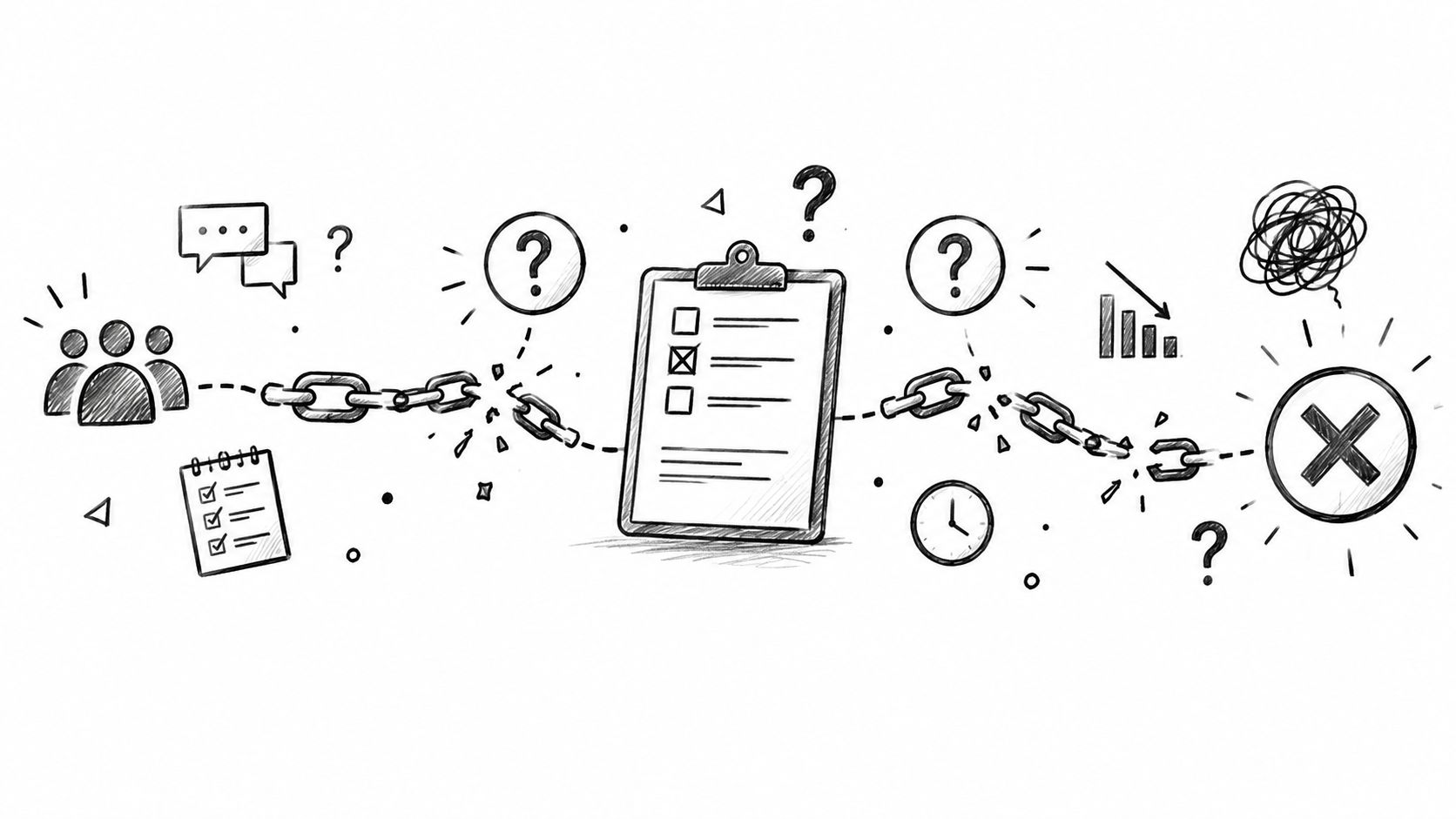
Classic warning signs include straightlining, where a participant chooses the same scale point repeatedly, and speeding, where the person completes tasks too quickly to plausibly process them. Inconsistent answers create a third problem. A participant may claim unfamiliarity with a product in the screener, then describe advanced workflows during the session. That contradiction could indicate dishonesty, confusion, or a flawed question. It still needs investigation.
Why one check misses too much
A 2026 analysis reports that standard screens may detect only 44% to 75% of inattentive respondents, while published estimates of inattentiveness range from 3% to 9% in some studies to more than 30% in others (the analysis of inattentiveness estimates and screening sensitivity). The method and population change the observed rate, so a benchmark from one panel shouldn't be treated as a universal truth.
The same evidence found that a timestamp-based approach identified likely inattentive respondents in as many as 52% of participants in one study. Requiring respondents to leave an item blank increased the flagged rate by 16.8 percentage points. Those figures demonstrate that screening is a measurement problem. Different instruments reveal different forms of low-quality behavior.
AI-assisted participation creates a newer failure mode. Generated answers may be fluent, detailed, and positive while hiding weak engagement with the task. Removing every generic-sounding answer can unfairly penalize real participants with different language abilities or communication styles. Accepting polished prose at face value can manufacture consensus.
For teams that need to inspect pacing beyond a single completion timestamp, response time analysis features can support a broader review. The review should still combine timing with instruction following, response consistency, task behavior, and follow-up specificity.
A participant who passes one check may still fail another. Use checks as quality flags, examine the pattern across signals, and analyze how exclusions change the conclusion. Automatic exclusion from one ambiguous item creates false positives, while no exclusion process at all lets silent failures contaminate the study.
A Practical QA Audit for Validating Research Participants
A useful audit starts before data collection. Define what an eligible participant must be able to do, what audience they must represent, and which behaviors would make their data unsafe to interpret. The ESOMAR/GRBN Online Sample Quality Guideline organizes the work around four controls: eligibility, fraud prevention, engagement, and exclusion of categories that could bias results.
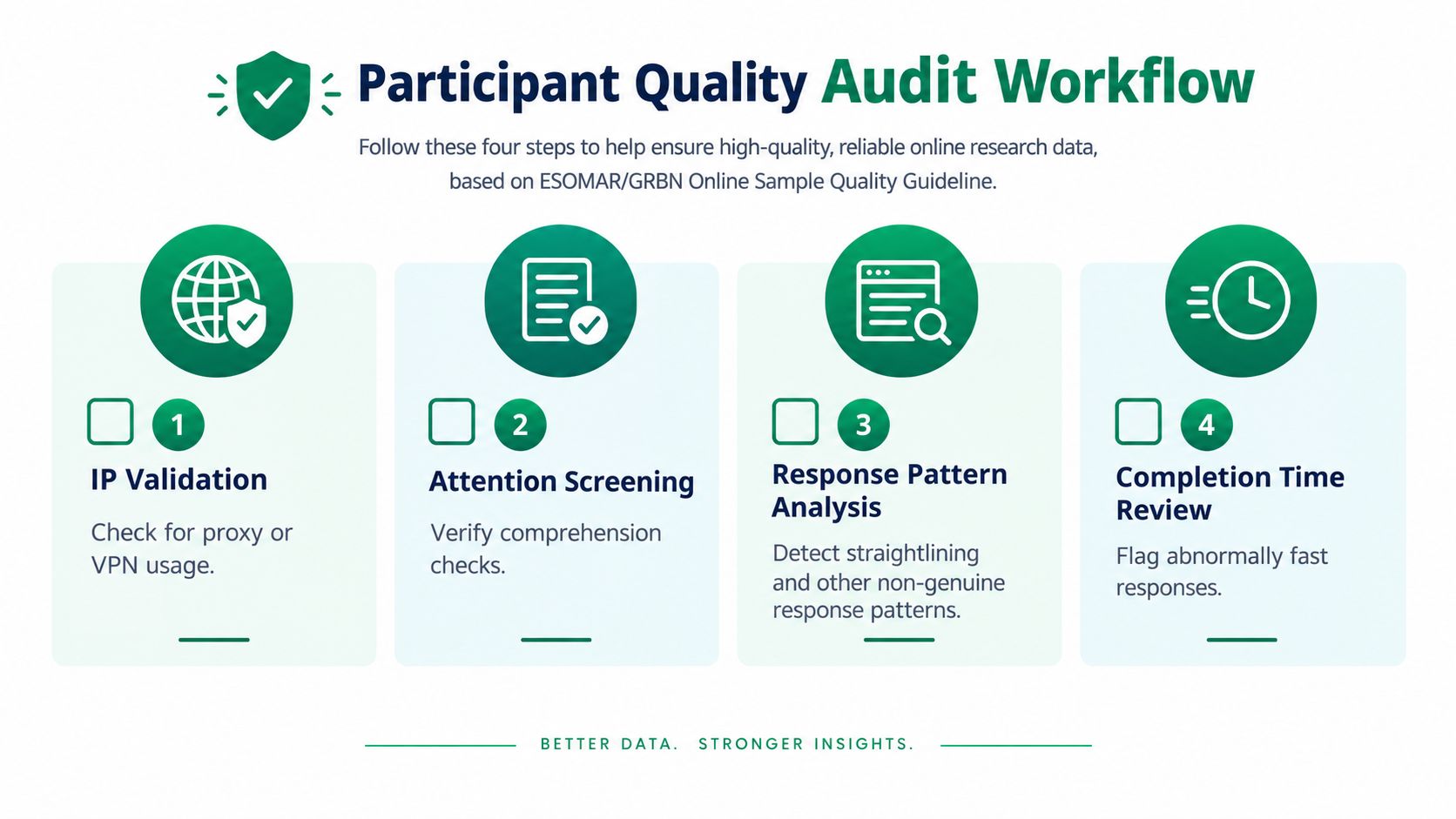
Start with eligibility
Write the target profile in behavioral terms, not only demographic labels. Specify relevant experience, environment, access needs, language context, and the behavior the study must observe. For synthetic research, define the same constraints before generating testers. A plausible transcript isn't enough if the generated profile doesn't match the decision audience.
Prevent duplication and fraud
Check for repeat participation where incentives or repeated exposure could distort behavior. Review identity and eligibility evidence against the recruitment brief, and document exclusions. A participant can be genuine and still be unsuitable because prior exposure has changed how they approach the prototype.
Verify engagement through independent signals
Use at least three signals:
Instruction following: Can the participant restate or demonstrate the task correctly?
Realistic duration: Does the pacing allow enough time for the required interaction?
Cross-response consistency: Do stated reasons match choices, navigation, and follow-up answers?
Add open-ended specificity and path exploration where the method supports them. Don't let one failed item decide the case if the rest of the evidence indicates genuine effort, but don't excuse repeated contradictions because the transcript reads smoothly.
Exclude biasing categories deliberately
Some participants can be attentive yet introduce systematic bias through prior exposure, conflicts of interest, or a mismatch with the intended population. Record the rationale for every exclusion and report pass rates transparently. Findings that survive screening and recur across independent behavioral paths deserve more confidence than isolated comments.
For Uxia workflows, the equivalent audit is to define the audience and behavioral profile first, inspect whether generated participants conform, compare their stated reasoning with navigation behavior, and rerun high-severity findings. Quality control belongs inside the workflow, not in a rushed spreadsheet review after the study ends.
Beyond Quality and Representativeness and Sampling Gaps
Participant quality is not participant representativeness. A dataset can contain attentive, consistent, honest respondents and still exclude the people most affected by a product decision. That distinction matters whenever teams generalize from a convenient sample to a broader market.
An analysis of 65 online research datasets comprising 60,681 participants found generally high completion and retention, but quality and representativeness varied by task and stimulus. Default general-population recruitment tended to over-recruit middle-aged men and included few gender-diverse participants (the analysis of online research datasets and representation).
The question after a quality audit therefore isn't only, “Are these participants genuine?” It's also, “Whose behavior is missing?”
Representation audits should sit beside participant-level quality scores. At minimum, teams should record:
Recruitment source: Which panel, customer list, community, or generation process supplied the participant?
Geographic and linguistic coverage: Where do participants live, and in which language contexts do they use the product?
Accessibility characteristics: Which assistive technologies, physical constraints, and access conditions are represented?
Prior research exposure: Could repeated testing or familiarity influence behavior?
Synthetic testing can help teams run an early breadth-and-bias diagnostic by deliberately generating audience profiles that a default panel might under-cover. It can't prove that a design works for every real population. High-risk segments still need targeted validation with real users who bring the relevant context, constraints, and consequences of failure.
AI-assisted open-ended responses sharpen this issue. Differences in writing ability, language proficiency, disability, and communication style can resemble automation, while polished generated text can resemble authentic reflection. Product teams should compare response diversity, contradictions, observed task behavior, and follow-up consistency instead of making a binary human-versus-bot judgment. The right standard is whether the evidence supports the decision for the people who matter, not whether the dataset merely looks clean.
Actionable Recommendations for Product Research Teams
Start with a participant-level record that makes quality inspectable. Don't store only a completed or excluded label. Score each person across instruction following, task completion, path exploration, response coherence, transcript specificity, and time-on-task, then review the combined pattern.
A practical operating order looks like this:
Define the audience before the study: Write the demographic, behavioral, accessibility, language, and experience constraints that matter to the decision.
Use multiple detection methods: Combine completion time, comprehension, navigation behavior, consistency, and substantive explanations.
Separate quality from coverage: Report who passed quality checks and which important segments remain absent.
Use synthetic testing diagnostically: Generate constrained profiles to explore breadth, friction, and possible bias early, then validate high-risk findings with appropriately targeted human participants.
Report exclusions transparently: Record the signal, decision, and effect of removing questionable sessions.
Rerun persistent findings: Repeat the prototype mission with quality-filtered participants and check whether high-severity issues survive independent sessions.
A fluent answer should never outrank observed behavior automatically. A fast session shouldn't be rejected without context, and a slow session shouldn't be accepted without checking comprehension. The strongest evidence is reproducible: the same serious problem appears across multiple credible participants, behavioral paths, or appropriately defined synthetic profiles.
The benchmark for trust isn't a perfect participant. It's a finding that remains stable after quality and representation have been examined.
Use Uxia when you need rapid, repeatable testing against explicitly defined audience and behavioral profiles, but keep the boundary clear. Synthetic results can expose likely usability, navigation, copy, trust, and accessibility problems early. They don't replace targeted human validation where lived experience or underrepresented context determines the decision.
Use Uxia to define audience profiles, run synthetic participants through prototype missions, and inspect behavior alongside transcripts and prioritized findings. Build a quality audit into your next study, then visit Uxia to test whether the issues you find persist across independent sessions before you commit to launch.