Research Interviews: A Practical Guide to Insights
Learn how to conduct research interviews effectively and uncover deeper insights with proven methods in this practical guide.

Most advice about research interviews gets the hard part backward. Teams are told to recruit carefully, ask open questions, and “let users speak,” then they're surprised when the work still feels slow, vague, and expensive to repeat. In practice, the gap isn't between good intentions and bad skill, it's between what teams expect interviews to deliver and what the process produces when recruiting drags, answers stay shallow, and analysis eats the rest of the week.
The interview itself is only one piece of the system. In qualitative work, sample size is usually guided by saturation, not a fixed count, and many PhD-level studies commonly reach it between 12 and 25 interviews (methodological review). In hiring, interviews are still central, but the process is compressed, standardized, and heavily filtered, with only 2% to 3% of applicants reaching interview stage in recent U.S. benchmarks, roughly 4 to 6 candidates shortlisted from about 250 resumes per posting, and average time-to-hire around 41 to 44 days (industry data). Those numbers are a reminder that interviews are high-value and high-friction at the same time.
Why Research Interviews Rarely Match Expectations
Teams usually expect research interviews to be fast, representative, and revealing. What they often get is a pile of recordings, a few memorable quotes, and a long afternoon spent trying to separate signal from polite small talk. That mismatch is why interviews get postponed, trimmed, or replaced by guesswork.
Key bottlenecks show up after the call ends
Recruitment is usually the first bottleneck, because finding the right people takes longer than the discussion itself. In hiring, the broader market already shows how constrained interviews can be, with only a small fraction of applicants making it to the conversation stage and many candidates dropping out when scheduling drags (industry data). Research teams feel the same pressure in a different form, because every additional participant means more outreach, more scheduling, more note cleanup, and more synthesis.
Depth is the second bottleneck. Participants often answer with what is easy, not what is useful, especially if the interviewer asks broad or ambiguous questions. Method guidance is clear that interviewers need controlled settings, rapport, consent, recording workflows, and careful probing because transcript quality shapes the analysis that follows (interview method guide).
Practical rule: if the interview cannot be coded cleanly later, it probably was not specific enough in the room.
A third gap is representativeness. Qualitative work can reach saturation, but saturation is a pattern judgment, not a guarantee that a small set of conversations mirrors the whole market. PhD-level studies often reach it between 12 and 25 interviews (methodological review), yet that range does not mean teams have captured every segment, behavior, or edge case they care about.
Why teams keep repeating the same mistakes
A lot of teams still start with a topic list instead of a decision. That sounds efficient, but it creates drift, because broad questions invite broad answers, and broad answers rarely support a product choice. The result is research that feels interesting but does not move the roadmap.
The other failure point is over-reliance on human sessions for early exploration. Traditional interviews can be valuable, but when every round depends on recruiting people, matching calendars, and transcribing hours of discussion, teams naturally run fewer studies. That is not a methodology problem, it is a workflow problem.
A better setup starts by separating exploration, validation, and decision support. That distinction matters because it lets teams use the right interview format at the right moment instead of forcing one process to do everything.
Start with the Decision Your Research Must Support
The strongest interview plans begin with a decision, not a question bank. If the work cannot point to a decision, it usually produces stories that are interesting and hard to act on. A decision-first brief keeps the research tied to something concrete.
Write the brief before you write the guide
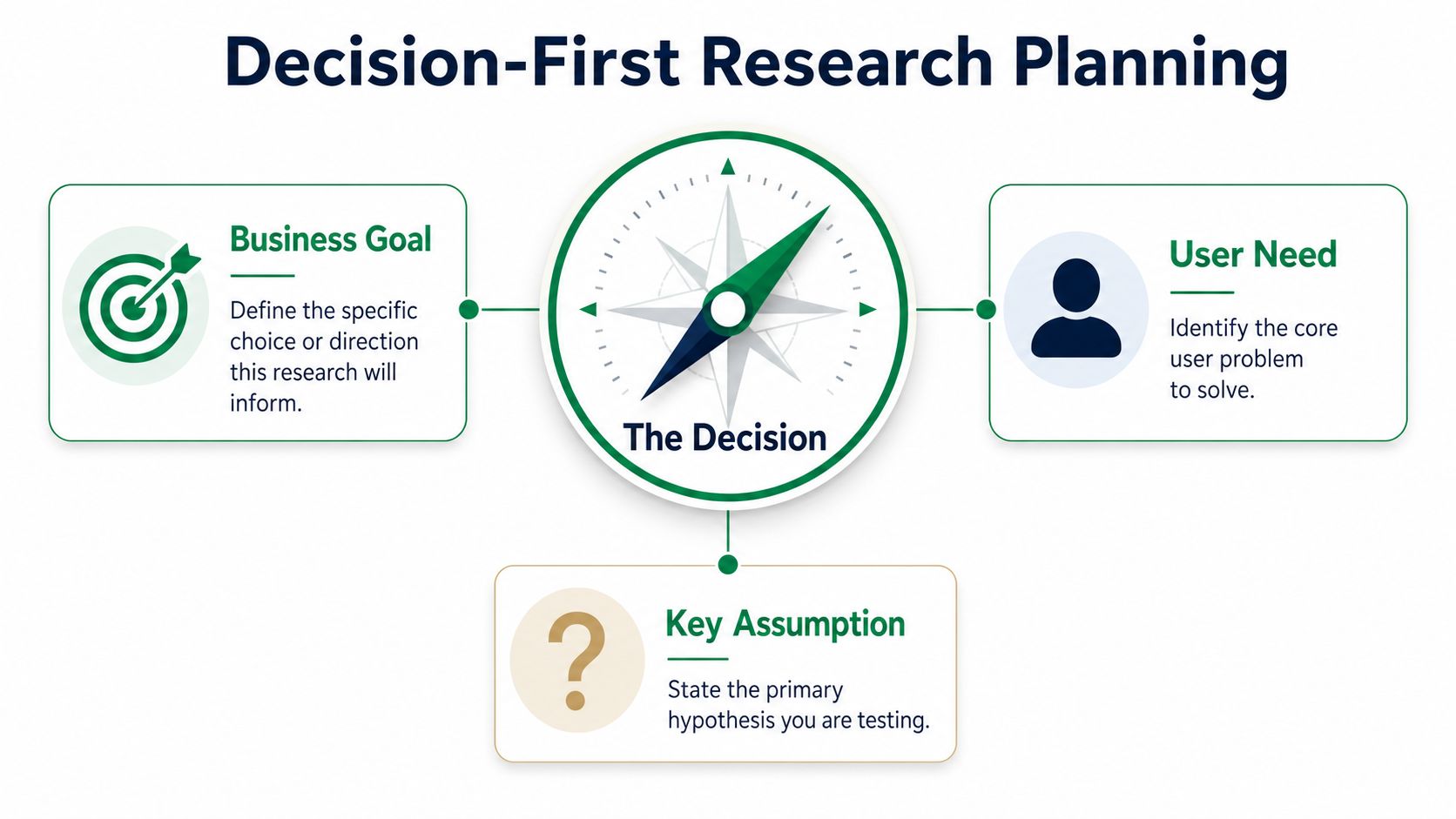
Put three things on one page. First, the decision the work must inform. Second, the user segment you need to understand. Third, the main hypothesis or risk you are trying to confirm or disprove. That sequence keeps the conversation tied to a real outcome instead of drifting into general curiosity.
A vague version sounds like, “Understand user thoughts about onboarding.” A better version sounds like, “Decide whether first-time subscribers can complete account setup without support, for mobile-only users who arrive from paid campaigns.” The second version gives you a filter for recruitment, question design, and analysis.
Clear purpose matters because interviewees need to understand what the project is for and how much detail you want from them. Guidance on high-quality case study work also warns against ambiguous wording and culturally loaded terms such as “usually,” “big,” or “recently” (Cambridge guidance). That is not just academic advice. Ambiguity in the brief becomes ambiguity in the interview.
Keep the scope tight enough to be useful
A good interview plan answers one decision well, not five decisions loosely.
That is why a narrow brief usually beats a broad one. If the team needs to choose between two flows, two messages, or two audience segments, say so. If the goal is only to learn what confuses people, say that too. The tighter the decision, the easier it is to tell which findings matter and which ones are just noise.
Uxia supports this kind of decision-first work by running AI interview missions around a defined audience and objective, which is useful when you need a first pass before spending time on human recruiting. For a practical way to structure that setup, see this guide to conducting user interviews. The infographic below shows how to connect business goal, user need, and the key assumption before the guide gets written.
Build and Pilot a Structured Interview Guide
A strong guide doesn't feel like a script, it feels like a path. It starts where people are comfortable, then moves toward the parts of the experience that answer the research decision. That structure is what keeps an interviewer from jumping too early into interpretation.
Move from general behavior to specific friction
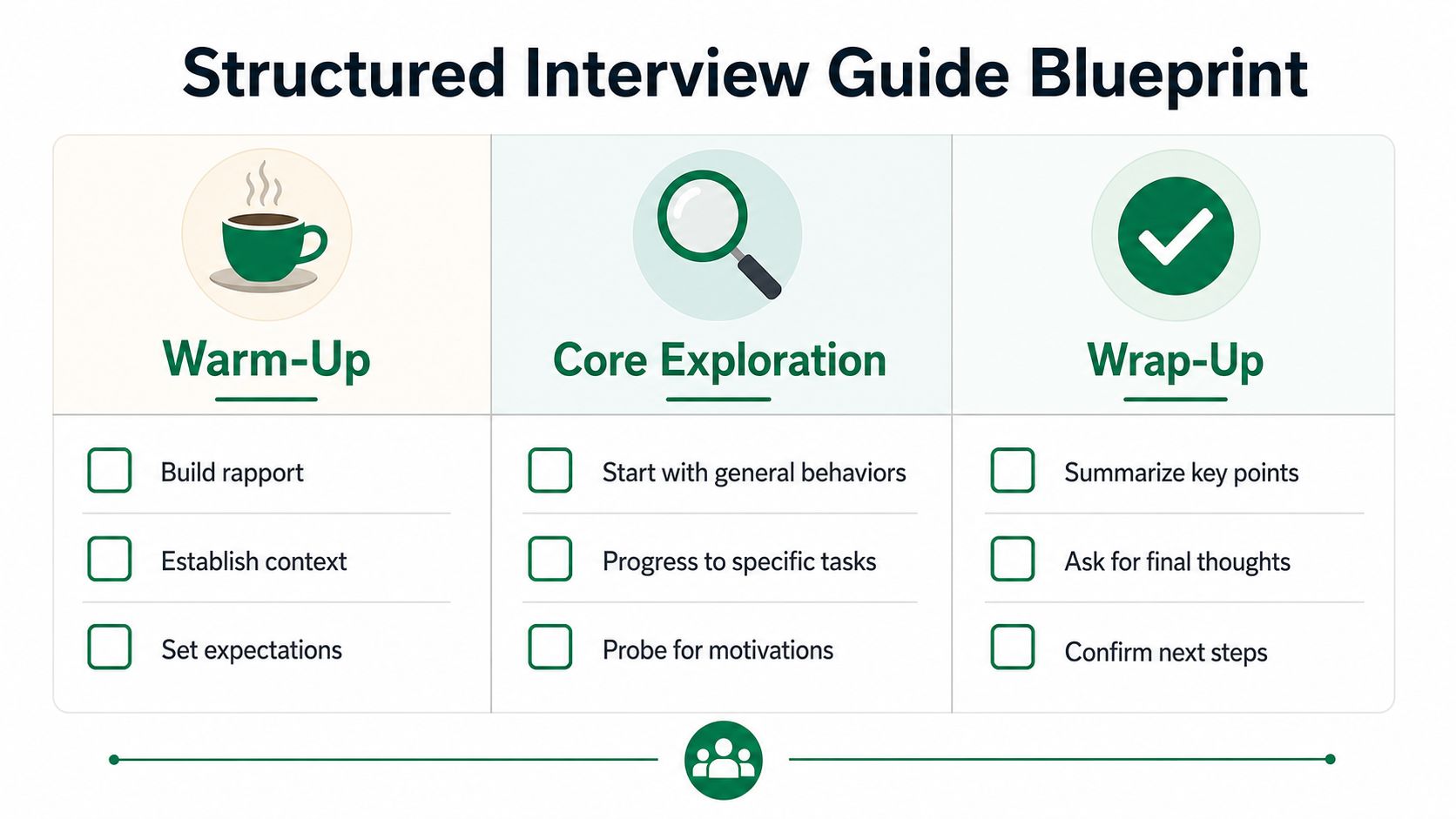
The most usable guides start with easy factual context, then move into behavior, then narrow toward pain points and concept reactions. One practical structure is an opening statement, a warm-up question, three to five thematic blocks with two to four main questions each, and a closing question (guide structure). That shape gives the session momentum without forcing every participant through the same cadence at the same pace.
Early questions should build rapport and reduce cognitive load. Ask about a recent routine, a familiar process, or a concrete task before you ask for opinion or evaluation. Once people settle in, probes like “what happened next,” “what made that hard,” or “what did you do instead” usually produce better detail than abstract prompts.
The purpose is not to make the guide sound polished. The purpose is to make it searchable later. If each question only covers one idea, coding becomes far cleaner.
Pilot before you trust the guide
Pilot testing is where weak questions get exposed. Multiple interviewing guides recommend at least one test interview before fielding the study, and one source calls the pilot the single most valuable preparation step many researchers skip (pilot guidance). That's consistent with what seasoned researchers already know, the first version of a guide is usually too long, too clever, or too vague.
Use the pilot to check for three things. Are any questions leading? Are any double-barreled? Does the timing leave enough room for meaningful probes? If the participant keeps answering one way while you need another, the guide is probably asking the wrong thing.
The infographic below is the simplest way to keep that structure visible during prep, especially when multiple stakeholders want to add “just one more question.”
For a fuller walkthrough of session flow, this practical reference on how to conduct user interviews is a useful companion when you're turning the guide into a live session.
If you want a reminder of the rhythm, the short video below is worth reviewing after you've drafted the guide.
Synthetic Testers vs Human Panels in Research Interviews
Synthetic testers change the economics of interview work because they let teams separate early learning from final validation. That matters when you want broad pattern spotting without waiting on recruiting, scheduling, and manual cleanup.
A side-by-side comparison that reflects the real trade-off
The strongest case for synthetic testing isn't that it replaces humans. It's that it can compress the first pass, surface recurring themes quickly, and leave human interviews for the findings that need lived experience. In one comparative study, the full research cycle took 25 minutes with Uxia versus more than 12 hours with a traditional human-testing platform, and the estimated cost was 65% lower for a recurring program.
Metric | Synthetic Testers (Uxia) | Human Panel |
|---|---|---|
Time to complete cycle | 25 minutes | More than 12 hours |
Estimated cost in recurring program | 65% lower | Higher baseline cost |
Usability issues detected | 17 | 4 |
Transcript length per session | About 2,200 words | Around 300 words |
Validation role | Early exploration and pattern spotting | Lived experience and final confirmation |
The same comparison found that every usability issue identified by the human participants was also detected by Uxia, while the synthetic testers uncovered more issues overall and produced much longer think-aloud transcripts. That extra volume isn't automatically better, but it does give analysts more material to work with when they're mapping friction points across flows.
Where each method belongs
Synthetic testers are strongest when the goal is to test a draft flow, pressure-test the wording of a guide, or find the biggest friction points before a human study. Human panels still matter when uncertainty is high, the stakes are sensitive, or lived experience is the finding itself. That split keeps teams from paying human-recruiting costs for questions that synthetic interviews can answer first.
If you're trying to keep the documentation side clean while moving fast, this resource on eliminate doc rot in 2026 is useful because the same problem shows up in research notes, where outdated summaries create bad decisions later.
For a deeper comparison of method choice, the discussion in synthetic users vs human users maps the trade-offs well when your team is deciding what to test first.
Real Examples and Insights from Research Interviews
A single quote can be enough to expose a design issue, but only if you listen for the mismatch between what the participant is trying to do and what the interface is inviting them to do. In a public transport ticket-purchase study, one participant said, “Do I click into this? Tickets? Click on tickets. Ah, there we go.” That hesitation mattered because it showed the screen was steering attention toward the journey planner instead of the ticket flow.
Why that quote mattered more than a simple complaint
The obvious reading is that the participant couldn't find tickets. The deeper reading is that the most visually prominent action did not match the user's primary intent, especially for first-time tourists. That's a different problem, because it points to hierarchy, not just labeling.
When several participants showed the same hesitation, the quote stopped being an anecdote and became a pattern. That's the point where a researcher has to resist over-crediting the loudest comment in the room and instead ask whether the same friction appears across multiple sessions. Transcripts matter here because the exact words show where confusion starts, and clean transcription makes those moments easier to compare later. For teams that want more support on live capture, top software picks from iScribe Live Transcribe is a useful reference point for understanding transcription workflows in research contexts.
How to probe without over-directing
The best follow-up questions stay close to the participant's mental model. Ask what they expected to happen, what they noticed first, and what they would have clicked if they were less cautious. Don't rescue them too quickly, because the hesitation itself is often the insight.
Practical rule: when a participant pauses before a click, treat the pause as data, not just noise.
That kind of moment is exactly why interviews remain valuable even when teams have analytics and heatmaps. Numbers can show drop-off, but they can't always explain why a user's attention went somewhere else. A careful interview can.
Synthesize Findings and Translate Them into Action
The value of research interviews is not the conversation, it's the decision that changes because of the conversation. That only happens when teams turn raw transcripts into evidence they can audit, compare, and defend.
Code before you over-interpret
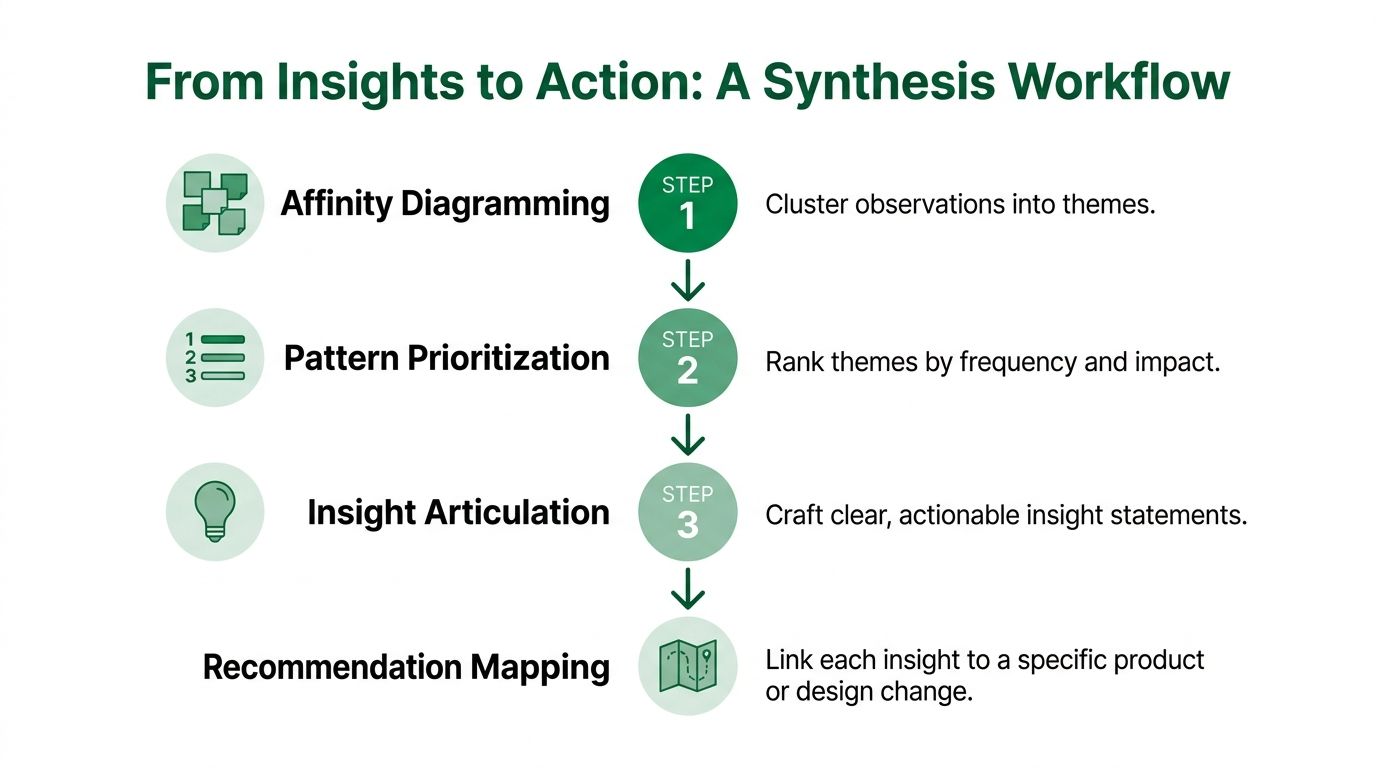
A rigorous workflow starts with transcription into verbatim text, then moves into speaker turns, timestamps, and coding into categories and subcategories before segment-level analysis (transcript workflow). That order matters because it keeps the analyst close to the source material instead of jumping straight to summary language. It also makes it easier to trace a finding back to the quote that supported it.
Repeated themes should be treated as hypotheses, not truths. If a pattern appears several times, ask what evidence supports it and what would change your mind. That discipline keeps the team from turning one strong session into a false universal.
Prioritize by evidence and business relevance
Once themes are coded, sort them by how strongly they're supported and how much they matter to the decision on the table. A complaint that appears often but doesn't affect the key workflow may be less urgent than a smaller issue that blocks conversion or trust. The highest-stakes findings deserve human validation when uncertainty remains, especially if the consequence of being wrong is expensive.
This is also where traceability matters. Preserve notes that show how a quote became a theme, how the theme became a recommendation, and why that recommendation outranked others. A bridge like research documentation and insight-to-action workflow helps teams keep that trail intact when multiple stakeholders are involved.
The workflow below is a simple way to make synthesis visible instead of hiding it in a deck.
A Hybrid Workflow for Faster and Deeper Research Interviews
The most practical interview stack right now is hybrid. Use synthetic testers to get early signal fast, then reserve human interviews for the questions that need lived experience, nuance, or final confirmation. That setup respects both speed and credibility.
A workflow that matches how teams actually work
Start with the decision and the audience, then draft and pilot the guide. Launch an initial round with synthetic testers to identify recurring themes, follow up with individual testers when a point needs deeper exploration, and validate the most uncertain or high-stakes findings with human participants. Uxia can handle that first pass by removing recruitment, scheduling, incentives, and much of the manual analysis from the opening cycle, while still letting teams revisit the strongest hypotheses later.
That kind of layered process works especially well inside sprint cycles because it gives product teams something usable before the week is over. It also reduces the chance that a team spends human research budget on questions that should have been filtered out earlier. For teams evaluating the underlying technology, the Voice Control Pro NLP guide is a helpful read on the kinds of language-processing tools that make structured synthesis more practical.
What to measure so the work doesn't disappear
Track time to insight, usable session rate, depth and relevance of responses, number of validated findings, overlap with human research, and the share of findings that lead to a product decision or design change. Those metrics keep the conversation honest, because they focus on whether interviews change decisions, not just whether they produced notes. In the best setups, the synthetic round informs the guide, the human round validates the riskiest parts, and the final synthesis lands in a roadmap meeting with clear evidence attached.
If you want a faster way to run research interviews without giving up depth, Uxia gives you AI interview missions, structured transcripts, and synthesis you can use before the end of the day. It's a practical fit when you need to test ideas, sharpen your guide, and validate the findings that matter most. Visit Uxia to see how synthetic testers can slot into your research workflow.