Top 7 Product Design Conferences to Attend in 2026
Discover the top 7 product design conferences for 2026. A curated guide for product teams looking to level up their skills, network, and find inspiration.
In the fast-paced world of product development, staying ahead of the curve isn't just an advantage, it's essential. Product design conferences are more than just a series of talks; they are vibrant hubs for innovation, networking, and inspiration. Attending these events allows your team to absorb modern techniques, understand emerging trends like AI-driven design validation, and learn from the successes and failures of leading global companies.
However, the real return on investment comes from applying these new insights to your daily workflows. For instance, after learning about rapid prototyping and continuous discovery, you need tools to match that speed. This is where platforms like Uxia become invaluable, enabling teams to test designs with AI-powered synthetic users in minutes, not weeks. This approach complements the strategic knowledge gained from these gatherings. A practical recommendation is to schedule a debrief session post-conference to identify 2-3 key learnings and assign owners to pilot them, ensuring insights translate into action.
Investing in product design conferences can yield significant returns, as these events, often akin to customer conferences, provide crucial insights into user needs and market trends. To help you make the right choice, we've organised a definitive list of the most impactful product design conferences for 2026. Each entry provides a clear overview of the event’s focus, target audience, and key takeaways, complete with direct links and details to help you decide. This guide will help you find the best events to sharpen your skills, inspire your team, and ultimately, build better products, faster.
1. OFFF Barcelona 2026: The Intersection of Creativity and Digital Design
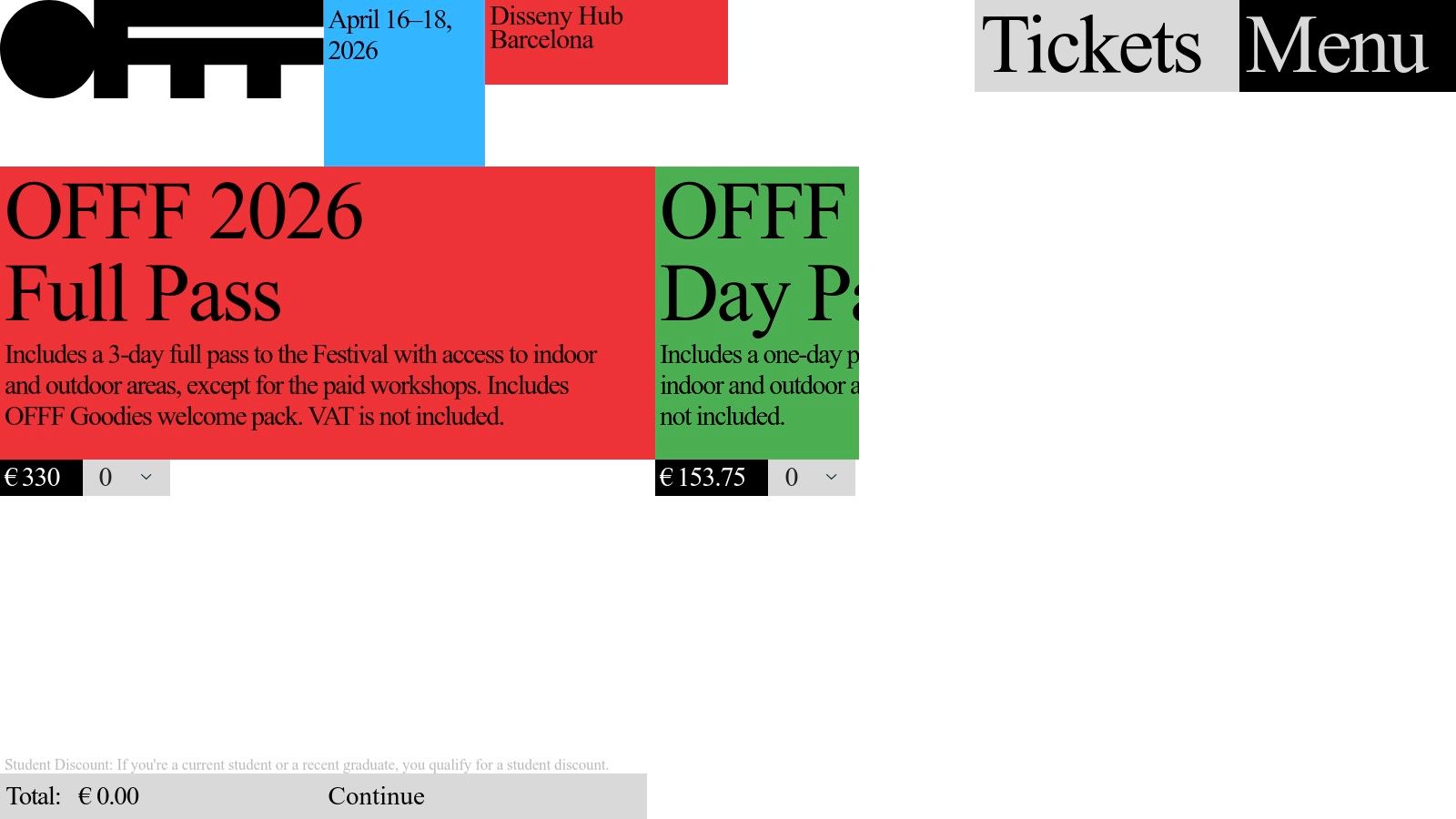
While many product design conferences focus squarely on process and research methodologies, OFFF Barcelona offers a different, yet equally important, perspective. Hosted at the iconic Disseny Hub Barcelona, this long-running festival is a vibrant celebration of creativity, visual design, and emerging digital art. For product teams, its value lies in stepping outside the typical UX/UI bubble to find fresh inspiration for brand expression, motion design, and truly memorable user interfaces.
This event is particularly suited for teams looking to inject a dose of artistic energy into their work. If your product's visual identity feels stale or your UI animations lack personality, the talks from leading creative studios and motion graphics artists at OFFF can provide the spark needed for a breakthrough. It’s an ideal choice for teams based in Spain or the wider Iberian region, offering world-class inspiration close to home.
Core Focus and Why Your Team Should Attend
OFFF is not a traditional product design conference; its strength is its breadth. The 3-day programme sprawls across multiple stages, encouraging attendees to wander and discover new ideas.
Primary Themes: Visual and UI design, motion graphics, typography, art direction, and new media. You won't find deep dives into user research frameworks, but you will see how the world's best creatives build emotional connections through pixels.
Target Audience: Perfect for UI designers, brand strategists, and product managers who want to understand the "art of the possible" in digital aesthetics. UX researchers can also benefit by observing how visual storytelling influences user perception and engagement.
Networking Potential: The atmosphere is less corporate and more creatively charged, making it a great place to connect with visual designers, animators, and studio heads.
Practical Recommendation: Send your UI/visual designers to OFFF to gather inspiration for a new design system or a major rebranding project. They can bring back mood boards, animation concepts, and fresh typographic styles. Before implementing these bold ideas, you can quickly validate their impact on usability and brand perception with Uxia’s AI-powered user testing to ensure creativity doesn't compromise function.
Getting the Most Out of OFFF Barcelona
To maximise your investment, a little planning goes a long way. The official website, offf-tickets.com, is your primary resource for securing your place.
Access and Pricing:
Full Pass: Around €330 (excluding VAT), providing access to all three days of talks.
Day Passes: Available for approximately €153.75 each, ideal if you can only attend for a specific speaker.
Workshops: These are separately ticketed, in-demand sessions for deep skill development. Book them early as they sell out fast.
Discounts: Student and group discounts are often available, making it more affordable to send a small team.
Pros & Cons for Product Teams:
Pros | Cons |
|---|---|
Highly convenient and affordable for Iberia-based teams. | Lacks deep, hands-on product strategy or UX research content. |
Offers a broad creative perspective to elevate UI, brand, and motion design. | High-demand workshops require separate tickets and sell out quickly. |
More affordably priced than many specialised product conferences. | Core value is inspiration, which can be harder to measure than process skills. |
2. UXLx: User Experience Lisbon 2026
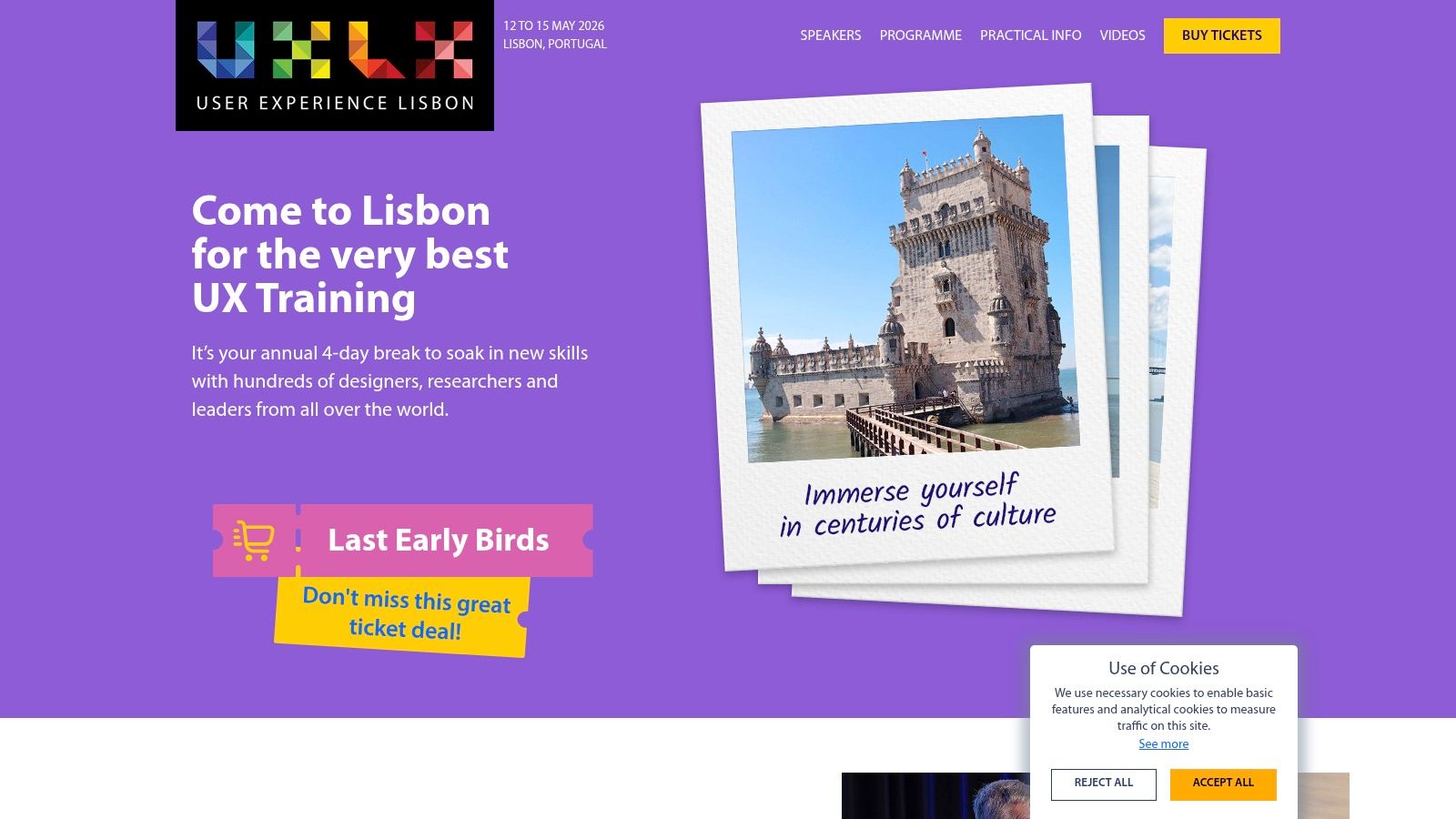
Where some product design conferences lean heavily into either high-level strategy or niche creative skills, UXLx has perfected the art of blending both. This flagship European event is meticulously structured over four days, offering a powerful combination of hands-on workshops, inspirational talks, and a new dedicated day for leadership and strategy. For teams aiming to build both practical skills and strategic alignment, UXLx is one of the most efficient investments you can make.
This conference is ideal for entire product teams, from junior designers seeking deep craft skills to product leaders refining their vision. The multi-track workshop format allows a team to "divide and conquer," with one member mastering accessibility while another sharpens their prototyping skills. The Lisbon setting also makes it a highly accessible and affordable option for most European teams.
Core Focus and Why Your Team Should Attend
UXLx is a well-oiled machine, known for its reliable curation and a programme that delivers tangible value. The four-day structure is its key differentiator, allowing for deep learning that a single day of talks cannot provide.
Primary Themes: The conference covers the full spectrum of user experience design. This includes user research, information architecture, content strategy, prototyping, accessibility, and product leadership. The distinction between the craft of UX and UI becomes very clear here; you can learn more about the differences between UX and UI to prepare.
Target Audience: A perfect fit for UX designers, researchers, content strategists, and product managers. The new leadership day makes it especially valuable for team leads and heads of product who need to connect design execution with business objectives.
Networking Potential: With a large international crowd, UXLx offers structured networking opportunities, making it easier to connect with peers facing similar challenges. The workshop format fosters deeper connections than a typical conference mixer.
Practical Recommendation: Send your product manager to the leadership day and your UX/UI designers to the workshop tracks. They can return with a shared language and aligned goals. For instance, after a workshop on advanced prototyping, your designer can build a high-fidelity prototype which you can then test with Uxia’s AI users to get rapid feedback on new interaction patterns before committing development resources.
Getting the Most Out of UXLx
To get full value from the multi-day format, pre-planning is essential. The official website, www.ux-lx.com, is your hub for tickets and workshop selection.
Access and Pricing:
Talks-Only Pass: Provides access to the main conference day of talks.
Workshop Bundles: Tiered pricing is available to combine the talks day with one or two days of hands-on workshops.
Full 4-Day Pass: Includes the leadership day, two workshop days, and the talks day for a complete experience.
Booking: Popular workshops are in high demand and often sell out months in advance. Book early to secure your preferred sessions.
Pros & Cons for Product Teams:
Pros | Cons |
|---|---|
Combines deep skills training and strategic content in one event. | Popular workshops can sell out very early, requiring fast booking. |
Lisbon is an affordable and accessible city for European-based teams. | The full 4-day commitment can be a significant time investment for small teams. |
Reliably well-organised programme with high-quality, vetted speakers. | Can be overwhelming if you don't plan your schedule in advance. |
3. UXDX EMEA 2026 (Berlin): Bridging Product, Design, and Engineering
Where many product design conferences focus on a single discipline, UXDX EMEA 2026 in Berlin is built on the philosophy of cross-functional collaboration. It directly addresses the common organisational silos that hinder progress by bringing product, UX, design, and engineering together. For teams struggling with alignment and slow delivery cycles, this conference offers a blueprint for building better products faster, together.
The EMEA edition is particularly valuable for its focus on practical case studies from leading product companies. Instead of abstract theory, sessions demonstrate how teams have successfully implemented frameworks for continuous discovery and delivery. It’s an ideal conference for sending a small, cross-functional team of a product manager, a designer, and an engineer who can learn and apply new operational models as a unit.
Core Focus and Why Your Team Should Attend
UXDX stands for User Experience (UX), Developer Experience (DX), and the Product (X) that connects them. The programme is designed to break down communication barriers and foster a shared understanding of the product development lifecycle.
Primary Themes: Cross-functional team alignment, product delivery frameworks, continuous discovery and delivery, scaling product teams, and bridging the gap between UX research and engineering implementation.
Target Audience: Perfect for product managers, UX/UI designers, and software engineers who work in integrated teams. It's especially beneficial for team leads and heads of department looking to improve their operational processes.
Networking Potential: The collaborative theme attracts a mix of disciplines, providing a unique opportunity to connect with peers facing similar organisational challenges and learn how they've overcome them.
Practical Recommendation: Your team can learn new methods for integrating user feedback into the development pipeline. For instance, after attending a talk on continuous discovery, you can implement a new process where insights from Uxia’s AI user testing are directly fed into your team's sprint planning. This ensures that user-validated feedback from the earliest design stages informs engineering priorities without delay, just as the conference preaches.
Getting the Most Out of UXDX EMEA
To maximise the ROI for your team, planning your attendance through the official website, uxdx.com/berlin/2026/, is essential. The site provides detailed schedules for both talks and the highly practical workshops.
Access and Pricing:
Team Tickets: UXDX encourages team attendance with significant multi-ticket discounts.
Workshops: Hands-on sessions that require separate booking; these are invaluable for skill development.
Discounts: Special pricing is typically available for startups, freelancers, and students.
On-Demand Access: Talk recordings are usually made available after the event, allowing you to revisit key sessions.
Pros & Cons for Product Teams:
Pros | Cons |
|---|---|
Strong product-delivery focus, ideal for PM/Design/Dev teams. | Less emphasis on pure visual craft or creative UI inspiration. |
High-calibre speakers from leading international product companies. | Berlin travel and accommodation costs can be significant for smaller teams. |
Practical, actionable case studies over abstract theory. | The broad, cross-functional content might feel less specialised for deep experts. |
4. Mind the Product — #mtpcon London 2026
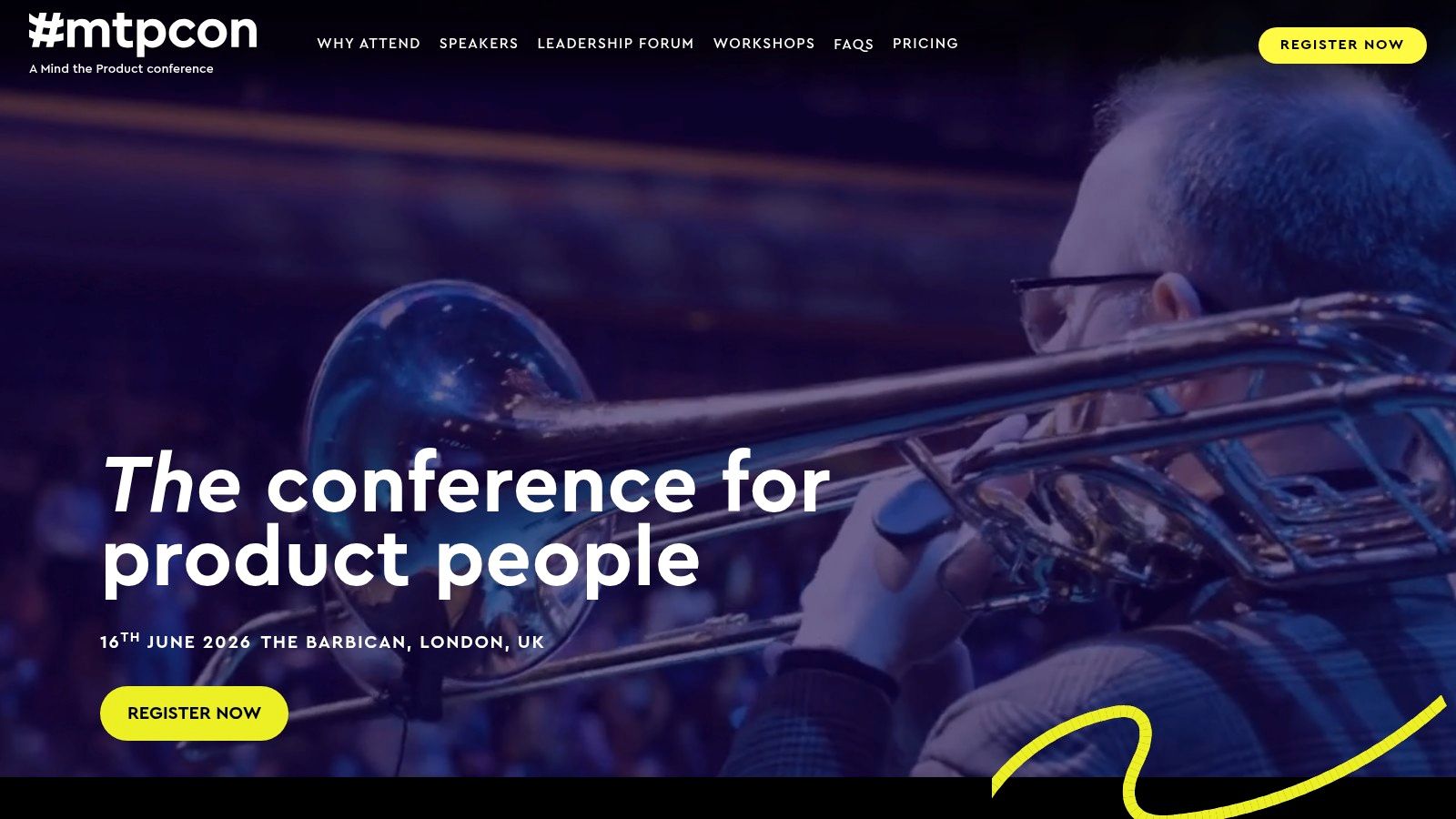
Where many product design conferences centre on the craft of UX and UI, #mtpcon London broadens the aperture to the entire product lifecycle. Hosted at the Barbican, this is one of Europe’s most significant gatherings for product people. For designers and researchers, its primary value is in building a shared language and strategic alignment with their product management counterparts, ensuring design decisions are deeply connected to business goals and market realities.
This event is ideal for product trios-designers, engineers, and product managers-looking to improve how they collaborate on discovery and strategy. If your team struggles with siloed thinking or translating research insights into prioritised features, the sessions on leadership, strategy, and cross-functional teamwork at #mtpcon can provide a unifying framework. It’s an essential conference for any team serious about building products that win in the market.
Core Focus and Why Your Team Should Attend
Mind the Product has a long-standing reputation for its focus on the strategic side of product development. The programme features a mix of high-level keynotes from global product leaders and practical workshops.
Primary Themes: Product management, product strategy, discovery best practices, leadership, and cross-functional collaboration. You'll learn how to build business cases for design initiatives and align UX goals with company objectives.
Target Audience: Perfect for Product Managers, UX Researchers, and Product Designers who want to elevate their strategic influence. It's a prime example of a conference that serves as a hub for product leaders, providing invaluable insights for dedicated Product Managers.
Networking Potential: The atmosphere is professional and driven, with opportunities like roundtables and speed networking to connect with senior product leaders from a wide range of industries. The strong alumni community is a valuable ongoing resource.
Practical Recommendation: Send your product manager and lead designer together to foster alignment. They can attend sessions on discovery and return with a unified plan for running more effective experiments. Before committing development resources, use Uxia to quickly test the core assumptions from these new discovery sprints, ensuring your team is building on a solid foundation of user understanding.
Getting the Most Out of #mtpcon London
The official website, mindtheproduct.com/mtpcon/london/, is the central hub for all conference information. Planning ahead is key to maximising its value.
Access and Pricing:
Conference Pass: Provides full access to the main stage talks and networking events. Prices are in GBP and can be substantial, so early booking is recommended.
Workshops: Separately ticketed, in-depth sessions that dive deep into specific skills. These are extremely popular and require advance booking.
Team Tickets: Corporate and group discounts are usually available, making it more cost-effective to send a small, cross-functional team.
Member Discounts: Mind the Product members often receive preferential pricing on tickets.
Pros & Cons for Product Teams:
Pros | Cons |
|---|---|
Excellent for PM/UX alignment and learning discovery best practices. | Heavier product management focus; not ideal for deep design craft skills. |
Long-standing reputation and a powerful alumni community for networking. | London travel costs and GBP pricing can be expensive for non-UK teams. |
High-calibre speakers and strategic-level content. | Workshops sell out very quickly and add to the overall cost. |
5. Productized Conference 2026: Practical Insights for Product Teams
For teams who need actionable takeaways over abstract inspiration, the Productized Conference in Lisbon offers a focused and pragmatic alternative. This event bridges the gap between high-level product strategy, hands-on product management, and effective design execution, making it one of the most practical product design conferences for startups and agencies. It's designed for those who build, ship, and iterate on products daily.
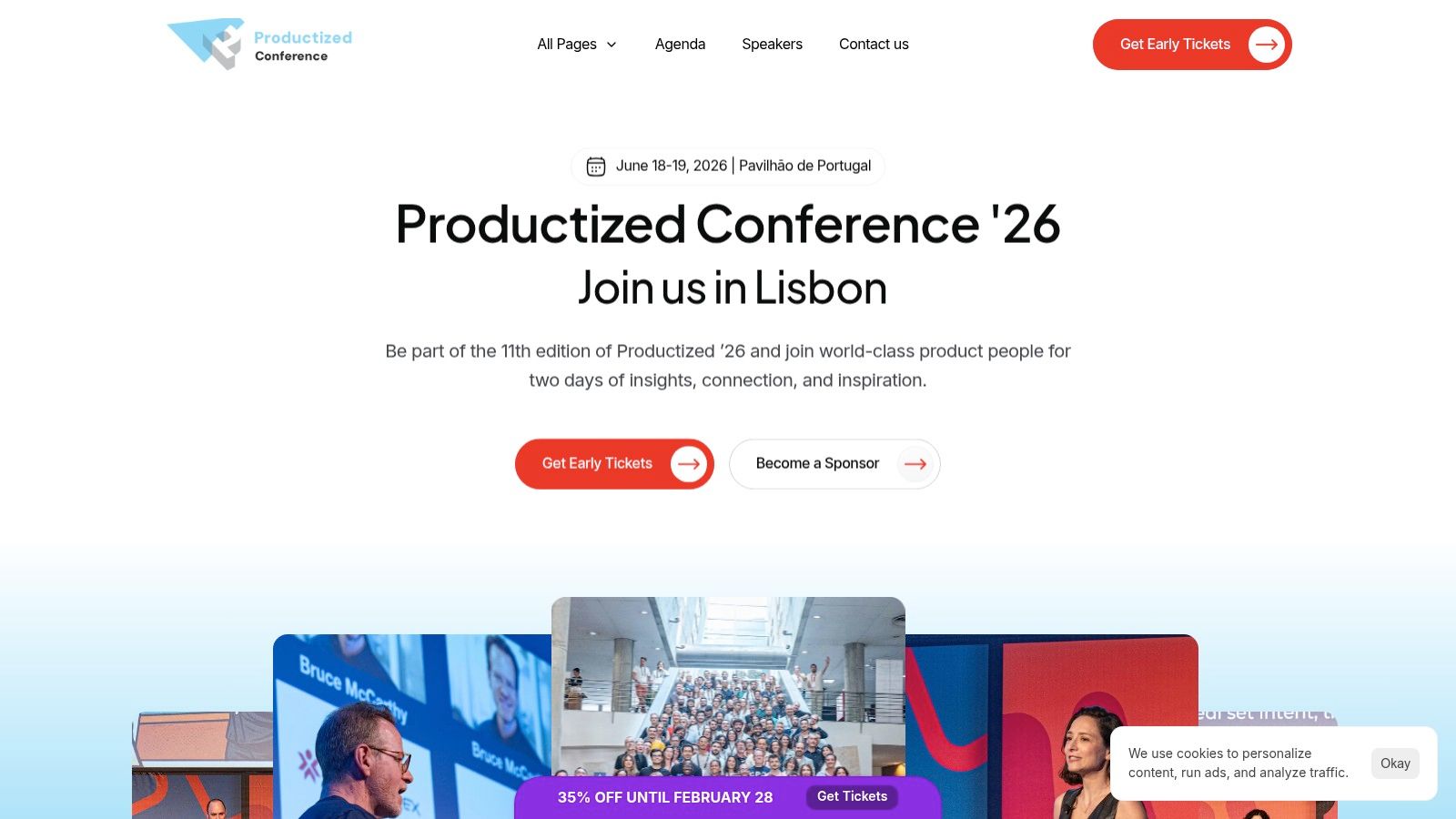
Held over two days with an optional third day for intensive workshops, the conference is perfectly suited to the realities of smaller teams with limited budgets. Its manageable scale-with around 600 attendees and 45 speakers-fosters a strong sense of community and provides excellent networking opportunities within the vibrant Southern European tech scene.
Core Focus and Why Your Team Should Attend
Productized excels by concentrating on the 'how' rather than just the 'what' of product development. The single-track main conference day ensures everyone shares a common learning experience, while the workshop day allows for deep skill acquisition.
Primary Themes: Product management, product discovery, UX research, go-to-market strategy, and scaling product teams. The content is directly applicable to the daily challenges faced by product managers and designers.
Target Audience: Ideal for cross-functional teams from startups, scaleups, and agencies. Product managers, UX/UI designers, and researchers will find the talks and workshops directly relevant to their work.
Networking Potential: The intimate setting is perfect for building meaningful connections with peers, speakers, and potential collaborators from Portugal, Spain, and beyond.
Practical Recommendation: Send a product manager and a UX researcher to attend both the workshops and the main conference. They can learn new frameworks for prioritisation and discovery, then immediately apply them. For instance, after a session on user-centric roadmapping, you can use Uxia’s AI-powered analysis to quickly gather qualitative insights that validate or challenge your new feature priorities, ensuring your roadmap is truly backed by user needs.
Getting the Most Out of Productized
To secure the best value, plan your attendance through the official website, productized.co. Early booking is key, especially for the popular workshop bundles.
Access and Pricing:
Conference Only Pass: Early-bird pricing starts around €249 (excluding VAT).
Workshops + Conference Bundle: A comprehensive option beginning at approximately €599 (excluding VAT) for the full three-day experience.
Group Discounts: A 20% discount is typically offered for teams of five or more, making it an affordable choice for sending a small product squad.
Pros & Cons for Product Teams:
Pros | Cons |
|---|---|
Focused, affordable programme attractive to startups and agencies. | Smaller scale can mean variable talk depth across some sessions. |
Strong networking within the Southern Europe product community. | Less breadth of parallel programming compared to larger multi-track events. |
Practical, hands-on content that is immediately applicable. | May not attract the same 'big name' keynote speakers as flagship global events. |
6. Future Product Days 2026: A World Stage for Product People
Billed as a "world stage for product people," Future Product Days 2026 is designed for entire cross-functional teams. This large-scale, festival-style event breaks down silos by featuring tracks for product design, UX, engineering, AI, and leadership. It’s one of the few product design conferences where a designer, an engineer, and a product manager can attend together and find immense, relevant value in their respective domains.
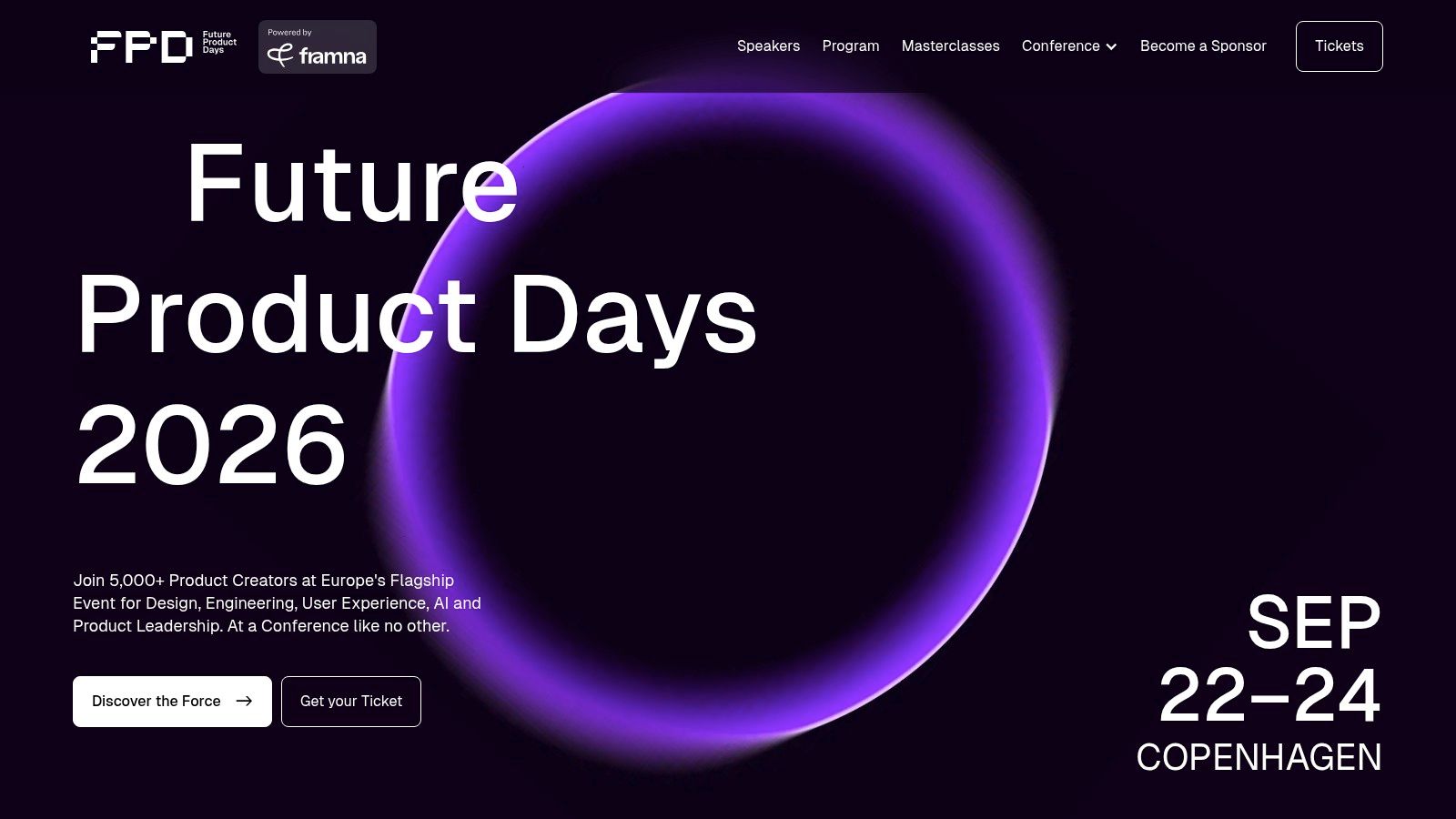
The primary appeal for product squads is the shared learning experience. Instead of sending individuals to specialised events, teams can immerse themselves in a common environment, discuss new ideas from different functional perspectives, and align on modern methods. This makes it a powerful catalyst for improving collaboration and adopting new, contemporary practices like integrating AI into the product lifecycle.
Core Focus and Why Your Team Should Attend
Future Product Days organises its multi-stage agenda to cater to the diverse roles within a modern product organisation, expecting over 5,000 participants. This scale allows for a breadth of content that is difficult to find elsewhere.
Primary Themes: Product design and UX, product strategy, engineering best practices, the application of AI in product development, and leadership skills. It provides a 360-degree view of what it takes to build successful products today.
Target Audience: Ideal for entire product squads-from UX/UI designers and researchers to developers and product managers. It's particularly useful for scale-ups and enterprises aiming to synchronise their teams' skills and strategic direction.
Networking Potential: The festival format fosters a more relaxed and open networking environment. It's an excellent opportunity to connect with peers across different disciplines, not just within your own specialisation.
Practical Recommendation: Use this conference to align your entire team on a new initiative, like building an AI-powered feature. The design track can offer UI patterns for AI, the engineering track can cover implementation, and the strategy track can provide go-to-market frameworks. Before committing development resources, use Uxia to test prototypes of your proposed AI feature with its AI-powered users to validate its value and usability early on.
Getting the Most Out of Future Product Days
The official website, futureproductdays.com/2026, is the hub for all planning. The event’s scale means advance preparation is key.
Access and Pricing:
Ticket Tiers: Pricing is tiered, rewarding early booking. Super-early-bird tickets might start around €300 per day (excluding 25% VAT).
Masterclasses: Optional full-day workshops are available for deep dives into specific topics, but they are ticketed separately and fill up fast.
Recordings: Some ticket tiers include access to talk recordings and slide packs, a great resource for sharing learnings with the wider organisation.
Group Discounts: Check for group packages to make it more cost-effective to bring your whole product squad.
Pros & Cons for Product Teams:
Pros | Cons |
|---|---|
Broad, contemporary coverage including AI in product and UX. | Festival-like scale can make session selection and logistics challenging. |
Excellent for aligning entire product squads on modern methods. | Very limited inventory of low-price tickets; prices rise significantly. |
Fosters cross-functional understanding and collaboration within teams. | The sheer number of attendees can make intimate networking more difficult. |
7. SmashingConf Antwerp 2026: Bridging Design and Front-End Development
SmashingConf Antwerp is a standout event for product teams that value craftsmanship and practical, hands-on knowledge. Unlike massive, multi-track conferences, this gathering is intentionally curated and intimate, focusing on a single track of expert talks. It is one of the few product design conferences that genuinely bridges the gap between UX/UI design and front-end development, making it essential for teams aiming to build more cohesive and collaborative workflows.
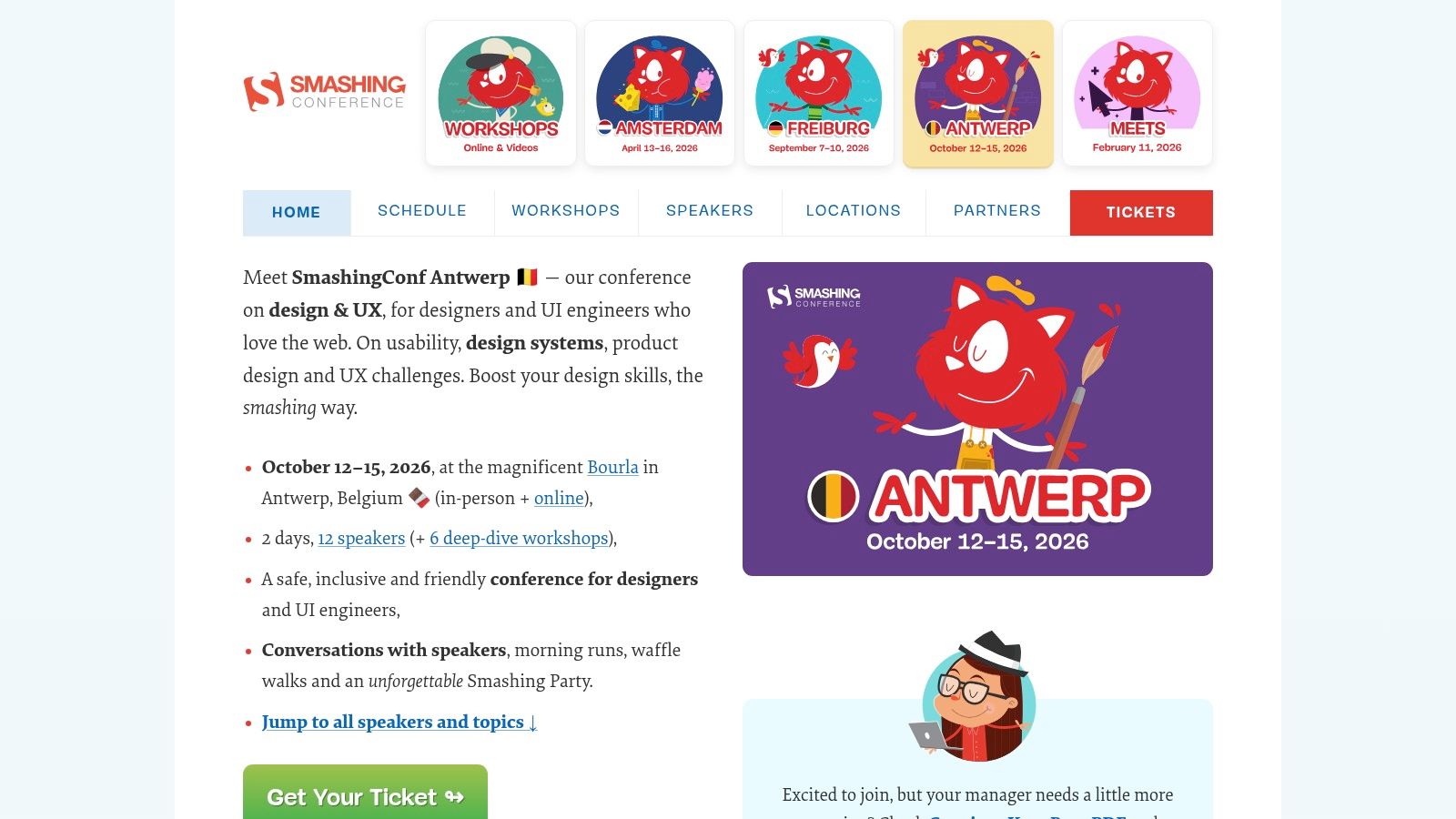
Hosted in the beautiful city of Antwerp, the event is designed for practitioners. Speakers often present detailed "this-is-how-we-work" demos, showing real-world techniques rather than high-level theory. This focus on actionable skills makes it perfect for designers and developers who want to return to work on Monday with new methods to apply directly to their projects, from optimising a design system to implementing more accessible components.
Core Focus and Why Your Team Should Attend
SmashingConf’s strength is its depth and community focus. With only 500-600 attendees, it’s an environment where you can easily connect with speakers and peers.
Primary Themes: Actionable UX techniques, design systems, accessibility, and front-end collaboration. The single track ensures every attendee shares a common learning experience.
Target Audience: Ideal for UI designers, UX engineers, and front-end developers who work closely together. Product managers will gain a deeper appreciation for the technical craft behind the user experience.
Networking Potential: The smaller scale and strong community vibe make it exceptionally easy to meet speakers and fellow attendees. It's less about collecting business cards and more about having meaningful conversations over coffee.
Practical Recommendation: Send a cross-functional pair-a designer and a developer-to SmashingConf. They will return with a shared vocabulary and aligned techniques for improving collaboration. After they learn new accessibility patterns or component strategies, use Uxia to test the real-world impact of these changes. You can run targeted UX tests to confirm that the new, technically sound components are also intuitive for users.
Getting the Most Out of SmashingConf Antwerp
To secure your spot and plan your trip, the official website, smashingconf.com/antwerp-2026/, is the main hub for all information.
Access and Pricing:
Conference Ticket: Pricing is revealed during the ticket purchase process but is competitive. Group and student discounts are typically offered.
Deep-Dive Workshops: Six hands-on workshops are available, ticketed separately. These are a major draw and provide deep skill development with industry experts.
Scholarships: The organisation offers scholarships and volunteer opportunities, making the event more accessible to a wider audience.
Community: The intimate setting is a core feature, so be prepared to engage and participate.
Pros & Cons for Product Teams:
Pros | Cons |
|---|---|
High signal-to-noise ratio with practitioner-focused talks and demos. | Smaller scale with a single track, offering less breadth than larger events. |
Strong community atmosphere makes it easy to meet speakers and peers. | Ticket pricing is not listed on the landing page, requiring a click-through. |
Excellent for improving designer-developer collaboration and workflows. | Deep-dive workshops are popular and can sell out, requiring early booking. |
Product Design Conferences: 7-Event Comparison
Conference | 🔄 Complexity | ⚡ Resources | 📊 Expected outcomes | 💡 Ideal use cases | ⭐ Key advantages |
|---|---|---|---|---|---|
OFFF Barcelona 2026 | Moderate 🔄 festival-style, multi-stage; workshops sold separately | Moderate ⚡ Full pass ~€330; easy for Iberian teams | Creative inspiration and UI/brand direction 📊; quality ⭐⭐⭐ | Teams seeking visual/UI, motion and design-culture boost 💡 | Regional hub for creative exchange; good value for design inspiration ⭐⭐⭐ |
UXLx: User Experience Lisbon 2026 | High 🔄 Four-day format with leadership day + multiple workshop tracks | High ⚡ 4 days; tiered pricing (talks → multi-day bundles) | Deep skills, strategy and hands-on training 📊; quality ⭐⭐⭐⭐ | Designers, researchers and product leaders seeking upskilling 💡 | Comprehensive training + strategic leadership content; strong curation ⭐⭐⭐⭐ |
UXDX EMEA 2026 (Berlin) | Moderate–High 🔄 Cross-functional workshops and case-study format | Moderate ⚡ Team discounts common; travel to Berlin may add cost | Better product-delivery practices and team alignment 📊; quality ⭐⭐⭐ | PM/Design/Dev teams focused on delivery & continuous discovery 💡 | Practical operational frameworks for building products faster ⭐⭐⭐ |
Mind the Product — #mtpcon London 2026 | Moderate 🔄 Flagship keynotes + workshops; strong program logistics | High ⚡ London travel and GBP pricing; corporate tickets typical | Product strategy, discovery and leadership insights 📊; quality ⭐⭐⭐⭐ | Product managers and leaders aiming for PM/UX alignment 💡 | Industry-leading speakers, large PM community and networking ⭐⭐⭐⭐ |
Productized Conference 2026 | Low–Moderate 🔄 Compact 1–2 day event with optional workshop day | Low ⚡ Affordable tiers (~€249 conference); good regional access | Practical takeaways and local network growth 📊; quality ⭐⭐⭐ | Startups, agencies and small teams seeking focused, affordable learning 💡 | Cost-effective, hands-on program with strong Southern Europe network ⭐⭐⭐ |
Future Product Days 2026 | High 🔄 Large multi-track festival with masterclasses and many choices | High ⚡ 5,000+ participants; tiered pricing and potential travel costs | Broad contemporary coverage (AI, engineering, leadership) 📊; quality ⭐⭐⭐ | Whole product squads needing broad upskilling and alignment 💡 | Scale and breadth for cross-functional squad alignment and modern topics ⭐⭐⭐ |
SmashingConf Antwerp 2026 | Low 🔄 Single-track curated program with deep-dive workshops | Low ⚡ 500–600 attendees; workshops add extra cost | Actionable techniques and practical craft takeaways 📊; quality ⭐⭐⭐⭐ | UX/UI designers and design engineers focused on craft and delivery 💡 | High signal-to-noise, practitioner-focused talks and strong community access ⭐⭐⭐⭐ |
Turn Inspiration into Action: Maximising Your Conference ROI
Navigating the vibrant world of product design conferences is only the first step. The true measure of success lies in what happens after the final keynote, when the excitement of events like UXDX EMEA, SmashingConf, or Mind the Product must be converted into tangible progress. The real challenge is to prevent your newfound knowledge from becoming a forgotten stack of notes and instead use it as a catalyst for genuine change within your team's workflow.
The conferences we have explored, from the creative energy of OFFF Barcelona to the practical focus of Productized, all share common threads. Themes of efficiency, cross-functional alignment, and the intelligent integration of AI are no longer future-gazing; they are present-day necessities for building successful products. Your investment in attending these gatherings pays its greatest dividends when you systematically translate high-level concepts into your day-to-day operations.
From Conference Insights to Practical Application
The journey from inspiration to implementation requires a structured approach. Avoid the common pitfall of returning to the office with a vague sense of motivation but no clear plan. Instead, organise a post-conference debrief with your team.
Share Key Learnings: Dedicate a session to presenting the most impactful talks, workshops, and conversations. Focus on insights that directly address your team's current challenges, whether it's breaking down silos, speeding up research cycles, or adopting new design methodologies.
Identify Actionable Opportunities: Don't just list what you learned; pinpoint specific, small-scale experiments you can run. Was there a talk on continuous discovery? Propose a pilot for a new feedback collection method. Did a speaker demonstrate a new prototyping technique? Schedule a hands-on workshop for your design team.
Build a Business Case: Use the authority of conference speakers and case studies to justify trying new tools or processes. Frame it as a low-risk experiment. For instance, you can say, "At Future Product Days, a key theme was reducing the time from research question to insight. I propose we trial a tool like Uxia for one sprint to see if we can achieve a similar outcome."
Practical Recommendation: Focus on one or two high-impact changes rather than attempting to overhaul your entire process at once. A successful small-scale pilot provides the evidence and momentum needed for broader adoption. For example, test a new design component library on a single, non-critical user flow before proposing a site-wide migration.
Connecting Conference Themes with the Right Tools
Many of this year's product design conferences highlight a critical need for speed and agility in user research and validation. The traditional, months-long research project is becoming a bottleneck in an environment that demands rapid iteration. This is precisely where modern platforms come into play, offering a direct line from conference theory to practical execution.
When you hear speakers at UXLx or #mtpcon discuss the importance of embedding user feedback directly into the development cycle, consider how a tool like Uxia makes this a reality. Instead of organising complex, time-consuming user interviews for every minor design tweak, you can get AI-powered insights on usability and user perception in minutes. This aligns perfectly with the conference-driven goal of making product teams more autonomous and data-informed.
Choosing the right tool depends on your immediate needs. If your team's primary bottleneck is validating UI changes, a platform offering quick heuristic analysis and design feedback is essential. If you are struggling to get qualitative insights from a broad user base, a tool that can simulate user personas and generate feedback can fill that gap. A practical recommendation is to map your team's top 3 bottlenecks and then look for tools that solve one of them directly. By piloting a tool like Uxia to automate repetitive research tasks, you free up your team to focus on the strategic, creative work that truly drives product innovation, turning conference inspiration into a measurable return on investment.
Ready to turn conference insights into action? The fastest way to apply principles of speed and efficiency is to eliminate research bottlenecks. With Uxia, you can test designs, analyse usability, and get AI-powered user feedback in minutes, not weeks. Start making data-informed decisions today by exploring Uxia and see how it can transform your product development lifecycle.