
The planning meeting starts with a familiar pile: interview notes, heatmaps, support tickets, and a wishlist from sales. Everyone has evidence, but each person has a different idea of what it means. Before long, the conversation has shifted from customer problems to a contest between feature requests.
Opportunity mapping gives the team a way to connect customer needs to product outcomes before choosing a solution. Done well, it isn't a wall of sticky notes or a one-off workshop artifact. It's an auditable decision system: each opportunity has a traceable evidence trail, a confidence level, and an assumption the team can test.
The Moment Opportunity Mapping Solves
A product manager brings a research sprint into planning. Sales wants a faster onboarding flow, support wants clearer error messages, and design has spotted confusing navigation in usability sessions. Engineering asks which issue matters most. Nobody can answer without leaning on a favorite anecdote or a forceful opinion.
That's the moment opportunity mapping earns its place. Instead of jumping from a complaint to a feature, the team identifies the underlying need, connects it to a measurable outcome, and considers different ways to address it. A request for a new dashboard, for example, might point to a deeper problem: users can't find the information they need to make a decision.
The map isn't a feature backlog, a vote, or a guarantee that a solution will work. It's a structure for asking better questions: who is affected, what are they trying to do, what gets in the way, and which outcome would improve if the obstacle were removed? That distinction keeps a loud request from becoming a roadmap commitment before the team understands the problem.
Teams also need to separate a recurring, consequential need from an isolated suggestion. A useful starting point is to examine workflow pain points worth solving and ask whether each apparent pain point connects to a real user goal and product outcome.
Practical rule: Don't debate solutions until the team can state the user problem without naming a feature.
Opportunity mapping changes the tone of planning. The conversation moves from “Who asked for this?” to “What evidence shows this is a meaningful barrier, and what would tell us we've reduced it?” That's the standard to carry into discovery and product decisions.
Inputs You Need Before You Map Anything
A mapping workshop can't repair weak evidence. Before you open a board, gather multiple kinds of customer evidence and preserve where each finding came from. Interviews reveal motivation and language; analytics show patterns of behavior; support tickets and sales feedback reveal recurring confusion, objections, and unmet needs. Journey maps, prototype tests, and accessibility audits help put those signals into context.

Make every finding traceable. Keep the source, date, audience, journey or task, and observed behavior beside the summary. Mark whether a finding is a direct observation, a user's interpretation, or a team hypothesis. That simple discipline makes later synthesis auditable and helps prevent a confident paraphrase from masquerading as research evidence.
A single channel can mislead. Interviews alone may overrepresent people willing to talk; support tickets capture problems that users report, not every obstacle they encounter. Analytics can flag a drop-off without explaining its cause. Combine sources so the team can compare what people say with what they do, then decide what still needs investigation. Convenience samples deserve particular scrutiny: if a finding comes from an easy-to-reach group, record that limitation instead of treating it as representative.
Use the map to distinguish how often a problem appears from how much it matters to the outcome. A frequently mentioned inconvenience may have little effect on completion, while a less common barrier may stop an important task. If evidence is thin, make the opportunity a discovery priority, not a roadmap priority.
Teams can use a user research methodology for faster insights to make this evidence-gathering work more deliberate. For market context, a thoughtful approach to analyzing competitors before launching can help clarify where a product's experience differs, but competitor observations shouldn't stand in for customer evidence.
Running the Workshop and Building the Map
A useful workshop turns evidence into a structure the team can act on. Keep the right people in the room: product, design, engineering, research, and colleagues close to customers. For a remote team, use one shared board and keep source material one click away. Don't ask participants to reconstruct research from memory.
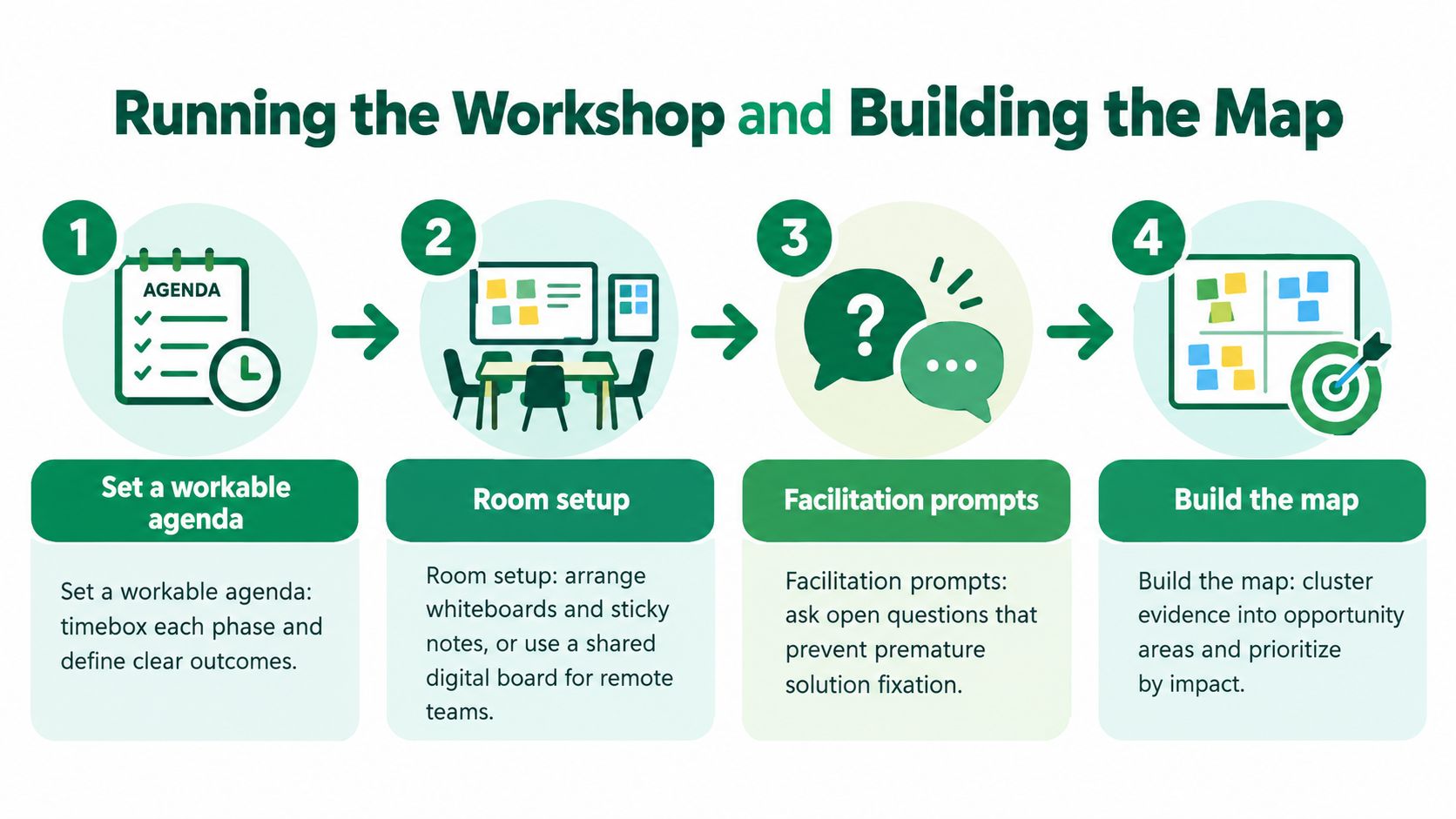
Start by agreeing on the business or product outcome. “Make the experience better” isn't a useful outcome; a defined target such as increasing successful completion of a specified task gives the team something to reason about. Then review evidence, cluster related observations, and write opportunity statements in plain language. Ask open questions that keep the discussion on the user's goal: “What was the person trying to do?” “Where did they get stuck?” “What did they do next?”
The map follows the logic Outcome → Opportunity → Solution → Experiment. One outcome can contain distinct opportunities, and each opportunity should support multiple solution hypotheses. If a team sees that users struggle to identify the next step, possible hypotheses might include changing labels, clarifying page hierarchy, or adding contextual guidance. Keep these as alternatives until evidence helps the team choose what to test.
Keep audience context visible
Don't collapse different experiences into one broad label. A first-time mobile user, a returning desktop user, and a screen-reader user may face different barriers while pursuing what looks like the same goal. Create separate branches when the context changes the problem, and merge only when the evidence supports treating the need as shared. This keeps the map useful without turning it into a catalogue of personas.
The finished board should show each opportunity's evidence, affected audience, outcome connection, and testable assumptions. Teams looking for other ways to make complex problems visible can explore visual problem-solving methods for engineers, but the board itself should stay focused: a clear map beats an elaborate canvas nobody revisits.
Synthesis and Prioritization Without the Bloat
A large map isn't a sign of thorough discovery. It often means the team hasn't made hard choices. Rank opportunities using impact on the target outcome, prevalence across the intended users, and strategic fit. Add confidence as a separate signal. It tells you how much the team knows, not how valuable the opportunity would be if the evidence holds.
Don't force every consideration into one score. A compact impact-and-effort comparison helps when the team needs a quick discussion, but it can hide uncertainty. ICE-style scoring can make candidates easier to compare, yet the result is only as trustworthy as the evidence and definitions behind the ratings. Weighted scoring is more appropriate when stakeholders agree on the criteria and their relative importance. A confidence-rated ranking is useful when evidence quality varies: it makes low-confidence, potentially important opportunities visible without pretending they're validated.
Method | Best use case | Strength | Watch out for |
|---|---|---|---|
Impact and effort | A quick comparison of a short list | Simple to explain and discuss | Effort can dominate the conversation and obscure user evidence |
ICE-style scoring | Comparing candidates using a shared set of factors | Makes assumptions visible across opportunities | Scores can create false precision if criteria aren't defined |
Weighted scoring | Decisions with agreed strategic priorities | Reflects the team's explicit trade-offs | Disagreements about weights can become the real debate |
Confidence-rated ranking | Mixed or incomplete evidence | Separates potential value from certainty | Confidence must reflect evidence, not seniority or enthusiasm |
When synthesis involves evidence from several sources, the team's data-driven design approach can help keep decisions tied to observed behavior rather than preferences. Whatever method you choose, retain the source evidence and write down why an opportunity moved up or down.
A low-confidence opportunity is a reason to investigate, not a reason to build.
Keep the active shortlist small enough to guide actual work. Archive duplicates and lower-priority opportunities with their evidence intact; don't delete them or leave them competing for attention on the live board. Review the shortlist when new evidence changes confidence, user impact, or strategic fit.
Adding Evidence With Uxia at the Mapping Layer
Teams treat opportunity mapping as a synthesis exercise, then leave the map unchanged while the roadmap moves on. That's backwards. The map should be a working record of what the team believes, how well it knows it, and what evidence could change its mind.
For each node, record the affected user and context, the goal, the source evidence, the outcome metric, and a falsifiable assumption. Include uncertainty explicitly. “Users can't finish checkout” is too broad; “first-time mobile buyers may hesitate because payment steps are unclear” gives the team a specific audience, situation, and claim to investigate. If the evidence doesn't support the claim, the team should be able to revise or discard it.

Uxia can supply a practical evidence layer for prototype validation. Teams upload an image or video prototype, define a mission, and configure synthetic tester profiles around relevant audiences and behaviors. The testers move through the flow and generate think-aloud feedback, transcripts, friction flags, heatmaps, and prioritized insights. Treat those outputs as evidence to review and attach to the relevant map node, not as an automatic verdict about what the whole customer base thinks.
For a priority opportunity, run the same mission across relevant contexts. Compare where testers complete the task, where they hesitate or make errors, and what they say about the experience. Link observations to indicators that fit the goal, such as task completion, time on task, errors, or satisfaction. If the evidence contradicts the assumption, lower confidence or rewrite the opportunity; don't keep the original wording just because it has already been prioritized.
Turn each run into a map update
Keep the evidence attached to the decision it informs: the audience tested, the prototype and mission, the findings, and the change in confidence. Synthetic testing can help a team examine flows quickly, but it doesn't establish lived experience or settle high-risk accessibility questions on its own. Validate with affected users when the decision could exclude them or when their context may differ substantially.
This is the shift from a workshop deliverable to a decision system. Uxia can help teams generate prototype evidence, while the map preserves what that evidence means for prioritization. Review both together so the team can tell the difference between an opportunity that matters and one it has merely discussed often.
Where Opportunity Maps Usually Fail
The first failure is solution fixation. A stakeholder arrives with a feature idea, and the group reorganizes research to justify it. Stop that drift by writing the user problem before discussing possible solutions, then require each proposed solution to connect back to a specific opportunity and outcome.
Weak synthesis causes a different problem. Teams combine distinct barriers into a vague label such as “improve usability,” then rank the label without knowing which users or tasks it represents. Keep the branches separate when the underlying causes differ. Also challenge leading questions and convenient samples; both can make a preferred conclusion look better supported than it is.
The quietest failure is a map that averages away people with different constraints. A navigation issue may reflect cognitive load for one group, language or localization for another, and screen-reader incompatibility for a third. Represent the observable constraint and context on the relevant node. Don't assume a broad persona label captures why the experience breaks down.
If a map can't show who the evidence comes from, it can't show whose needs it missed.
Finally, teams let the map grow until nobody can use it, or treat the workshop board as finished work. Archive duplicates, limit active investigation to the strongest candidates, and refresh the evidence as the product changes. A map without an owner and a review habit is a poster, not a decision system.
Handing Off and Measuring Whether It Worked
The workshop ends; the work doesn't. Hand off a ranked shortlist with the evidence behind each opportunity, the affected audience, a named owner, the target outcome metric, the falsifiable assumption, and a review date. Engineering and design should be able to see not just what the team wants to test, but why that opportunity earned attention and what result would change the decision.
Agree on a review cadence that fits the product team's discovery and delivery rhythm. Revisit the map when new research, analytics, support evidence, or prototype results challenge a current assumption. Keep the evidence record intact so a changed ranking has a clear explanation rather than appearing as another unexplained roadmap pivot.
Use process and outcome measures
A generic success-rate claim won't tell you whether your mapping practice is useful. Track whether the team has evidence behind its active opportunities, whether synthesis is consistent across reviewers, how long it takes to turn an insight into an experiment, and whether the chosen product outcome moves after a change. Choose leading and lagging indicators deliberately; this guide to leading and lagging indicators can help teams separate early signals from realized outcomes.
Use this handoff checklist to make the map operational:
Owner: Assign one person to maintain each active opportunity and its evidence.
Outcome: Name the product or business measure the opportunity should affect.
Assumption: State what the team believes and what observation would disprove it.
Evidence: Link the supporting research, analytics, and prototype-test findings.
Review: Set a date to revisit the opportunity and update its confidence.
Learning: Record the experiment result and any change to the map or decision.
A map that has an owner, evidence, and a review date can evolve with the product. Without those, it won't tell the team what to do next.
Uxia lets product teams test prototype flows with synthetic participants and review transcripts, friction points, heatmaps, and prioritized insights as evidence for opportunity decisions. Try Uxia to validate a priority journey and bring the findings back into your map.