Best AI Interviewers for UX Research: Top 10 Tools 2026
Explore the best AI interviewers for UX Research in 2026. Compare top tools, features, & use cases, including AI-moderated interviews, to optimize your

AI interviewers stopped being an experimental UX workflow when they became cheaper, faster, and operationally easier than the human-led alternative. The clearest signal came in late 2025, when AI moderation crossed from edge case to industry default in raw interview volume.
Choosing among the best AI interviewers for UX research now requires more than checking whether a tool can ask questions in sequence. Dividing lines are deeper: can it probe adaptively, can it ground responses in domain-specific data, can it support multilingual research without breaking consistency, and can it turn conversations into findings without pushing researchers back into manual cleanup work.
Introduction to AI Moderated Interviews
In Q4 2025, AI-moderated interviews surpassed human-moderated interviews by volume globally, and the shift was driven by a 95% drop in cost per interview, from about $487 to about $22, according to Alignify's review of the category. That is more than a tooling trend. It is a structural change in how product teams can run qualitative research.
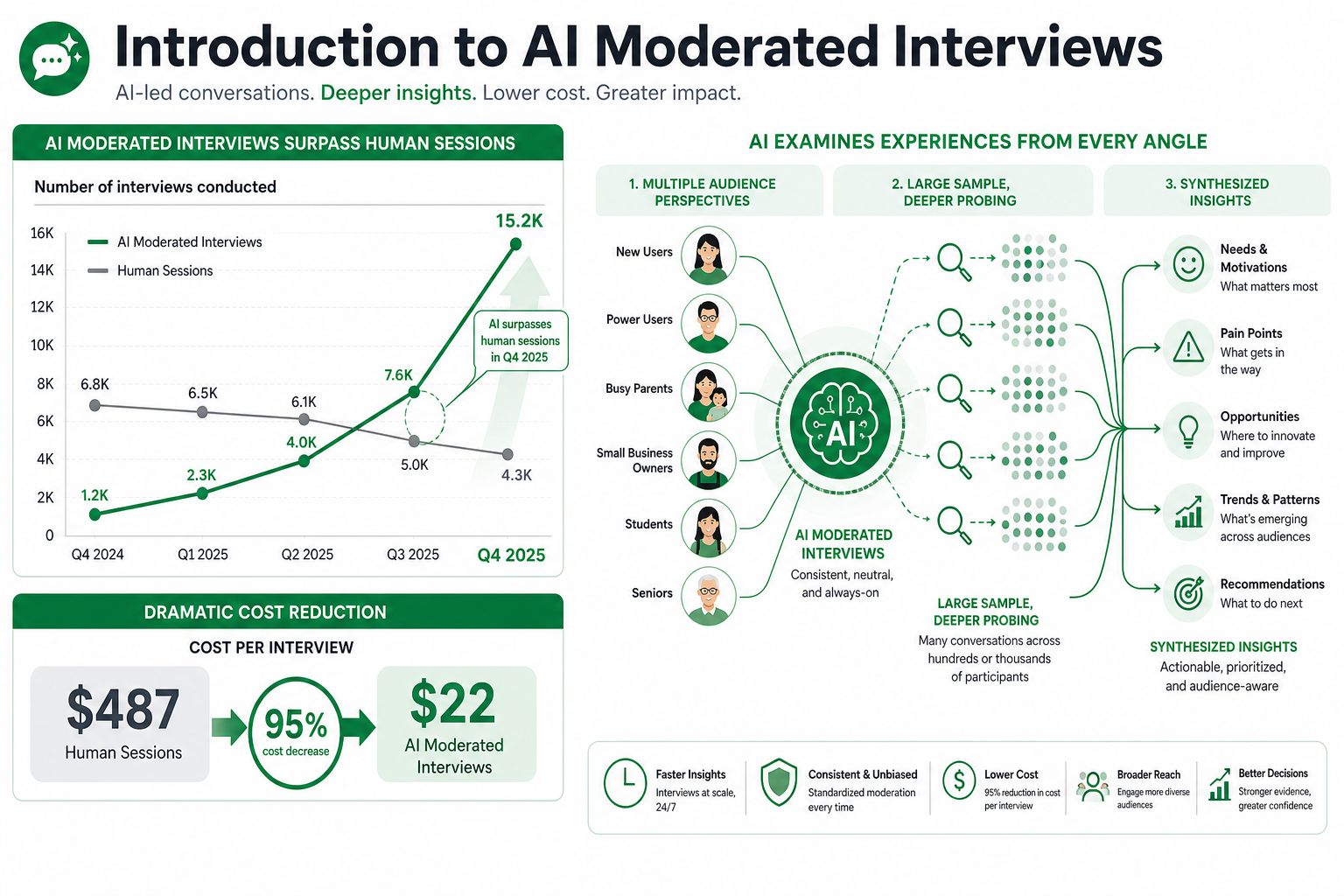
The practical consequence is simple. Interviews no longer have to be reserved for a small, expensive set of strategic questions. Teams can bring conversational research into normal product cycles, test assumptions earlier, and revisit the same theme across more markets and audience segments.
That change also explains why synthetic testers and AI interviewers are converging. One layer simulates or recruits the audience. Another layer runs the conversation. A stronger platform links both to structured analysis so researchers don't trade moderation time for transcript review time. That's the most useful way to read the market now, including newer approaches discussed in Uxia's guide to AI-moderated interviews for faster UX insights.
Why adoption accelerated
Three forces pushed adoption forward:
Lower operating cost: The economics changed enough to make continuous discovery feasible for more teams.
Higher throughput: AI can run many interviews in parallel without the scheduling drag that slows human-led studies.
Better integration into sprint work: Product and design teams can collect qualitative input during iteration, not only before launch gates.
What matters now
The category no longer lives or dies on automation alone. Most tools can save time. Fewer can preserve research quality while scaling. The best products in 2026 separate themselves through adaptive follow-up, domain grounding, multilingual consistency, and analysis that is usable without a second workflow.
AI moderation is most valuable when it removes repetitive execution work while preserving the parts of interviewing that generate insight, especially follow-up, clarification, and pattern detection across large samples.
Defining Key Evaluation Criteria
Most buyers still start with the wrong question. They ask whether a tool can automate interviews. A better question is whether it can produce credible qualitative depth without forcing a researcher to manually rescue the output afterward.
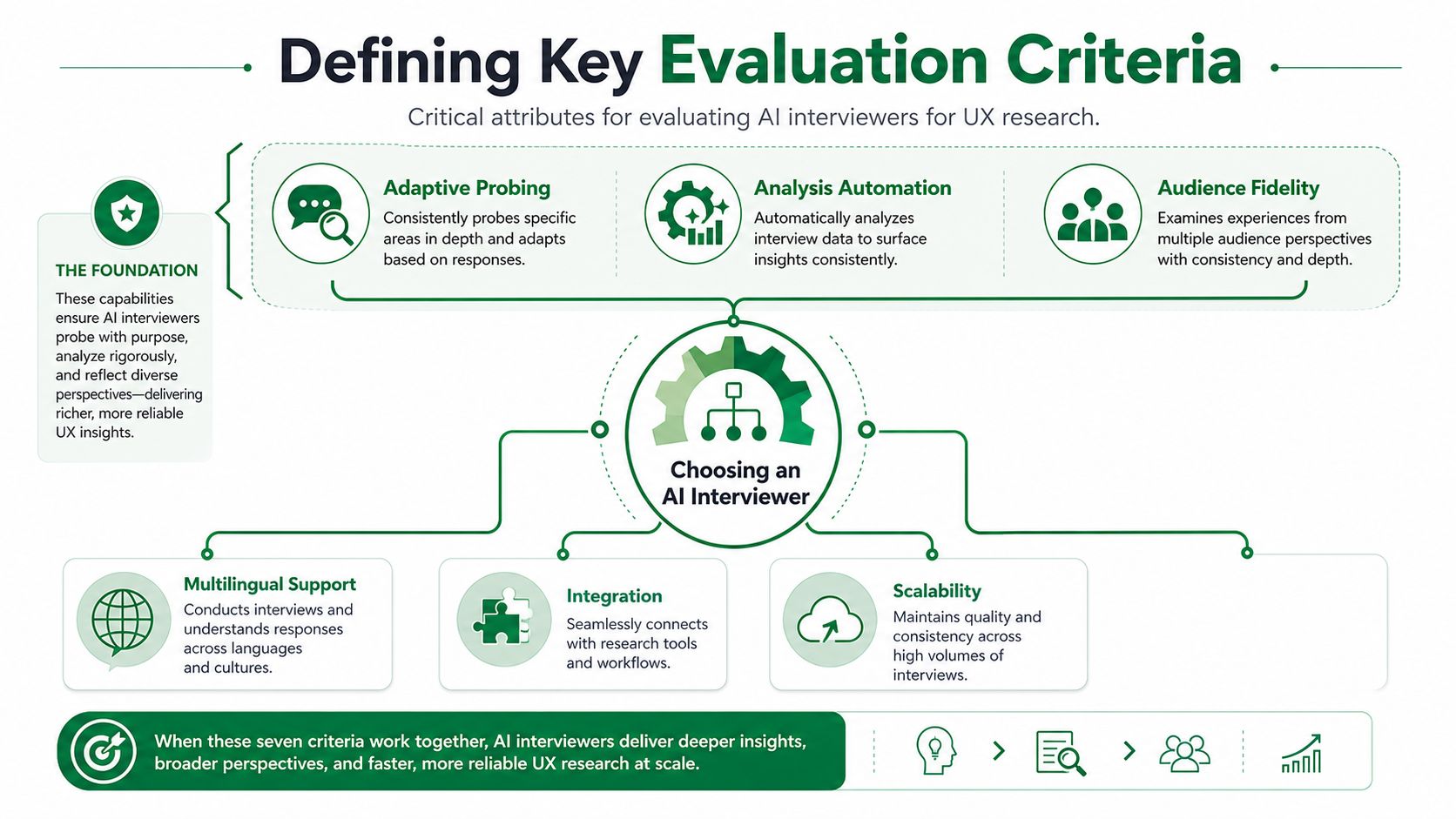
The strongest benchmark comes from the category itself. In 2026, AI-moderated interview platforms need to show adaptive probing beyond predefined scripts if they want to deliver genuine qualitative depth rather than just faster collection, as noted in Perspective AI's evaluation framework.
Adaptive probing
This is the first filter. If the system can't recognize what is vague, interesting, contradictory, or incomplete in a participant's answer, it isn't really interviewing. It's administering a dynamic survey.
Good probing does three things at once. It stays aligned to the study objective, follows the participant's language, and avoids nudging the participant toward a preferred explanation.
Transcript quality and conversation fidelity
Transcripts are only as useful as the conversation that generated them. Researchers should look for signs of coherent turn-taking, clear question phrasing, and enough conversational context to interpret why a response emerged.
A shallow transcript often looks deceptively complete. It contains many words, but very little progression. That's why quality should be assessed at the exchange level, not just by whether a transcript exists.
Analysis automation
Automation matters most after the interview ends. Faster moderation is not valuable if researchers still need to watch recordings, clean transcripts, and manually extract themes.
The strongest tools connect interviews to structured synthesis. They cluster recurring issues, surface notable contrasts, and produce outputs that are useful in design and product decisions, not just in research archives.
Audience fidelity
A generic audience produces generic findings. Many AI interviewer evaluations still fall short in this regard. A useful system needs enough context to represent the difference between, say, a casual banking app user and a finance leader with specialized workflow knowledge.
Practical rule: If your audience prompt could describe almost anyone, your interview findings will probably describe almost no one in particular.
Multilingual support
Multilingual capability isn't just a translation feature. It affects recruitment reach, moderation consistency, and whether a team can run research in markets where the internal team lacks language coverage.
For distributed product teams, this can be the difference between occasional international validation and repeatable market-by-market discovery.
Integration flexibility
The next frontier is how tools ingest company context. Teams that are serious about assessing AI for your use case increasingly need systems that fit existing research, CRM, support, and persona workflows rather than forcing isolated studies.
Research consistency
The most underrated criterion is consistency. Human moderators vary. AI should reduce that variance without becoming rigid. The ideal balance is a system that holds the study objective steady across sessions while adapting to each participant's knowledge level, language, and style.
That balance also supports an “AI before humans” model. Use AI to explore hypotheses, reduce obvious uncertainty, and widen coverage. Then bring human researchers in where emotional nuance, strategic ambiguity, or high-stakes interpretation still matter most.
Comparison of Top AI Interviewers
The current market has clear leaders, but they lead in different ways. Some platforms win on participant access. Others win on adaptive moderation, domain grounding, or usability-specific observation. That's why a flat ranking is less useful than a structured comparison.
Top 10 AI Interviewers Compared
Tool | Adaptive Probing | RAG Support | Languages | Analysis Depth | Pricing Tier |
|---|---|---|---|---|---|
CleverX | Strong, with real-time follow-up infrastructure | Not verified in reviewed source | Not specified in reviewed source | High, with automated execution and analysis | Premium |
Userology | Strong, with screen-aware follow-up | Not specified in reviewed source | Recognized for working across diverse languages and expertise levels | High, including heatmaps and prioritized insights | Premium |
Tellet | Strong for multilingual interviewing | Not specified in reviewed source | Best positioned for global multilingual audiences | Moderate to high | Mid to premium |
Perspective AI | Strong, category benchmark for adaptive probing | Not specified in reviewed source | Not specified in reviewed source | High for conversational studies | Mid to premium |
Synthetic Users | Not the most discussed strength | Verified focus on domain-adaptive knowledge grounding | Not specified in reviewed source | Moderate to high | Mid |
User Intuition | Claimed depth in follow-up layering | Not specified in reviewed source | Not specified in reviewed source | Interview depth is core positioning | Mid |
Uxia | New AI-moderated interview feature with synthetic audience linkage | Supports audience enrichment with proprietary context | Built for scaling across several markets and languages | Structured findings for iterative testing | Mid |
Maze | Better known for evaluative testing than conversational depth | Not specified in reviewed source | Not specified in reviewed source | Strong in testing workflows, less interview-centric | Mid to premium |
UserTesting | Strong for observing real users, less centered on AI-led conversation | Not specified in reviewed source | Not specified in reviewed source | Strong observational output | Premium |
Dovetail | Better suited to synthesis than moderation | Not specified in reviewed source | Not specified in reviewed source | High as a repository and synthesis layer | Mid to premium |
CleverX
CleverX is the most clearly evidenced leader on participant access and workflow consolidation. It has 8M+ B2B participants and an AI Study Agent that automates execution and analysis on one platform, with LiveKit supporting low-latency voice interactions for real-time probes, according to CleverX's category review. That combination makes it particularly strong for B2B teams that want recruitment, interviewing, recording, and synthesis in one system.
Userology
Userology stands out because its moderator is screen-aware, not just language-aware. According to Listen Labs' review of top AI user research platforms, it can observe the participant's interface and ask context-aware follow-ups during usability sessions, then generate heatmaps and prioritized insights. That makes it one of the strongest options for teams that care about what users do on-screen as much as what they say.
Tellet
Tellet's clearest advantage is international scale. It is positioned as the strongest platform for global audiences across multiple languages, enabling UX teams to scale research in markets where internal moderators may not speak the audience's language, as described in CleverX's multilingual AI moderation comparison. If your main constraint is cross-market coverage, Tellet belongs on the shortlist.
Perspective AI
Perspective AI is important because it sharpens the category standard. Its strongest contribution is not a panel claim or a repository claim, but the insistence that AI interviewers must probe beyond scripts to create real qualitative depth. That makes it a strong fit for teams prioritizing generative discovery and follow-up-heavy interviewing over broader research suite functionality.
Synthetic Users
Synthetic Users is one of the most interesting entries because it reflects where the category is heading, not just where it is now. Leading platforms increasingly use retrieval-augmented generation to ingest support tickets, CRM data, and prior transcripts so personas respond with company-specific knowledge rather than generic profiles, according to Articos' analysis of AI interview tools. That matters most when accuracy depends on domain memory, not just conversational fluency.
User Intuition
User Intuition addresses a blind spot many comparison lists miss: synthetic participant fidelity for behavioral nuance. In User Intuition's review of user interview platforms, the company argues that most competitors ask one follow-up and move on, while deeper systems should be able to ladder several layers into substantive answers. Even if buyers treat vendor framing cautiously, the evaluation point is valid. Follow-up depth is often where weak tools collapse.
Uxia
Uxia is worth watching because its new AI-moderated interview feature links interviewing with synthetic testing and audience enrichment. The distinctive angle isn't just that it can run interviews. It's that the interview output can feed back into synthetic testers, making it useful for iterative validation loops where teams refine both the audience model and the research questions over time.
Maze
Maze remains more naturally aligned with structured evaluative testing than with open-ended moderated interviewing. For teams working heavily in prototype validation, that can still be useful. But if your primary goal is qualitative discovery through probing conversation, Maze is less central than the category specialists above.
UserTesting
UserTesting stays relevant because some studies still benefit from seeing real users interact with shipped products under lighter AI mediation. It is best treated as a strong observational platform with AI-assisted layers, not as the default answer for every AI interview use case.
Dovetail
Dovetail fits best as a synthesis and repository layer. It matters when an organization already has many studies and needs cross-study search, theme retrieval, and research memory. It is less useful as a primary AI interviewer than as an analysis complement.
The best buying decision usually comes from separating interview execution from research memory. Some teams need both in one platform. Others need a specialist interviewer plus a dedicated repository.
Deep Dive on Uxia AI Moderation
Uxia's newer moderation model is most interesting when viewed as part of a larger research system rather than as a standalone interviewer. Its role is to interview testers, turn those conversations into structured findings, and use the result either as direct research output or as a way to enrich future synthetic testers.
Where the model fits
A global fintech team offers the clearest example. Suppose the team needs feedback from finance leaders across several markets. The challenge isn't just language. It's domain specificity. A generic AI participant or loosely defined audience won't understand accounting workflows, internal approval dynamics, or the terminology that shapes trust in enterprise finance software.
Uxia's approach addresses that by allowing teams to enrich the audience context with proprietary personas, help-center material, and company knowledge. The interviewer can then probe around trust, expectations, terminology, and prior behavior with more consistency than a manually run, one-market-at-a-time workflow.
Why this matters in practice
The value isn't a dramatic one-off story where AI spotted something no human ever could. There isn't a documented public head-to-head case proving that. The stronger claim is narrower and more credible. AI can examine the same experience from multiple audience perspectives with unusual consistency, then keep probing the same categories across a larger sample.
That consistency matters when researchers want to compare how different audience segments interpret the same flow, phrase, or task. Human moderators often need to prioritize one thread in a limited session. An AI moderator can revisit the same dimensions repeatedly without fatigue.
For teams evaluating whether synthetic testing and moderated interviewing should live in one workflow, this practical guide comparing Synthetic Users and Uxia for UX validation is useful because it highlights the broader difference between generic simulation and domain-shaped validation.
Best use cases for Uxia's model
Uxia is a strong fit when teams need to:
Scale repeated validation: Run the same research objective across several audience variants or markets.
Ground synthetic testers in company context: Enrich responses with internal personas, documentation, and domain knowledge.
Reduce manual cleanup work: Turn sessions into structured findings rather than transcript archives.
Support iterative loops: Feed interview learning back into future synthetic studies.
Where human researchers still matter
Some studies still need live human interpretation. Timing-sensitive experiences, emotionally charged contexts, and situations where physical environment matters remain better suited to human-led work or at least human review.
That's why the most sensible operating model isn't AI instead of researchers. It's AI for repeatable exploration, then human judgment where nuance and consequences are highest.
Real-World Use Cases and Impact
The most persuasive use cases for AI interviewers are not dramatic replacement stories. They are workflow stories. They show how research becomes easier to run earlier, more often, and with tighter links to design iteration.
Domain-rich financial software research
One representative example comes from a financial software project focused on CFO workflows. The key lesson was not that a machine magically understood finance better than people. It was that a generic participant profile would have failed. CFO users operate with specialized terminology, priorities, and decision frameworks that broad prompts don't capture.
By enriching the synthetic audience with proprietary personas, help-center material, and domain-specific context, the research could evaluate the experience from the standpoint of users who recognize those workflows. That changed the kind of feedback available. Terminology, trust cues, and feature expectations became testable in a more realistic context.
K-Chess onboarding comparison
A more concrete workflow comparison comes from the K-Chess onboarding study. The full research cycle with Uxia took 21 minutes, with about nine minutes for setup and twelve minutes to run. The comparable human-panel study took 362 minutes, including 236 minutes for completion and 115 minutes for manual analysis. In that side-by-side comparison, the Uxia workflow was about 17 times faster.
Reliability also differed. The synthetic study had no failed sessions, while 40% of the human sessions failed because of platform issues or participants not following instructions correctly. From a budget perspective, the study estimated that recurring research with Uxia could be about five times more affordable than equivalent traditional participant-panel work.
What changed operationally
The deeper impact wasn't just saving time on a single study. The research cadence changed.
Earlier testing: Teams could check concepts, copy, and navigation before a design was nearly finished.
More frequent iteration: Research became part of the normal product cycle rather than a large validation checkpoint.
Lower execution drag: Less time went into recruiting, scheduling, and manual synthesis.
Broader comparative coverage: Teams could examine multiple audience perspectives with higher consistency.
The real advantage of AI interviewing often isn't one spectacular insight. It's the ability to ask the same high-value follow-ups across a wider sample, then act on patterns sooner.
International research and language coverage
For teams that need global reach, multilingual moderation can be the deciding factor. Tellet is the strongest documented option for this use case because it is recognized as the best AI-moderated interview platform for accessing global audiences in multiple languages, enabling international UX research without in-person moderators, according to CleverX's cross-market platform review.
That use case matters more than many teams realize. International research often fails not because the team lacks interest, but because the operational burden is too high. A multilingual interviewer lowers that barrier, especially when the internal team can't moderate every market directly.
A practical reading of ROI
AI interviewer ROI should be judged in three layers:
Layer | What to evaluate | Why it matters |
|---|---|---|
Speed | How quickly a study goes from setup to findings | Faster cycles support iteration during design, not after it |
Reliability | Whether sessions complete cleanly and consistently | Failed sessions create hidden cost and weak comparisons |
Usability of output | Whether findings arrive in a structured form | Raw transcript volume can cancel out moderation savings |
Teams that evaluate only moderation speed usually miss the point. The better question is whether the whole research loop gets shorter without reducing confidence.
Implementation Best Practices
Implementation quality determines whether AI interviewing produces decision-ready evidence or a pile of plausible sounding transcripts. The strongest teams treat setup as a research design problem: they define what knowledge the system should draw from, which participant model it should represent, and where human review still needs to stay in the loop.

Step 1 Define the knowledge base and audience together
Teams often separate retrieval setup from audience design. That usually weakens both. Domain-adaptive RAG only improves interview quality if the retrieved material matches the participant model the system is supposed to represent.
A fintech onboarding study, for example, should not pull the same corpus for a first-time retail customer and an operations manager at a mid-market bank. Their vocabulary, constraints, and decision criteria differ. If the retrieval layer is broad but the persona is narrow, the interview sounds informed yet inconsistent. If the persona is broad and the retrieval layer is specific, responses can become overly confident and unrepresentative.
Useful inputs usually include:
Support and success data: Tickets, chat logs, FAQs, and call notes reveal recurring friction and user language.
Behavioral segmentation data: CRM fields, lifecycle stage, plan tier, and product usage help separate materially different user groups.
Prior research artifacts: Interview transcripts, usability findings, and survey verbatims anchor follow-up questions in known patterns.
For teams comparing simulated participants with live respondents, this analysis of synthetic users versus human users is a practical reference for deciding where synthetic persona fidelity is high enough for early exploration and where direct observation remains the safer choice.
Step 2 Write interview logic that tests decisions, not just topics
Coverage is a weak goal. Decision support is the better one.
An effective AI-moderated guide starts with the product or design decision at stake, then works backward to the evidence needed. That means specifying the scenario, the tension to probe, and the conditions that should trigger follow-up. Uxia's AI-moderated interview feature makes this especially important because the quality of moderation depends on how clearly the system can distinguish between a participant stating a preference, describing a behavior, or revealing a constraint.
A stronger interview design usually includes:
One decision-focused research question tied to a product, design, or prioritization choice.
A concrete user situation that provides context without suggesting the preferred answer.
Probe rules that tell the system when to ask for examples, clarify contradictions, or test claimed behavior against actual workflow details.
Good prompts create room for unexpected evidence. Over-scripted guides produce clean summaries and weak insight.
Step 3 Configure outputs around comparison and review
Output settings should reflect how findings will be used, not just what the platform can generate. A design team reviewing three onboarding variants needs comparative friction patterns. A product team evaluating roadmap risk needs severity, frequency, and segment-level differences. Researchers still need access to raw sessions for auditability, especially when moderation is automated.
That usually means prioritizing:
Theme clustering with segment splits
Flags for contradictions, uncertainty, or low-evidence claims
Quote selection linked to the underlying session
Summaries mapped to the original research questions
This is also where tool differences matter. Conventional AI interviewers often stop at summarization. Platforms that combine moderated interviewing with domain-adaptive retrieval and higher-fidelity participant modeling can produce outputs that are easier to validate, because the reasoning chain is closer to the actual study context.
Step 4 Validate with a narrow, falsifiable pilot
Pilot studies work best when success and failure are both easy to see. Start with a question where the team already has some baseline knowledge, such as onboarding friction, pricing page comprehension, or feature discoverability. Then compare the AI-moderated findings against a small human-reviewed sample, prior interviews, or known support themes.
The goal is calibration, not blind trust. Check whether the system identifies the same high-signal issues, whether follow-up questions surface real motivations instead of restating prompts, and whether segment differences hold up under review. If synthetic persona fidelity is part of the workflow, test the personas against known user behaviors before using them to shape major product bets.
Teams that follow this sequence usually learn faster where AI moderation is reliable, where retrieval improves specificity, and where a human researcher should still review edge cases or sensitive topics.
Common Pitfalls and How to Overcome Them
Adoption usually stalls for predictable reasons. The problem is rarely that teams hate the idea of AI interviewing. It's that early setups are too generic, too broad, or too output-heavy.
Trust in fidelity
Researchers often want proof that AI participants or AI moderators are realistic enough to support decisions. That caution is reasonable. The best response isn't to force a replacement narrative. It's to use AI where repeatability and breadth matter most, then keep human researchers involved for sensitive or high-context work.
Generic audience profiles
This is the most common setup error. Broad audience descriptions like “banking customer” or “software user” flatten the behaviors that drive meaningful findings. Stronger studies use richer demographic, behavioral, and contextual detail, often supported by proprietary material.
For teams thinking through that tradeoff, this comparison of synthetic users and human users is helpful because it clarifies where simulation is strongest and where direct human observation still matters more.
Weak study design
Leading questions, vague missions, and overloaded interview guides produce weak results whether the moderator is human or AI. Teams usually improve fastest when they use templates, clear scenarios, and a tighter link between each question and the decision it informs.
Transcript overload
AI makes it easy to run many sessions. It doesn't automatically make the findings clearer. More transcripts can become more confusion if the platform only exports raw conversation.
A better operating rule is to prioritize:
Pattern-first reporting: Surface recurring findings before individual anecdotes.
Review by exception: Read full conversations when the system flags contradictions, unusual reactions, or uncertainty.
Action framing: Tie themes to product decisions, copy changes, or usability fixes.
The teams that get the most value from AI moderation usually transition gradually. They start with a bounded question, compare outcomes against known signals, refine the audience model, and expand only after the workflow proves credible.
How to Choose the Best AI Interviewer
The right choice starts with the decision you need to make, then works backward to the interview method, data source, and level of researcher oversight.
A team validating workflow friction in a live product usually needs a different tool than a team stress-testing concepts across many audience variants. That distinction matters because the strongest platforms now compete on three less obvious dimensions, not just scheduling and transcription. They differ in how well they adapt to domain-specific knowledge through RAG, how realistic their synthetic personas are when no live participant is present, and how far AI moderation can go before a human researcher needs to step back in.
A useful selection framework is to match the platform to the dominant research constraint:
Choose CleverX if participant recruitment is the bottleneck and you need a single workflow that connects access, interviewing, and synthesis.
Choose Userology if your studies depend on visual context, interface interpretation, or moderated usability tasks that require the system to “see” what participants see.
Choose Tellet if language coverage and cross-market interviewing matter more than advanced audience modeling.
Choose Uxia if you need repeated testing loops that combine synthetic users, domain-adaptive context from proprietary material, and its newer AI-moderated interview capability in one research system.
The harder question is not which tool has more features. It is which failure mode you can tolerate.
If your team cannot risk weak audience fit, prioritize participant quality and domain grounding over automation. If your team already has strong customer knowledge but needs faster directional feedback, synthetic persona fidelity and retrieval quality may matter more than live recruitment scale. If the cost center is analyst time, compare reporting outputs closely. Some products save time during fieldwork but push the synthesis burden to the end of the process.
Use five checks before you commit:
Probing quality. Can the interviewer ask relevant follow-ups without turning leading or repetitive?
Domain adaptation. Can it use your research repository, product docs, customer context, or prior interviews through RAG or similar retrieval methods?
Persona fidelity. If synthetic users are involved, are they behaviorally specific enough to produce plausible tradeoffs rather than generic opinions?
Decision-ready outputs. Does the tool identify patterns, contradictions, and implications, or only produce transcripts and summaries?
Human handoff points. Is it clear when a researcher should review raw sessions, refine prompts, or intervene in moderation?
Organizations comparing these tools as part of broader AI integration strategies for businesses should evaluate fit at the workflow level. A platform that performs well in a demo can still underperform if it does not match your recruitment model, evidence standards, or synthesis process.
The best buyer usually starts with one bounded study. Test the platform on a question where you already have partial ground truth, such as feature comprehension, onboarding friction, or message clarity. That gives you a clearer read on whether the system improves speed only, or improves speed and research quality together.
If you want to test an AI-first workflow built around synthetic testers, multilingual validation, domain-adaptive audience enrichment, and Uxia's newer AI-moderated interview feature, explore Uxia. It is a strong fit for teams that want faster iteration without giving up contextual grounding or researcher control where judgment still matters most.