
AI Moderated Interviews: A Guide to Faster UX Insights
Scale your UX research with AI moderated interviews. Learn how to set up, run, and analyze insights in hours, not weeks, with this practical guide from Uxia.

AI Moderated Interviews: A Guide to Faster UX Insights
Your roadmap is moving every week. Your research cadence probably isn't.
That gap shows up in familiar ways. A team wants feedback from users in several countries, but recruiting drags, calendars don't line up, and transcript review becomes its own project. By the time the insight deck lands, design has already shipped the next iteration.
That's the problem AI moderated interviews solve when you use them properly. They don't replace research craft. They remove the parts of the workflow that slow good research down.
The End of Slow Research Cycles
The first step my team took was simple. We mapped where traditional moderated interviews were breaking down.
It wasn't the discussion guide. It wasn't the value of talking to users. The friction came from three places: recruiting the right participants, scheduling across time zones, and manually analyzing transcripts after sessions ended. Those bottlenecks made multi-market research feel heavier than it should have.
When teams use AI moderation for urgent studies, transcripts, tags, and themes can be automated so results are ready in hours, which makes it useful for validating findings across larger samples or several markets at once, as noted in Maze's explanation of AI moderation. That matched what we saw in practice. Once the interview itself became automated, we could keep the research goals human-designed and still get structured insights within a few hours.
Where the old workflow breaks
Traditional moderated research still works well for deep exploration. But the operational cost adds up fast when you're trying to move with a product team.
A typical slowdown looks like this:
Recruitment stalls momentum: finding the right audience across countries takes coordination and follow-up.
Scheduling creates artificial delay: even when participants are ready, matching calendars across regions introduces lag.
Analysis becomes a second project: transcripts, tagging, and synthesis often take longer than the sessions themselves.
Practical rule: Before adopting AI moderated interviews, identify the single slowest part of your current workflow. That's usually where you'll see the first payoff.
We approached AI moderated interviews as a workflow shift, not a novelty. The immediate win was speed, but its true value was consistency. We could run interviews across markets without requiring our own team to speak every language or personally attend every session.
That shift also changed how we thought about decision-making infrastructure more broadly. Teams that are already reworking research operations usually benefit from rethinking analytics at the same time, which is why I often recommend reading Querio's take on AI for smarter business decisions. Research speed matters most when the rest of the organization can absorb and act on what you learn.
For a deeper look at how this kind of workflow compresses research timelines, our own write-up on generative UX research with AI insights is useful context.
What Are AI Moderated Interviews
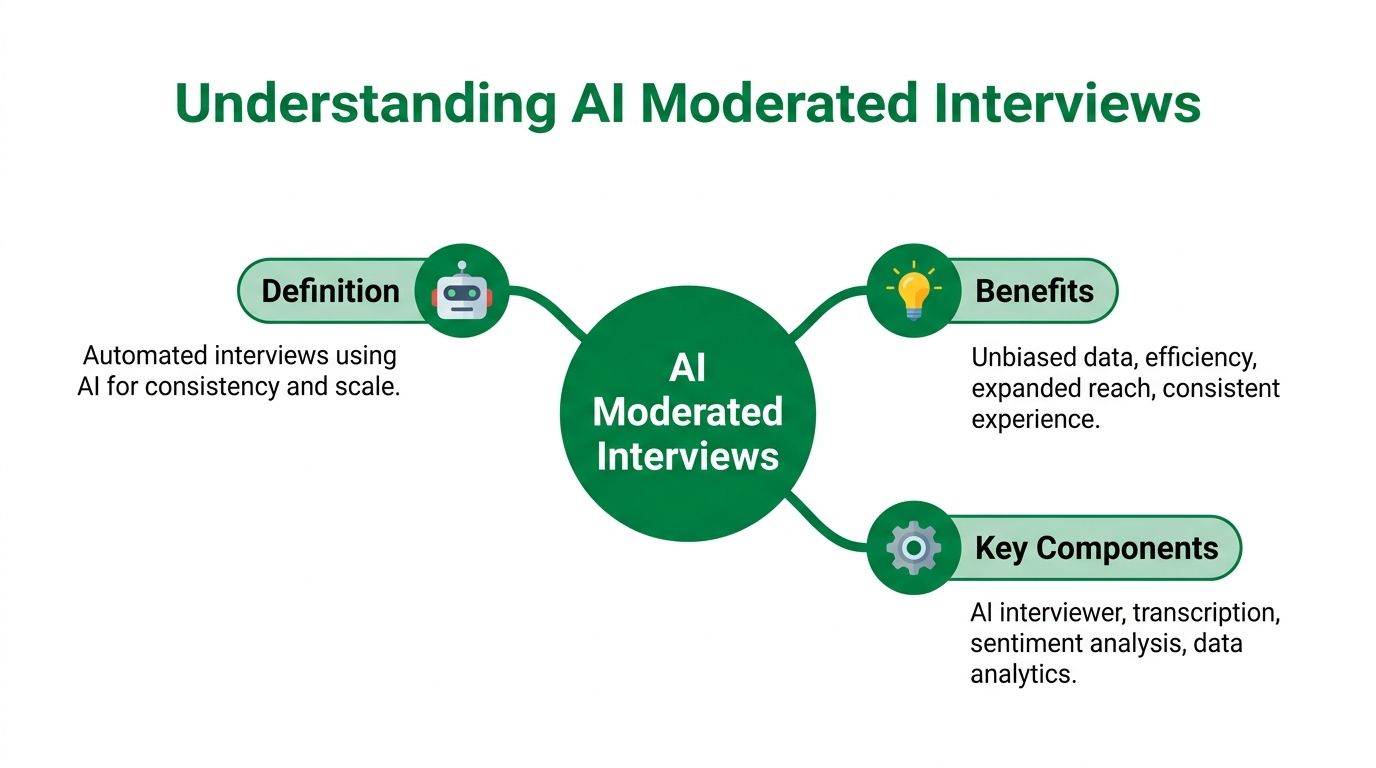
AI moderated interviews sit between a static survey and a live researcher-led session.
A survey asks the same prewritten questions no matter what the participant says. A human interviewer can probe, clarify, and dig into contradictions. AI moderated interviews combine the structure of the first with some of the adaptiveness of the second. The system follows a researcher-defined discussion guide, then asks follow-up questions in real time when an answer is vague, emotional, or unexpectedly interesting.
How they differ from surveys and unmoderated tests
The easiest way to understand the method is to compare it to adjacent tools.
Method | What it does well | Where it falls short |
|---|---|---|
Static survey | Fast collection of standardized answers | Can't probe beyond a shallow response |
Unmoderated usability test | Captures task behavior well | Doesn't always surface the user's underlying reasoning |
Human moderated interview | Handles nuance, emotion, and ambiguity well | Hard to scale across markets and schedules |
AI moderated interview | Runs conversational qualitative research at scale | Still depends on strong research design and clear boundaries |
The most important distinction is adaptive probing. AI moderated interviews using LLMs such as GPT-4, Claude, or Gemini have been shown to produce responses that are 2.5 to 8 times longer and richer than traditional static questionnaires because they can probe in real time, typically within an 8 to 20 minute session, according to CleverX's guide to AI moderated interviews.
That richer output is why this method works so well for product questions like:
Onboarding friction: where users hesitate, what they expected, and why
Concept feedback: what sounds appealing at first, then falls apart under probing
Copy comprehension: which terms seem obvious to the team but land poorly with users
Cross-market validation: whether the same issue appears consistently across regions
What powers the conversation
The AI isn't inventing a research plan. Researchers still have to define the objective, write the guide, and set the boundaries.
A useful mental model is this: the AI is an endlessly patient interviewer that never gets tired, never forgets the guide, and can run many sessions at the same time. But it only performs as well as the prompts, probe rules, and participant targeting behind it.
If you're thinking about the broader operational model behind systems like this, Captapi's article on robust automation strategies with Captapi is a good companion read. The same principle applies here. Automation works best when you define the guardrails first.
AI moderated interviews aren't a shortcut around research design. They're a way to scale disciplined research behavior.
Your First AI Interview Workflow
The teams that get value from AI moderated interviews fastest don't start with a giant research program. They start with one narrow question, one clear audience, and one workflow problem worth fixing.
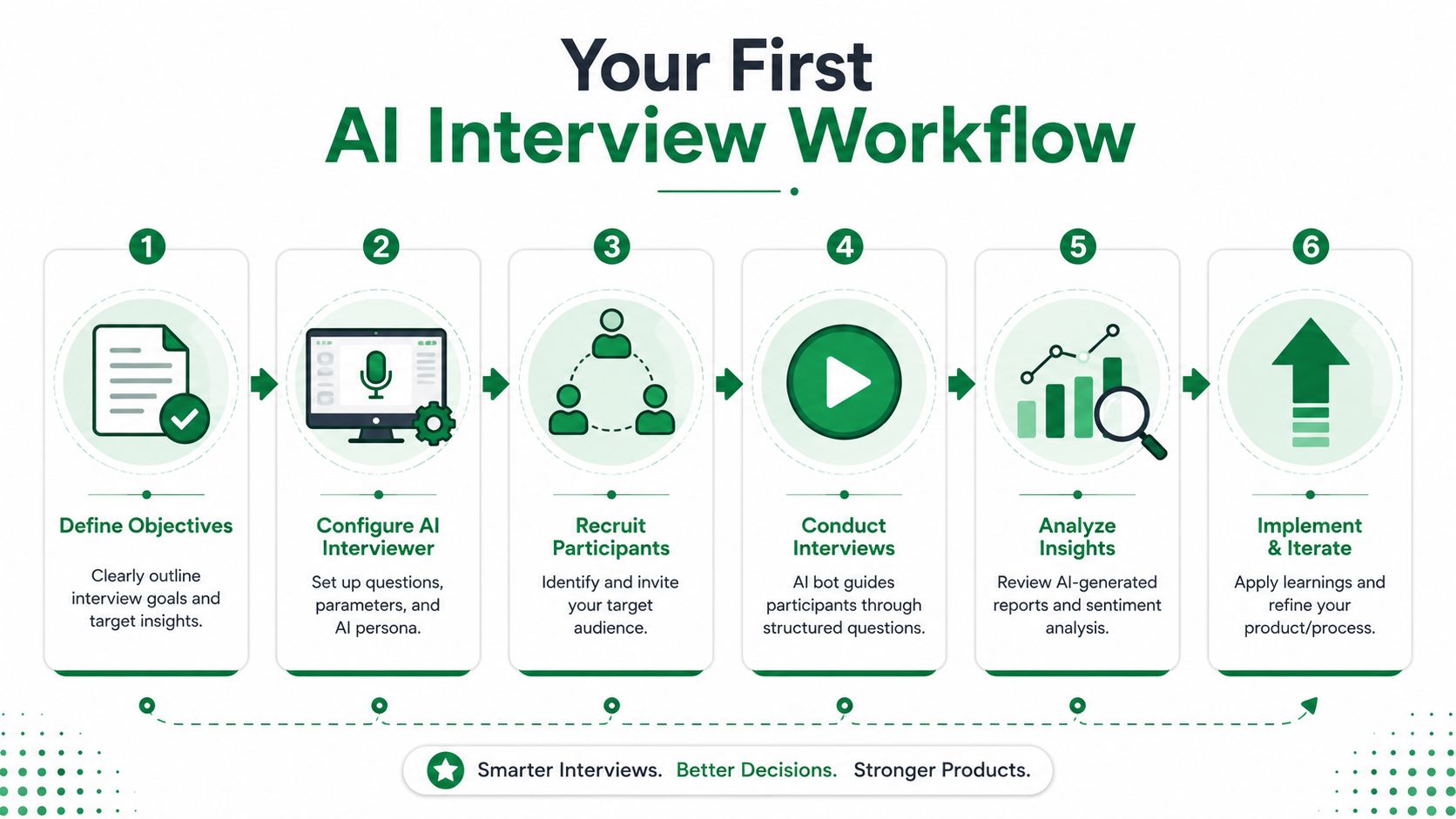
A good launch sequence is more operational than technical.
Step 1 Identify the real bottleneck
Our own adoption started with diagnosis, not tooling. We asked where traditional moderated interviews were slowing the team down most. The answer was recruitment, scheduling, and transcript analysis across multiple countries.
That matters because AI moderated interviews don't need to replace everything. They need to remove the specific constraints that are blocking good research.
Step 2 Narrow the research objective
The biggest setup mistake is trying to answer too much in one interview.
Pick one focused objective. Examples include understanding why users abandon onboarding, what new signups misunderstand about verification language, or how churned users describe the product gap in their own words. If your guide tries to answer five strategic questions at once, the interviews get shallow fast.
Use prompts that invite explanation. Avoid yes or no wording, avoid product language that leads the witness, and make room for follow-up questions that ask why.
Step 3 Build an AI-ready discussion guide
A strong guide for AI moderation needs more than a list of questions. It needs rules.
Include instructions like:
Probe ambiguity: if a participant says something was confusing, ask what specifically caused confusion.
Ask for examples: when someone makes a general claim, request a concrete moment.
Move on deliberately: don't let the interviewer loop forever on one weak thread.
Protect neutrality: avoid suggesting reasons the participant hasn't stated.
This is also the point where teams can decide how the method fits into their broader stack. On the product side, platforms such as Uxia's AI user research workflow can automate the interview itself and use those conversations to enrich synthetic testers, which is useful when you want both direct interview evidence and scaled simulation in the same process.
Step 4 Launch small, then inspect the first outputs
You don't need a massive first study. Launch a small batch, then read the outputs carefully before scaling.
A helpful benchmark from external practice comes from a mid-market B2B SaaS team that moved from 5–10 interviews per study to 80+ interviews per study within six months using a hybrid model where AI handled fielding across the US, UK, and DACH regions while researchers reviewed a 10–20% human validation sample, reaching 82% AI coding accuracy, according to CleverX's case example.
That pattern is sensible. Start with a pilot. Read representative transcripts. Check whether the AI is probing naturally or leading. Then scale.
Field note: The first review should focus less on the summary and more on the raw exchanges. If the conversations sound weak, the dashboard will only hide the weakness faster.
AI moderated research can compress a traditional 4–6 week qualitative cycle into hours by automating recruitment, running adaptive interviews, and generating summarized themes quickly, which is how platforms such as Uxia can return structured transcripts and summaries within a few hours of launch, as described in Listen Labs' overview of AI moderated research tools.
Step 5 Turn the output into product action
Once the interviews finish, don't stop at reading summaries. Translate patterns into product decisions.
Product teams benefit from pairing research signals with operational measurement. Trackingplan's piece on agentic analytics is worth reading if you're trying to connect behavioral data, instrumentation quality, and qualitative patterns into one decision loop.
A quick walkthrough helps make the workflow concrete:
Use the findings to rewrite copy, reorder flows, clarify navigation, or prioritize the next round of live interviews. The point isn't just faster feedback. It's getting to a better next decision.
Analyzing Actionable Insights at Scale
The output that matters most isn't a single sentiment score or a polished summary paragraph. It's the combination of structured analysis and direct qualitative evidence.
When AI moderated interviews are set up well, the platform gives product teams more than transcripts. It groups recurring issues, extracts verbatims, traces themes back to specific moments in the conversation, and surfaces emotional cues that help explain why a friction point matters.
What to look at first
The most useful review order is usually this:
Recurring themes across interviews
Look for the problems that show up repeatedly, especially when participants describe them in different words.Frequency of the same issue
If the same usability problem appears across many sessions, it becomes easier to prioritize with confidence.Follow-up responses that explain the why
Initial complaints are often vague. The follow-up answer is usually where the design problem becomes clear.Contextual quotes
Quotes help PMs and designers understand the logic behind a user's hesitation, not just the fact that it happened.Emotional signals at key moments
Uncertainty, confidence, or frustration can reveal whether a problem is a minor annoyance or a trust issue.
Why synthesis quality matters
Automated synthesis in AIMI pipelines can process full transcripts within minutes of completion, including thematic coding, sentiment analysis, and verbatim extraction tied back to conversation timestamps, which reduces manual coding time from days to minutes. That same source also notes that human synthesis cost scales with question complexity more than participant count, which is a useful reminder that bad research design doesn't become cheap just because analysis is automated, according to User Intuition's breakdown of AI moderated insight workflows.
That's why I don't treat summaries as the final product. I treat them as a routing layer.
A strong AI synthesis layer helps you answer questions like:
Which issue deserves design time first
Whether the problem is isolated or systemic
Which market or segment experiences it differently
What evidence you can show stakeholders without asking them to read every transcript
The best summary format groups findings by usability problem, not by participant. Product teams ship changes against problems, not against interview IDs.
This is also where AI moderated interviews become more practical than a stack of open-ended survey responses. The system doesn't just collect comments. It organizes them into something teams can use in sprint planning, design critique, and prioritization conversations.
How AI Uncovered a Critical Onboarding Flaw
A new user reached account verification, paused, reread the screen, and still picked the wrong interpretation of what would happen next. We saw that pattern while testing a financial product onboarding flow across multiple markets, and it explained why completion looked acceptable in analytics while confidence was weaker than it should have been.
The team had already run human moderated interviews. Those sessions found the visible problems. Some screens asked for too much effort, some steps felt dense, and users wanted more reassurance. Useful, but still too broad to justify a specific rewrite.

What changed with AI moderated interviews was coverage. At Uxia, we used the method to run many more conversations in parallel and let participants respond in their native language. That mattered because the issue was not dramatic. People were not failing loudly. They were hesitating, making quiet assumptions, and continuing with the wrong mental model.
Once we reviewed those interviews side by side, the pattern became hard to ignore. Participants kept paraphrasing the verification copy in ways the product team did not intend. They described different expectations for what the check was for, what data would be used, and whether the step would delay access. In a smaller study, those comments would have looked like isolated wording complaints. At scale, they pointed to a real comprehension gap.
This is the kind of flaw AI is good at surfacing early. It catches repeated micro-breakdowns that sit below the threshold of a clean analytics signal and below the confidence level of a small moderated sample.
The method still needed human judgment. We did not ship copy changes because a summary said "confusion detected." Researchers reviewed transcripts, checked excerpts across markets, and made sure the pattern reflected a real usability issue rather than a translation artifact or a weak prompt. Teams adopting this workflow should keep the same standard they would use in any well-structured user interview study.
The result was straightforward. After the verification copy changed, the onboarding flow was easier to understand for new users. The value was not just more interview volume. We got enough evidence, fast enough, to turn a vague concern into a specific product decision within hours instead of waiting through another full research cycle.
Common Pitfalls and How to Avoid Them
Most bad outcomes with AI moderated interviews don't come from the model. They come from loose research design.
Teams often expect the tool to rescue a vague objective, weak participant targeting, or a leading script. It won't. The method is powerful, but it's still a research instrument. If you set it up badly, it scales bad habits.
Mistake one treating AI as a substitute for thinking
The most common error is trying to answer too many questions in one mission.
A single interview shouldn't cover onboarding comprehension, pricing perception, feature prioritization, and brand trust at the same time. Pick one focused objective, then write the guide around that objective. If you need multiple answers, run multiple studies.
Mistake two writing prompts that lead the participant
Leading questions are dangerous in any format. They're worse at scale.
If you ask, "Was account verification confusing because the wording was too technical?" you've already biased the answer. Ask what the participant expected, what felt unclear, and what they thought would happen next. Let the confusion describe itself.
A practical safeguard is to review your script against standard interviewing principles before launch. Our article on how to conduct user interviews is a useful refresher if your team needs to tighten question design.
Mistake three trusting summaries without reading excerpts
AI-generated summaries are helpful. They are not enough on their own.
Read representative interview excerpts for each major theme. Check whether the summary matches what people said. Look for over-grouping, weak evidence, or a theme that's driven by vague complaints rather than concrete behavior.
A solid review routine looks like this:
Check raw transcripts early: inspect the first batch before you scale the study wider.
Validate major themes: read supporting excerpts for every high-priority finding.
Review across segments: make sure a pattern isn't being overstated from one audience slice.
Keep human judgment in the loop: use researchers to decide which findings are trustworthy enough to act on.
Mistake four using AI where human moderation is still required
AI moderated interviews aren't the right choice for every topic.
They're a poor fit for trauma-informed work, emotionally sensitive research, or situations where cultural nuance and real-time ethical judgment are essential. They're also less reliable in messy problem spaces where the value comes from an expert interviewer reframing the conversation on the fly.
The practical recommendation is straightforward:
Use AI moderated interviews when | Keep human moderation when |
|---|---|
You need structured feedback at scale | The topic is sensitive, culturally complex, or high-stakes |
The discussion guide is clear and repeatable | The problem space is ambiguous and exploratory |
You want broad evidence across markets | You need deep judgment during the conversation |
The teams that do this well treat AI moderation as a complement to human research, not a replacement. That's also how we use it. Let AI handle repeatable, scalable conversation workflows. Let researchers handle framing, calibration, and the calls that require judgment.
If your team is trying to move from slow interview ops to a faster, repeatable research system, Uxia is built for that workflow. It lets teams run AI-moderated interviews, collect structured qualitative evidence, and enrich synthetic testers without requiring researchers to manually schedule and moderate every session themselves.