Comparing User Testing:
Uxia's AI vs. Human
This report compares AI vs. Human user testing using the onboarding flow of K-Chess as the case study. Provide your email to unlock the full report.



Trusted by +700 leading Product Teams
About the Report
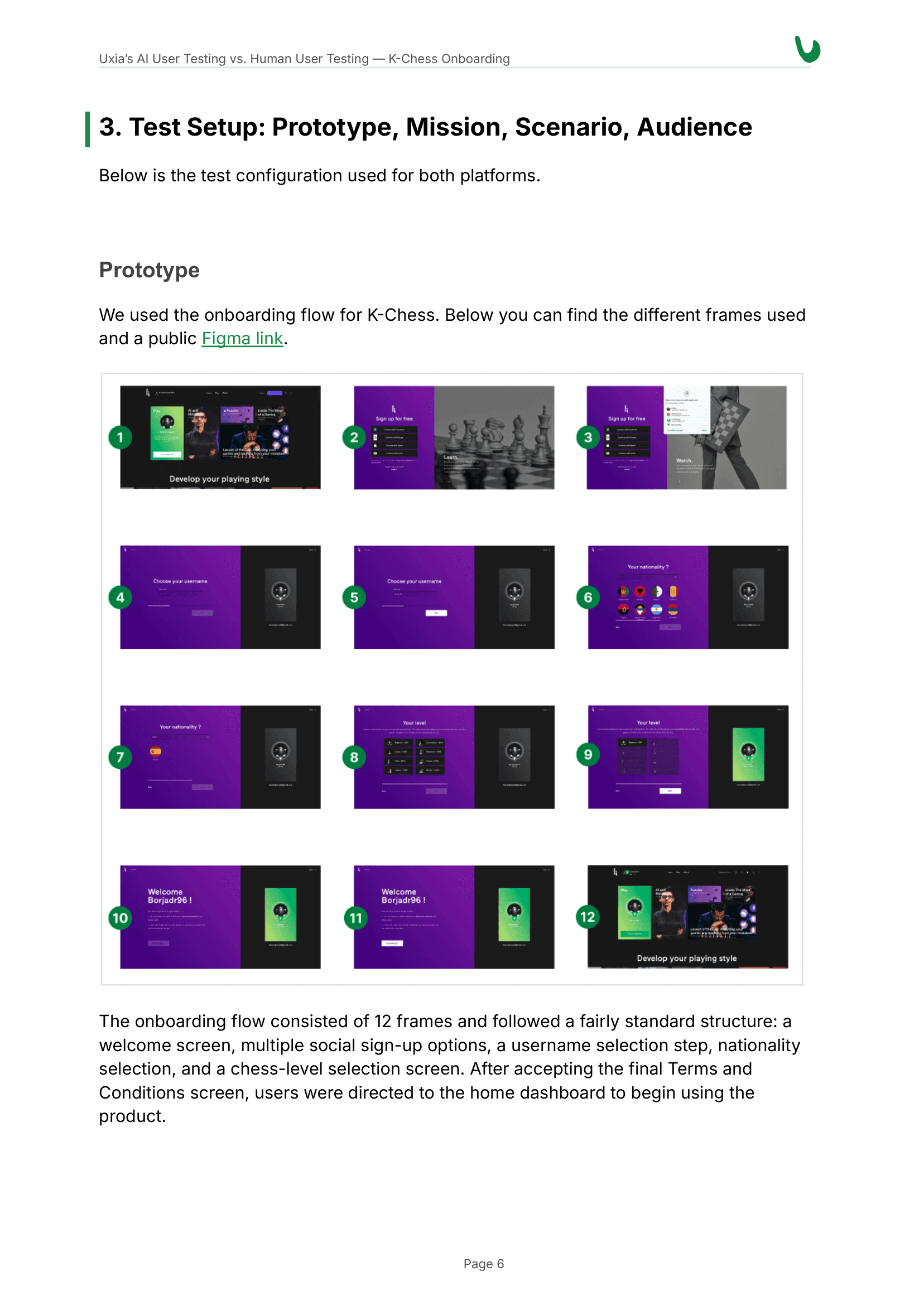
The study evaluated a 12-frame onboarding process, including social sign-up, username selection, and skill-level setting. Both testing methods used identical missions, scenarios, and broad audience criteria (English speakers, ages 18–40, university-educated) to ensure a direct comparison.
Main Findings
Uxia demonstrated a substantial lead in both speed and financial scalability:
17x Faster Cycle: Uxia completed the full testing cycle (setup, execution, and analysis) in 21 minutes, compared to 362 minutes for the human panel.
Zero Analysis Time: Uxia's analysis time is effectively 0 minutes because it delivers a summarized report immediately, whereas researchers spent nearly 2 hours (115 minutes) manually analyzing human sessions.
Cost Savings at Scale: While a single human test ($149) is cheaper than a monthly Uxia subscription ($299), Uxia becomes 5x more affordable as testing frequency increases. For teams running 15 tests a month, Uxia saves $550 monthly ($6,600 per year) compared to traditional platforms.
Higher Reliability and Data Quality
The AI testers provided a more consistent and error-free testing experience:
0% Failure Rate: Every synthetic tester followed instructions perfectly and provided clear, structured reasoning.
40% Human Failure Rate: Four out of ten human participants failed to provide usable data—one due to platform technical issues and three because they failed to follow the "think-aloud" instructions.
Verbalization Gap: Human testers provided "minimal feedback" even when prompted, whereas AI transcripts were deep, logical, and fully aligned with task objectives.
Deeper and More Comprehensive Insights
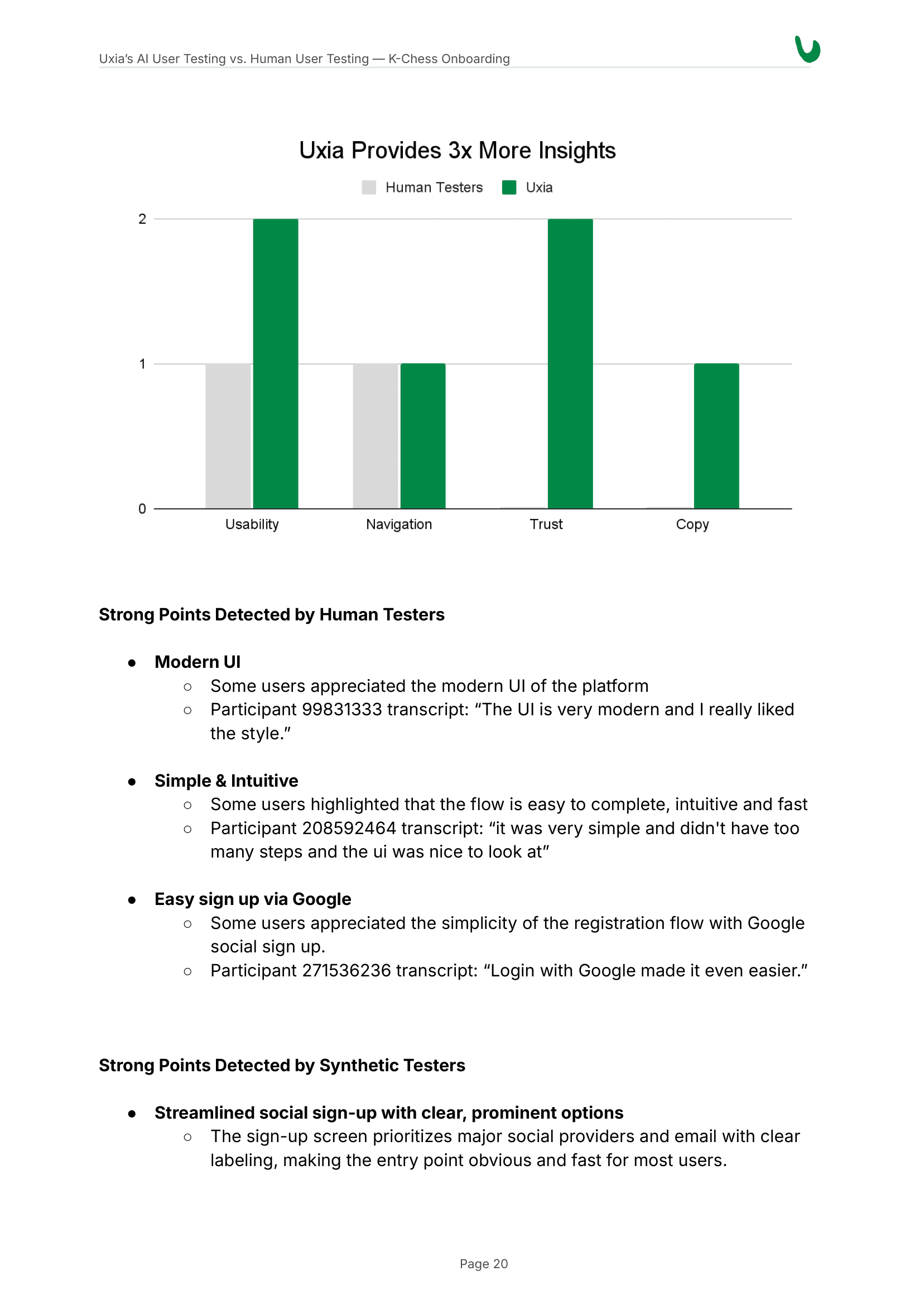
Uxia uncovered 3x more insights than the human panel, identifying subtle technical and branding issues that people overlooked :
Technical Discrepancies: AI testers identified a level rating mismatch (selecting "800" in onboarding but seeing "700" on the dashboard) and branding inconsistencies where the app referred to itself as "Keysquare" instead of K-Chess.
UX Friction Points: Both methods detected confusion on the final Terms & Conditions screen, but Uxia specifically noted the lack of guidance on username rules and microcopy punctuation errors.
Human Nuance: The primary advantage of human testers was providing subjective emotional impressions, such as noting the UI felt "modern" and the flow was "simple".