
Your Career in Product Design: The 2026 Guide
Grow your career in product design. This guide covers essential skills, AI portfolio testing, salary insights, and how to advance past junior roles.
Most advice about a career in product design is still stuck in the portfolio era. It tells you to polish three case studies, make the mockups pretty, and rehearse your design process like a script.
That advice is incomplete.
Hiring teams don't only want a designer who can arrange screens. They want someone who can spot friction, explain trade-offs, work with engineering and product, and help the team make better decisions under uncertainty. Recent market commentary makes that shift explicit: companies increasingly want designers who can work across platforms, tell a compelling story, demonstrate product impact, and show AI fluency in hybrid, builder-oriented roles, not just present a conventional portfolio (Verified Insider on product design in 2025).
My first project that helped land a real product role wasn't a glossy redesign. It was a messy growth and product problem. I had to understand user behavior, identify where people got stuck, and recommend changes that had a reason to exist beyond visual cleanup. That taught me the lesson a lot of juniors learn late: product design is less about decoration and more about reducing uncertainty.
What a Career in Product Design Really Means
A career in product design isn't a career in making screens look modern.
It's a career in helping teams decide what to build, why it matters, and whether it's working.
A lot of early-career designers enter the field through UI examples on Dribbble, polished Figma files, and redesign challenges. Those can help you practice craft. They don't teach the full job. In a real team, your work is tied to activation, trust, comprehension, retention, internal efficiency, or some other business and user outcome.
If you're still defining the role too narrowly, this breakdown of what a product designer does is a useful reference point. The short version is that the role sits between user needs, business goals, and technical constraints.
The real unit of value
The most valuable product designers don't just produce artifacts. They produce clarity.
They answer questions like:
Where is the user getting stuck
What assumption are we making
What evidence supports this direction
What trade-off are we accepting
How will we know if this improved the product
That shift matters more now because the market has changed. Teams increasingly look for designers who can move across platforms, communicate impact, and work in more hybrid ways rather than staying inside a narrow visual lane, as noted in the earlier market commentary.
Practical rule: If your design explanation starts and ends with aesthetics, you're describing UI work, not product design.
Why this career is more strategic than it looks
The historical path into product design often runs through industrial design, especially in companies that still build physical products, devices, or design-heavy manufactured goods. The U.S. Bureau of Labor Statistics projects industrial designers to grow 3% from 2024 to 2034, describes that as about as fast as average, reports a median annual wage of $79,450 in May 2024, and notes the field typically requires at least a bachelor's degree with about 2,500 openings per year on average over the decade (BLS industrial designers profile).
That doesn't describe a mass-entry field. It describes a specialized profession where training, judgment, and portfolio quality matter.
The practical takeaway is simple. Don't build your plan around the idea that demand alone will carry you. A career in product design rewards people who can connect design decisions to product outcomes, operate well with others, and show evidence that their work holds up outside a static mockup.
The Core Skills and Tools for Product Designers
A common pitfall for junior designers is treating product design like a software tutorial plus a Dribbble account.
Teams do not hire for screens alone. They hire for judgment. Can you spot the actual problem, choose a direction with incomplete information, explain the trade-offs, and help the team ship something that improves the product?
That changes what "core skills" means. Yes, craft matters. So does tool fluency. But the designers who become trusted fastest are the ones who connect user behavior, product constraints, and business goals without getting lost in polish.
Craft that earns trust
Strong product designers still need to make good work. If layouts are weak, flows break, or prototypes create confusion, nobody will care how strategic the thinking sounds.
Your craft foundation usually includes:
User research basics such as interviews, usability observation, and spotting friction patterns
Flow thinking so you can map what happens before, during, and after a key action
Wireframing and prototyping to make decisions visible early
UI judgment around hierarchy, states, copy support, and interaction clarity
Tool fluency in products like Figma, Sketch, Miro, and documentation tools
If you want a grounded overview of current UX and UI designer tools, use it as a working checklist. Learn the tools well enough to move fast and collaborate cleanly. Do not confuse software speed with product sense.
I have seen designers build polished prototypes in a day and still miss the core issue because they never clarified what behavior needed to change. I have also seen rough wireframes win support because the reasoning was sharp and the team could test them quickly. In practice, the second designer is usually more useful.
Communication is part of the job
Communication gets mislabeled as a soft skill. In product teams, it is operating skill.
A design review is rarely about whether a screen looks good. It is usually about whether the team agrees on the problem, whether the proposed change is worth building, and what risk comes with shipping it now. If you cannot explain those points clearly, stronger visual work will not save you.
A solid design explanation usually covers four things:
Focus | What you need to say |
|---|---|
Problem | What user or business issue are we solving |
Evidence | What signals, observations, or feedback shaped this |
Trade-off | What did we optimize for, and what did we not |
Decision | What should the team do next |
This matters in ordinary moments, not just presentations to leadership. Engineers want to know what cannot break. Product managers want to know what outcome this supports. Researchers want to know which assumption still looks shaky. Good designers answer those questions early, before feedback turns into confusion.
What actually moves you forward
Product design is cross-functional work. The day-to-day job includes explaining decisions, testing assumptions, handling constraints, and adjusting when the business context changes.
The skill that often changes a junior designer's trajectory is learning to make their thinking usable for other people. That means turning observations into a recommendation a PM can prioritize, an engineer can build, and a manager can defend. Clean files help. Clear reasoning gets the work shipped.
If you're early in your career, get better at three things fast:
Presenting rationale clearly. Start with the problem, then explain the solution.
Using imperfect evidence. You will often have partial research, support tickets, analytics gaps, or limited time.
Discussing trade-offs calmly. Good designers do not argue for every detail. They explain what matters most and why.
That is the shift from making interfaces to doing product design.
Building a Portfolio That Proves Your Thinking
The portfolio advice that hurts juniors most is the obsession with polish.
A polished case study without real thinking is easy to spot. It reads like a movie trailer. Nice visuals, smooth narrative, no actual decision-making. Hiring teams notice when the work has been cleaned up so much that the uncertainty disappeared.
My first project that helped me get hired looked nothing like that. It was a practical product and growth problem. I had to identify friction, make assumptions explicit, gather evidence, and turn that into a recommendation someone could build.

What hiring managers actually look for
They want to see how you think when the answer isn't obvious.
That means your case study should show:
The problem context and why it mattered
Who the user was and what you believed about their behavior
What evidence you gathered before changing the design
How your design choices followed from that evidence
What you learned and what you'd change with more time
A strong portfolio piece can come from freelance work, a startup side project, an internal tool, a redesign with clear reasoning, or an adjacent role where you influenced the product. It doesn't need to be famous. It needs to be real enough to expose your judgment.
A better case study structure
Use a structure that makes your thinking easy to inspect.
Start with the tension. What wasn't working, for whom, and why the team cared.
State your assumptions. Don't hide them. Name them.
Show the path, not just the final frame. Include discarded options and why they failed.
Connect decisions to evidence. Even lightweight testing is better than unsupported opinion.
End with reflection. Good designers revise their own thinking.
If your portfolio needs stronger flow logic, mapping the path with a user flow diagram helps expose missing states, weak transitions, and assumptions you've glossed over.
The case study should prove that you can reduce risk for a team, not just produce a clean final UI.
How to create evidence when you don't have a client
Many junior designers stall at this stage. They believe they must work with a real company and have access to production metrics before they can present credible work.
You don't.
You do need a way to test assumptions. Side projects are useful because they force you to go end to end. You define the problem, propose a flow, get feedback, revise, and document what changed. That's much closer to real product work than posting a one-off redesign.
One practical option is Uxia, an AI-powered UX/UI testing platform where you can upload images or prototypes, define a mission and audience, and review synthetic user feedback, friction points, and summarized patterns. For early-career designers, that makes it easier to validate a concept and include actual testing evidence in a case study instead of relying only on self-critique.
A quick walkthrough helps show what that testing loop can look like:
The portfolio habit that compounds fastest is simple: treat every project like a future interview. Document the problem, the process, the decision points, and the lessons. Most designers wait until they're job hunting to reconstruct that story. By then, the details are gone.
Navigating the Interview and Hiring Process
Most product design interviews are not evaluating whether you can talk about a case study. They're evaluating whether they can trust you inside a product team.
That means your presentation style matters almost as much as the work itself. Rambling through every screen doesn't help. Interviewers are listening for judgment, prioritization, and collaboration.
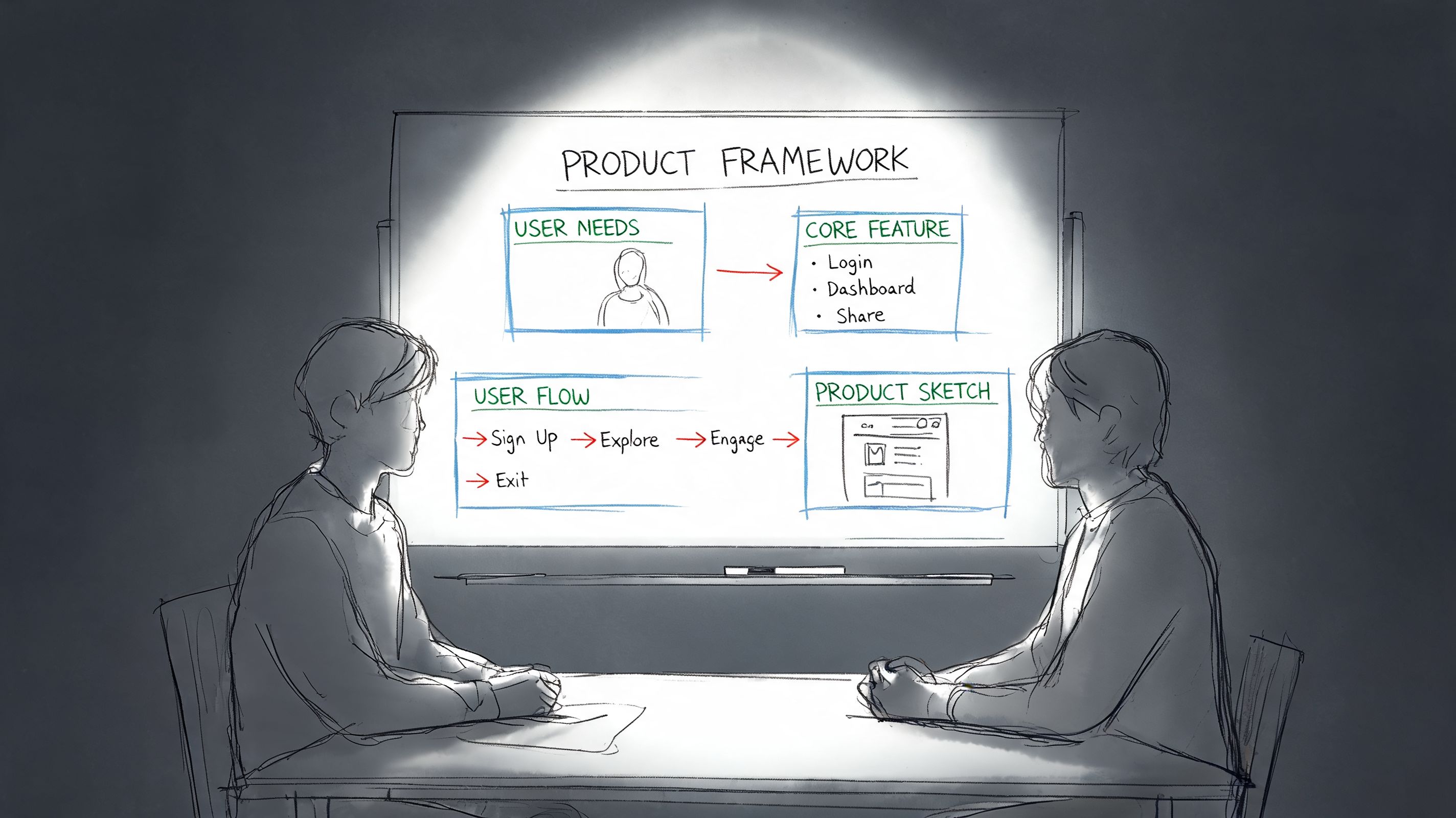
Present your work like a product decision
A good portfolio walkthrough sounds less like a gallery tour and more like a product review.
Use this order:
Context first. What was happening in the business or product.
User problem next. What friction or need did you focus on.
Decision path after that. What options existed, and why you chose one.
Collaboration throughout. Where engineering, PM, research, or marketing changed the outcome.
Reflection at the end. What you learned, what remained unresolved, and how you'd test the next step.
That structure tells the team you understand design as part of delivery, not as a personal art project.
What interviewers are really checking
They want signs that you can work through ambiguity without becoming rigid or vague.
Here are the common failure modes:
Weak signal | Stronger signal |
|---|---|
Defending every detail | Explaining trade-offs and constraints |
Jumping into UI too early | Framing the problem before proposing a solution |
Talking only about solo work | Showing how decisions changed through collaboration |
Treating critique as opposition | Using critique to sharpen reasoning |
For practice, it can help to use tools to prepare for job interviews that let you rehearse structured answers out loud. That's useful if your main gap isn't design skill but clarity under pressure.
In a whiteboard exercise, don't race to the interface. Slow down and define the problem, users, constraints, and success criteria before you sketch.
Handle critique like a working designer
A design critique interview isn't asking whether your first idea is flawless. It's checking whether you can reason in public.
When someone challenges your approach, don't panic and don't become defensive. A better response is: clarify the concern, restate the constraint, explain your trade-off, and offer what you'd test next. That's how real product conversations work.
The same rule applies to take-home assignments. Don't over-index on pixel polish. Make your assumptions visible. Show what you intentionally left unresolved. Teams trust designers who know where uncertainty still exists.
Understanding Salary and Compensation
Product design pay does not rise because your screens look cleaner. It rises when the company trusts you with decisions that affect revenue, retention, delivery speed, or risk.
As noted earlier in the article, salary ranges in product design can start modestly, settle into a solid mid-career band, and climb meaningfully at the top end. The pattern matters more than the exact number. The strongest compensation jumps usually come when a designer stops being seen as someone who decorates solutions and starts being seen as someone who helps the team choose the right solution in the first place.
I have seen this play out more than once. A mid-level designer with average visual craft but strong product judgment often becomes more valuable than a stronger UI specialist who cannot explain why a change matters, what it should improve, or how the team will know if it worked. Product teams pay for reduced uncertainty.
What salary usually reflects
Early roles are often priced around execution. Can you turn requirements into usable flows, take feedback without friction, and ship work that does not create extra cleanup for engineering?
Higher-paying roles are usually tied to judgment and range. Can you spot a weak assumption in the brief, push for evidence before a costly build, and explain trade-offs in a way product and engineering can act on? Can you protect the user experience without losing sight of time, scope, and business constraints?
That is the shift junior designers often miss. Better compensation rarely comes from saying, "I designed this feature." It comes from showing, "I helped the team avoid building the wrong thing, tested the risky assumption early, and clarified the decision for stakeholders."
A practical way to read your market value
Benchmarking only by title is a fast way to misread your value. A product designer at one company may spend most of the week polishing tickets. At another, the same title may include discovery work, experiment design, success metrics, and post-launch analysis.
Use your scope as the reference point:
Execution scope: You design assigned screens or flows with clear direction.
Ownership scope: You shape the problem, not just the output.
Strategic scope: You influence roadmap choices, research priorities, or success metrics.
Specialized scope: You bring hard-to-find skill in systems, accessibility, complex workflows, or a domain like fintech or healthcare.
This is also where geography, company stage, and remote policy change the equation. A startup may offer lower base pay and more upside through equity. A larger company may pay more cash for narrower ownership. If you want a broader view of how tech roles are framed across remote markets, YayRemote is useful for comparing compensation language and expectations.
Don't negotiate from title alone
Negotiate from evidence.
Bring examples that show the level of problems you can handle. Show where your work changed a product decision, reduced support burden, improved conversion quality, sped up delivery through clearer flows, or prevented wasted engineering effort. Even if you do not have perfect metrics, a clear before-and-after story is stronger than a gallery of polished mockups.
Ask direct questions before you accept an offer. Who defines the problem? Are designers expected to work with data? What does success look like in the first six months? How are design decisions made when product, engineering, and design disagree?
Those answers tell you more about future earning power than the title on the contract.
The Product Design Career Ladder
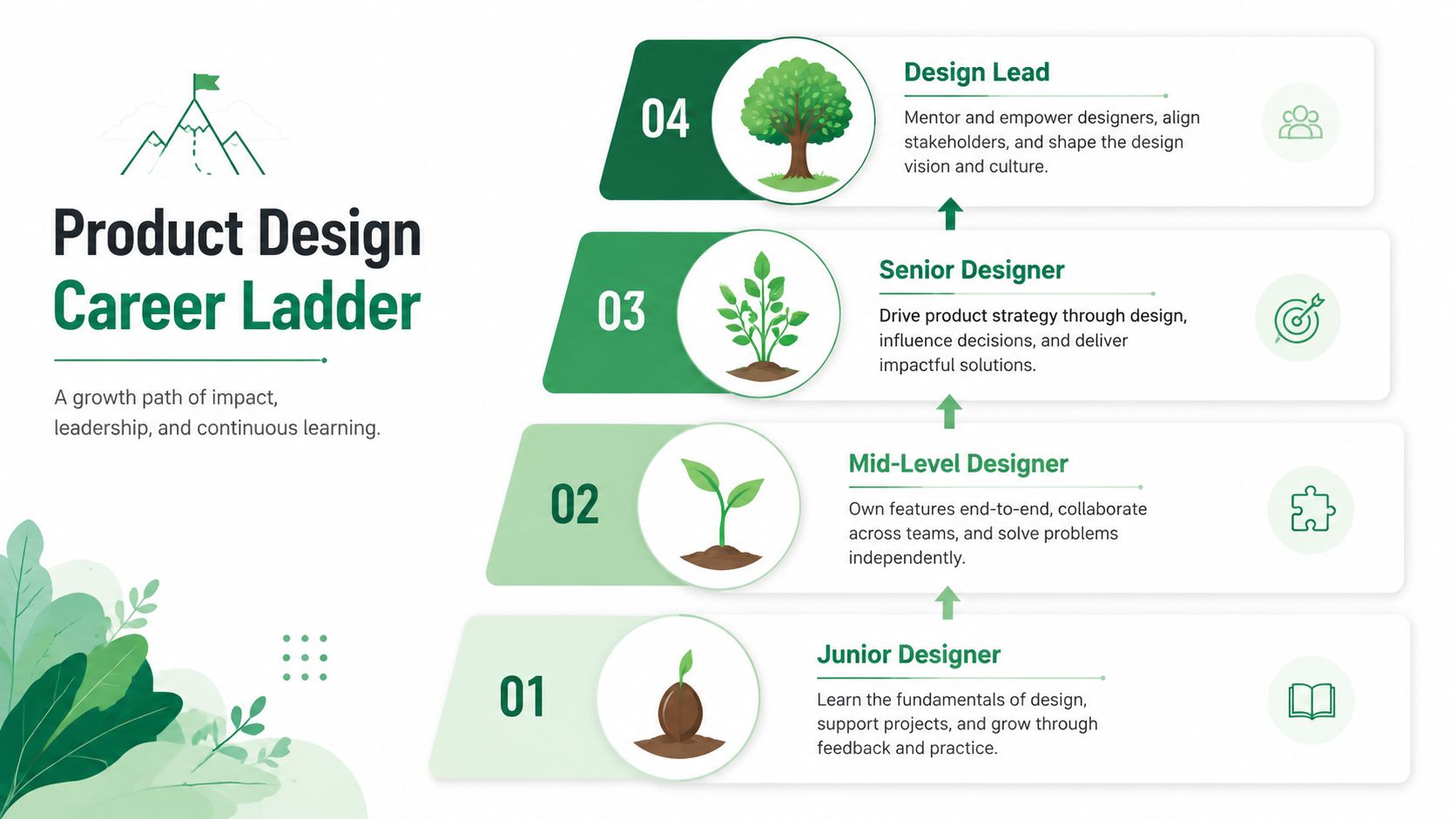
The clean version of the ladder is junior, mid-level, senior, then lead or principal. Real careers are messier than that.
Some people move quickly because they get close to hard product problems early. Others spend years doing mostly execution work and wonder why they aren't advancing. Progress in product design isn't just about time served. It's about the level of ambiguity and responsibility you can handle.
What changes at each level
The work gets less visible and more consequential as you move up.
Level | What usually defines it |
|---|---|
Junior | Learns fundamentals, executes with support, improves craft and communication |
Mid-level | Owns features more independently, works across functions with less supervision |
Senior | Frames problems, handles ambiguity, influences decisions beyond the interface |
Lead | Shapes direction, mentors others, aligns teams around product vision |
Recent career-path guidance on senior product designers emphasizes leading strategy, conducting research, mentoring other designers, and aligning stakeholders around measurable goals. It also notes that advanced practitioners may become translators between design and engineering or specialize in areas like accessibility, workflow automation, or AI-assisted design processes (Course Report on the product designer career path).
Seniority is not just better craft
This is the shift many designers miss.
At higher levels, product design moves away from producing screens and toward managing system constraints. You become responsible for reducing uncertainty across the development process. That means choosing what to test, identifying where teams disagree, and helping engineering, product, and design move with fewer mismatches.
The ceiling in product design isn't only management. Deep specialization can matter just as much.
A strong senior designer often does things that don't show up in a polished portfolio screenshot:
spots where the team is solving the wrong problem
reframes a vague request into a testable direction
helps engineering avoid waste by clarifying intent early
mentors newer designers on trade-offs, not just aesthetics
protects accessibility, consistency, and usability under deadline pressure
The adjacent-entry path is often more realistic
A lot of people still picture the path as: bootcamp, portfolio, junior product designer role, then upward from there.
That route exists, but it's narrower than many guides admit. Recent commentary argues that the traditional junior funnel has tightened due to layoffs, fewer junior openings, and AI taking over some tactical tasks that juniors used to learn on. It points to a more practical route through adjacent roles like front-end development, growth or marketing design, visual design, and production-focused work where you can build a track record of shipped outcomes and cross-functional collaboration (UX Design on the shrinking junior funnel).
If you're trying to break in, this matters. An adjacent role isn't a detour if it gets you closer to product decisions, user feedback, and shipped work. In many cases, it's the better path.
Your Toolkit for Continuous Learning
Passive learning feels productive because it's clean. You read threads, save articles, watch talks, and collect opinions from experienced designers.
It doesn't change your level fast enough.
The designers who improve quickest usually stay close to real product work. They build side projects, audit live flows, test assumptions, rewrite case studies after feedback, and spend time around people who ship. That's how you develop product judgment instead of only design vocabulary.
What compounds over time
A useful learning system has three parts.
First, communities. Being around founders, PMs, engineers, researchers, and operators teaches you how decisions really get made. You start hearing the trade-offs behind roadmap choices, technical constraints, and commercial pressure. That context sharpens your design sense faster than isolated inspiration ever will.
Second, side projects. Nothing teaches product thinking like trying to get someone to care about a thing you made. You see where people hesitate, what they misunderstand, what they ignore, and what you assumed too confidently.
Third, documentation. Treat every meaningful project as a case study while you're doing it, not months later. Capture the problem, your assumptions, the dead ends, the feedback, and the decisions.
What to practice deliberately
Don't make continuous learning abstract. Tie it to recurring habits:
Run small critiques often. Ask peers to challenge your framing, not only your visuals.
Rewrite one case study every few months. Your thinking matures faster than your portfolio usually reflects.
Study shipped products with intent. Don't just admire them. Reverse-engineer what problem they're solving and what trade-offs they're making.
Learn enough technical language to collaborate well. You don't need to become an engineer, but you do need to understand implementation constraints.
Practice AI fluency in a practical way. Use it to generate alternatives, test assumptions, organize feedback, or accelerate exploration. Don't use it as a substitute for judgment.
Why this matters more now
The market for junior roles has tightened, and the old portfolio-to-interview path is less reliable than it used to be. That's one reason adjacent roles have become a more practical route for many people, as covered earlier through the discussion of the narrowing junior funnel and the move toward shipped, cross-functional work.
The implication is straightforward. You can't rely on credentials or surface polish to carry you. You need repeated cycles of making, testing, explaining, and refining.
If you want to grow faster, shorten the distance between an idea and feedback.
That's why hands-on practice beats passive consumption. It builds the thing employers need from you: credible judgment. When you can show how you identified a problem, tested a direction, handled constraints, and changed your mind based on evidence, you're no longer presenting as "aspiring." You're already operating like a product designer.
If you're building a case study, refining a flow, or trying to make your portfolio show real product thinking, Uxia can help you test concepts earlier and document stronger evidence behind your decisions. That's useful when you're trying to turn design work into proof, not just presentation.