What Does a Product Designer Do? Your 2026 Career Guide
Ever wonder what does a product designer do? Explore daily tasks, essential skills, workflow, salary insights, and career paths for 2026 success.
So, what does a product designer really do? In short, they are the strategic mind behind a digital product’s entire experience, ensuring it’s not just beautiful, but also intuitive, effective, and perfectly aligned with the business’s goals.
The Modern Product Designer Demystified
A product designer is the critical link between what users need and what the company aims to achieve. They own the entire journey of creating a valuable product, from the very first spark of an idea to the polished final version that people interact with every day.
Their job goes far beyond just the visuals; it's about making a product work for people in a way that feels effortless.
Think of them as a film director, but for a digital product. They don't just shoot one scene or write one line of dialogue; they oversee the whole production to ensure every element—from the story to the sound to the final edit—works together to create a powerful, cohesive experience.
From Initial Idea to Final Product
A product designer guides a product through several key stages, each with its own focus.
They start with deep user research to understand real-world behaviours, frustrations, and goals. This is like a director studying a script to get inside the characters' heads.
Next comes feature prioritisation. Just as a director decides which scenes are essential to the story, a designer must decide which features are most important to build, carefully balancing user wants, technical limits, and business impact.
Then, they move into UI design, bringing the interactive elements to life. They create wireframes, mockups, and prototypes—the equivalent of a director shooting the individual scenes that will eventually become the full movie.
Finally, there’s usability testing. A director screens a rough cut to see how audiences react, trimming scenes and tightening the pace. A product designer does the same, testing prototypes with users to find friction points and refine the experience before launch.
This end-to-end ownership is what defines the role. They don't just hand off a design; they steer its entire evolution. A huge part of this is validating their decisions, which traditionally meant weeks of slow, expensive user testing. Thankfully, modern tools have completely changed the game.
Practical Recommendation: To accelerate the "final cut" process, designers are increasingly turning to AI-powered platforms like Uxia. Instead of spending weeks on recruitment and scheduling, you can get actionable feedback on your prototypes in minutes. This allows for much faster iteration and building with greater confidence.
To give you a clearer picture, this table breaks down a product designer's key functions, collaborators, and measures of success.
A Product Designer's Role at a Glance
Core Function | Key Collaborators | Primary Success Metric |
|---|---|---|
User Research and Analysis | Product Managers, UX Researchers | User Satisfaction (CSAT), Task Success Rate |
Ideation and Wireframing | Engineers, Stakeholders | Time to Validate Concepts, Number of Viable Ideas |
Prototyping and UI Design | UI Designers, Front-End Developers | Prototype Fidelity, Design System Adherence |
Usability Testing and Iteration | End-Users, QA Teams | Reduction in Usability Issues, Conversion Rate Uplift |
Ultimately, a product designer's success isn't just about a good-looking interface. It's measured by the real-world impact the product has on its users and the business.
A Day in the Life of a Product Designer
So, what does a product designer actually do all day? If you picture someone just making things look pretty in Figma, you're only seeing a tiny piece of the puzzle. The reality is a dynamic mix of investigation, creation, and validation that shifts throughout a project's lifecycle.
Forget the neat, linear job description. A product designer's work is a continuous loop. They are constantly cycling through three core activities: research, design, and testing.
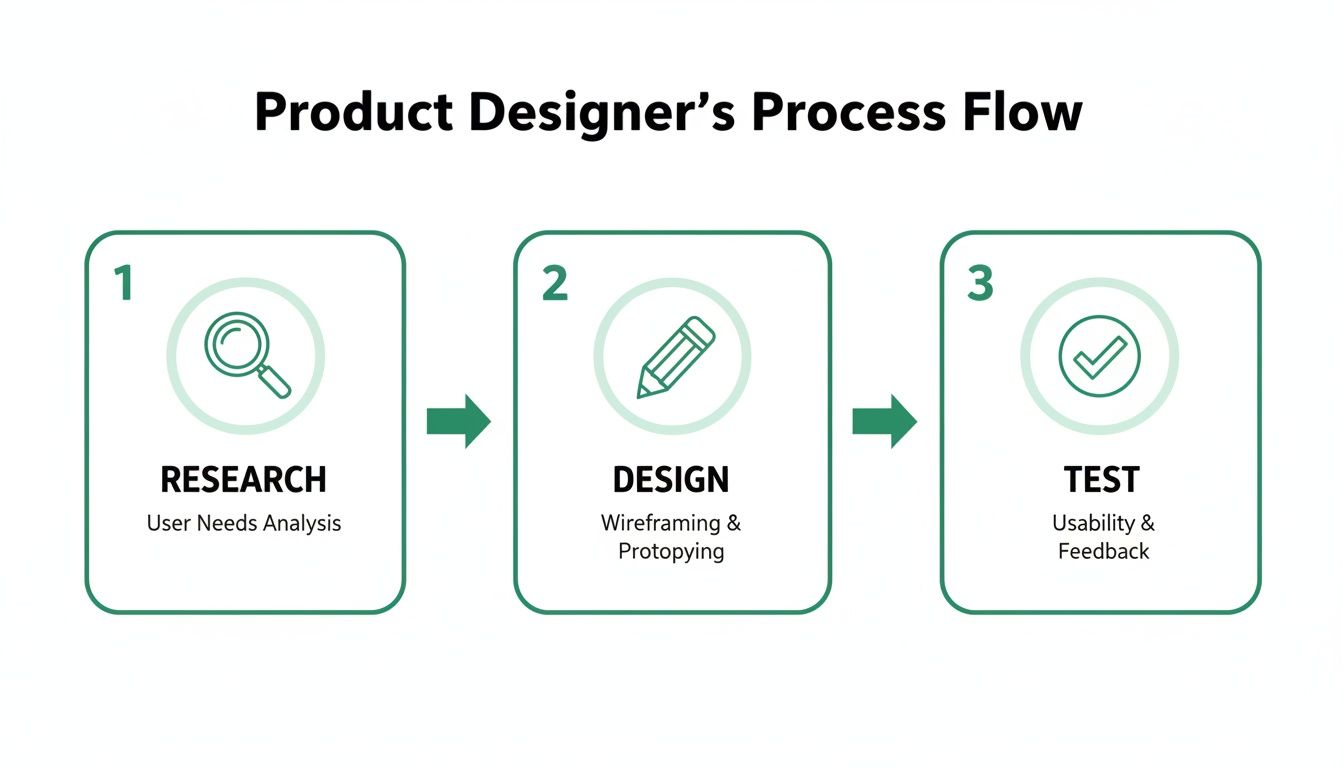
This simple diagram tells a crucial story: a designer’s work is never truly “done.” It’s an iterative process aimed at constant improvement. Let’s break down what that looks like in practice.
Morning: The Discovery and Definition Phase
A product designer’s day often begins not with a design tool, but with people and problems. This is the discovery phase, and the goal is to get to the heart of the challenge. A typical morning might involve:
Stakeholder interviews: Meeting with product managers, engineers, and business leaders to align on goals. They’re all trying to answer one question: "What problem are we solving for the business and for our users?"
Competitive analysis: Digging into how other products tackle similar issues. This isn't about copying; it's about spotting best practices and finding gaps where your product can win.
Once that initial context is gathered, the focus shifts to the definition phase. This is where raw information becomes actionable insight. The designer will synthesise their findings to create foundational documents that guide the entire project.
These deliverables often include user personas (detailed profiles of your ideal customers) or customer journey maps that visualise the user’s entire experience. These documents aren't just paperwork; they create a shared understanding across the team of who they’re building for and what pain points need to be solved.
Afternoon: The Design and Delivery Phase
With a clear problem to solve, the afternoon is for hands-on creation. This design phase is where ideas take shape, moving from rough concepts to polished, interactive designs. The process usually flows like this:
Sketches and Wireframes: Quick explorations of layouts and user flows, often just with pen and paper or a simple tool. The focus here is purely on structure and function, not looks.
High-Fidelity Mockups: Once a direction is chosen, the designer moves into tools like Figma or Sketch to create detailed, pixel-perfect visuals of the interface.
Interactive Prototypes: Finally, they link these screens together to build a clickable prototype. It simulates the real app, allowing everyone to feel the user experience firsthand.
This prototype is the star of the delivery phase, where the design gets validated before a single line of code is written. Traditionally, this meant scheduling usability tests with real people—a process that could easily stall a project for weeks.
A critical bottleneck in a designer's day has always been validating ideas. Finding participants, scheduling tests, and analysing feedback is incredibly time-consuming. This is where modern tools completely change the game.
A practical recommendation: Instead of waiting weeks, a designer can now use a platform like Uxia. By uploading their prototype, they get actionable feedback from AI-powered synthetic testers in minutes. Uxia provides reports on usability issues, heatmaps showing where users click, and even transcripts of AI-generated "think-aloud" feedback.
This immediate validation loop lets designers test, iterate, and refine their work with incredible speed. What used to take the better part of a month can now be done in an afternoon, making sure everything a product designer does is grounded in solid, user-centred data.
Essential Skills Every Product Designer Needs
So, what does it really take to be a product designer? It’s not just about knowing your way around a design tool. The best product designers are a unique mix of artist, analyst, and diplomat.
They blend concrete technical skills with the nuanced soft skills needed to navigate a team and champion the user. One without the other just doesn't work.
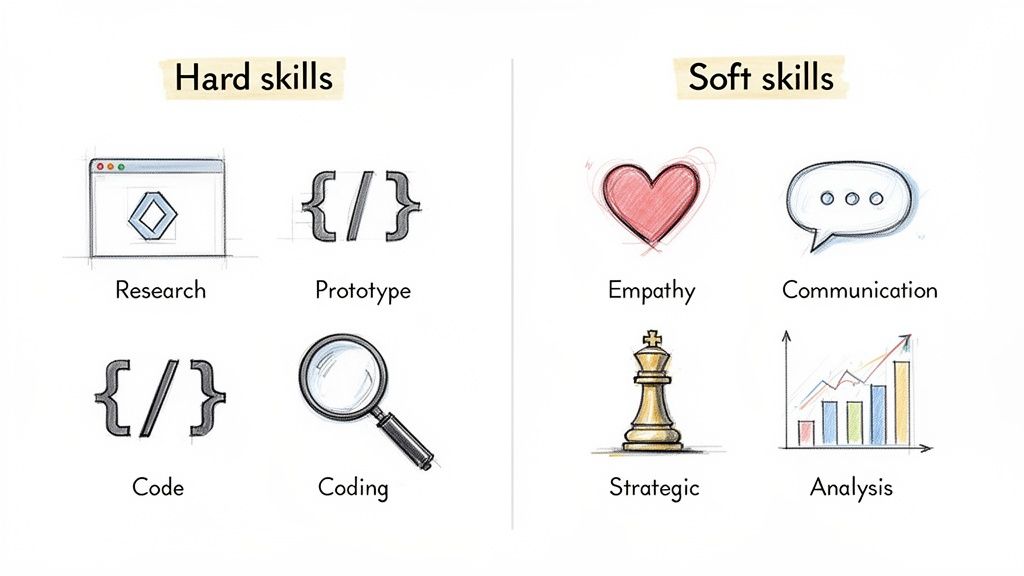
This balance is what lets a designer guide a product from a vague idea scribbled on a napkin to a polished feature that people genuinely love using.
Let's break down what that looks like in practice.
Hard Skills: The Technical Toolkit
Hard skills are the practical, hands-on abilities a designer uses every single day. They are the bedrock of the role—without them, even the most brilliant concepts remain just that: concepts.
Here are the absolute must-haves:
Design and Prototyping: Fluency in modern design tools is non-negotiable. Mastery of software like Figma or Sketch is essential for creating everything from rough wireframes to pixel-perfect, interactive prototypes. You can see our complete rundown of essential UX/UI designer tools here.
User Research: You can't design for users you don't understand. Product designers must know how to conduct effective user research, whether that means running interviews, crafting surveys, or analysing behaviour to find real pain points.
Front-End Awareness: While you don't need to be a coding wizard, a solid understanding of HTML and CSS is a game-changer. This knowledge ensures your designs are technically realistic and makes collaborating with developers infinitely smoother.
These technical skills are the price of entry. But what truly sets a great product designer apart is how they pair them with a powerful set of soft skills.
Soft Skills: The Strategic Differentiator
Soft skills are what turn a good designer into an influential leader. These are the interpersonal and strategic abilities that allow a designer to align teams, advocate for users, and connect their work to the bigger picture.
The ability to clearly articulate why a design decision was made is often more important than the decision itself. A brilliant design that no one understands or supports will never get built.
These are the skills that make the difference:
Empathy: This is the absolute core of product design. It’s the ability to step into a user's world, understand their context, and feel their frustrations. True empathy is what ensures the product solves a real problem for a real person.
Communication: Product designers are constantly communicating. They have to present their work to stakeholders, defend their choices with logic and data, and give clear, constructive feedback to engineers and other teammates.
Strategic Thinking: A great designer never works in a vacuum. They constantly think about market trends, business goals, and technical limitations to ensure their solutions not only delight users but also drive the business forward.
The Modern Skill: Data-Driven Validation
Today, there’s one more skill that bridges the gap between hard and soft: data analysis and validation. The modern product designer doesn't just rely on intuition; they use data to prove their designs work.
This is where their toolkit expands beyond creative software into powerful analytical platforms.
A practical tip: To really stand out, you need to back up your design instincts with evidence. Incorporate tools that give you both quantitative and qualitative feedback, fast.
A platform like Uxia is built for exactly this. It lets you test prototypes and get instant AI-generated insights, including heatmaps, usability scores, and detailed feedback reports.
Using a tool like Uxia, you can quickly validate concepts and generate the hard data you need to justify your design decisions. It’s the fastest way to prove your work has a real impact and to build a reputation as a designer who delivers results.
Product Designer vs UX Designer vs UI Designer
One of the biggest points of confusion in the tech world is the difference between Product, UX, and UI Designers. Their titles all sound pretty similar, and they definitely work closely together, but each role is distinct and absolutely crucial.
Let’s clear this up with a simple analogy: building a house.
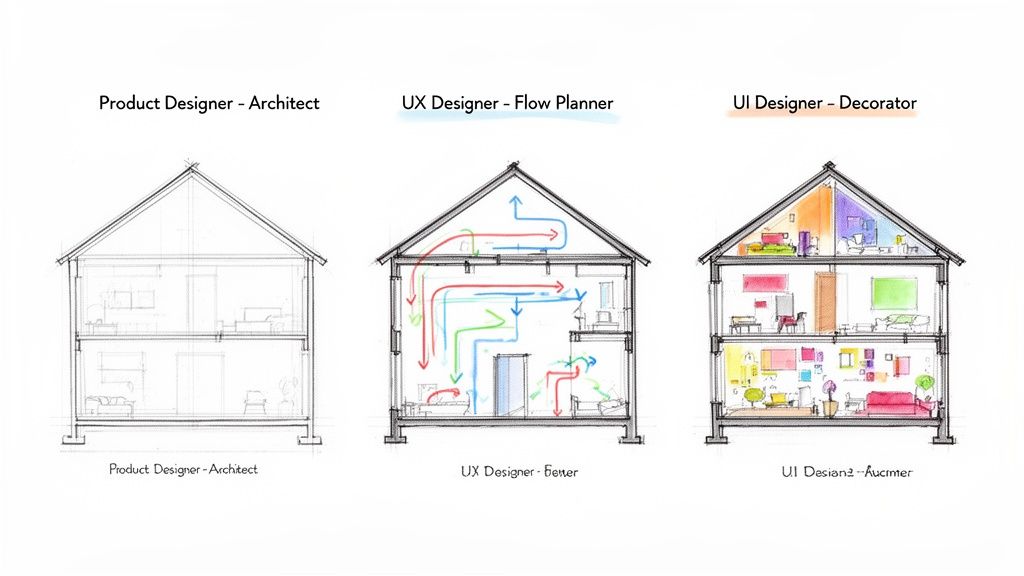
This picture nails the different layers of responsibility. Each designer is essential, but they’re all focused on very different problems from different altitudes.
The Product Designer: The Architect
Think of the Product Designer as the lead architect for the whole house. Their responsibility spans the entire project, from the initial concept right through to the final build. They aren’t just designing one room; they’re making sure the entire structure meets the family’s needs (user needs), stays on budget (business goals), and is structurally sound (technical feasibility).
The architect is the one asking the big-picture questions:
How many bedrooms are needed for the family to live comfortably?
Does the overall design fit the style of the neighbourhood?
Will this house be a good long-term investment for the owners?
In the digital world, a Product Designer asks those same kinds of strategic questions. They own the "why" and the "what" of the product, ensuring it all adds up to a successful outcome.
The UX Designer: The Flow Planner
The UX (User Experience) Designer is like an interior architect or the person who draws up the floor plan. They aren’t worried about paint colours or furniture just yet. Their entire focus is on the flow and logic of the space.
Their goal is to make the house easy and intuitive to live in. Is the kitchen right next to the dining room? Can you get groceries from the garage to the pantry without a ten-minute walk? They map out exactly how people will move from room to room, creating a seamless and logical experience.
A UX Designer is the one building wireframes and user flow diagrams—the blueprints for how a digital product will function. They answer the question: "How does it work?"
The UI Designer: The Interior Decorator
Finally, we have the UI (User Interface) Designer, who acts as the interior decorator. Their job is to bring the house to life visually and make it a beautiful, enjoyable place to be.
They focus on the look and feel—the paint colours, the furniture, the light fixtures, the textures. All the little details that make the space feel cohesive and polished. They make sure every doorknob, light switch, and faucet is not only attractive but also feels good to use.
A UI Designer creates the high-fidelity mockups, picks the colour palettes and fonts, and designs all the icons and buttons. They answer the question: "How does it look?"
While all three roles are distinct, the Product Designer has the broadest scope. They must understand the UX and UI work deeply to ensure the final product not only looks good and is easy to use but also solves a genuine user problem and achieves its business objectives.
To help you tell them apart at a glance, here’s a table that breaks down their core differences.
Product Designer vs UX Designer vs UI Designer
Aspect | Product Designer | UX Designer | UI Designer |
|---|---|---|---|
Primary Focus | The overall product strategy and its success (The "Why" & "What") | The usability and feel of the user's journey (How it works) | The visual and interactive elements of the interface (How it looks) |
Key Responsibilities | Owns the end-to-end design process, aligns with business goals, defines problems | User research, journey mapping, wireframing, information architecture | Visual design, creating design systems, interactive elements, micro-animations |
Main Deliverables | Product roadmaps, feature specs, prototypes, A/B test results | Personas, wireframes, user flow diagrams, usability reports | High-fidelity mockups, style guides, icon libraries, prototypes |
Understanding these distinctions is key. If you want to go even deeper, check out our guide on the core differences between UX vs UI design.
Ultimately, while UX and UI designers zoom in on specific parts of the experience, the Product Designer is the one orchestrating the entire project to make sure it all comes together perfectly.
Product Designer Career Path and Salary in Spain
Thinking about a career as a product designer in Spain? It’s more than just a job title; it’s a clear path where your responsibilities, influence, and salary grow directly with your experience and the impact you deliver.
As you move up, your focus shifts. You’ll go from executing on designs to defining the entire product strategy. That evolution is exactly what employers in Spain are willing to pay for.
From Junior to Lead: A Typical Career Ladder
The product designer career is a journey of expanding influence. You start by getting the fundamentals right and, over time, grow into a leader who shapes high-level product vision. Each stage is a stepping stone to the next.
Here’s what that progression usually looks like:
Junior Product Designer (0-2 years): This is where you learn the ropes. As a junior, you’ll work closely with senior designers, helping out with user research, creating wireframes, perfecting UI details, and building prototypes. The goal is simple: master the core skills and learn how your team operates.
Mid-Level Product Designer (3-5 years): At this point, you start taking the lead. Mid-level designers own smaller features from start to finish, run their own research, and begin to weigh in on product strategy. You’re expected to be more self-sufficient and even start mentoring the juniors.
Senior Product Designer (6-9 years): Seniors are the problem-solvers and mentors. They handle the big, messy, ambiguous challenges and drive major product initiatives. Their work is highly strategic, and they collaborate closely with product managers and engineers to set the roadmap. They also play a huge role in building and maintaining the design system.
Lead or Principal Designer (10+ years): This is the visionary stage. Lead and Principal designers oversee the design organisation, create processes that scale, and shape the company’s long-term product direction. Their focus shifts from hands-on design to empowering their teams and ensuring design aligns with the biggest business goals.
Product Designer Salaries in the Spanish Market
In Spain, product designers are crucial for creating great digital experiences, and their salaries show just how in-demand these skills are.
According to 2026 data, a mid-level product designer in Spain with 3-5 years of experience can expect a median salary between €38,000 and €55,000 annually. This reflects their growing responsibility in shaping product strategy and prioritising features.
Entry-level designers usually start between €28,000 and €38,000, while senior designers (6-9 years) command salaries from €55,000 to €75,000. Principal leads with over a decade of experience often earn more than €75,000.
These numbers paint a clear picture: as your strategic impact grows, so does your earning potential. You can dive deeper into the data with this guide to product designer salaries in Spain on UI/UX Jobs Board.
This salary progression is a huge motivator. It pushes designers to develop skills that deliver real business impact. The faster you can prove your designs solve actual user problems, the more valuable you become.
And that’s where your toolkit can become your biggest career asset.
Accelerating Your Career with the Right Tools
Climbing the career ladder isn’t just about putting in the years; it’s about proving you can get results. The most successful designers are the ones who can test ideas fast, learn from real feedback, and iterate toward a solution that actually works.
Here’s a practical tip: If you want to fast-track your career, you need to adopt tools that let you validate your designs with data. Getting good with a platform like Uxia allows you to move past gut feelings and ground your decisions in hard evidence.
Instead of waiting days or weeks for a traditional user testing panel, you can use Uxia to get feedback on your prototypes in minutes. By generating data-backed reports on usability, you can show stakeholders that your design choices lead to measurable improvements.
This ability—to connect design directly to business outcomes—is what truly separates senior talent from junior practitioners. It's the key to unlocking bigger responsibilities and a higher salary.
The Future of Product Design and the Role of AI
The product designer’s role is always shifting, and the next big change is already here: Artificial Intelligence. A lot of designers are worried AI will make their skills redundant. The reality is much more exciting.
AI isn’t here to replace designers; it's here to give them superpowers.
AI tools are quickly becoming table stakes for automating the repetitive, time-sucking parts of the job. This frees designers from grunt work, letting them focus on what really moves the needle—high-level strategic thinking and creative problem-solving. This shift is already changing what a product designer does day-to-day.
AI as a Creative and Strategic Partner
The biggest impact is on user research and design validation. Traditionally, this is a huge bottleneck. It can take weeks just to recruit participants, schedule sessions, and then manually analyse all the feedback. This is where AI completely changes the game.
To get ahead, product designers need to get familiar with the growing ecosystem of AI UI UX tools built to streamline development. These aren't just automation scripts; they are becoming collaborative partners that amplify a designer's own abilities.
The core of what a product designer does—understanding people and solving their problems—remains the same. What’s changing is the toolset, which is becoming exponentially more powerful and allowing designers to build better products, faster than ever before.
This evolution is especially clear in Spain, where the product design service market is growing fast. In tech hubs like Barcelona and Madrid, designers are at the centre of this innovation, using advanced tools to slash development cycles. Platforms like Uxia are vital here, letting teams validate user flows in minutes without the old delays of recruitment.
This kind of efficiency is a huge advantage, especially as the European market, with Spain as a key player, is projected to see a massive surge in design service revenue through 2033. You can dig into the numbers in the projected growth of the product design market from Data Insights Market.
Uxia: Your Army of Synthetic Testers
This isn't some far-off future; it's already happening with platforms like Uxia. It represents the next wave of design tools, giving product designers an on-demand army of AI-powered synthetic testers.
Instead of fighting with logistics, a designer can just upload a prototype and get back comprehensive feedback almost instantly.
Uxia delivers these "superpowers" with:
Instant Feedback: Get actionable insights on usability, navigation, and clarity in minutes, not weeks.
Prioritised Issues: The platform automatically flags and ranks the most critical problems, so you can focus your effort where it will have the biggest impact.
Realistic User Simulation: AI testers mimic real user behaviours and provide "think-aloud" feedback, giving you deep qualitative insights without the biases of human testers.
By taking on the heavy lifting of validation, Uxia frees up designers to think about strategy and get creative. It lets them test more ideas, iterate with real confidence, and ultimately prove the value of their work with hard data.
You can learn more about how to supercharge your workflow with AI user research in our detailed guide.
A Few Common Questions About Product Design
As you get to grips with what a product designer does, a few questions tend to pop up again and again. Here are some quick answers to help you connect the dots on what this role really involves.
How Do I Become a Product Designer with No Experience?
First, build your foundation. Get a solid handle on UX/UI principles through online courses or a focused bootcamp.
Next, you need a portfolio with two or three solid case studies. It doesn't matter if they're for made-up projects—what matters is showing your thinking from start to finish. Walk readers through your entire process, from the initial research and problem-framing all the way to prototyping and how you validated your ideas.
Practical recommendation: Show, don't just tell. In your portfolio, don't just display final screens. Include early sketches, user flow diagrams, and a dedicated section on how you tested your concepts. Using a tool like Uxia, you can generate actual usability reports and heatmaps for your projects, which provides concrete evidence of your validation skills and makes your portfolio far more impressive to hiring managers.
Finally, start connecting with other designers. Get active in the community and look for internships or junior roles to get that crucial first bit of real-world experience.
What Is the Most Important Skill for a Product Designer?
While the technical side is important, empathy is arguably the most critical skill a product designer can have. Your primary job, above all else, is to be the voice of the user in the room.
The ability to genuinely understand a user's needs, what drives them, and where their frustrations lie is what separates a good designer from a great one. This empathy informs every single decision you make—from which features get built to the layout of an interface—ensuring the final product is actually useful and doesn't create new problems.
How Much Do Product Designers Earn in Spain?
A product designer's salary in Spain is a reflection of just how vital they are to the digital economy. Based on 2026 data, the average annual salary is around €54,000.
For junior designers just starting out, the range is typically between €32,500 and €43,000. This pay is directly tied to core activities like running user interviews, iterating on prototypes, and measuring success rates—all tasks that modern tools are making faster than ever. You can dig into more salary data and learn more about product designer compensation in Spain via Jobicy.
How Does a Tool Like Uxia Help a Product Designer?
Uxia acts as a force multiplier, completely changing the speed of the design validation process. It swaps out slow, costly human user testing for instant, AI-powered synthetic testers.
Instead of spending weeks trying to recruit and schedule people for testing, a designer can upload their prototype to Uxia and get back detailed, actionable feedback in just a few minutes. This includes full usability reports, heatmaps, and even user transcripts, all ready for rapid iteration.
This allows designers to test far more ideas, make decisions backed by real data, and ultimately ship better products, faster. It turns validation from a major bottleneck into a smooth, everyday part of the design workflow.
Ready to supercharge your design process and validate ideas in minutes, not weeks? See how Uxia can help you build better products with AI-powered user testing. Try Uxia for free today!