
What Is CX and Why It's the Future of Your Business
Confused about what is CX? This guide explains customer experience with real-world examples, key metrics, and practical steps to improve it for lasting growth.
When people talk about Customer Experience (CX), they’re talking about the entire relationship a person has with your company.
It’s the sum of every single interaction—from the first time they hear your name to the moment they get help from your support team, and everything in between.
What Is Customer Experience and Why It Matters Now
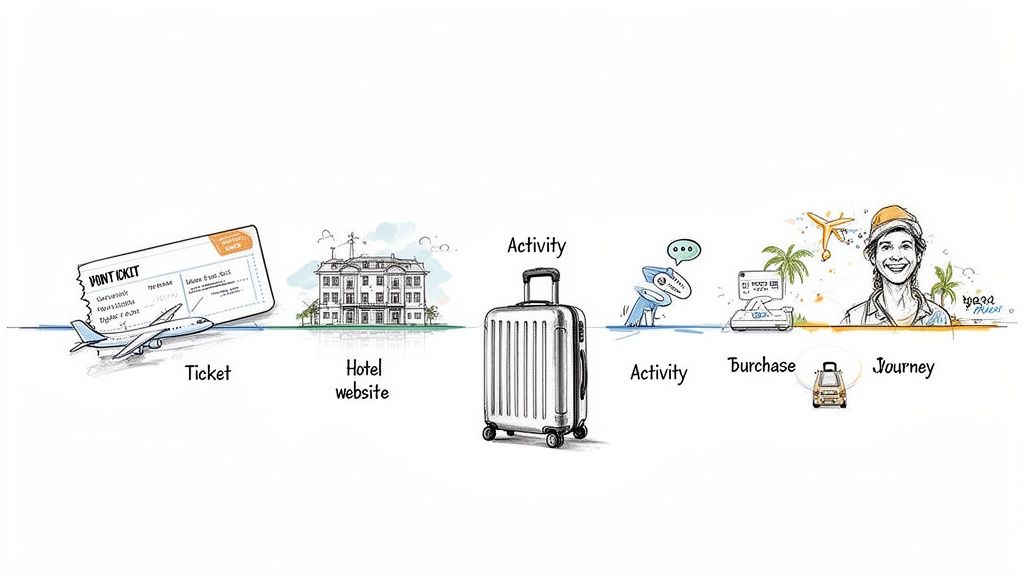
Think about planning a holiday. The whole process—researching destinations, booking flights, checking into the hotel, the tours you take, and even sharing photos when you get back—that’s the Customer Experience.
The flight itself is just one piece of that puzzle. In the same way, your product is just one part of your customer’s much bigger journey.
CX is often confused with User Experience (UX), but they are not the same thing. UX is laser-focused on how a person interacts with a specific product or digital interface. A great UX is critical, but it’s only a single chapter in the complete story of CX.
To quickly see the difference, this table breaks down how they compare.
CX vs UX At a Glance
Aspect | Customer Experience (CX) | User Experience (UX) |
|---|---|---|
Scope | The entire customer journey, across all touchpoints (marketing, sales, product, support). | A user's interaction with a specific product, website, or app. |
Focus | The overall perception and feeling towards the brand. | The usability, accessibility, and efficiency of a single product. |
Goal | Build long-term loyalty, advocacy, and brand relationship. | Make a product easy, enjoyable, and effective to use. |
Metrics | NPS, CSAT, Customer Lifetime Value, Churn Rate. | Task success rate, time on task, error rate, usability heuristics. |
While UX focuses on winning the battle over product usability, CX is about winning the war for the customer's loyalty.
By 2026, CX has become the primary battlefield for businesses. Competing on price or features alone is no longer enough. A consistently great experience is what creates delighted customers and drives sustainable growth through effective retention marketing.
The Shift to Experience-Led Growth
Companies that truly master CX build deep, lasting loyalty. Why? Because a positive experience creates an emotional connection that a price discount simply can’t buy.
This connection translates directly into business growth.
Increased Loyalty: Happy customers are far more forgiving. They’ll stick with you even if a competitor is slightly cheaper or if they hit a minor snag.
Higher Lifetime Value: They come back for more. Loyal customers are more likely to make repeat purchases and try new products you launch.
Brand Advocacy: They become your best marketers, leaving positive reviews and telling their friends and family about you.
In today’s market, customers don’t just buy products; they buy experiences. A seamless, positive journey is the most sustainable competitive advantage you can build.
To get there, you have to understand every step of the customer journey, from awareness to advocacy. A powerful first step is to start listening intently to what your audience is telling you. You can learn more about this by exploring the Voice of the Customer methodology.
For product teams, this means validating digital experiences early and often. This is where tools like Uxia come in. By testing prototypes with AI-powered synthetic users, you can find and fix friction points before they ever affect a real customer, ensuring your digital touchpoints contribute positively to the overall CX.
The Pillars of a Winning Customer Experience
A great customer experience doesn’t happen by accident. It's carefully built on a solid foundation, not just a single interaction. To really understand what CX is, you have to see the core elements that shape how a customer feels about your brand from start to finish.
A winning strategy is always built on three interconnected pillars. Think of them as the essential ingredients that work together to create a smooth, positive, and memorable journey for every customer.
People: The Human Connection
The first and most important pillar is People. These are the individuals who represent your brand—your customer support agents, salespeople, and even the social media managers answering questions online. Every human interaction is a chance to build trust and forge an emotional connection that lasts much longer than the memory of a single purchase.
Practical Recommendation: Train your customer-facing teams not just to solve problems, but to listen for recurring pain points. Use this qualitative data to inform your product and process improvements, turning your support team into a valuable source of CX insights.
Process: The Path of Least Resistance
Next up is Process. This covers all the systems and workflows a customer has to go through when they deal with your company. Is it easy to buy something? Is your returns process a headache? Can people find answers on your website without having to call you?
An effective process should feel invisible to the customer. It's an effortless path where their needs are anticipated at every step, removing friction before it even has a chance to cause frustration.
An overly complicated or clunky process is a direct tax on your customer’s time and patience. For example, a checkout flow with too many steps or an app that’s confusing to navigate will actively damage the customer experience, no matter how great your product is.
Product: The Core Value
The third pillar is the Product or service itself. This is the bedrock of the value you provide. At a minimum, it has to solve a real problem or fulfil a genuine need, and do it reliably. A high-quality product that delivers on its promises is non-negotiable for good CX.
But a great product alone isn't enough. The experience surrounding it matters just as much. The best teams get this and adopt a user-centred approach from day one. If you want to go deeper, you can learn about mastering user-centred design in our detailed article. This mindset ensures the product isn’t just functional, but genuinely delightful to use.
A truly powerful CX strategy ties these three pillars together. For digital product teams, this means making sure the online journey is flawless. Modern tools like Uxia are essential here, letting you test your digital processes with AI-powered synthetic users. This helps you find and fix friction points on your website or app, ensuring your digital touchpoints are as strong as your people and your product.
How to Measure Customer Experience Like a Pro
To really get a handle on customer experience, you have to measure it. Moving from fuzzy ideas to hard data is the only way to make smart decisions, see what’s working, and track your progress over time.
You can't manage what you don't measure. For product teams, this means picking a handful of core metrics that act as a scorecard for the customer’s journey. The good news is, you can start with three powerful and widely-used scores that give you a solid foundation.
The Big Three CX Metrics
If you want a clear picture of your customer experience, you need to track a few key numbers. These metrics give you direct feedback on how customers feel about your brand and how much work they have to put in to get things done.
Net Promoter Score (NPS): This is the go-to metric for measuring long-term customer loyalty. It all boils down to a single question: "How likely are you to recommend our company/product to a friend or colleague?" Customers answer on a 0-10 scale. They are then grouped into Promoters (9-10), Passives (7-8), and Detractors (0-6). Your NPS is simply the percentage of Promoters minus the percentage of Detractors.
Customer Satisfaction (CSAT): CSAT is all about short-term happiness with a specific interaction. Think of it as a spot-check. After a support call or a purchase, you ask, "How satisfied were you with your recent experience?" This gives you an instant pulse on individual touchpoints in the journey.
Customer Effort Score (CES): This score measures how easy it was for a customer to resolve an issue or complete a task. The question is usually something like, "How much effort did you personally have to put forth to handle your request?" A low-effort experience is one of the strongest predictors of loyalty.
Getting a grip on customer sentiment is vital, and monitoring feedback and satisfaction scores is a great way to see if your CX efforts are actually paying off.
Visualising the Entire Journey
Metrics are essential, but they don't paint the full picture. To really understand what your CX feels like, you need to walk in your customer’s shoes. This is where Customer Journey Mapping becomes an absolute game-changer. It’s a visual map of every single step a customer takes when interacting with your company.
A good journey map helps you pinpoint moments of friction and uncover opportunities to create delight. It blends your quantitative data (like NPS and CSAT scores) with qualitative insights (like customer quotes and pain points) to give you a complete, human-centred view.
A journey map transforms abstract data into a human story. It forces every team—from marketing to product to support—to see how their work contributes to the overall experience, highlighting gaps and chances to collaborate.
Practical Recommendation: When building a journey map, don't just guess. Use real customer feedback, support tickets, and analytics data. Better yet, use a platform like Uxia to run AI-driven tests on key digital touchpoints. Uxia's reports will instantly highlight usability friction and confusing copy, providing concrete evidence to pinpoint pain points on your map.
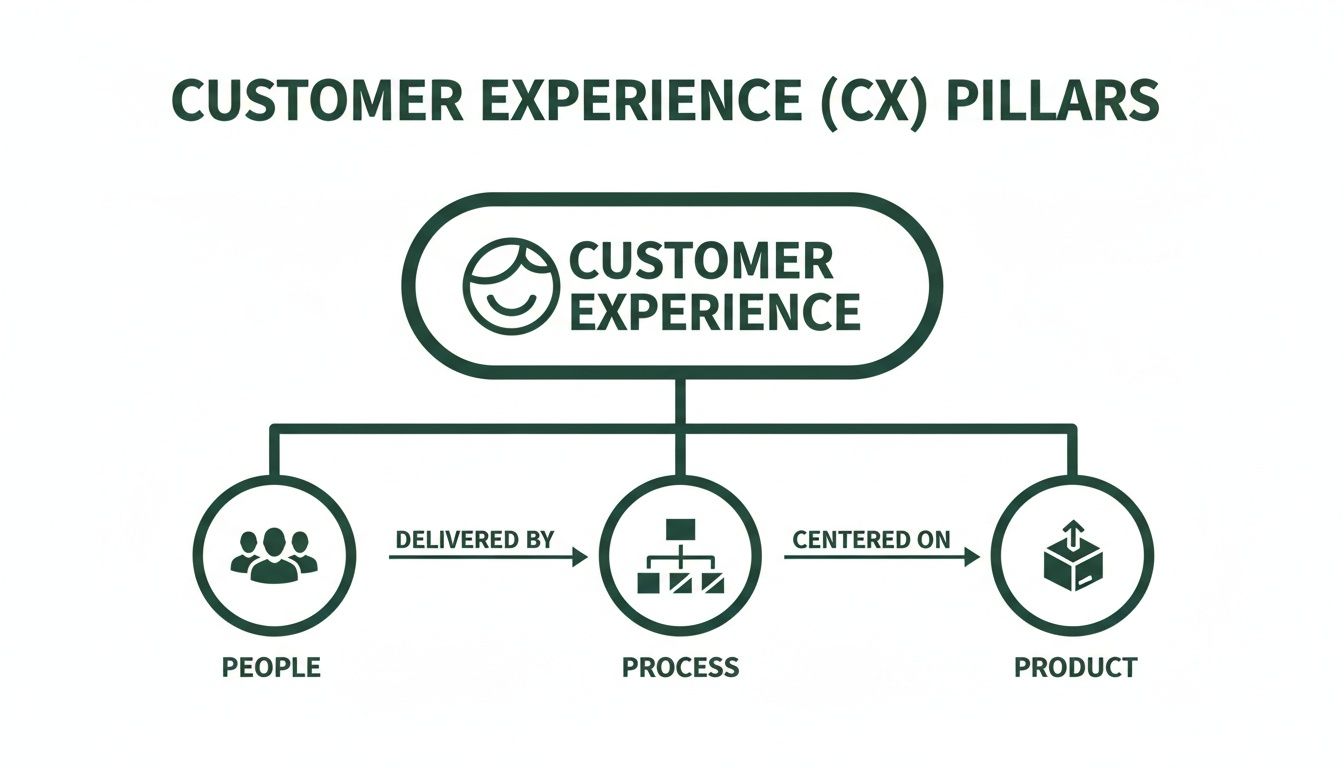
This model shows that a fantastic customer experience isn't just about one thing; it's about the seamless integration of your team, your internal workflows, and the product itself.
But here’s the catch: the perception gap is a huge challenge. Research shows that while 89% of businesses expect to compete mainly on CX by 2025-2026, internal teams often rate their own performance four times higher than their customers do.
This is where a platform like Uxia becomes so valuable for product teams. It helps close that gap by capturing detailed, unbiased feedback and flagging issues instantly, all without the usual recruiting headaches.
Upgrading Your CX With AI-Powered Insights
While your metrics and journey maps give you a solid starting point, the traditional ways we gather feedback are fundamentally broken for modern product teams. They’re slow, expensive, and a nightmare to scale, especially if you’re working in fast-paced agile cycles.
Let’s be honest: waiting weeks for user research findings can completely throw a product roadmap off course. This lag time creates a massive blind spot where design flaws, confusing copy, and usability friction slip into the final product, poisoning the real customer experience you’ve worked so hard to build.
The Limits of Traditional Feedback
Old-school user research just comes with too much operational baggage. The whole process of recruiting participants, scheduling sessions, and then manually sifting through hours of video feedback creates a huge bottleneck.
This classic approach also brings a few serious risks to the table:
High Costs: Paying for recruitment services and participant incentives adds up fast. It makes frequent testing feel like a luxury, not a necessity.
Slow Turnaround: The full cycle—from planning the study to delivering the final report—can easily stretch over several weeks. That’s completely out of sync with a modern two-week sprint.
Potential for Bias: When you keep going back to the same small pool of "professional testers," you risk getting feedback that’s stale, skewed, and unrepresentative of your actual audience.
These limitations make it nearly impossible for teams to get the constant flow of input they need. This is exactly where a more modern approach becomes non-negotiable for any team that’s serious about their CX.
A Faster Path to Actionable Insights
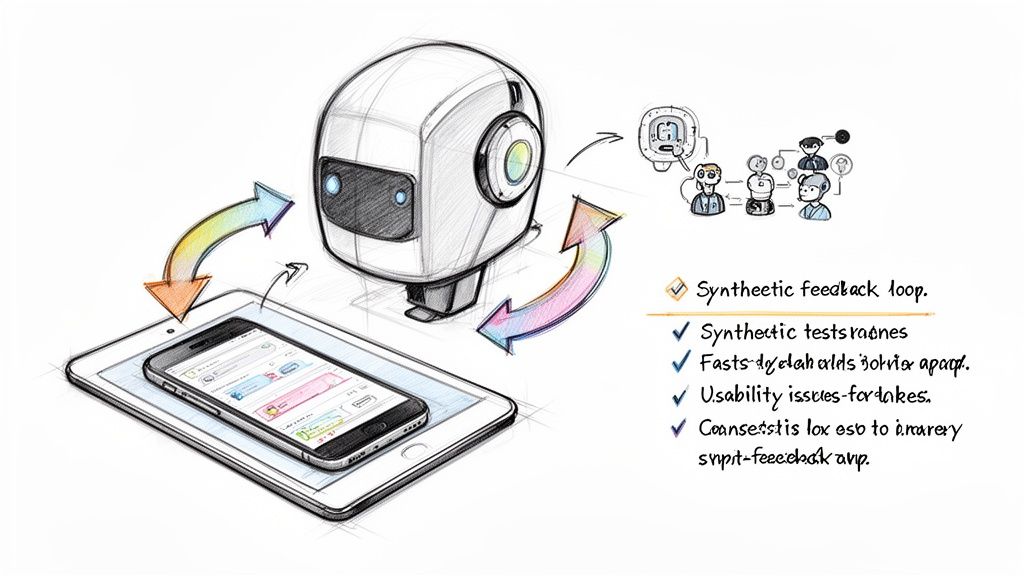
To actually keep pace, product teams need a way to get reliable feedback in minutes, not weeks. This is where AI-powered platforms like Uxia become a game-changer for your CX toolkit. Uxia uses synthetic testers—AI agents built to simulate human behaviour—to test your digital experiences on demand.
Instead of recruiting people, you just upload a prototype or paste in a link to your live site. Uxia’s synthetic users then get to work, interacting with your design and giving you instant, unbiased feedback on all the factors that make or break CX.
The real power here is the combination of speed and objectivity. You get to validate design choices and flag friction points before they ever damage a real customer relationship. That directly strengthens your CX metrics without slowing down development one bit.
This is especially powerful in markets with unique customer behaviours. For instance, B2B customer experience strategies in Spain are a fast-moving blend of traditional relationship-building and new digital tools. The data shows that organisations mastering this balance achieve up to 35% higher customer retention and 28% greater wallet share. For designers, AI testers can simulate these nuanced behaviours instantly, helping to reduce bias and cut development sprints by as much as 50%. You can discover more insights about European B2B CX benchmark trends.
Putting AI to Work in Your Sprints
With a platform like Uxia, your team can embed testing directly into its daily workflow. You can upload new designs, give the synthetic testers a mission, and get back an actionable report in minutes. The process helps you zero in on specific issues like:
Usability Friction: Where are users getting stuck or confused?
Confusing Copy: Is your language clear, persuasive, and on-brand?
Trust Gaps: Are there any design elements that make users hesitate or feel uncertain?
Getting answers to these questions almost instantly allows your team to iterate with genuine confidence. You can learn more about how to achieve rapid UX insights with AI-driven workflows in our dedicated guide. This kind of continuous feedback loop ensures every digital touchpoint is always making a positive contribution to your overall customer experience.
Your Action Plan for Improving CX Today
Knowing what great customer experience looks like is the easy part. Actually building it is a different game entirely.
This isn’t about abstract theories. This is a practical, step-by-step playbook for product managers, designers, and researchers who want to turn insights into real, measurable improvements.
Follow these steps to start making a difference in your organisation’s CX, right now.
1. Secure Executive Buy-In
Before you can get teams on board, you need your leadership’s support.
But don’t just talk about "making customers happy." You need to build a business case that ties CX improvements directly to the bottom line—revenue, retention, and growth.
Practical Recommendation: Use industry benchmarks and data to make your case. For example, show them the direct link between a higher Net Promoter Score (NPS) and increased Customer Lifetime Value (CLV). Present CX not as a cost, but as a proven driver of sustainable growth.
Frame CX as what it is: a powerful engine for growth, not just another cost centre.
2. Build a Cross-Functional CX Team
Customer experience is a team sport. It’s not a solo mission for the design department.
Your next move is to break down those frustrating internal silos. Pull together a dedicated, cross-functional group to own the entire customer journey from start to finish.
Your dream team should include people from:
Product: To make sure the core offering actually delivers on its promise.
Design and Research: To be the unapologetic advocate for the user.
Marketing: To manage how your brand communicates and is perceived.
Support: To bring real, firsthand knowledge of where customers are struggling.
Engineering: To ground everyone in what’s technically possible and how it impacts performance.
This group’s job is to map, measure, and relentlessly improve the journey, ensuring every touchpoint feels consistent and intentional.
A dedicated cross-functional team ensures that the customer's voice is heard in every decision, transforming CX from an abstract concept into a shared organisational responsibility.
3. Map the Journey and Create Personas
With your team assembled, it’s time to get your hands dirty.
Start by developing customer personas based on real data—not just assumptions—to represent your most important audience segments. Then, create detailed journey maps that trace every single interaction these personas have with your brand, from the first time they hear about you to becoming a loyal advocate.
This process is like turning on the lights in a dark room. It will immediately expose the moments of truth—those critical touchpoints that make or break a customer’s satisfaction. You'll see exactly where the high-friction spots are, allowing you to prioritise them for immediate action.
4. Implement a Continuous Feedback Loop
To make improvements that actually stick, you need a constant flow of fresh feedback.
Build a system that combines traditional methods with modern, rapid-testing tools. While big annual surveys give you valuable high-level metrics, they’re far too slow for today's agile teams. You can’t wait a year to find out a feature is broken.
This is where a platform like Uxia changes the game.
Practical Recommendation: Embed Uxia into your design and development sprints. Before every release, run a quick test on new features or UI changes. This takes minutes and provides an objective report on potential issues, allowing you to fix them before they impact real users and your CX scores.
5. Report and Share Your Wins
Finally, you need to close the loop. Create a dead-simple reporting system that shows progress on key CX metrics to your stakeholders.
And most importantly, celebrate the wins.
For example, you can take Uxia's prioritised visual reports and feed them directly into your product backlog. This makes CX improvements visible and trackable. It shows executives exactly how your team’s work is reducing friction and making the experience better.
When you can demonstrate a clear ROI, you don’t just fix problems—you build unstoppable momentum for all your future CX initiatives.
Common Questions About Customer Experience
Once you start digging into customer experience, a few key questions always pop up. Let's tackle them head-on with some straightforward answers to clear up any confusion.
What Is the Difference Between Customer Service and Customer Experience?
Think of it like this: customer service is a moment, while customer experience is the entire journey.
Customer service is what happens when something goes wrong and a customer needs help. It’s a reactive, specific interaction—one small piece of a much bigger puzzle.
Customer Experience (CX), on the other hand, is the sum of every single interaction a person has with your brand. From the first ad they see, to navigating your website, using your product, and even reading an email.
While excellent service is a crucial part of a positive CX, a great CX strategy is proactive. It aims to design a journey so seamless that customers rarely need to contact support in the first place.
Who in an Organisation Is Responsible for CX?
In a company that truly gets it, the answer is simple: everyone.
Every single team plays a role. The product team designs the core value. Engineering ensures the app is stable and fast. Marketing sets expectations from the very first touchpoint.
True success, however, comes from having a dedicated CX leader or team to champion the customer's voice across all departments. Their job is to orchestrate these efforts and ensure a consistent, high-quality experience at every touchpoint.
This kind of leadership is what breaks down the internal silos that so often get in the way, making sure the entire organisation is moving together for the customer's benefit.
How Can a Small Business Improve CX with a Limited Budget?
You don’t need a huge budget to make a real difference. It’s about being smart and focusing on high-impact, low-cost activities.
Practical Recommendation: Prioritise fixing friction on your most critical digital touchpoints, like your homepage or checkout flow. Instead of burning cash on slow, traditional human studies, a startup can use a platform like Uxia. With Uxia, you can get fast, affordable feedback on your website, app, or prototype using AI-powered synthetic testers. Iterating on your digital experience based on Uxia's AI insights is one of the highest-ROI activities you can do to improve CX from day one.
How Does CX Directly Impact Business Revenue?
The link between CX and revenue isn't soft or vague—it's direct and powerful. Great CX is a primary driver of financial performance.
A positive experience builds loyalty, and retaining customers is far cheaper than constantly finding new ones. Loyal customers don't just buy again; they spend more over time. They also become your best marketing channel, spreading positive word-of-mouth that brings in new business for free.
On the flip side, a poor CX leads directly to churn. Study after study confirms that most customers will leave for a competitor after just one bad experience. Investing in CX isn’t a cost—it’s a direct investment in sustainable revenue growth.
Ready to stop guessing and start understanding your users? Get fast, actionable feedback on your designs with Uxia. Visit https://www.uxia.app to see how our AI-powered synthetic testers can help you build better digital experiences in minutes.