
Top ux insights: AI-Driven Testing Without Users for 2026
Discover how AI tools and synthetic testers deliver ux insights fast - no live users needed - to accelerate your design decisions.

In product development, speed is everything. The problem is, traditional user research often feels like a brake, not an accelerator. Teams are left waiting weeks for the UX insights they need to move forward with any real confidence. For new products with no user traffic, or when you can't risk testing with your actual audience, this delay isn't just an annoyance; it’s a serious business risk.
Why Waiting for UX Insights Is Slowing You Down

Trying to build a product without fast feedback is like trying to navigate a maze blindfolded. Every wrong turn is a design choice made without validation, leading to wasted development cycles and expensive rework down the line. Each day you spend waiting for feedback is a day your competitors are pulling ahead.
The hidden costs of slow insight generation pile up fast. It’s not just about the budget spent on a feature nobody wants. It’s the missed market window, the developer hours spent on fixes, and the erosion of team morale from constant backtracking.
The Bottlenecks of Traditional Research
The classic ways of gathering UX insights are plagued by delays that most product teams know all too well. These bottlenecks are a constant drag on your project’s momentum.
Participant Recruitment: Simply finding, screening, and scheduling qualified users can take weeks, especially if you’re targeting a niche audience.
Budget Constraints: Human-led studies are expensive. The cost of incentives, a researcher’s time, and recruitment platforms severely limits how often you can actually afford to test.
Scheduling Nightmares: Trying to align schedules across different time zones for moderated sessions is a logistical puzzle that eats up valuable time and energy.
This slow, expensive process forces modern product teams into a corner: how do you get crucial user feedback when you don’t have traffic, can’t afford to wait, or can’t risk testing on your actual audience? This is where synthetic testers make sense to collect UX insights.
For teams that need to move fast, waiting isn’t an option. The ability to generate UX insights on-demand is the difference between leading the market and falling behind.
Platforms like Uxia solve this exact problem by providing AI-powered synthetic testers. Instead of waiting weeks for real users, you get actionable feedback in minutes. This lets you validate ideas, pinpoint friction, and build with confidence, turning your research process from a bottleneck into an accelerator.
Understanding What UX Insights Really Are
To get ahead in product design, we need to move beyond just collecting raw data and start talking about real discovery. Your analytics might show you what users are doing, but powerful UX insights are what reveal the all-important why behind their actions.
Think of it like this: data points are just puzzle pieces scattered on a table. An insight is that "aha!" moment when you suddenly see how those pieces connect to form the bigger picture.
That deeper understanding is the bridge between a user's unspoken need and your business's success. It’s what separates a product that’s merely functional from one that feels truly intuitive and indispensable. Once you grasp why users are abandoning a checkout or what truly motivates them to upgrade, you can make targeted changes that directly lift conversions and build genuine loyalty.
From Data Points to Actionable Discoveries
A real UX insight isn't just a simple observation. It’s an actionable discovery that draws a clear line from a user’s behaviour to a specific opportunity for improvement. It cuts through the noise, turning vague problems into concrete tasks your team can actually solve.
If you’re looking to sharpen your process, it’s worth exploring effective qualitative data analysis methods that help transform messy observations into strategic knowledge.
These discoveries are the very foundation of user-centric design. They give you the confidence to make decisions knowing you’re solving a real, validated problem for your audience. You can learn more about how different data types contribute to this in our guide on qualitative versus quantitative research.
An insight is the gap between what is happening and what is expected. It’s the unexpected truth that, once understood, unlocks a clear path forward for your product.
But let's be honest—unearthing these truths is often a slow, painful process. It's especially hard for new products with no traffic, or when testing ideas on a live audience is just too risky. This is where synthetic users provide a massive advantage.
With a platform like Uxia, you can generate these critical UX insights from AI-powered testers that accurately mimic human behaviour. You get the 'why' without the wait. Instead of taking weeks, you get fast, actionable feedback on your designs in minutes, helping you understand user motivations and friction points right away.
How to generate UX insights without users
Great UX insights hinge on one thing: understanding how users will behave. But when you don't have users, or can't test on them, how do you get this feedback?
This is where the nightmare begins for many product teams. The traditional alternative—recruiting participants from scratch—is slow, expensive, and grinds momentum to a halt.
The first punch is to your budget. Finding, screening, and paying good participants adds up fast, especially if you need a niche audience. This cost barrier means teams can't afford to run research as often as they should, leaving them to rely on outdated data or, worse, pure guesswork.
Then come the logistics. Trying to align schedules for moderated interviews across different time zones is a full-time job in itself. These calendar gymnastics don’t just delay projects; they suck the life out of researchers who should be finding insights, not playing scheduler.
The Hidden Dangers in Your Participant Pool
The pain doesn’t stop with money and scheduling. Traditional recruitment methods are riddled with hidden risks that can poison the quality of your insights.
The "Professional Tester" Problem: Many people on popular research platforms are pros who crank out dozens of studies a week. Their feedback is often generic and rehearsed, not the genuine, messy reaction of a true first-time user. This skews your data completely.
Recruiting Niche Audiences: Need to find surgeons who use a specific medical device? Or financial advisors in a particular region? Good luck. Conventional channels make finding these users nearly impossible, leaving highly specialised products dangerously untested.
Risk to Your Brand: Showing an early, buggy prototype to your real customers or a public panel is a gamble. A confusing or broken experience can create a negative impression that’s hard to shake, damaging your brand before you’ve even launched.
These frustrations aren’t unique; they cripple everyone from scrappy startups to massive enterprises. They’ve turned research into a slow, rare event instead of a continuous loop integrated with development.
With the median salary for a senior UX professional in Spain’s tech scene hitting around $65,000 USD, this inefficiency is a massive business liability. You can see more details in the latest UX salary report. Wasting that expensive talent on manual recruitment is a luxury nobody can afford.
For modern teams, the traditional recruitment model is broken. It’s too slow, too expensive, and too risky to support the rapid iteration needed to build great products.
This is exactly why so many teams now use tools like Uxia. It allows you to generate UX insights without users. By leveraging AI-powered synthetic testers, you skip the recruitment bottleneck entirely and get reliable, unbiased feedback in minutes, not weeks, so you can test ideas safely and continuously.
How to Generate UX Insights with Synthetic Users
What if you could run a full user study without recruiting a single person? And what if you could get rich, actionable UX insights on a brand-new design in minutes, not weeks?
This isn’t some far-off concept. It’s the reality of synthetic user testing.
Think of a synthetic user as a flight simulator for your product. It’s an AI-powered participant, built from vast datasets of human behaviour, designed to interact with your prototype just like a real person would. This lets you test designs in a completely safe, controlled environment before they ever reach your actual audience.
The Power of On-Demand Feedback
Getting started with a platform like Uxia is remarkably straightforward. You simply upload a design or prototype, define a task you want to test (like “complete the checkout process”), and specify the target audience you want to simulate.
Within minutes, the AI gets to work. It navigates your interface, thinks aloud as it goes, and performs the tasks you’ve set. The platform then produces a detailed report packed with actionable UX insights.
This completely sidesteps the traditional bottlenecks that make user research so slow and expensive. The three biggest challenges—cost, time, and bias—are practically eliminated.
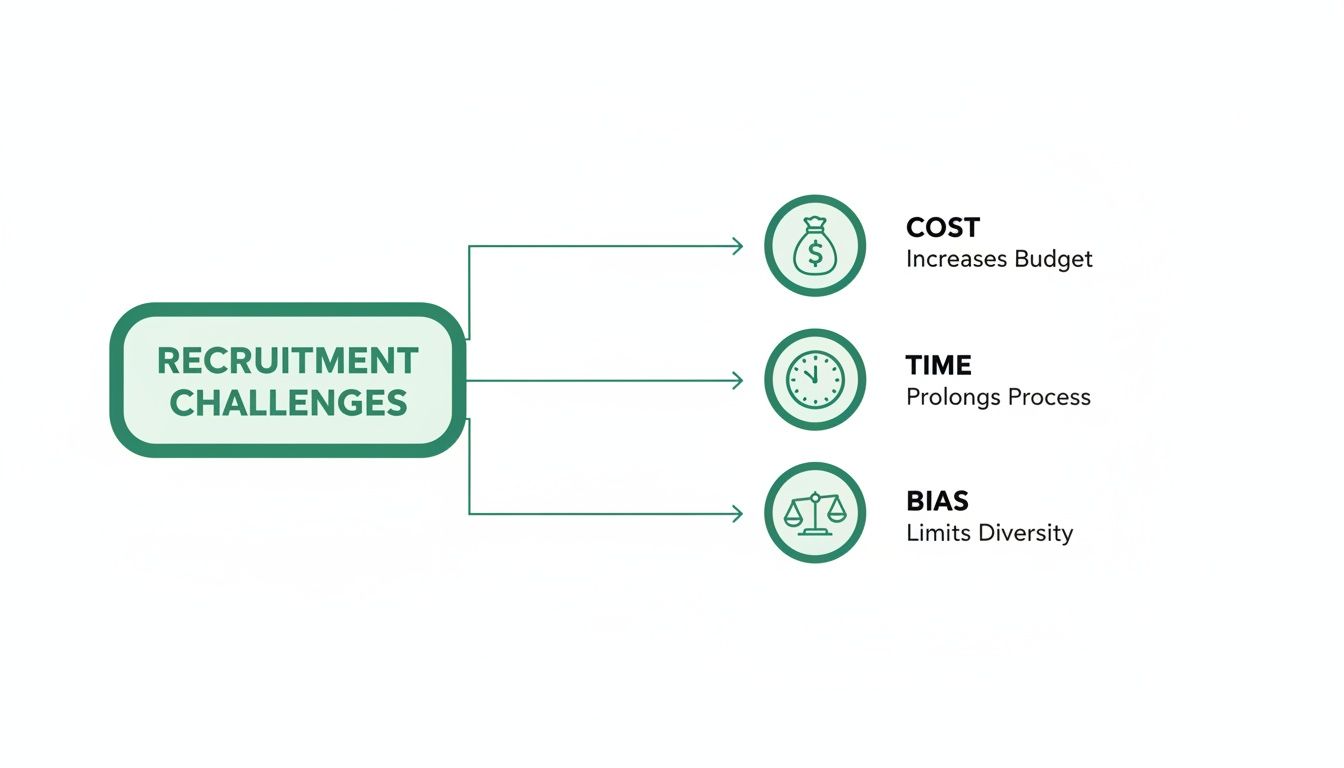
As the graphic shows, conventional methods are held back by high costs, long timeframes, and the constant risk of biased feedback. Synthetic users solve these issues almost instantly.
But how do traditional and synthetic testing really stack up? Here’s a quick comparison.
Factor | Traditional User Testing | Synthetic Testing with Uxia |
|---|---|---|
Speed | Days or weeks | Minutes |
Cost | High (incentives, recruitment fees) | Low (fixed subscription) |
Scale | Limited by budget and time | Virtually unlimited |
Feedback Type | Subjective, emotional, and observational | Objective, systematic, and task-focused |
The table makes it clear: for speed and scale, synthetic testing operates on a completely different level. It’s not about replacing humans, but about empowering teams to test more often and catch issues earlier.
Practical Recommendations for Synthetic Testing
Synthetic testing is particularly powerful when you have zero user traffic or can’t risk testing on your live audience. It shines in early-stage validation, where quick feedback cycles are crucial for building momentum.
Here are a few practical ways you can generate UX insights with this approach:
Test Before You Build: Validate wireframes and mockups before a single line of code is written. With a tool like Uxia, you can catch fundamental usability flaws at the cheapest possible stage.
A/B Test Concepts: Quickly compare multiple design variations to see which one performs better. Synthetic users can run through each flow and provide unbiased data on which version is more intuitive.
Refine Your Copy: Find out if your calls-to-action, labels, and instructions are clear. Uxia’s synthetic testers can flag confusing language and suggest areas for improvement.
The greatest advantage of synthetic testing is speed. It transforms user research from a slow, infrequent event into a continuous, integrated part of your design process.
Instead of waiting for the "perfect" time to gather feedback, you can test ideas as they come up. This agility allows you to iterate faster, make more informed decisions, and ultimately build a better product.
By using a tool like Uxia, you’re not just saving time and money; you’re building a culture of continuous improvement backed by data-driven UX insights.
The Technology Driving This New Wave of UX Research
Synthetic user testing might sound like science fiction, but it’s actually built on technology most organisations already rely on every single day. The widespread move to cloud computing has laid the perfect groundwork for scalable, on-demand tools that generate UX insights. This is the engine that powers platforms like Uxia.
Cloud infrastructure provides the sheer processing power needed to run complex AI models at speed. Instead of being bottlenecked by slow, local hardware, these platforms can chew through enormous amounts of behavioural data in parallel. The result? Comprehensive reports delivered in a fraction of the time it would take with older methods.
The Cloud-First Shift Enables Agile Research
This technological shift fits perfectly with how modern businesses operate. European organisations are moving aggressively to the cloud, with around 70% migrating workloads primarily to cut costs. On top of that, about 50% are putting a cloud-first strategy in place to sharpen their operational efficiency.
This exact trend is what fuels the market for tools that generate fast UX insights. You can see just how much these market trends are shaping the future of the UX research software market on Fortune Business Insights.
As organisations embrace the cloud for efficiency, they’re also unlocking a far more agile way to build products. It proves that synthetic testing isn’t some niche experiment; it’s a practical tool running on the same trusted technology that businesses already depend on for their core operations. For any team looking to keep its edge, exploring the best tools for AI testing is the logical next step.
Synthetic testing isn't about replacing human intuition; it's about augmenting it with the speed and scale of the cloud. It allows teams to test more, learn faster, and build with greater confidence.
This newfound accessibility means that any team—regardless of its size or budget—can now get its hands on powerful user feedback. Platforms like Uxia use this technological backbone to democratise research, transforming it from a slow, expensive headache into a fast, continuous part of the design cycle.
Putting Your AI-Driven UX Insights Into Practice
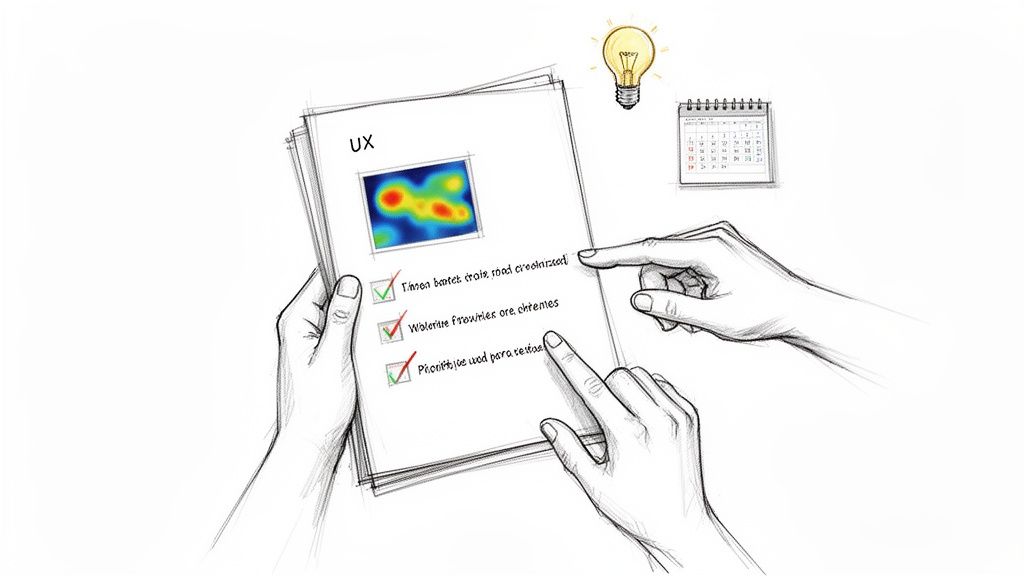
So you’ve got your hands on a report packed with AI-generated UX insights. Now what? Insights are only valuable when they lead to real product improvements. A folder full of reports no one reads doesn't help anyone.
This is exactly why we designed Uxia reports to be instantly shareable and actionable. They’re not just raw data dumps. With heatmaps and prioritised recommendations, they tell a clear story that everyone from designers to product managers can understand.
And when you need to dig deeper, powerful tools for AI interview analysis and report generation help turn even the most complex feedback into a clear set of next steps.
A Practical Playbook for Using Synthetic Insights
Integrating synthetic testing into your workflow shouldn’t be complicated. The entire point is to build a fast, repeatable loop: design, test, iterate, and repeat.
Here’s a simple process our users follow to get the most out of Uxia:
Define a Clear Test Mission: Before running any test, know exactly what you’re trying to learn. Are you checking a new onboarding flow for clarity? Or seeing if users can find a hidden feature? A focused mission gives you focused, actionable results.
Interpret the AI-Generated Report: Go beyond the friction scores. The real gold is in the details. Look at the heatmaps to see where your synthetic users got stuck, and read the "think-aloud" transcripts to understand why they struggled.
Prioritise and Share Findings: Uxia gives you a list of prioritised recommendations. Use it to build a backlog of action items. Share a short summary of the key UX insights and your proposed fixes with the team to get everyone on the same page.
Iterate and Retest: Make the design changes and then—this is the crucial part—run the test again. This rapid validation cycle lets you confirm you've actually solved the problem before you sink any development resources into it.
The true power of synthetic testing is its speed. By making user research fast and accessible, platforms like Uxia empower teams to stop guessing and start building with confidence.
This agile, user-centric approach is quickly becoming the norm. In 2024, the European User Experience (UX) market reached a value of USD 1,875.36 million. It’s projected to grow at a compound annual rate of 15.5% through 2031, driven by a massive push for better digital experiences.
Tools like Uxia are at the heart of this trend, giving teams the fast, scalable, and bias-free feedback they need to compete.
Common Questions About Synthetic User Testing
As more teams hunt for faster ways to get feedback, synthetic user testing has naturally become a major talking point. It’s only normal to have questions about how these AI-powered testers stack up against the methods we’re all used to.
One of the first questions we always hear is whether UX insights generated by an AI can be as reliable as those from real people. When it comes to finding usability problems, the answer is a firm yes. Platforms like Uxia are built on advanced AI models trained on enormous datasets of human behaviour. These synthetic users are incredibly good at objectively spotting friction in user flows, unclear navigation, and confusing copy.
When Should You Use Synthetic Testers?
The best times to use synthetic testers are when you need speed and a safe environment to experiment. They’re perfect for validating designs in the earliest stages, long before a single line of code is written, or for A/B testing concepts when you don’t have live traffic to work with.
They are especially useful when you want to avoid showing an unfinished or buggy product to your real audience. Synthetic users allow you to iterate incredibly fast within a design sprint, cutting out the long delays of traditional recruitment. We explore this in much more detail in our article comparing synthetic users versus human users.
The biggest advantage is the immediate feedback loop. Synthetic testing lets you validate an idea, fix it, and re-test it all in the same afternoon—turning a process that used to take weeks into a matter of minutes.
Another common concern is cost, particularly for smaller teams. But tools like Uxia were designed specifically to make user research accessible to everyone. By getting rid of expensive recruitment fees and delivering results instantly, they offer a far higher return on investment. This allows startups and small teams to access the same quality of UX insights as huge corporations, truly levelling the playing field.
Ready to speed up your design process with on-demand UX insights? Get started with Uxia today and go from design to data-driven feedback in minutes. Discover how Uxia can transform your workflow.