Synthetic Users: A Practical Guide to Faster UX Validation
Explore how synthetic users powered by AI speed UX testing, delivering scalable, actionable insights to validate your design choices quickly.

What if you could get solid user feedback in minutes instead of weeks? That's the new reality, powered by synthetic users—AI models that are trained to mimic how real people think and behave. For far too long, product teams have been stuck in the slow lane, bogged down by expensive and time-consuming user testing that creates a huge bottleneck for UX validation.
What Are Synthetic Users and Why Are They So Popular?
Product management has always been a frustrating trade-off. You either move fast and risk shipping the wrong thing, or you slow way down to gather user feedback and risk missing your window in the market. While traditional user research is valuable, it is painfully slow. Recruiting participants, running sessions, and sifting through data can take weeks. By the time you have insights, your product roadmap has already moved on.
This is exactly the problem synthetic users were built to solve. They are not mindless bots. They are sophisticated AI agents built on real-world data, able to interact, behave, and even "think aloud" just like your target users would. They offer a digital dress rehearsal for your product.
Why the Sudden Surge in Popularity?
The rise of synthetic users is happening now because the need for speed and efficiency in product development is critical. The best teams are adopting this technology to gain a competitive advantage. The main reasons for this shift are clear:
Unmatched Speed: You can get full usability reports in minutes. A practical recommendation is to run a test at the end of each day. You'll have a full report waiting for you in the morning.
Massive Scale: You can test designs with hundreds of different AI personas at once, covering niche demographics that are usually incredibly difficult and expensive to recruit.
Significant Cost Reduction: You skip the high costs of recruiting, paying incentives, and managing human test panels, especially for smaller design tweaks.
Synthetic users offer a practical fix for a chronic problem: the gap between who we think our customers are and what they actually do. Platforms like Uxia give us a way to get insights much faster without losing the depth we need.
How They Actually Help Validate UX
This new approach completely changes how teams can validate the user experience. Instead of waiting for a formal research cycle, a designer can get instant feedback. Imagine running a test on new wireframes at the end of the day. Before your morning coffee, you have a report highlighting friction points, confusing copy, or navigation dead-ends.
Platforms like Uxia are at the forefront of this movement, making it simple to run these tests. You just upload a design, define a task (like "sign up for a new account"), and pick your target audience. Uxia's synthetic users then get to work, interacting with your design and generating think-aloud transcripts while flagging specific usability problems. This gives you the power to build with data-backed confidence right from the earliest stages.
Ready to stop waiting and start building better products faster? It's time to book a demo with Uxia and see how quickly you can get actionable feedback.
How Synthetic Users Are Built
Let's clear something up: synthetic users aren't mindless bots. They are high-fidelity digital twins of your target audience—AI agents with their own goals, behaviors, and even frustrations, ready to interact with your product just like a real person.
The process is grounded in data. A synthetic user is built on a massive foundation of aggregated, anonymous data from countless real-world user interactions. It's not about any single person's data; it’s about understanding the collective patterns and cognitive processes of millions of users. This huge dataset is the textbook from which the AI learns what it means to be a user.
The Building Blocks of a Digital Persona
With recent advancements in models like GPT-4o, creating incredibly nuanced and accurate user profiles is now a reality. Platforms like Uxia use this technology to go far beyond simple, scripted automation. The AI isn’t just following a checklist; it’s trained to "think aloud," generating feedback transcripts and pinpointing friction in a user journey all on its own.
Bringing these AI participants to life is a multi-step process, which this diagram breaks down.
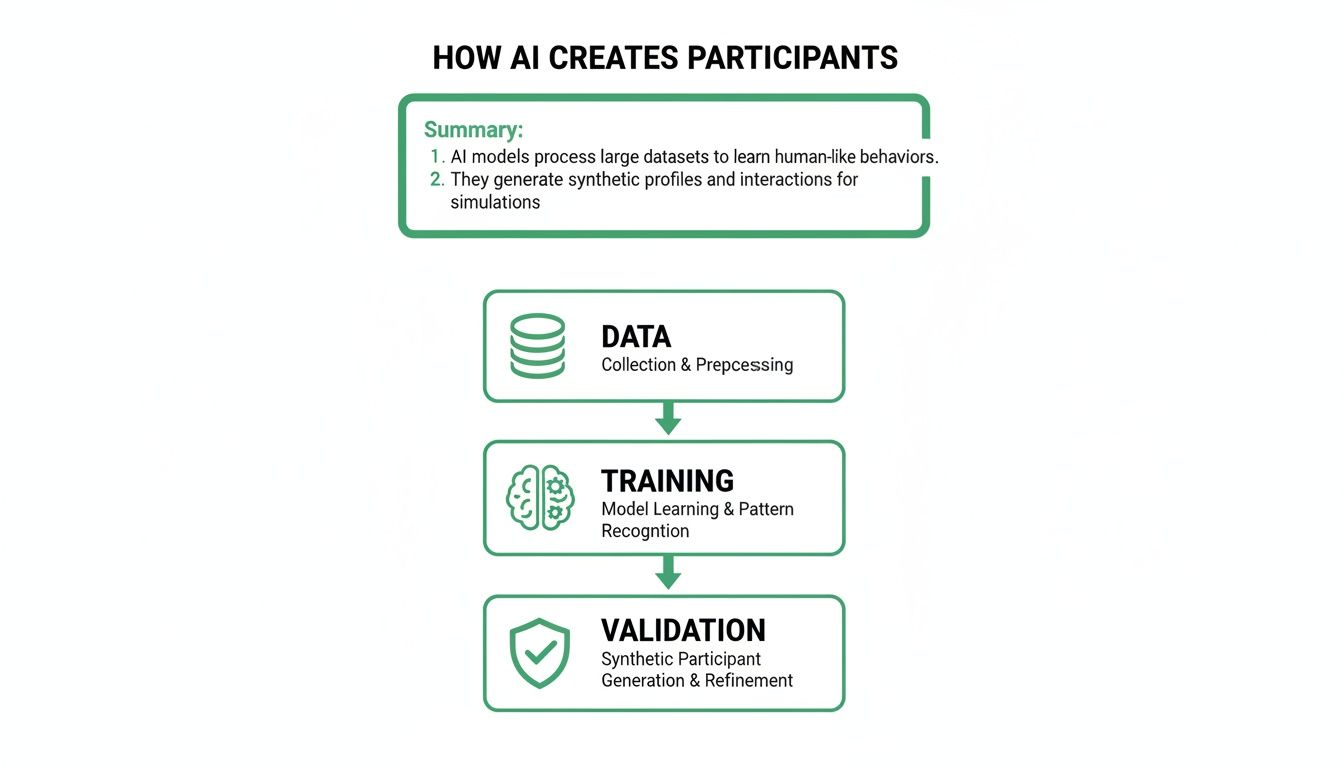
As you can see, it's a constant cycle of refining raw data through training and validation to produce AI participants you can actually rely on.
This technology isn't just a niche, either. It’s part of a massive, rapidly expanding field. For instance, the European synthetic biology market—which underpins many of these AI advancements—is projected to jump from $5.5 billion in 2025 to over $18.7 billion by 2033. This growth is fuelling the innovation that allows platforms like Uxia to create ever more realistic AI participants.
From Training Models to Task Execution
Once foundational models are trained on general user behaviour, we can shape them into specific personas. Maybe you need to test a new fintech app with a "cautious, first-time investor" or a "busy small business owner." With Uxia, you simply select the profile, and the AI adapts its entire approach.
Here’s a practical look at how it works:
Goal-Oriented Interaction: The synthetic user gets a clear mission, like ‘find and buy a specific product’ or ‘finish the onboarding flow’. It then tries to complete the task based on its assigned persona.
Cognitive Simulation: As it moves through your design, the AI simulates a human thought process. It produces ‘think-aloud’ transcripts that tell you what it’s thinking—whether it's confused, satisfied, or frustrated.
Friction Identification: The system automatically flags every point of friction, such as a confusing button or unclear instructions. These are surfaced as clear, actionable usability issues.
The real magic here is that these AI participants don't just follow the happy path. They make mistakes, get distracted, and react to confusing design choices—giving you a far more realistic test than any simple automated script ever could. This is how you uncover the why behind user behaviour, but at scale.
This approach gives you a powerful, almost instant way to validate your UX decisions. For a closer look at the specifics, you can learn more about how Uxia’s AI-generated testers provide instant feedback.
Ultimately, the goal is to create a reliable proxy for your users that can be deployed in minutes. By constantly checking the AI's outputs against real-world human test results, we make sure the insights you get aren't just fast—they're accurate and cognitively aligned with your actual users.
The Benefits of Testing With Synthetic Users
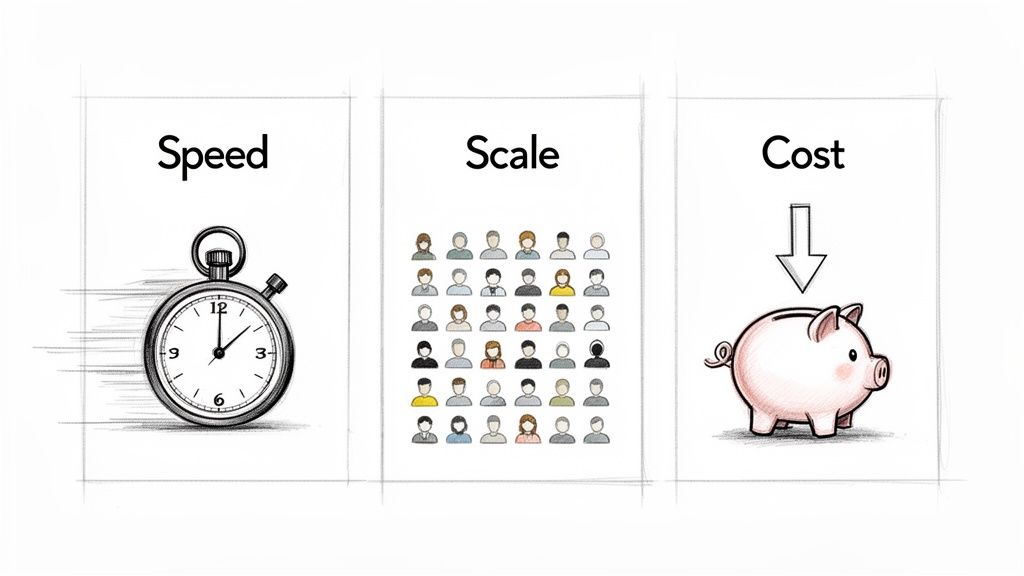
Switching to synthetic users isn't just a small tweak; it completely changes the game for your entire development workflow. When you move from slow, traditional research to fast AI-driven validation, you unlock serious advantages in speed, scale, and cost.
Let's break down what that actually means for your team.
Unbeatable Speed and Agility
The first thing you'll notice is how much faster you get feedback. Traditional usability testing can easily take weeks to recruit, schedule, and analyze. With synthetic users, that entire process shrinks to just a few minutes.
A practical recommendation: Your team could finish designing a new checkout flow in the afternoon, run a full usability test with a tool like Uxia, and have a detailed report ready before the end of the day. This makes true continuous iteration possible within a single workday, not just a single sprint.
This speed isn’t just about moving fast—it's about building momentum. When designers get instant feedback, they can explore more ideas, fix flaws early, and refine their work with data-backed confidence, all without losing their creative flow.
Massive Scale and User Diversity
Recruiting real users always involves a trade-off between your budget and getting a diverse group. Finding people who truly represent your entire audience is expensive and time-consuming. More often than not, you end up testing with a small, homogenous group.
Synthetic users get rid of that limitation. Imagine testing your product not with five people, but with hundreds of different AI personas at the same time. With a platform like Uxia, you can test against a whole library of profiles representing different:
Demographics: Check how users of various ages, locations, and technical skill levels interact with your design.
Behaviours: Simulate the difference between a cautious first-time user and a seasoned power user.
Needs: Make sure your design is accessible for users with specific needs, like those who depend on screen readers.
This kind of scale helps you find edge cases and friction points that a small human panel would almost certainly miss. For any team serious about inclusive, data-driven design, this is a must-have capability.
A Radically Lower Cost
Let's be honest: traditional usability studies are expensive. A single study across multiple countries can easily run into a six-figure budget. This high cost forces teams to be picky about what they test, leaving many design choices up to guesswork.
Synthetic user testing completely changes the economics. By swapping manual work for an automated platform, the cost per test drops dramatically. Running that same multi-country study on a platform like Uxia costs only a tiny fraction of the traditional price.
This cost-efficiency means you can finally afford to test everything—from major new features down to small copy changes. The ROI is obvious: you spend less on testing but get far more insights, leading to better product decisions and less risk of expensive post-launch fixes.
Synthetic Users vs Traditional Usability Testing
Aspect | Traditional Usability Testing | Synthetic User Testing (with Uxia) |
|---|---|---|
Time | Weeks (recruitment, scheduling, analysis) | Minutes (from setup to report) |
Cost | High (incentives, agency fees, moderator time) | Low (fixed subscription fee) |
Scale | Small (typically 5-10 users per segment) | Massive (hundreds of personas at once) |
Bias | High (professional testers, politeness bias) | None (AI has no agenda or desire to please) |
Diversity | Limited by recruitment budget and effort | High (easily simulate global demographics/needs) |
Consistency | Low (human behaviour varies test-to-test) | 100% repeatable and consistent |
As you can see, it’s not just a minor improvement. It’s a fundamental shift that gives you better, more reliable data while saving you a massive amount of time and money.
Practical Ways Synthetic Users Can Validate Your UX
Alright, theory is great, but what really matters is how synthetic users perform when you put them to work. This is where we get practical and look at concrete ways your team can use AI participants to stop guessing and start making data-backed design decisions.
While traditional methods like the usability testing of a website are still valuable, synthetic users can now run those same tests—only faster and with more pointed feedback.
Let's say you're about to launch a new onboarding flow. The goal? To slash that painful 40% drop-off rate you're seeing on day one. With a platform like Uxia, you give your synthetic users a simple mission: "Create a new account and finish the setup."
Just minutes later, you have a full report. The AI testers give you think-aloud transcripts, showing you exactly where they stumbled. One might comment, "I'm not sure what 'enterprise-grade security' means for my personal account," while another flags, "This step wants my phone number, but it never said why."
This is the kind of instant, actionable feedback that lets you move fast. You can immediately tweak your microcopy or add tooltips to clarify the value, directly tackling the friction that makes real people churn.
Identifying Hidden Friction Points
Let's be honest, the most frustrating usability issues are rarely the obvious ones. They're the small hesitations, the confusing labels, and the navigational dead-ends that slowly chip away at a user's patience. This is where AI-generated heatmaps and session recordings are a game-changer.
Think about a complicated settings page in your app. A human tester might just tell you it feels "a bit confusing," which doesn't give you much to go on.
With Uxia, you can run a simulation where synthetic users are told to find and change one specific setting. The platform then generates a predictive heatmap showing where the AI participants 'looked' and 'clicked'. You might instantly spot a bright red cluster of activity around the wrong menu item, proving your labelling is misleading.
These insights let you zero in on the exact source of confusion. The impact is direct and measurable:
Task Success Rate: When you clarify confusing paths and labels, the percentage of users who complete their goal goes up. It's that simple.
Time on Task: A cleaner layout means users find what they need faster, creating a much more efficient and pleasant experience.
Error Rate: By fixing misleading UI elements before they ever reach production, you slash the number of wrong clicks and frustrating mistakes.
Assessing and Improving Accessibility
Accessibility isn't just a checkbox; it's a core component of great design. But testing for it properly can be tough. Synthetic users give you a powerful, automated way to run those initial checks.
A practical recommendation: Deploy AI participants from Uxia configured to mimic the experience of someone using a screen reader. Their task could be to navigate your site using only keyboard commands and the resulting audio feedback.
The feedback you get is incredibly specific. For instance, a synthetic user might flag an image missing its alt text by stating, "An image is present, but I don't have a description of what it shows." That’s not a vague complaint; it's a clear, actionable ticket for your dev team.
This move toward AI-driven testing is quickly becoming the new standard. By 2026, synthetic data is expected to completely reshape UX research in Europe, solving long-standing problems with sample quality and tight budgets. The European synthetic data market is projected to explode from USD 0.77 billion in 2026 to USD 7.22 billion by 2033, a massive 37.65% compound annual growth rate.
For product teams, this means tools like Uxia can deliver statistically sound insights without the privacy headaches of traditional testing—a massive win under regulations like GDPR.
By building these practical tests into your workflow, you move from hunches to confidence. You can find out more by reading our full guide to testing UX for better digital products. And when you’re ready to see it in action, book a demo with Uxia and find out how fast you can get results for your own designs.
How Uxia Delivers Instant UX Insights
Knowing that synthetic users exist is one thing. Actually putting them to work in your daily workflow is another challenge entirely. That's where a platform like Uxia comes in. We’ve built a process so fast and simple that it removes all the usual friction, letting you get user feedback the moment you need it.
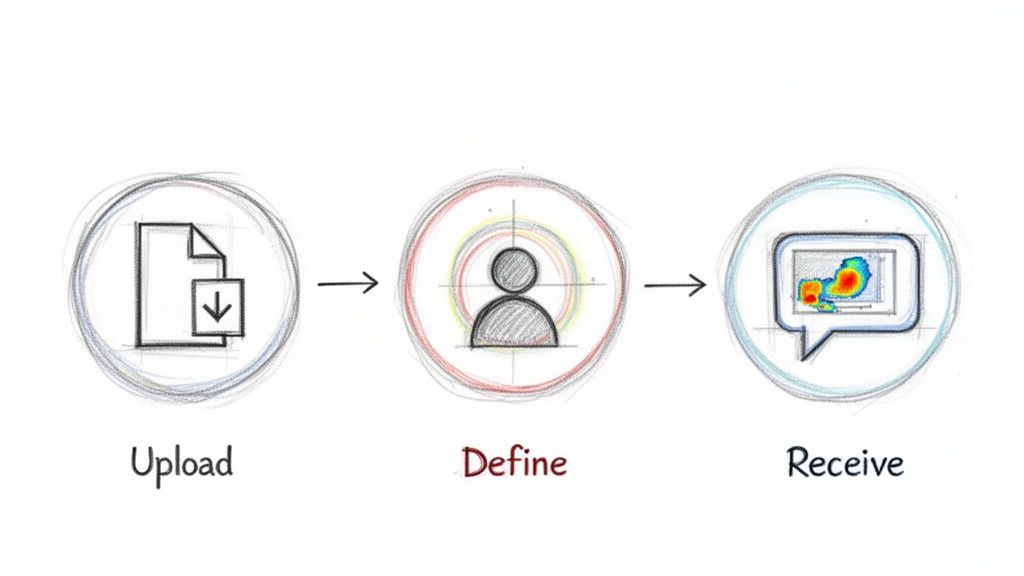
The whole thing is designed around speed. It’s a clean, three-step journey from a design idea to actionable data you can actually use.
From Design to Data in Three Steps
Getting started with Uxia couldn't be easier. You don’t need a complex setup or a PhD in data science. If you have a design and a question, you're ready to go.
Upload Your Design: Drag and drop whatever you have—a rough sketch, a polished screenshot, or even a link to an interactive prototype. Uxia can analyse static images just as easily as clickable flows.
Define Your Mission: Tell the synthetic users what they need to accomplish. This can be a simple task like "find the pricing page" or a full flow like "complete the checkout process." Then, pick your target audience from our library of pre-built personas.
Receive Instant Feedback: In minutes, Uxia's AI participants get to work and generate a full report. You get immediate access to insights without the typical waiting game of traditional research.
This rapid feedback loop means you can test, refine, and re-test your designs several times in a single afternoon, making sure every decision is backed by solid user feedback.
Beyond Automation: A Deeper Level of Insight
What really sets Uxia apart are the features that give you genuine understanding, not just raw data. We go beyond simple pass/fail metrics to show you the why behind user behaviour. This gives your team the context to make truly smart design choices.
Our platform generates detailed 'think-aloud' transcripts—AI-powered narratives that reveal a synthetic user's thought process at every single step. You'll see exactly where they get stuck, what confuses them, and what clicks, just as if you were listening in on a real person.
Imagine a synthetic user trying to sign up. The transcript might read: "Okay, it's asking for my phone number, but I don't see why it's needed. This makes me a little hesitant to proceed." This isn't just an error flag; it's a direct insight into user trust and friction.
Uxia also flags usability issues automatically and organises them for you. On top of that, it creates visual reports with predictive heatmaps that show precisely where users will focus their attention, helping you spot a confusing layout or a badly placed call to action at a glance. Hundreds of teams are already using this to get from an idea to a validated design in just one day.
The push for privacy-first technology has made synthetic users a game-changer, especially in Europe. The region's strict GDPR regulations have fast-tracked the synthetic data market, which is on pace to hit USD 485.9 million by 2026. For product managers stuck with data scarcity or ethical hurdles, this is the perfect way forward.
The ability to test designs without ever touching real user data is critical. See for yourself how quickly you can get the insights you need to build better products with confidence.
Book a demo with Uxia to get started.
Why You Should Try Synthetic Users Now
The biggest barrier to user testing has always been the process itself: the long research cycles, recruitment headaches, and painful costs. It’s a process that forces you to rely on guesswork for weeks.
Waiting that long is a massive competitive disadvantage. This is about giving your whole team the confidence to build. Designers can finally validate ideas on the fly, and product managers can get the data they need to make decisions without the usual delays. The debate is over. It's time to start testing.
From Theory to Instant Practice
For a while now, talk about synthetic users has felt theoretical. But the conversation is shifting, fast. The real value isn't in reading about this technology—it's in seeing it work on your own designs. The only way to truly grasp how much this changes the game is to experience it firsthand.
Platforms like Uxia make this incredibly simple. You can take a design you're working on right now and get real, actionable feedback in minutes. Forget about the pain of recruiting panels or trying to schedule interviews. Just upload your work, define a goal, and watch the insights roll in.
This isn't about replacing deep human research. Think of it as the crucial first step that was always missing. It's the quick, iterative check that catches 80% of usability issues before they snowball, freeing up your team to focus human research on the more complex, emotional side of user experience.
Take the First Step Today
You can empower your team to stop guessing and start knowing. When you weave rapid, AI-powered testing into your daily workflow, you build a culture of continuous improvement that gives you a tangible edge.
Empower Designers: Let them test, refine, and re-test their work in real-time, without waiting for anyone.
Support Product Managers: Give them the hard data they need to prioritise features with absolute confidence.
Boost Organisational Agility: Dramatically shorten your feedback loops and ship better products, faster.
It's time to move toward a more efficient and confident way of building products. Book a demo with Uxia and see for yourself how synthetic users can bring critical insights to your project in minutes, not weeks.
Frequently Asked Questions About Synthetic Users
As teams start exploring synthetic users, a few common questions always come up. Let's get straight to them and clear up how this fits into a modern product workflow.
Do Synthetic Users Completely Replace Human Testers?
No, they augment them. Think of synthetic users as your first line of defence.
They’re perfect for that early-stage, rapid testing where you need to catch 80% of usability problems, and you need to do it fast. This frees up your human researchers to focus on the deep, qualitative insights—the kind of complex emotional and contextual feedback only humans can give.
Uxia is built to supercharge this early validation. It lets you iterate on wireframes and prototypes over and over again. By the time you bring in human testers, you’re showing them a much more polished design, which makes their expensive feedback far more valuable.
How Is Bias Handled in AI User Populations?
This is a critical point, and it’s where synthetic users have a surprising advantage. Traditional testing with small human panels, often just 5-10 people, can be riddled with bias. The sample is almost never diverse enough to truly represent your user base.
Synthetic user platforms like Uxia tackle this head-on. We build our AI populations from huge, aggregated datasets. This allows us to generate hundreds of distinct personas that cover a wide range of demographics, technical skills, and behavioural patterns.
By testing against a much broader and more controlled set of synthetic users, you can actually get a more representative and less biased sample than what’s practical with small-scale human testing.
What Kinds of Designs Can I Test?
The flexibility here is a huge plus. You can test just about any visual design, at any stage of development.
This includes:
Low-fidelity wireframes to check if your core concepts and user flows make sense.
Simple screenshots to get instant feedback on a single screen or component.
High-fidelity prototypes to test interactive elements and more complex user journeys.
With Uxia, you just upload an image or drop in a link to your prototype. The AI gets to work immediately, no matter how polished (or unpolished) your design is.
How Quickly Will I Actually Get Results?
The speed is dramatic. A traditional user study can take weeks to recruit for, schedule, and analyse. You get feedback from synthetic users in minutes.
Once you set up a test in Uxia—which only takes a moment—you can expect a full, detailed report with transcripts, heatmaps, and prioritised issues in under an hour.
This "minutes, not weeks" advantage is what makes true rapid iteration and continuous improvement possible.
The barrier to fast, reliable user feedback is gone. It's time to stop debating and start testing to build with data-backed confidence. Uxia gives designers, product managers, and entire organisations the power to ship better products, faster.
Book a demo with Uxia to see how you can get insights for your project today.