Product Manager vs Project Manager: What's the Difference?
Clarify the product manager vs project manager debate. This guide covers key differences in roles, skills, salary, and career paths, with tips on who to hire.
A lot of teams hit the same moment. A product is slipping, customers are asking for more, design feedback is slow, and leadership asks a simple question that usually isn’t simple at all: do we need a product manager or a project manager?
If you hire the wrong one, the pain doesn’t go away. It just changes shape. You might get cleaner timelines for the wrong roadmap, or a sharper roadmap that never ships cleanly.
That’s why the product manager vs project manager debate matters. These roles sound adjacent, and they do collaborate closely, but they solve different business problems. One role owns the direction of the product. The other owns the discipline of delivery.
Here’s the shortest useful version before we go deeper:
Area | Product Manager | Project Manager |
|---|---|---|
Primary focus | What to build and why | How to deliver it and when |
Time horizon | Ongoing product lifecycle | Defined project timeline |
Main concern | Market fit, user value, business impact | Delivery, coordination, risk, scope |
Typical outputs | Vision, roadmap, priorities, requirements | Plan, schedule, status updates, risk tracking |
Success signals | Adoption, retention, engagement, revenue-related product outcomes | On-time delivery, budget control, scope management, quality of execution |
Best fit when | The team needs direction and prioritization | The team needs structure and predictable execution |
The Strategic Question Behind Every Great Product
A hiring manager usually feels the difference before they can name it.
If the team keeps asking, “What should we build next?” that’s a product problem. If the team knows what to build but keeps missing handoffs, timelines, or release windows, that’s an execution problem. The title you hire for should match the bottleneck, not the org chart template.
In practice, this gets messy fast. Early-stage startups often expect one person to handle customer insight, prioritization, sprint coordination, stakeholder updates, and launch readiness. That can work for a while. Then scale shows the cracks.
When the wrong hire creates the wrong fix
A product manager won’t automatically fix a delivery system that lacks planning discipline. A project manager won’t decide whether a feature deserves to exist in the first place. Both can look competent while the business still loses time.
That’s the useful lens for product manager vs project manager. Don’t compare titles. Compare decision ownership.
Hire a product manager when you need someone to define value, shape priorities, and keep the team tied to user needs.
Hire a project manager when you need someone to organize moving parts, manage dependencies, and push work to completion.
Hire both when product complexity and delivery complexity are both high.
Teams that want stronger product decisions usually benefit from tighter evidence loops, especially in design and validation. That’s why product leaders spend time building data-driven design practices instead of relying on stakeholder opinion alone.
Practical rule: If your team debates priorities more than deadlines, you likely need product leadership. If it debates deadlines more than priorities, you likely need project leadership.
The Core Distinction Vision vs Execution
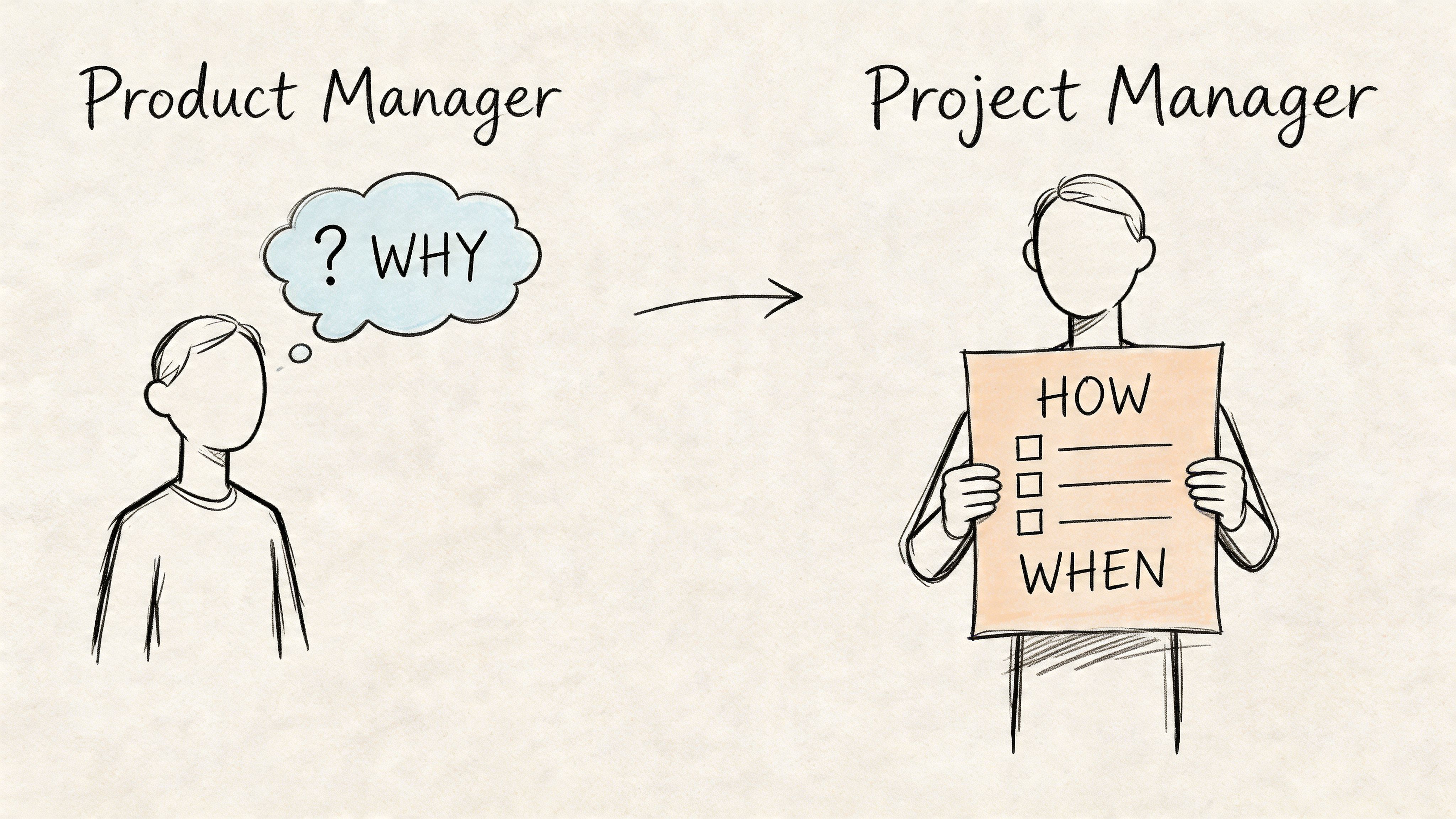
The clearest distinction is still the most useful one. Product managers own the what and why. Project managers own the how and when.
That sounds neat in theory. In day-to-day work, it changes almost everything. It changes which meetings matter, which conflicts each role resolves, what good judgment looks like, and what success feels like at the end of a quarter.
What the product manager is actually doing
A product manager is trying to answer a tougher question than most job descriptions admit: what should this team spend its time on so the product gets more valuable over time?
That means weighing customer pain, market context, business goals, engineering constraints, and product strategy. The job is not just collecting feature requests. It’s saying no to many of them, then making the reason legible to executives, design, engineering, marketing, and support.
The product role emerged from a very different lineage than project work. Product management began in 1931 at Procter & Gamble, then evolved with software in the 1980s, while project management was formalized in the 1950s, including milestones such as the U.S. Navy’s Polaris program in 1955, as outlined by Product School’s history of product manager vs project manager. That history matters because it explains the mindset split. Product management grew around product evolution. Project management grew around controlled delivery.
What the project manager is actually doing
A project manager turns agreed work into a plan people can execute. That sounds procedural, but strong project managers are never just schedulers. They surface risk early, sequence work realistically, clarify ownership, and keep delivery from collapsing under hidden dependencies.
When a launch gets tense, the project manager becomes the person asking the operational questions everyone else avoids. What’s blocked? What moved? What’s at risk if design changes this week? What needs escalation today instead of Friday?
The product manager protects the team from building the wrong thing. The project manager protects the team from building the right thing badly.
Why teams confuse them
Both roles sit in cross-functional environments. Both talk to engineering, design, and stakeholders. Both work with ambiguity. That overlap creates the illusion that they’re interchangeable.
They aren’t. One role optimizes for enduring product value. The other optimizes for reliable execution under constraints.
A Detailed Comparison of Responsibilities and Skills
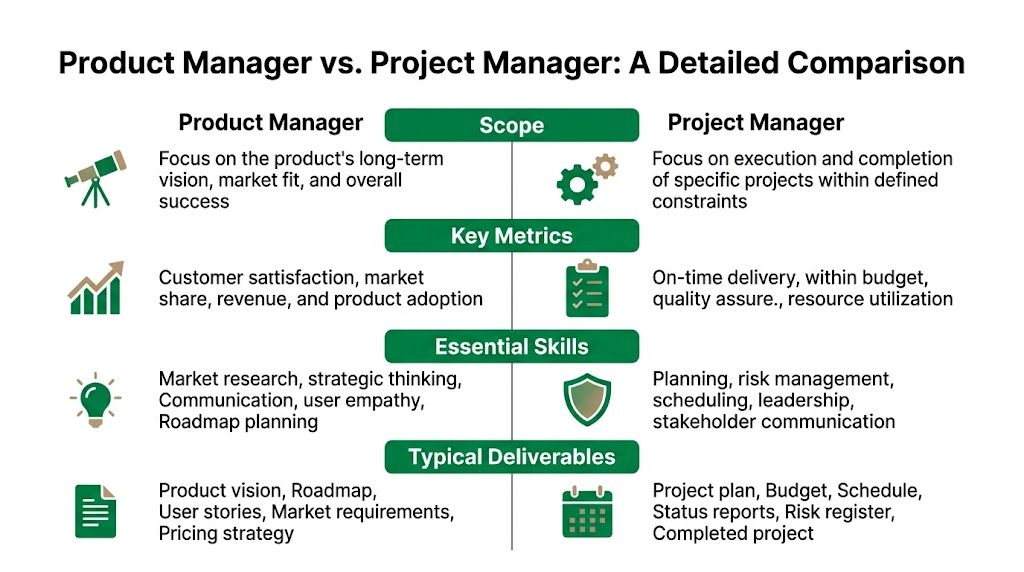
The fastest way to understand product manager vs project manager is to compare how each role handles scope, metrics, skills, and deliverables. The difference isn’t cosmetic. It affects daily behavior.
Scope and time horizon
A product manager works across the product lifecycle. Their scope is broad and persistent. They don’t stop at launch because launch is only one moment in the life of a product.
A project manager usually works within a bounded initiative. The scope has a start, an end, and explicit constraints. Their success depends on how well they move the team through that defined window.
That’s why a product manager often sounds unfinished. They’re always balancing current delivery against future opportunity. A project manager often sounds concrete. They need clarity now, because ambiguity turns into schedule risk quickly.
Metrics that define success
The cleanest metric split is this: product managers are judged by value creation, and project managers are judged by execution quality.
According to Project Management Academy’s comparison of product managers and project managers, product managers focus on long-term metrics such as MAU, retention, and CLV, while project managers are measured on execution KPIs such as on-time delivery rate, cost variance, and scope creep. The same source notes benchmark thresholds like on-time delivery above 90% and scope creep below 10% for project work.
Here’s how that plays out in practice:
Dimension | Product Manager | Project Manager |
|---|---|---|
Core success question | Did we create value people want? | Did we deliver the work predictably? |
Main metrics | MAU, DAU, retention, conversion, CLV, adoption, NPS | On-time delivery, cost variance, schedule performance, resource use, scope control, defect management |
Failure pattern | Strong output, weak market impact | Strong intent, weak delivery discipline |
Skills that transfer poorly
People often assume strong communication makes the roles interchangeable. It doesn’t.
A strong product manager usually has:
User judgment: They can tell the difference between a loud request and a meaningful problem.
Prioritization discipline: They choose what not to build.
Strategic communication: They align teams without formal authority.
Comfort with ambiguity: They can make directional calls before every variable is known.
A strong project manager usually has:
Planning precision: They can break work into a path that’s realistic.
Risk management: They spot delivery issues before they become escalation threads.
Resource coordination: They know when one team’s delay will hurt another team’s timeline.
Operational follow-through: They close loops relentlessly.
If you’re building your stack, this roundup of best tools for product managers is useful because it shows how roadmap, analytics, documentation, and collaboration tools support product work differently from project coordination tools.
Typical deliverables
The product manager’s signature artifact is a prioritized roadmap backed by reasoning. The project manager’s signature artifact is a delivery plan that the team can operate from.
Working test: Ask what document would hurt more if it disappeared tomorrow. If it’s the roadmap, strategy is thin. If it’s the plan, execution is thin.
Where They Sit in the Organization
In most tech companies, these roles sit in different power structures even when they share meetings.
A product manager usually reports into product leadership. That might be a Head of Product, VP Product, or Chief Product Officer. They tend to sit inside a product trio or squad with engineering and design, where influence matters more than formal authority.
A project manager often reports into a delivery function, PMO, operations group, or engineering-adjacent leadership team. Their authority is usually clearer around timelines, milestones, process hygiene, and status communication.
The product manager’s position
Product managers tend to operate laterally. They rarely “own” engineers or designers in a reporting sense. They still need those teams aligned.
That means the role depends heavily on credibility. If the product manager can’t explain trade-offs well, the roadmap becomes a negotiation arena instead of a decision system. In healthy teams, the PM aligns design, engineering, support, and go-to-market around a coherent product direction.
Teams working closely across product and design often benefit from a clearer shared vocabulary. A simple starting point is getting aligned on the difference between UX vs UI, because confusion at that layer often spills into ownership confusion higher up.
The project manager’s position
Project managers usually work through explicit coordination authority. They schedule, track, escalate, and document. Their influence comes from visibility and follow-through.
They also tend to be closest to execution truth. If a dependency is unrealistic, the project manager usually sees it before leadership does. If a launch plan is drifting, they’re often the first person with evidence.
Why org placement changes behavior
A product manager who sits too far from customers becomes a backlog manager. A project manager who sits too far from delivery becomes a status reporter. Org design pushes roles toward their best version or their weakest one.
Here’s a practical pattern that works:
Place product managers close to customer insight and business goals
Place project managers close to delivery mechanics and cross-team dependencies
Make handoffs explicit so roadmap decisions and execution plans don’t blur into each other
That setup reduces the common failure mode where nobody owns the gap between strategy and shipping.
How Modern Tools Reshape Collaboration
The old version of this debate assumed roles stayed fixed while tools stayed basic. That’s no longer true. Modern AI systems change how each role works, not by erasing the distinction, but by sharpening it.
The biggest shift is in validation speed. Product teams used to wait on research recruiting, scheduling, session moderation, note synthesis, and cross-functional review before making a confident call. That delay made product decisions slower and made project planning shakier.
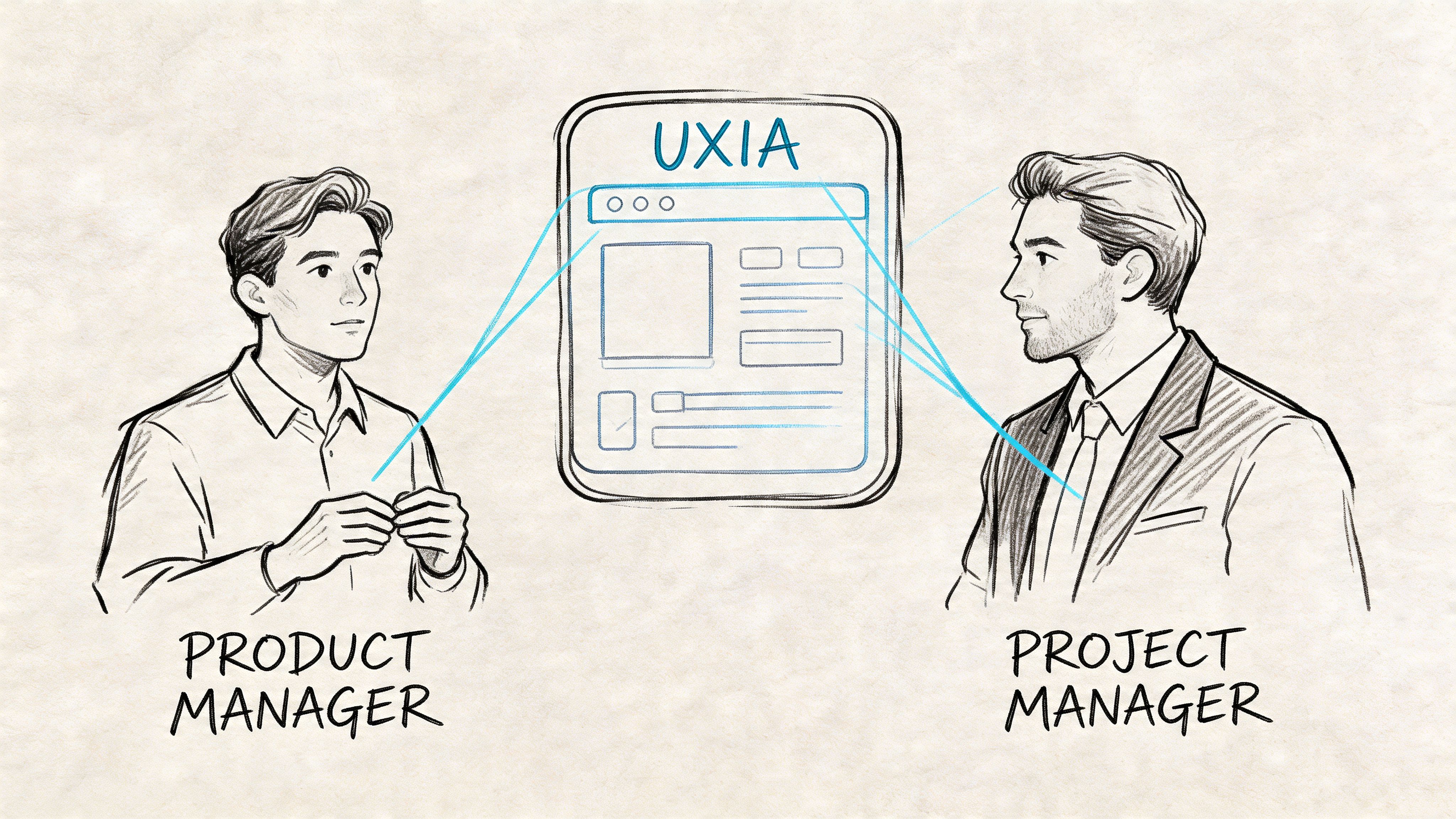
What changes for product managers
Product managers benefit first because they’re closest to prioritization and evidence gathering. Traditional UX research is often a bottleneck for fast-moving teams, and Coursera’s overview of product manager vs project manager notes that AI-driven testing platforms like Uxia help product managers get feedback in minutes, not weeks, with teams using such platforms shown to launch up to 40% faster.
That matters because product judgment improves when the feedback loop gets tighter. Instead of arguing abstractly about a prototype in Slack or a review meeting, the PM can bring observed friction into prioritization. The roadmap gets less political and more grounded.
In practice, that changes the PM’s workflow in three ways:
Faster concept validation: Product managers can test an idea before it hardens into a roadmap commitment.
Better prioritization: Usability friction and user confusion become easier to compare against feature demand.
Stronger stakeholder alignment: Evidence shortens debates that would otherwise run on opinion.
What changes for project managers
Project managers gain something different. They get cleaner inputs for planning.
If design validation is slow, project timelines absorb uncertainty. Scope shifts later. QA finds problems after build. Delivery risk compounds because the team learns too late. When validation happens quickly, the project manager can build plans around sharper assumptions.
That doesn’t make project managers strategic product owners. It makes them better operational leaders. They can spot whether a timeline is realistic, where rework risk sits, and which dependencies need protection.
The collaboration pattern that works
The strongest setup is simple:
Workflow step | Product Manager contribution | Project Manager contribution |
|---|---|---|
Early concept | Defines problem and success criteria | Flags delivery assumptions and sequencing risks |
Prototype validation | Interprets user feedback and decides priority | Adjusts timelines and milestones based on findings |
Build phase | Clarifies trade-offs and protects intent | Manages dependencies, blockers, and scope |
Pre-launch | Confirms readiness from a product perspective | Confirms readiness from an execution perspective |
Teams building modern design and research workflows usually pair validation platforms with broader stacks for handoff, planning, and design ops. This overview of UX UI designer tools is a good reference point for how those systems fit together.
Fast validation doesn’t remove the need for project management. It removes avoidable uncertainty before project pressure gets expensive.
Career Paths and Transitioning Between Roles
These careers can look similar from a distance. Up close, they reward different instincts.
A product manager usually grows toward broader product ownership. The path often moves through senior product roles into group product leadership, then toward Head of Product or CPO. The further up the ladder, the more the work becomes portfolio judgment, business strategy, and organizational alignment.
A project manager often grows toward larger delivery systems. That can lead to senior project leadership, program management, or PMO leadership. The work expands from task coordination into governance, cross-project dependency management, and operational oversight.
Why moving from project to product is hard
Many project managers want to move into product. Fewer make the jump than expected. According to Atlassian’s guide to product vs project management, 62% of project managers aspire to become product managers, but only 28% succeed, often because they haven’t demonstrated product vision skills.
That gap makes sense. Execution strength doesn’t automatically prove customer judgment. A hiring manager looking for a product manager wants evidence that you can identify a problem worth solving, make trade-offs, and connect user needs to business outcomes.
What to build if you want to transition
If you’re moving from project to product, don’t start by rewriting your resume. Start by creating proof.
Run small product bets: Side projects work if you can show the problem, the audience, your prioritization logic, and what changed after feedback.
Learn to write like a product owner: Good product thinking shows up in problem framing, not only in delivery updates.
Get closer to users: If your current role is heavily operational, volunteer for discovery support, interview synthesis, or prototype review.
Show trade-off decisions: Product hiring managers want to see why you chose one path over another.
A useful way to hear how experienced practitioners think about role shifts is this discussion below.
What to avoid
The weakest transition story sounds like this: “I already worked with engineers, managed stakeholders, and shipped projects, so I can be a product manager.”
That’s not enough. Product leadership requires evidence of judgment under uncertainty.
Career advice: If you want a product role, build artifacts that show product reasoning. A polished delivery history helps, but it won’t substitute for demonstrated product thinking.
Hiring Guide Which Role Does Your Team Need
The hiring decision gets easier when you stop asking which role is more important and start asking where the team is failing.
If customers aren’t responding to what you ship, priorities feel reactive, and no one owns the long-term direction, you need a product manager. If priorities are clear but releases keep slipping, dependencies are unmanaged, and teams don’t trust timelines, you need a project manager.
A simple hiring filter
Use these questions:
Need a product manager? Ask, “How would you decide what to build next, and what evidence would change your mind?”
Need a project manager? Ask, “How would you recover a project that’s slipping while protecting quality and stakeholder trust?”
Need both? Ask where decisions currently break down. Before build, during build, or before launch.
Compensation also signals how the market values the roles. As of 2025, product managers in the U.S. earn a median salary of $147,000, compared with $105,000 for project managers, according to Asana’s salary and role comparison. That gap reflects the strategic, market-facing ownership expected from product roles.
If you’re formalizing your hiring process, this guide to hiring a Product Manager is a useful reference for evaluating product candidates beyond generic stakeholder and communication language.
A final rule I use with leadership teams is simple. Hire for the constraint, not the aspiration. Don’t hire a product manager because you want to be more strategic if the team is drowning in operational chaos. Don’t hire a project manager because execution feels messy if nobody has decided what matters.
If your team needs faster product decisions without waiting on slow research cycles, Uxia helps you validate prototypes and flows with AI-generated testers in minutes. It’s a practical way to give product managers stronger evidence and give project managers cleaner inputs for planning, so both roles can do their best work.