Observation Techniques for UX Research
Master UX observation techniques to uncover real user behavior. Learn core methods, avoid bias, and scale research faster with Uxia's synthetic testing.

Watching more people doesn't automatically make a research readout more truthful. If the protocol is loose, the notes get noisier, the interpretations get more subjective, and the team ends up mistaking repetition for evidence. Observation techniques only become useful when they're structured enough to separate behavior from guesswork, and that's where most product teams still struggle.
The history of observation is a lesson in rigor. Historians trace a major synthesis of observation and probability to around 1810, while an earlier milestone in modern statistical thinking is 1662, when John Graunt and William Petty developed census-based human statistical methods that helped establish demography as a structured observational field (history of statistics). By the 20th century, statistics had grown into a workflow that included collection, summarization, display, and interpretation of observational data, which is exactly why UX research needs more than casual watching.
Rethinking Observation Techniques in UX Research
"They say they want 'to watch users,' but what they really mean is they want a quick answer from a few sessions. That instinct is understandable, and it's also where weak research starts. In a contemporary review of quantitative articles across six major journals, observational studies made up 69.4% of studies from 2012-2016 and 77.1% in the first half of 2024, with similar mean citations for observational and experimental studies, 31.2 versus 33.0 (review of observational studies). Observation still matters, but it only works when the method is disciplined.
Observation is a method, not a vibe
A formal observation technique isn't passive watching. It means defining the behavior you care about, using a repeatable coding scheme, and collecting data in a way that makes sessions comparable. Systematic observational methods are strongest when they focus on observable behavior outside the lab, with naturally instigated tasks, few response constraints, and replicable coding for events (systematic observational methods).
That distinction matters in UX. Casual watching produces memorable anecdotes. Rigorous observation produces patterns you can compare across sessions, segments, and product iterations.
Practical rule: If you can't define the behavior before the session starts, you're probably not observing, you're improvising.
The useful shift is from “What did I notice?” to “What did I predefine, observe, code, and compare?” That's the difference between a story and evidence.
Core Observation Methods for Product Teams
Different observation methods solve different problems, and teams waste time when they treat them as interchangeable. Contextual inquiry works when you need to understand work in its natural setting. Shadowing is better when the workflow is spread across tools and handoffs. Fly-on-the-wall sessions reduce interference, while participant observation adds more immersion. Think-aloud protocols help when you need intent alongside action, but they can also distort the task if the user becomes self-conscious.
For a broad map of research options, Figr's overview of UX research methods is a useful companion resource. The right choice depends on how much context you need, how much intrusion the environment can tolerate, and how much setup your sprint can absorb.
Method | Intrusiveness | Best Used For |
|---|---|---|
Participant observation | Medium to high | Deeply embedded workflows where the researcher needs first-hand context |
Contextual inquiry | High | Work that depends on environment, tools, and real-time questioning |
Shadowing | Medium | Multi-step workflows and cross-team processes |
Fly-on-the-wall | Low | Behavior that breaks under pressure or researcher presence |
Think-aloud | Medium | Tracing intent, hesitation, and decision points |
Choose by friction, not by fashion
If you're studying a checkout flow, a silent fly-on-the-wall session can be enough. If you're studying how support agents triage tickets across systems, shadowing is usually better because the handoffs matter. If the question is why a user keeps using a workaround, contextual inquiry is the method that gives you a shot at the answer.
The trap is overengineering the session. Many teams reach for a heavy method because it sounds more “researchy,” then they burn recruiting time and end up with thin notes anyway. A lighter method used well often beats a rich method used sloppily.
Uxia's behavior research methods page is a useful reference if you're comparing structured approaches alongside synthetic workflows.
Running a Structured Observation Session
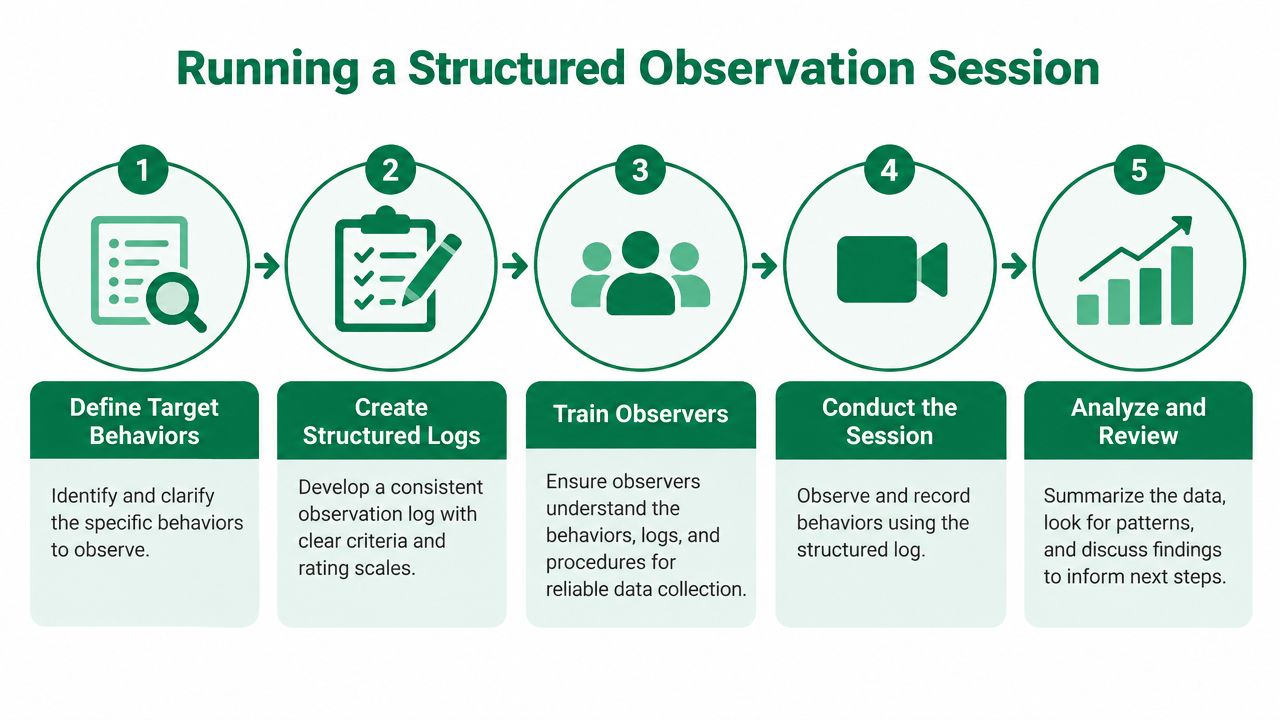
A strong session starts before the user arrives. Define the target behaviors, write the exact workflow you want to watch, and decide what counts as success, failure, hesitation, or workaround. If observers do not know what they are looking for, they end up noticing everything, which means they notice nothing.
Build the session around observable behavior
Use a structured log or checklist that matches the task flow. That structure keeps everyone coding the same event in the same way. It improves comparability and makes review less dependent on memory, improvisation, or the loudest voice in the room.
A practical workflow looks like this.
Define target behaviors. Write the exact actions you expect to see, not broad themes like “confusion” or “engagement.”
Create structured logs. Leave room for timestamps, errors, detours, and direct quotes.
Train observers. Make sure everyone knows the coding rules before the first session.
Run the session. Stay focused on the task flow, not on helping the user through it.
Review immediately. Capture what happened while the context is still fresh.
For teams that need a secure interview transcription tool, AIDictation's interview recording app is one option for keeping a clean record of session audio and follow-up analysis.
Don't let note-taking become the bottleneck
Notes should be detailed while the session is fresh. One practical rhythm is 60–90 minute observation blocks, a 15–30 minute break, and end-of-day review (UXMatters observation guidance). That cadence helps teams turn raw behavior into prioritized findings before fatigue blurs the details.
Write the note the way you would want to read it a week later, concrete, specific, and tied to a visible action.
When the user finishes, ask a few immediate questions about what you just saw. That pairing of passive observation and immediate post-session inquiry turns hesitation, workarounds, and errors into usable intent data. If you wait until later, you get a polished explanation, not the original behavior.
For teams using moderated sessions, Uxia's moderated research guide is a useful companion when you need protocol and synthesis to stay aligned.
Overcoming Observer Bias and Common Mistakes
Human observation breaks down fastest when the observer starts shaping what is being observed. That happens in UX the moment a researcher hints, nods too much, or turns the session into a back-and-forth too early. The participant stops working naturally and starts performing for the room.
The hidden cost of watching too closely
Observers need to stay quiet, out of sight, and disciplined. Guidance from NN/g observer guidelines is clear on this point, visible reactions, conversation, or advice can steer participant behavior and weaken the session. That is method control, not etiquette.
The broader research problem is bias. Observational work can still be distorted by non-random assignment, unmeasured variables, missing data, and misclassification, as noted in a recent methodological review. More observation does not automatically mean more truth.
More observation without stronger structure just gives you more chances to be wrong in a consistent way.
Unstructured sessions fail for predictable reasons. Weak definitions, loose recruiting, and improvised observation make the results hard to trust. Clear protocol, consistent coding, and explicit bias checks matter more than volume.
What to stop doing in live sessions
There are a few habits to cut immediately. Do not narrate the interface back to the participant. Do not accept the first explanation as the full explanation. Do not treat a smooth conversation as proof the method was sound, because rapport can hide poor observation.
A simple internal check helps here. If your note sheet contains more interpretation than observation, the session has drifted. If observers disagree on what happened, tighten the protocol instead of arguing after the fact.
Scaling Research with Synthetic Testing and Uxia
Human observation does not scale cleanly. Recruiting drags, schedules slip, and note quality changes from one session to the next. Even a well-run session can be hard to compare with the next one unless the protocol stays tight. Synthetic testing with Uxia gives product teams a repeatable observation layer when they need continuous validation and cannot afford to keep rebuilding the research process around people.
Synthetic observation keeps the structure and drops the logistics
Uxia is an AI-powered UX/UI testing platform that lets teams upload images or video prototypes, define a mission and audience, and generate realistic AI participants aligned to demographic and behavioral profiles. Those synthetic users run unmoderated tests, explore flows, and think aloud. The platform captures transcripts, flags usability, navigation, copy, trust, and accessibility issues, and turns recurring patterns into visual reports with heatmaps and prioritized insights.
A practical example: a team testing a checkout flow can set the mission to, “Complete purchase as a first-time mobile shopper,” then filter for people who match that audience, such as mobile-first shoppers with limited patience for account creation. That kind of setup keeps the task specific and makes the resulting observations easier to compare across rounds.
The point is not to recreate every detail of a live field visit. The point is to keep the same observation structure in place while the product changes. For a fuller walkthrough of the method, Uxia's synthetic user testing guide explains how mission-based sessions and structured feedback collection work in practice.
Use the platform like a research instrument
The strongest setups still begin with definition. Set audience criteria before launch, define the evaluation goal, and spell out the task flow so transcripts and issue flags can be compared across sessions. That mirrors good human observation, but without the recruiting friction or the risk that one moderator's style shapes the outcome too much.
Uxia works well for mission-based synthetic testing of prototype validation. The synthetic users follow a task, surface friction, and leave a record that is easier to review than scattered human notes. For sprint work, that matters. Teams get a fast answer without pretending the answer is final.
Synthetic testing is strongest when it is treated as structured observation, not as a substitute for judgment.
The practical win is consistency. Human sessions still matter for deep context, but synthetic sessions give product teams a repeatable way to check whether a design change removes friction or shifts it elsewhere.

Real-World Application and Continuous Validation
A product team I'd trust on a hard roadmap does not run one research study, call it done, and hope the next release holds up. It keeps rechecking the same flow as the design changes. That is value of continuous validation, because the first answer is often incomplete.
A contextual inquiry and a synthetic workflow do not solve the same problem
In a traditional contextual inquiry, the researcher enters the user's environment, watches the workflow, asks clarifying questions, and records what happened. That gives you context you cannot get from a lab task alone, especially when interruptions, workarounds, and surrounding tools explain the behavior. The trade-off is obvious, human recruiting is slow, travel adds overhead, and notes still need synthesis before the next iteration.
A continuous synthetic workflow with Uxia works differently. The team launches a mission-based test, reviews transcripts and issue flags, and checks the visual report for recurring friction. The goal is not to copy every detail of a live field visit. The goal is to keep a structured observation loop open while the product is still moving.
That difference matters when teams need fast, async research cycles. A 2025 UX research industry review notes that unmoderated usability testing is growing, AI-assisted analysis is becoming mainstream, and contextual inquiry and eye tracking are used less often in day-to-day work. The pattern makes sense, but lighter workflows can widen blind spots around context, accessibility, and long-horizon behavior unless teams add the right follow-up.
Continuous validation works best when the second run checks the change, not the theory
The useful pattern is a before-and-after run on the same task. One team starts with a checkout flow where synthetic users stall at the shipping step, and the issue flags cluster around form labels and a confusing default state. The team simplifies the labels, changes the default, and runs the same mission again. The second pass should show fewer hesitation points, fewer repeat issue flags, and a cleaner transcript around the shipping step.
That kind of check is more useful than a vague approval. If the same friction still appears, the design change missed the problem. If a new issue flag shows up in a later step, the fix shifted the burden elsewhere. The point is to catch that trade-off before the release reaches users.
Synthetic observation still needs judgment. Review where synthetic users hesitate, where they recover, and which issue flags recur across runs. Then decide whether the next move is another design change, a moderated follow-up, or a deeper human study.
Building Your Observation Strategy
A strong observation strategy starts with a decision, not a method. Decide what you need to learn, decide whether the work needs human context or repeatable validation, then choose the lightest protocol that can answer the question cleanly. If the result will affect a roadmap decision, the method has to be structured enough to survive scrutiny.
Treat human observation and synthetic testing as different tools
Use traditional observation when the environment itself is part of the problem. Use synthetic testing when the team needs scale, consistency, and fast iteration. A common mistake is treating one as morally superior to the other, when fit is what matters.
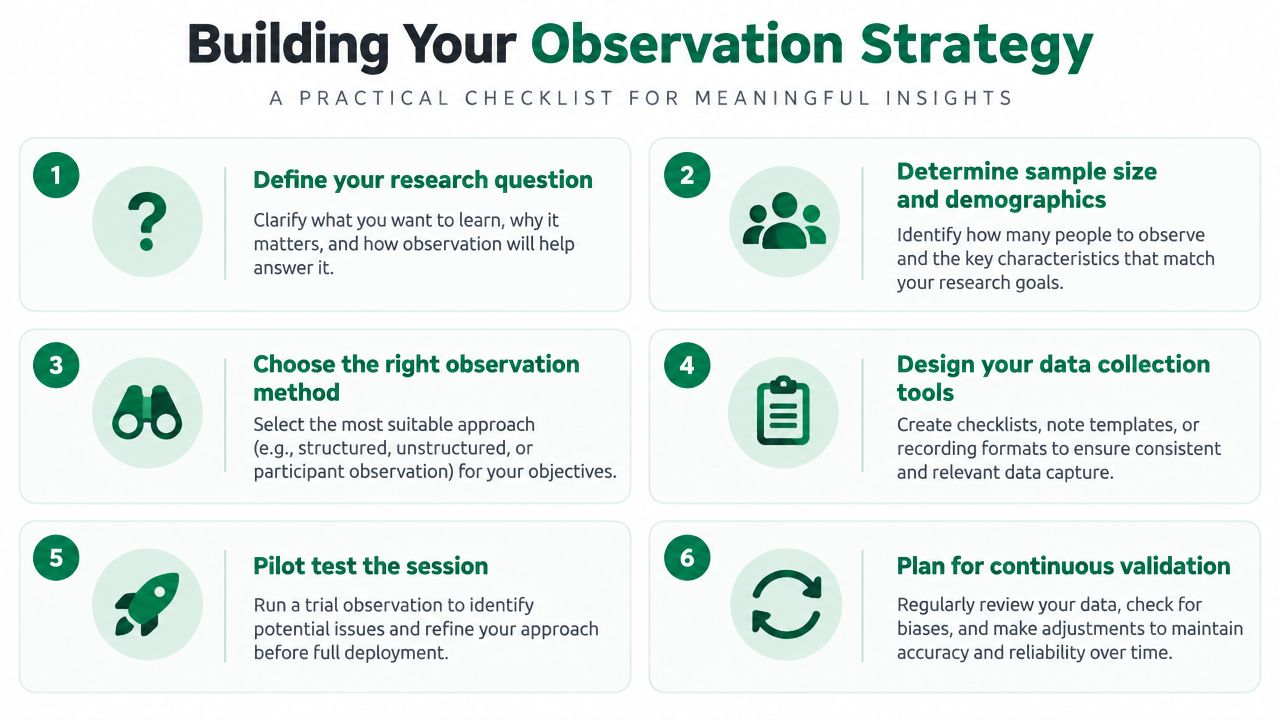
A practical checklist keeps the work honest.
Define your research question before you pick the method.
Determine sample size and demographics based on the behavior you want to see.
Choose the right observation method for the amount of context the task needs.
Design your data collection tools so observers code the same behavior the same way.
Pilot test the session before you trust the full run.
Plan for continuous validation if the product will keep changing.
For teams that want faster synthetic observation, Uxia supports mission-based testing, transcript capture, issue flags, and visual summaries. That lets product teams review behavioral patterns without rebuilding the research ops stack each time.
If you're tired of ad hoc watching and inconsistent notes, start with one flow and compare the output against your current human process.