Masters in UX Design: Is It Right For Your Career?
Considering a masters in ux design? This guide covers curriculum, ROI, admissions, & alternatives. Decide if it's the right career investment.
You might be staring at a familiar fork in the road.
You’ve already shipped work. Maybe you’re a product designer who can handle flows and prototypes but gets left out of roadmap conversations. Maybe you’re a PM who keeps circling back to UX because that’s where much product influence appears to be. Or maybe you’re trying to break into UX from another field and you’re unsure whether a master’s is a smart investment or an expensive delay.
That’s the fundamental question behind masters in ux design. It isn’t whether the degree sounds impressive. It’s whether it changes the kind of work you can do, the rooms you get invited into, and your ability to stay valuable as AI changes how research and testing happen.
A strong UX master’s doesn’t just teach interface craft. It formalizes how you define problems, validate decisions, and communicate trade-offs across product, engineering, and leadership. That matters more now because execution is getting faster. The people who keep gaining influence are the ones who can direct that speed, not just contribute to it.
Is a Master's in UX Design Your Next Step
A master’s in UX design makes the most sense when your current ceiling isn’t visual skill. It’s strategy, credibility, or access.
If you already work in design, you may have noticed that seniority often depends on more than shipping polished screens. Teams promote people who can run research well, defend decisions with evidence, align stakeholders, and connect design to business outcomes. That’s where graduate study can help. It gives structure to skills that many designers pick up unevenly on the job.
If you’re changing careers, the appeal is different. You’re not trying to sharpen one capability. You’re trying to build a coherent foundation fast enough to become employable and credible. A good program gives you that foundation across research, design, and communication rather than leaving you with a portfolio made only of surface-level artifacts.
Who benefits most
Three profiles tend to get the clearest return:
Working designers aiming for leadership who need stronger research, systems thinking, and stakeholder influence.
Career changers who want a formal path into UX rather than assembling isolated courses and hoping employers connect the dots.
Professionals adjacent to UX such as PMs, content strategists, or front-end developers who want to move closer to product discovery and experience strategy.
That doesn’t mean everyone needs the degree.
A master’s is usually a strong fit when your goal is to own decisions, not just execute them.
When it may not be the right move
It may not be the best choice if you need a job quickly, if your main interest is visual UI execution, or if the financial trade-off would create too much pressure. A degree works best when you can use the time to build judgment, not just credentials.
Use these questions as a first filter:
Do you need structured breadth? Graduate programs are often built for broad capability across UX disciplines.
Do you want strategic roles? If yes, formal training can accelerate that path.
Are you trying to future-proof your work? If automation handles more tactical UX tasks, strategic operators become more valuable.
Would mentorship and academic rigor help you more than speed? If yes, a master’s may outperform a shorter path for your goals.
The Core Curriculum and Skills You Will Gain
The most useful way to evaluate masters in ux design is not by course titles. It’s by whether the curriculum develops three capabilities together: research, design, and communication.
That structure isn’t accidental. Arizona State University’s online UX master’s is explicitly built as a collaboration between human systems engineering, graphic information technology, and technical writing and communication, which reflects the reality that effective UX leadership depends on all three competencies working together, as described on ASU Online’s UX master’s overview.
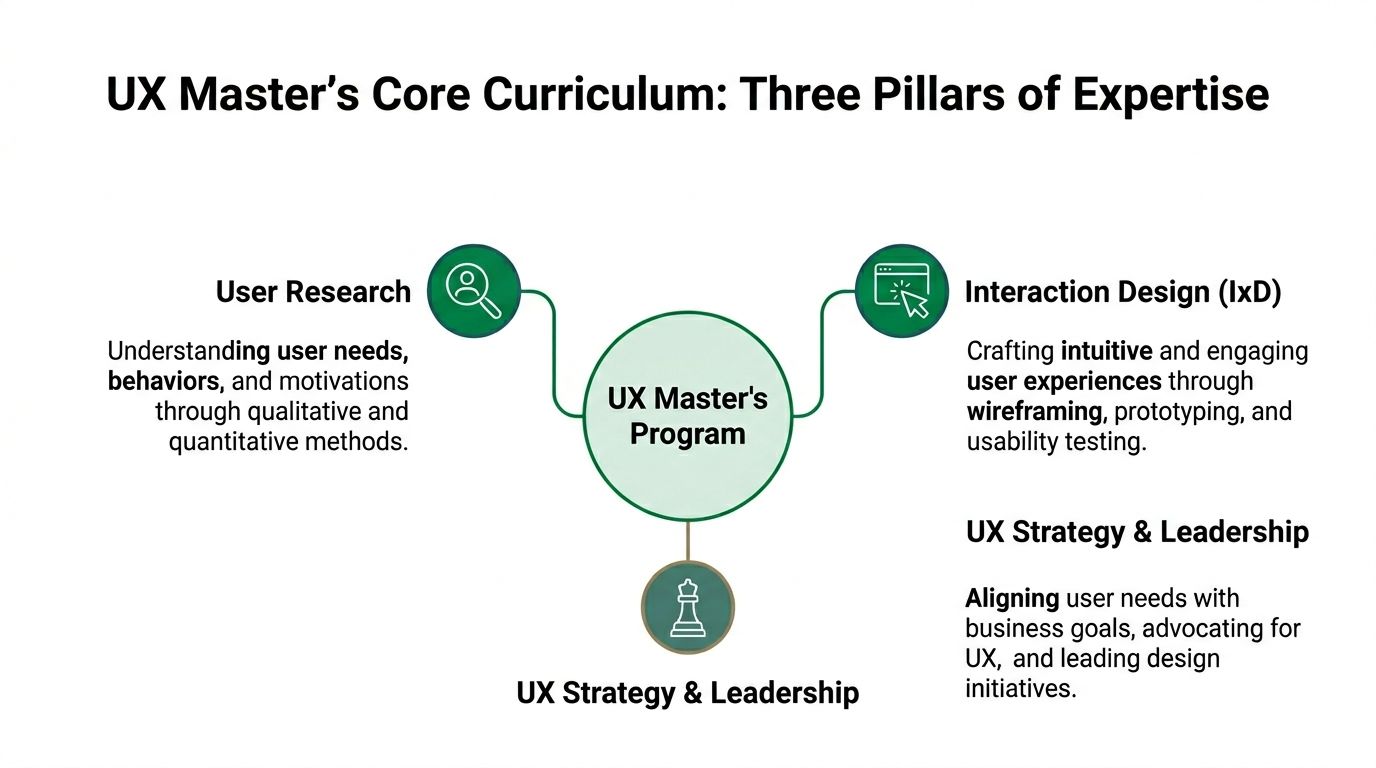
User research gives you decision authority
Plenty of junior designers can say what they prefer. Fewer can show why a product direction is wrong, risky, or unsupported by evidence.
Graduate programs usually train you in qualitative and quantitative research methods so your recommendations aren’t just taste dressed up as rationale. That includes interview design, usability testing, synthesis, and the statistical thinking needed to evaluate UX metrics. Nielsen Norman Group’s UX statistics training highlights methods such as confidence intervals, statistical significance, and analysis of metrics like success rates, task-completion times, SUS scores, and NPS, which are central to making defensible product decisions in advanced UX work, as outlined in NN/g’s Statistics for UX course.
This is the difference between saying “users seemed confused” and saying “the evidence supports changing the flow.”
Interaction design turns insight into behavior
Research alone doesn’t create better products. You still need to turn findings into interfaces people can use without friction.
This part of the curriculum usually covers information architecture, wireframing, prototyping, usability evaluation, and iteration. The strongest programs don’t treat design as decoration. They teach it as a translation layer between user needs and system behavior.
If you want a practical companion to this mindset, LearnStream’s guide to good UX practices is a useful reminder that strong experiences come from consistent choices around clarity, hierarchy, feedback, and accessibility, not isolated clever screens.
Strategy and communication create influence
This is the pillar many applicants underestimate.
Senior UX work depends on your ability to explain trade-offs, align teams, and turn user evidence into action. You’re often persuading stakeholders who care about delivery timelines, product risk, support burden, or commercial goals. If you can’t communicate across those concerns, your research and design skill won’t travel very far inside an organization.
That’s also why the old UX versus UI distinction can become limiting over time. If you need a clean refresher on that boundary before evaluating programs, this explanation of UX vs UI is worth reviewing.
Practical rule: Don’t choose a program because it offers the most software training. Choose one that teaches you how to frame problems, test assumptions, and persuade cross-functional teams.
A hidden advantage of this curriculum shows up later when teams adopt AI-assisted workflows. Tools can generate more feedback, faster. But someone still has to define the right questions, interpret patterns, and decide what deserves action. That’s exactly the kind of judgment a strong UX master’s develops.
Career Outcomes and Return on Investment
ROI in masters in ux design gets framed too narrowly. People ask whether salary after graduation beats tuition. That matters, but it’s not the full calculation.
The better question is whether the degree moves you from production labor to strategic influence.
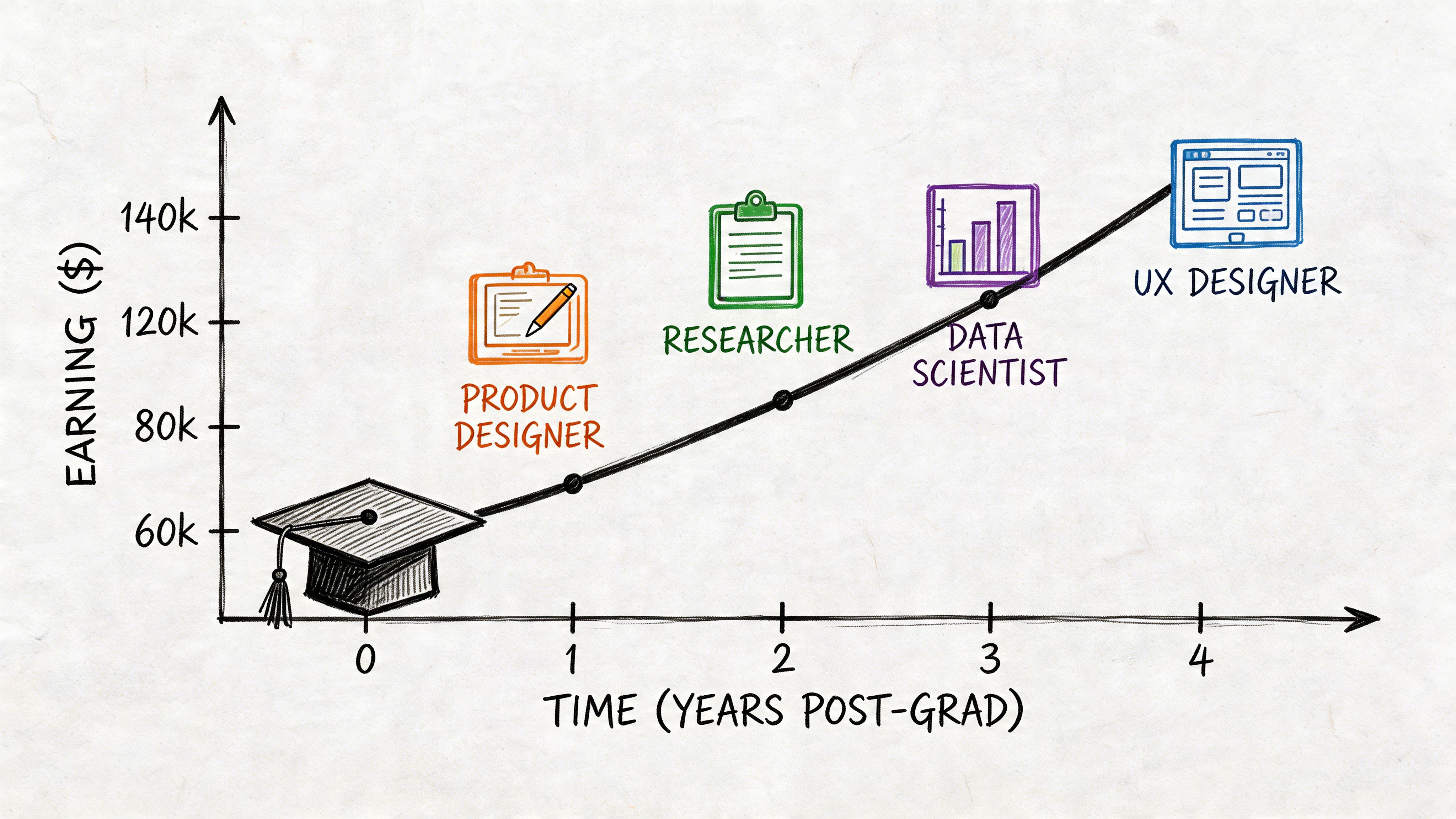
The labor market signal is real. The U.S. Bureau of Labor Statistics projects 8% growth in web designer jobs from 2023 to 2033, a category that includes UX roles, compared with 3% for all occupations, with about 16,500 job openings annually when retirements and workforce exits are included, according to the University of Florida’s summary of growing demand for UX designers.
That demand matters because it changes what advanced training can make possible. The same source notes that UX Managers earn a median of $103,384 per year and Product Designers average $115,589 annually. Those figures matter less as promises than as signals. Employers pay more when they expect someone to coordinate teams, connect design to product goals, and make higher-stakes decisions.
Salary is only one layer of return
A salary increase is visible. The more important returns are often structural:
Scope expansion so you influence discovery, prioritization, and roadmap choices.
Role resilience because strategic work is harder to automate than executional tasks.
Internal mobility into leadership, research-heavy, or product-shaping roles.
Higher credibility with executives and cross-functional partners.
The degree can outperform a faster path. If your long-term goal is to lead design practice, direct research, or shape product strategy, broad graduate training can compound over time in ways an entry-level job placement cannot.
The AI question changes the ROI logic
A few years ago, the argument for a master’s was often craftsmanship plus credentials. Today, AI changes the equation.
If more usability feedback, pattern detection, and testing support can happen through automated systems, then tactical UX work becomes more scalable. That doesn’t eliminate UX jobs. It shifts value toward people who can govern the system, interpret evidence, and decide what should happen next.
That’s why I’d treat a master’s less as “more school” and more as training for command responsibility.
For context on how the role itself is broadening, this breakdown of the modern UX/UI designer role in 2026 is useful because it shows how research, design, and product judgment increasingly overlap.
A short explainer can help if you’re weighing the economics against your current path:
The strongest ROI comes when the degree moves you into work that defines what gets built, not just how screens look.
How to Choose the Right UX Master's Program
Not all masters in ux design solve the same problem. Some are built for practitioners who need flexibility. Others are better for career changers who benefit from immersion, faculty contact, and in-person critique.
Program length also matters because it changes both your opportunity cost and your learning pace. Industry guidance summarized by Prototypr notes that most UX master’s programs run for 1 to 2 years and intentionally prioritize breadth over depth, preparing graduates with a versatile toolkit but leaving deeper specialization to industry experience, as discussed in how to choose a UX master’s program.
Use a scorecard, not a prestige shortcut
A recognizable school name can help, but it won’t rescue a weak fit. Build a scorecard around the work you want to do after graduation.
Factor | Online Program | On-Campus Program |
|---|---|---|
Flexibility | Better for working professionals who need to keep earning while studying | Better for students who can commit fully to immersion |
Peer network | Often broader geographically, but relationships may require more effort to build | Usually stronger day-to-day cohort interaction |
Faculty access | Can be strong, but depends on program structure and responsiveness | Often easier to develop informal mentorship |
Career transition support | Best when the program has clear portfolio and advising systems | Often stronger if you need hands-on transition support |
Learning style fit | Works well for self-directed learners | Works well if critique, studio energy, and physical presence help you learn |
Opportunity cost | Usually easier to combine with current employment | May accelerate identity shift if you want a full reset |
What to inspect in the curriculum
Don’t just read module names. Ask what kind of practitioner the program is trying to produce.
Look for these signals:
Research depth: Are students learning formal methods, not just running a few interviews?
Systems thinking: Does the program connect UX decisions to product, operations, and business trade-offs?
Communication training: Will you practice presenting findings, defending recommendations, and aligning stakeholders?
Portfolio quality: Are case studies process-heavy and evidence-based, or mostly polished UI?
Industry contact: Do faculty and alumni reflect the roles you want?
Questions worth asking admissions teams
These questions usually reveal more than marketing copy:
What types of roles do graduates typically pursue?
How much of the program is research-focused versus interface-focused?
How are students taught to work with product managers and engineers?
What kind of thesis, capstone, or client work is required?
How does the program prepare students for emerging AI-assisted workflows in UX research and validation?
Pick the program that closes your biggest professional gap. If you already design well, prioritize research and strategy. If you’re coming from another field, prioritize breadth and portfolio development.
Your Admissions Checklist and Portfolio Tips
Admissions committees aren’t only evaluating whether you can make attractive screens. They’re trying to predict whether you can thrive in a rigorous environment built around inquiry, critique, and evidence.
That changes how you should prepare.
What your application needs to show
Most programs will ask for transcripts, recommendations, a statement of purpose, and a portfolio. The strongest applications tell a coherent story across all four.
Use this checklist before you submit:
Statement of purpose: Explain the gap you’re trying to close. Be specific about whether you want to deepen research capability, pivot into UX, or move toward leadership.
Recommendations: Choose people who can speak to your thinking, collaboration, and initiative, not just your job title.
Academic record: If your prior degree isn’t design-related, frame that as context, not a weakness. Many strong applicants come from adjacent fields.
Portfolio: Treat this as the center of gravity. It carries the most evidence.
Build a portfolio around reasoning
Top programs value quantitative literacy because advanced UX work increasingly depends on proving that findings are meaningful. NN/g’s UX statistics material emphasizes that designers need to analyze metrics like success rates and SUS scores and demonstrate whether results are statistically significant. That’s why showing analytical thinking in your portfolio is so important.
Your case studies should include:
Problem framing: What was the business or user problem?
Research input: What did you learn from interviews, testing, surveys, or behavioral data?
Decision logic: How did evidence change the design direction?
Iteration: What did you revise after feedback?
Reflection: What would you do differently now?
One strong project with clear reasoning is better than several glossy but shallow ones.
If you want a practical walkthrough for structuring these case studies, How to Build UX Portfolio is a solid reference because it pushes you to document process rather than just outcomes.
What to include if you lack formal UX experience
You don’t need a perfect client roster. You do need evidence that you think like a UX practitioner.
Good substitutes include redesigns, volunteer work, internal company projects, or self-initiated studies where you defined a problem, gathered input, and improved a flow based on findings.
Application advice: Show one project where data changed your recommendation. That tells an admissions team you’re ready for graduate-level UX thinking.
Evaluating Alternatives to a Master's Degree
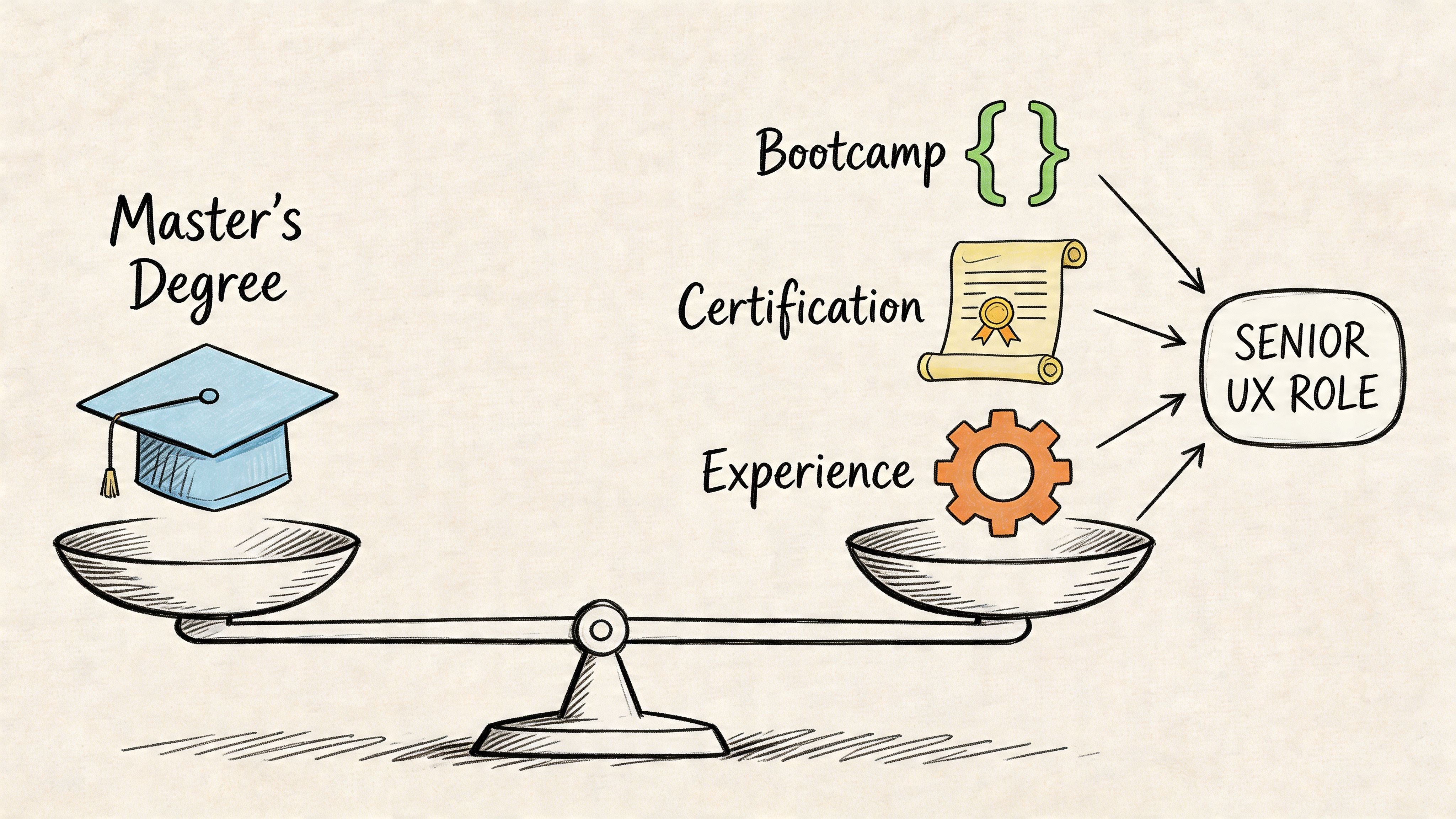
A master’s isn’t the only credible path into UX. It’s one option among several, and the right choice depends on the problem you’re solving.
If your problem is “I need to become employable fast,” a different route may win. If your problem is “I need to become trusted with higher-stakes product decisions,” graduate study may have a stronger case.
What each path is actually good for
Here’s the practical distinction.
Bootcamps are often best for speed, accountability, and basic job-readiness.
Certificates work well when you already have adjacent experience and need targeted credibility or structure.
On-the-job learning can be excellent if you’re in a company where senior practitioners will mentor you and let you grow beyond production tasks.
A master’s is strongest when you want a formal, interdisciplinary foundation that supports leadership and strategic influence.
Designlab’s discussion of UX master’s programs raises an important tension. A key question is whether a master’s offers better ROI than a bootcamp, especially as AI changes UX workflows. The piece notes that bootcamp graduates can be hired faster in startup environments, while the deeper value of a master’s may be in preparing people to manage human-AI collaboration, as explored in Designlab’s review of top UX master’s programs.
Why AI makes this comparison sharper
AI lowers the cost of getting feedback. It can accelerate parts of testing, synthesis, and pattern detection. That means some of the executional advantage once held by highly trained specialists becomes easier to access.
So the question isn’t “Will AI replace UX?” It’s “Which kind of UX work becomes more valuable when AI handles more of the mechanics?”
The answer is usually the work around framing, judgment, prioritization, ethics, and communication. In other words, the layer above tool operation.
That’s also why practical research skill still matters. If you want to strengthen your qualitative foundation while weighing your options, this guide on how to conduct user interviews is a useful reminder that asking better questions remains a human advantage.
A better decision rule
Don’t compare paths by status. Compare them by the capability they build.
Choose a master’s if you need:
Structured interdisciplinary training
Research rigor
Leadership preparation
A durable foundation for AI-augmented UX work
Choose an alternative if you need:
Faster entry into the field
Lower near-term opportunity cost
A narrower, more execution-focused skill build
The master’s premium isn’t just education. It’s the chance to become the person who sets the research agenda and interprets the output when everyone else has access to fast tools.
Making Your Final Decision
The best decision usually becomes clear when you stop asking whether a master’s is “worth it” in the abstract and start asking what kind of career you want to build.
If you want to move into strategic UX work, lead teams, strengthen your research authority, or make a serious career pivot with a structured foundation, masters in ux design can be a strong investment. The value isn’t only in salary. It’s in access, influence, and staying useful as execution gets cheaper and faster.
If you need immediate employment, prefer hands-on production work, or can’t justify the time and financial trade-off, a bootcamp, certificate, or disciplined self-directed path may be smarter right now.
Use a simple final filter:
Choose the master’s if you want breadth, rigor, and long-term advantage.
Choose an alternative if you want speed, lower risk, and a direct route into executional roles.
Before you decide, shortlist a few programs, speak with alumni, review student portfolios, and compare curricula against your real career gaps. Then keep building while you evaluate. Read, test, write case studies, and sharpen your research thinking. Momentum matters, no matter which path you choose.
If you’re trying to future-proof your UX career, don’t just study research methods. Practice modern validation workflows too. Uxia helps teams test prototypes and flows with AI-generated participants, surface usability issues quickly, and turn feedback into actionable decisions. It’s a useful way to build the judgment that matters most now: knowing how to direct fast insight, not get buried by it.