8 Buyer Personas Examples for Product Teams in 2026
Explore 8 detailed buyer personas examples for UX and product teams. Includes templates, validation tips, and how to use them to build better products faster.
Most buyer personas fail for a simple reason. Teams build them as polished documents for kickoff meetings, then never use them again. They sit in Notion, Miro, or a slide deck while essential product work moves on without them. The problem isn't the idea of personas. It's that most of them are too abstract, too static, and too disconnected from design decisions.
A useful persona doesn't just describe who buys. It helps a team predict what that person will notice, ignore, mistrust, struggle with, and need to complete a task. That's especially important for product teams. As monday.com puts it, "your target audience defines the market you're speaking to, while your buyer persona defines the individual you're persuading" in its guide to target audience vs buyer persona. For product work, I'd take that one step further. You also need personas that help you understand how users behave inside the interface, not just how buyers think during evaluation.
That gap marks where most advice breaks down. Marketing teams get messaging personas. Product teams need operational personas. They need profiles they can test against flows, prototypes, onboarding paths, accessibility issues, and task friction. That's why these buyer personas examples are built for day-to-day product work, not poster walls. Each one can be turned into a testable audience inside Uxia, where synthetic testers can surface friction in minutes instead of waiting on recruiting and scheduling.
If you want the full foundation first, start with this guide on how to create buyer personas that drive real growth.
1. The Agile Product Manager
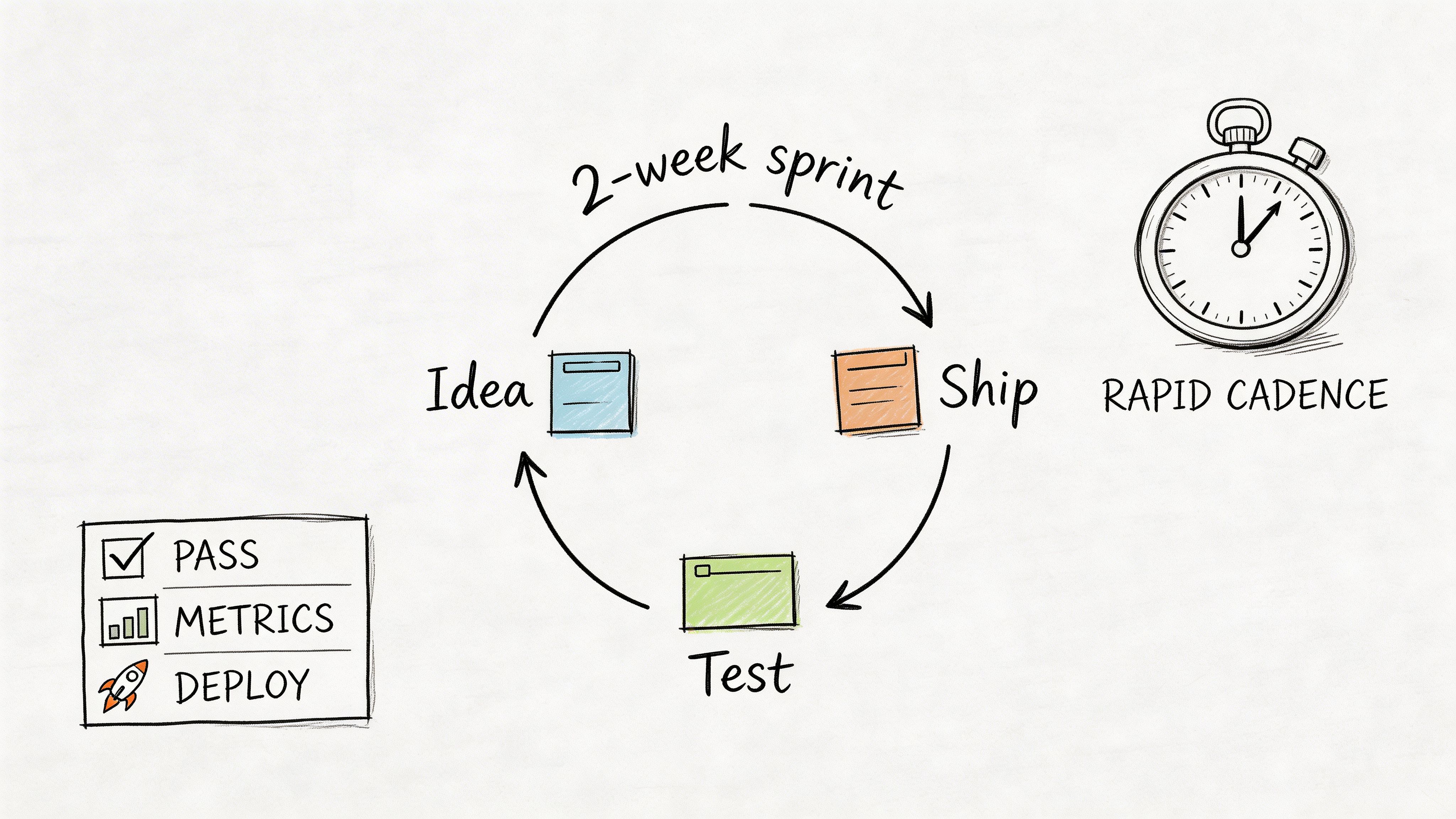
Agile product managers do not need richer persona documents. They need personas that help them decide what ships this sprint.
This role shows up in startups and scaleups with short release cycles, active backlog churn, and constant pressure to validate before engineering commits. A product manager at Slack reviewing a notification redesign fits. So does a team at Figma checking whether a collaboration update creates confusion before sprint close. The common trait is urgency. If feedback arrives after planning, it has little value.
What this persona buys
They buy faster decisions with less debate.
That changes what a useful persona looks like. Demographics matter less than delivery context. A polished backstory will not help a PM choose between fixing onboarding friction, cleaning up permissions, or shipping a new notification model.
Three inputs usually matter most:
Fast feedback loops: Research has to fit inside sprint planning, design review, or backlog refinement.
Clear severity signals: Problems need ranking by likely user impact and release risk.
Operational output: Findings should move cleanly into Jira, Linear, product specs, or acceptance criteria.
High-performing companies often map over 90% of their customer database by persona. For product teams, the lesson is not to produce more persona slides. The lesson is to make personas usable in delivery, where they influence prioritisation, scope, and QA.
How to model this persona in Uxia
Build this persona around pace, trade-offs, and decision pressure.
Include attributes like short iteration windows, low tolerance for ambiguous findings, and a preference for concise summaries over long research synthesis. Then give the persona tasks tied to real sprint decisions: complete onboarding without guidance, find the new notification controls, change a workspace setting, recover from an error state.
That is where synthetic testers become practical, not theoretical. Uxia removes recruiting delays and gives product managers quick evidence while the sprint window is still open.
I use one rule here. If a persona cannot change the order of the backlog, it is still descriptive, not operational.
Teams already working on data-driven design systems and product decisions get the most value from this persona because it turns abstract audience segments into testable release inputs. That is the difference between a persona workshop and a shipping tool.
2. The Design-Led Startup Founder
Founders who care about design are often the hardest persona to model well. They already trust their taste. The problem starts when taste becomes the default decision system for every user question.
A design-led founder usually helped shape the first product by staying close to customers, reviewing every screen, and making fast calls on what felt right. That speed is useful early. It also creates a predictable failure mode. As the team grows, design reviews drift into opinion contests, and nobody can clearly separate brand instinct from user evidence.
You can see this pattern in companies like Cal.com, Linear, or Webflow. The founder is not asking for another persona slide. They want to know whether a booking flow feels credible, whether a dense interface still feels precise, or whether a self-serve setup flow creates confidence for new users.
Where this persona gets stuck
This persona usually does not reject research outright. They reject slow research, vague research, and research that cannot be tied back to product choices on the screen.
What gets traction is concrete evidence:
Interface-level feedback: Friction points, hesitation moments, first-click behaviour, and comments tied to specific UI states.
Version comparison: Clear readouts on concept A versus concept B, especially for onboarding, pricing, and activation flows.
Language that respects craft: Position testing as design validation and decision support, not as a detached research function.
Generic persona fields are mostly noise here. "Cares about innovation" will not change a founder's mind. "Loses confidence when pricing language feels evasive" often will.
How to make this persona actionable
In Uxia, I would model this founder around scrutiny, speed, and a high sensitivity to product polish. Useful attributes include low patience for abstract summaries, strong reactions to trust signals, and close attention to whether the product feels intentional at first use.
Then test the places where founder instinct is strongest and user drop-off is expensive. Homepage messaging. Pricing structure. Onboarding steps. Empty states. Permission requests. Upgrade prompts.
Synthetic testers are useful here because they compress the feedback loop. A founder can review reactions to a new flow while the design is still changing, instead of waiting for a full research cycle. The practical trade-off is knowing when synthetic users are useful and when human users are still the better choice.
The best founder-facing persona exposes blind spots.
Keep the output tight. One hypothesis, one flow, one decision. If the persona does not help the founder approve, reject, or revise a design choice, it is still documentation, not a working product tool.
3. The Enterprise UX Research Lead
This persona doesn't need to be convinced that research matters. They need to know whether your method is defensible.
Inside large organisations, the UX research lead manages standards, consistency, stakeholder expectations, and governance. They may oversee multiple researchers across product lines, with requests coming from design, product, compliance, and leadership at the same time. Microsoft, IBM, and Salesforce are the kind of environments where this persona appears.
What earns trust with this audience
Enterprise research leads tend to reject tools that position themselves as replacements for every method. That's the wrong pitch.
The better position for Uxia is complementary coverage. Synthetic testers can help with high-frequency validation, repetitive flow checks, and faster iteration between larger human studies. That works because it respects the research function instead of trying to erase it.
Pega's persona work is a useful example. After implementing detailed buyer personas, the company saw a 20% increase in interactions with target accounts and a 10% rise in marketing-generated leads entering the pipeline. The same case also reported lead-to-opportunity conversion improving from 32% to over 40%. For an enterprise research lead, the lesson isn't about marketing alone. It shows what happens when teams align around well-defined personas instead of fragmented assumptions.
What to include in the persona definition
This persona should include:
Method sensitivity: They care how findings were produced.
Reproducibility needs: They want to rerun tests consistently.
Stakeholder translation pressure: They must turn research into language executives can use.
Governance awareness: Privacy, documentation, and process matter.
Linking Uxia to an established continuous discovery practice is often the strongest move. It helps the research lead expand test coverage without forcing every question into a full recruitment cycle.
A useful framing is to compare synthetic users vs human users based on job-to-be-done, not ideology. Human studies still matter for depth, nuance, and live probing. Synthetic testing matters when teams need speed, repeatability, and broader routine validation.
Research note: Enterprise personas should document acceptance criteria for evidence, not just user goals.
That's what makes them usable in real organisations.
4. The Freelance UX UI Service Provider
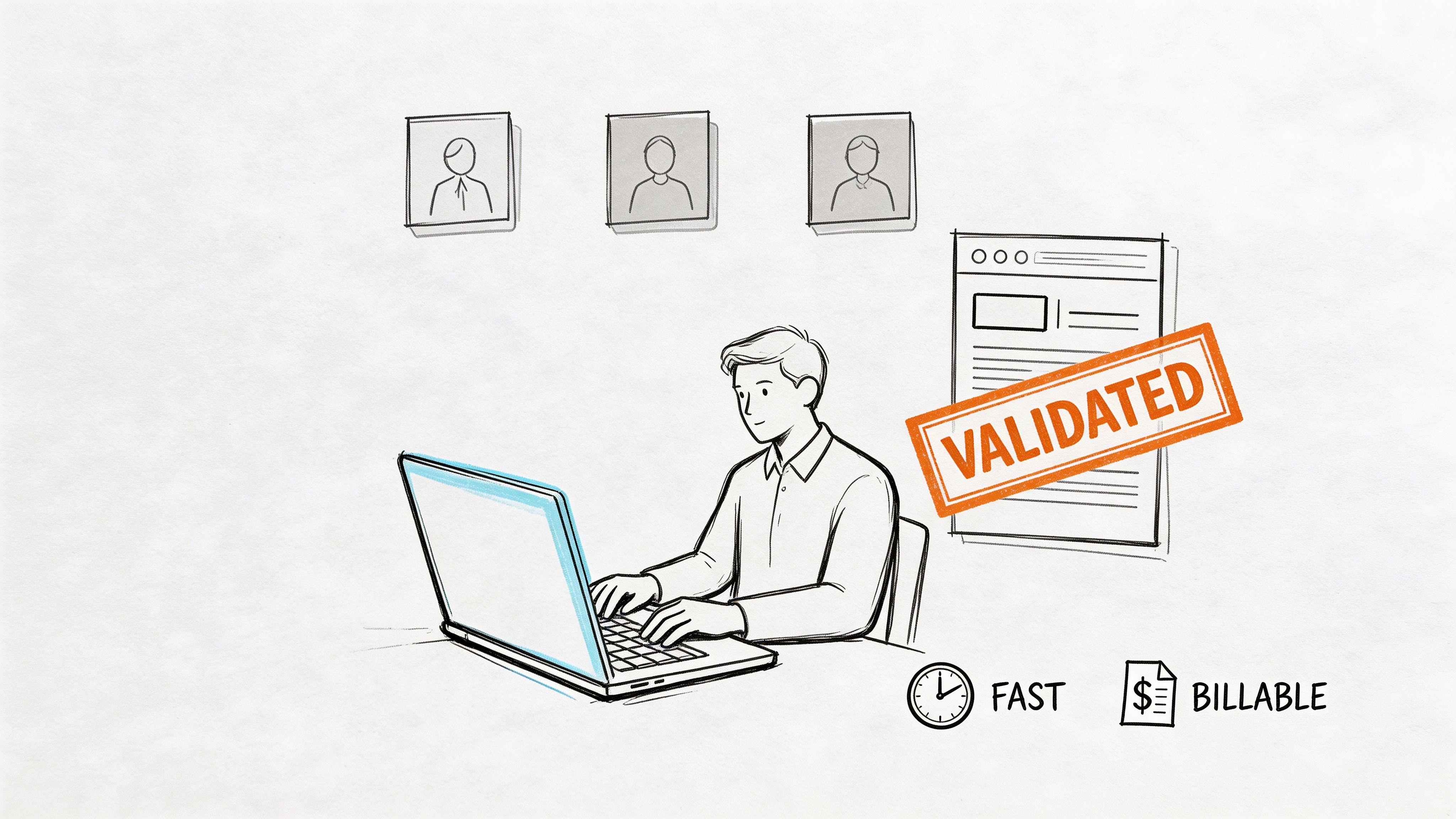
Freelancers and small agencies don't just need better research. They need research they can sell, deliver, and package cleanly.
This persona often works across several clients at once. One week it's a landing page for a local SaaS company. The next it's a mobile flow for an e-commerce brand or a dashboard redesign for a B2B product. They need validation without the overhead of participant recruitment on every engagement.
What makes this persona commercially useful
A strong freelance persona includes something many buyer personas examples miss. It maps not only the customer's pain, but also the consultant's business model.
That means asking practical questions:
Can they attach testing to a proposal as a line item?
Can they export reports that look client-ready?
Can they use the findings to control revision cycles?
For agencies and freelancers, verified data from the Semrush-based example is relevant. A persona-centred strategy produced 24% more leads, 56% higher-quality leads, and 36% shorter sales cycles. Those outcomes matter because service providers live on pipeline quality and delivery speed.
How Uxia helps this persona win and retain clients
Uxia fits well when the freelancer needs to show evidence quickly, especially before a client review. Synthetic testers can provide structured feedback on prototypes without waiting for external recruiting, which helps keep projects moving and supports a more premium service offer.
I'd operationalise this persona around three deliverables:
White-label style reports: Something they can drop into a client deck.
Pre-review validation: A quick round before presenting recommendations.
Revision control: Evidence that explains why a design decision changed.
A freelancer can also create lightweight persona variants for each client. One may be "first-time buyer with trust concerns". Another may be "busy ops lead completing a setup workflow between meetings". Those are more useful than generic archetypes because they connect directly to billable design decisions.
The trade-off is worth stating clearly. Synthetic testing won't replace every stakeholder interview or customer call. But for service providers balancing margin and speed, it can make validation repeatable enough to become part of the offer instead of an occasional extra.
5. The Mobile App Product Lead
Mobile teams feel friction faster than other teams because small interface issues become immediate user frustration. Tap targets, interrupted flows, permission prompts, and hidden navigation all carry more weight on a phone screen.
This persona usually works at a growth-stage company where the app is central to retention. Think of a product lead at DoorDash reviewing restaurant browse flows, a Robinhood team testing whether first-time investors understand a new interaction, or an Instacart product lead checking whether a checkout tweak introduces doubt.
A practical demo is worth seeing before you define this persona in your own workflow:
What this persona needs from a testing setup
Mobile leads don't just care whether users complete a task. They care where the task feels fragile.
A usable persona for mobile work should include:
Device context: Handheld, distracted, short-session behaviour.
Error tolerance: How quickly a user gives up after confusion.
Gesture expectations: Whether key actions feel obvious without labels.
Trust sensitivity: Especially around payments, permissions, or account steps.
This clearly demonstrates the gap between marketing personas and product personas. Existing guidance often focuses on motivations for purchase. The better product persona captures interaction habits, such as whether a user relies on back navigation, scans rather than reads, or abandons after repeated friction. That gap is explicitly underexplored in current persona literature, as noted in the monday.com-based brief in the verified data.
How to operationalise the mobile persona with Uxia
Uxia is useful here because mobile teams often need rapid checks on video prototypes or screen sequences before engineering commits fully. Set missions around real in-app tasks. Then look for moments where synthetic testers hesitate, miss a control, or misread the hierarchy.
The strongest mobile persona definitions are behavioural. "Growth marketer, age 31" is rarely enough. "Checks the app in short bursts, mistrusts dense permission requests, and expects bottom navigation conventions" is far more actionable.
If your team ships often, build persona variants by intent and app maturity. New user. Returning user. Goal-driven user. Comparison user. That's how buyer personas examples become product tools instead of presentation assets.
6. The E-Commerce Conversion Optimisation Manager
Conversion teams rarely need another persona poster. They need a persona that explains why a shopper stalls on the product page, hesitates at shipping, or abandons checkout after comparing one last option.
This role sits close to revenue, so vague persona work gets ignored fast. The e-commerce conversion optimisation manager already has dashboards for bounce rate, cart abandonment, and checkout completion. The missing layer is behavioural interpretation. What kind of shopper is this? What question were they trying to answer? What made the experience feel risky, confusing, or not worth the effort?
That changes how the persona should be written.
What this persona responds to
A useful e-commerce persona maps to buying intent and friction patterns inside the funnel, not broad demographic labels. Age band and job title matter less than how the shopper evaluates risk and urgency.
Strong inputs for this persona include:
Decision stage: Casual browsing, active comparison, or purchase-ready.
Trust checks: Reviews, stock confidence, return terms, delivery clarity, and visible total cost.
Abandonment triggers: Surprise fees, forced account creation, weak product detail, or checkout friction.
Traffic source context: Paid ad click, email return visit, organic search, or direct repeat session.
For this audience, personas earn their keep when they sharpen experiments. A team testing PDP layout, offer placement, or checkout fields needs to know which buyer type is likely to hesitate and why. "Discount-conscious repeat buyer" and "first-time buyer with low trust" may hit the same page, but they respond to very different cues.
Product teams can also borrow from adjacent validation practices. For example, teams improving checkout accessibility often spot friction that also hurts conversion, especially around form clarity, focus order, and error recovery. This guide to using an accessibility web checker in 2026 is useful if your conversion work overlaps with checkout usability and compliance.
How to use Uxia for conversion-focused personas
Uxia works best here when personas are defined by purchase intent and hesitation pattern. Set up synthetic testers such as a cautious first-time buyer, a comparison shopper checking variants, or a repeat customer trying to reorder quickly. Then give each one a concrete mission tied to revenue-critical tasks.
Review where they pause. Review what they reread. Review what creates doubt.
That is the difference between analytics and usable persona insight. Analytics shows the drop-off point. Synthetic testing helps explain the decision failure behind it before the team ships a new experiment.
If a conversion persona does not include a clear abandonment trigger, it is too vague to improve a funnel.
One trade-off matters here. It is tempting to keep adding detail until the persona feels complete. That usually makes it less useful. Conversion managers need a compact working model tied to product decisions. Keep the persona grounded in observable behaviour, trust sensitivity, and task flow blockers. Save revenue claims for cases where internal data can support them.
7. The Accessibility-Focused Design Lead
Accessibility personas are often oversimplified into compliance labels. That's a mistake.
The accessibility-focused design lead usually sits between ethical design goals and legal or governance pressure. They care about inclusive use, but they also need evidence their product works for people using different input methods, assistive technologies, and reading patterns. Teams at Microsoft, public sector services, and large retailers often operate this way.
What a real accessibility persona includes
Most persona libraries stop at static disability categories. That isn't enough for product validation.
A better persona captures interaction strategy. For example, a user who depends on keyboard navigation may move through a flow in a very different order from a mouse-first user. A low-vision user may notice hierarchy problems before copy issues. A user with motor limitations may need larger interaction targets and more forgiving controls. Regional and representation issues matter too. The verified data highlights a gap in current literature: many persona examples are North American by default and don't address regional behaviour or expectations in UX research. That's especially relevant when building products for European markets, where privacy expectations, language context, and mobile usage patterns can alter usability findings.
Making accessibility personas testable in Uxia
Uxia can help by letting teams define synthetic testers with accessibility-relevant profiles and missions. That makes it easier to pressure-test designs before launch and to catch repeated friction in navigation, copy, trust, and interface structure.
Use this persona to validate:
Keyboard-only task completion
Screen reader-friendly content order
Low-vision readability and contrast interpretation
Motor-accessible interaction paths
For teams formalising that process, this guide to using an accessibility web checker in 2026 fits naturally into the workflow.
Accessibility personas shouldn't just describe who users are. They should describe how users move through a product when the interface doesn't cooperate.
That's what makes them actionable for design and engineering.
8. The SaaS B2B Product Designer
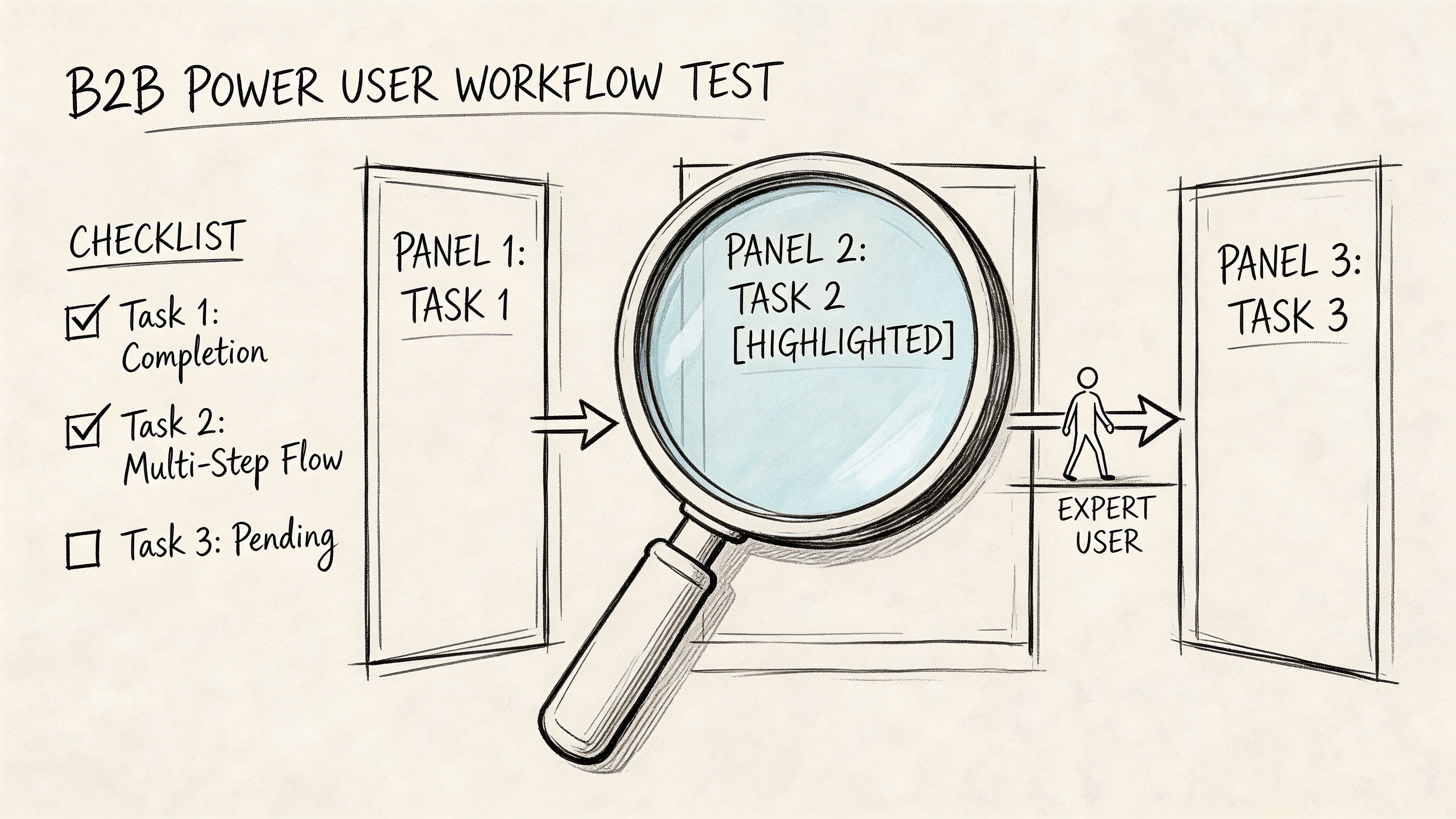
B2B SaaS design breaks fast when the persona is too generic.
A consumer app can sometimes survive with broad segments. A B2B product usually cannot. One screen may need to serve an admin configuring permissions, a manager reviewing outcomes, and an operator trying to finish repetitive work with as few clicks as possible. If those roles get flattened into one "target user," the product accumulates friction in the places that matter most.
Asana, HubSpot, and Slack show the pattern clearly. The workspace admin setting up access has different goals, different risk tolerance, and different product knowledge than the day to day end user. A sales manager reading dashboards behaves differently from a rep updating records between calls. Good persona work for SaaS product teams captures those differences before they turn into UX debt.
Why this persona needs more than a marketing profile
For a SaaS B2B product designer, a useful persona is operational. It needs to reflect how work gets done inside the tool, where mistakes are expensive, and which users will push through friction versus drop a task and ask support.
That usually means defining the persona around workflow reality, not biography:
Role-specific task complexity
Frequency of use
Experience level with the system
Tolerance for dense interfaces
Need for speed, accuracy, or auditability
Likelihood of recovering from errors without help
Those details shape product decisions directly. A heavy user may accept a denser interface if it saves time every day. An occasional approver often needs stronger signposting, clearer labels, and easier recovery because they do not remember the workflow from last month. A team setting personas at that level gets something far more useful than a template. It gets a design brief you can test.
How to put this persona to work in Uxia
For this role, synthetic testers are useful because they let product teams model different types of B2B usage before a release. Set them up by job to be done and skill level, then give each one a task that mirrors real product behavior.
A practical setup looks like this:
New team admin completing initial setup
Experienced operator running a recurring workflow
Manager reviewing outputs and exceptions
Occasional user returning after a long gap
Then test the product the way these users work. Ask the synthetic testers to complete multi-step tasks, handle edge cases, and explain where the interface expects too much prior knowledge. Watch for hesitation around permissions, table controls, filters, terminology, and empty states. In B2B SaaS, those are often the points where a design looks clean in review but fails under real usage.
The strongest persona here is specific enough to drive decisions. "Ops lead who uses the product heavily twice a month, skips help content, and expects bulk actions to be obvious" is far more useful than a name, age, and job title. That is the shift this article is pushing throughout all eight examples. Personas are not just a documentation exercise. Product teams can validate them, stress test them with tools like Uxia, and turn them into a repeatable input for design and roadmap decisions.
8 Buyer Personas: Product & Design Role Comparison
Persona | Implementation Complexity 🔄 | Resource Requirements ⚡ | Expected Outcomes ⭐ 📊 | Ideal Use Cases 💡 | Key Advantages ⭐ |
|---|---|---|---|---|---|
The Agile Product Manager | 🔄 Low–Moderate; simple, sprint-friendly tests | ⚡ Moderate; fast tools + integrations; $2k–10k/mo | ⭐ Quick, directional metrics to inform sprints | 💡 Sprint validation, rapid feature prioritization | ⭐ Fast feedback; integrates with Jira/Linear; high test cadence |
The Design-Led Startup Founder | 🔄 Low; visual, qualitative setups preferred | ⚡ Low; budget-conscious, pay-as-you-go; $500–3k/mo | ⭐ Design validation to de-risk decisions/fundraising | 💡 Pre-pivot checks, investor-facing UX proof | ⭐ Design-focused insights; visual heatmaps and transcripts |
The Enterprise UX Research Lead | 🔄 High; governance, procurement, compliance needs | ⚡ High; teams, security docs (SOC2/GDPR); large budgets | ⭐ Reproducible, program-level findings at scale | 💡 Scaling research programs, compliance testing | ⭐ Enterprise-grade security/compliance; large user access |
The Freelance UX/UI Service Provider | 🔄 Low; turnkey templates and short studies | ⚡ Low; project-based spend; pay-as-you-go preferred | ⭐ Client-ready validation, faster deliverables | 💡 Client engagements, proposal differentiation | ⭐ Time & cost efficiency; white-label reports; upsell ability |
The Mobile App Product Lead | 🔄 Moderate; device/OS fragmentation and gesture testing | ⚡ Moderate–High; mobile prototype & video support; $5k–25k/mo | ⭐ Mobile-specific usability improvements; fewer app-review issues | 💡 Pre-release mobile flows, gesture/UX validation | ⭐ Mobile-first testing, video prototypes, analytics integrations |
The E-Commerce Conversion Optimization Manager | 🔄 Moderate; rapid A/B and funnel experiments | ⚡ High; heavy analytics integration; $10k–50k+/mo | ⭐ Direct revenue and conversion lift metrics | 💡 Checkout, PDP, personalization experiments | ⭐ Metrics-driven ROI; high test velocity; clear success metrics |
The Accessibility-Focused Design Lead | 🔄 High; specialized audits and documentation | ⚡ High; accessibility experts + compliance budgets; $25k–100k+/mo | ⭐ Compliance validation and inclusive UX improvements | 💡 WCAG audits, assistive-technology workflows | ⭐ Diverse-user coverage; compliance-ready reports; legal defensibility |
The SaaS B2B Product Designer | 🔄 Moderate–High; complex workflows and longer sessions | ⚡ Moderate; domain experts and detailed scenarios; $5k–30k/mo | ⭐ Task-efficiency gains and deep qualitative insights | 💡 Power-user workflow validation, task-completion studies | ⭐ Workflow-focused testing; scenario depth; task metrics |
From Persona to Product Operationalizing Your Insights
Persona work usually fails after the workshop, not during it.
Teams often have enough research to describe the user in a deck. The gap is operational. The persona is not connected to the choices product, design, and engineering make each week, so it never affects what gets tested, how findings are written up, or which issues make it into the sprint.
That is the standard to use. If a persona does not change prioritisation, it is reference material, not a product tool.
As noted earlier, there is a consistent gap between documenting personas and validating them against behavior. Product teams should treat that gap as a workflow problem. The fix is to turn each persona into a reusable test audience with defined goals, known risk areas, and realistic tasks. That is the point of the eight examples in this article. They are not just templates to copy. They are starting points for repeatable product validation.
In Uxia, that means building audience definitions your team can reuse across onboarding, pricing, checkout, dashboard workflows, admin settings, and accessibility reviews. Uxia's synthetic audience setup helps because teams can test the same persona logic across multiple flows without restarting research every time a new prototype is ready.
A practical operating rhythm looks like this:
Define the audience in behavioral terms: capture goals, objections, trust signals, experience level, and usage context.
Assign a realistic mission: test a task the persona would try to complete, not a generic usability prompt.
Review friction by pattern: use transcripts, summaries, and issue clusters to spot repeated failures rather than isolated comments.
Convert insight into delivery work: turn validated issues into design changes, Jira tickets, and acceptance criteria.
Refresh the persona when reality changes: update it when the product, market, pricing model, or buyer behavior shifts.
Regional variation matters here too. A persona for a UK fintech buyer should not behave like a US ecommerce shopper or a German enterprise admin. Privacy expectations, terminology, trust cues, and form tolerance change by market. Synthetic testers are useful because they let teams calibrate those differences early, before broad rollout turns a local mismatch into a product problem.
The best teams also wire personas into planning. Add the primary persona to sprint briefs. Tie experiments to the persona they are meant to help. Reference it in your product requirements document template. When design, product, and engineering are working from the same persona assumptions, debates get shorter and trade-offs get clearer.
I have found that personas become useful only when they are forced to earn their place. If a persona cannot explain why one flow needs more guidance, why another needs stronger trust signals, or why a feature should be delayed, it is still too vague.
Uxia gives product teams a practical way to turn buyer personas examples into living test audiences. Upload a prototype, define the mission, choose the audience, and let synthetic testers surface friction in minutes. If your personas have been sitting in slides instead of shaping product decisions, start using Uxia to validate designs continuously and make persona work operational.