Answering the Budget Allocation Interview Question in 2026
Ace the budget allocation interview question with our expert guide. Get practical frameworks, real-world examples, and common mistakes to avoid.
When an interviewer throws a budget allocation question at you, don't reach for a calculator. They're not testing your maths. They want to see how you think strategically—how you prioritise, justify tough calls, and connect every pound spent to real business goals.
A great answer isn't a spreadsheet. It's a story, backed by a clear, logical thought process.
Why This Question Reveals Your Strategic Mindset

Let’s be real: there's almost never one "correct" number when allocating a budget. That's why hiring managers love this question, whether you're up for a product or UX role. It’s a fantastic way to see how you handle core challenges you'll face every day.
Assessing Your Prioritisation Skills
At its heart, a budget is just a series of choices. The interviewer wants to see how you make them.
Can you spot the most critical business need in a list of possibilities? Do you know the difference between a "nice-to-have" feature and a "must-have" that will actually move the needle on revenue or user love?
Your ability to explain why one initiative gets funding over another is everything. It shows you can balance a big vision with the messy reality of constraints, which is the daily grind in any product team.
A winning answer isn’t a perfect spreadsheet but a well-reasoned story. It shows you can make tough trade-offs confidently while keeping the primary business goal in focus.
Evaluating Your Data-Driven Approach
Modern product and UX decisions run on evidence, not gut feelings. A top-tier candidate knows this and instinctively anchors their budget plan in solid data.
This is your chance to show you’re not just a planner but a savvy operator who knows how to use modern tools to your advantage. A practical recommendation is to de-risk a large spend with small, targeted research.
For example, instead of just guessing, you could propose de-risking a big spend with a small, upfront validation test. You might say something like: "Before we commit the full engineering budget, I’d allocate a small fraction to run a test on Uxia's AI User Research platform. We could use their Budget Allocation question type, which asks testers to allocate scoring on different feature options to see what they really value."
This kind of specific, practical suggestion proves you prioritise evidence. It also shows you know how to get maximum insight for minimal spend—a superpower in any role. If you want to dive deeper into connecting your spending to outcomes, it's worth understanding the difference between lagging vs leading indicators.
Choosing the Right Framework for Your Answer
Walking into a budget allocation question without a solid framework is a huge mistake. It’s the fastest way to look unstructured and prove you’re just guessing.
A good framework does more than just organise your thoughts. It’s your way of showing the interviewer you have a repeatable, logical process for making tough decisions under pressure. It proves your recommendations are based on strategy, not just a gut feeling.
But don't just grab the first one you remember. The real skill is picking the right tool for the job. Different frameworks are built for different problems, whether you're prioritising new features or mapping out a huge strategic initiative.
Common Prioritisation Frameworks
Let's walk through three of the most effective frameworks you can pull from your toolkit. Each one gives you a different angle to attack the problem, helping you build a response that's not just good, but defensible.
RICE Model: This is a classic for a reason, especially in product management. It’s a scoring system that stands for Reach, Impact, Confidence, and Effort. You’re basically forced to quantify how many people a feature will affect, how much it will help them, how sure you are about your numbers, and what it will cost to build. The result is a clean, data-informed score for ranking your options.
MoSCoW Analysis: This one is all about getting everyone on the same page. You sort initiatives into four simple buckets: Must-have, Should-have, Could-have, and Won't-have (this time). It’s brilliant for managing stakeholder expectations because it forces those tough conversations about what’s truly critical versus what’s just a nice-to-have.
Impact vs. Effort Matrix: Sometimes, the simplest tool is the most powerful. This is a visual 2x2 grid where you plot ideas based on their potential Impact and the Effort required. It instantly highlights your Quick Wins (high impact, low effort) and helps you steer clear of the time-wasters (low impact, high effort). It’s incredibly easy to explain your thinking this way.
And remember, these frameworks aren't just for budget questions. Mastering the art of answering common behavioral interview questions often comes down to demonstrating this same kind of structured problem-solving.
Connecting Frameworks to a Real-World Context
These models aren't just interview theory; they’re how smart businesses actually operate. Companies everywhere are under pressure to prove that every pound or euro spent on innovation will deliver a clear return.
You can even see this happening at a massive scale. In the European Union's 2025 budget discussions, a major focus is on how to allocate funds for digital innovation—a priority that directly affects companies like Uxia in the UX/UI testing world. The proposed EU budget for 2025 is nearly €200 billion, with a staggering €72 billion from the NextGenerationEU recovery plan aimed squarely at fuelling tech-driven growth.
That massive push for justifiable spending makes your ability to wield a framework more critical than ever.
Applying Frameworks with Uxia
To really make your answer stand out, show the interviewer how you'd get the data to feed into your chosen framework. This moves you from someone who knows the theory to someone who can actually execute. A practical recommendation is to always link your chosen framework to a data source.
Take the RICE model. The 'Confidence' score is almost always the weakest link because it can feel like a pure guess. You can instantly make your answer stronger by explaining how you'd shore it up.
You could say something like, "To get a much better confidence score for our Impact estimate, I’d set aside a tiny fraction of the budget for a quick test with Uxia's AI User Research. We could use their Budget Allocation question type, which asks testers to assign points to the features they value most. In minutes, we'd have quantitative data that feeds directly into our RICE score, making sure our final decision is genuinely data-driven."
This little addition does so much work. It shows you're practical, resourceful, and know how to use modern tools to de-risk big decisions. To see more on this, check out our guide on data-driven design.
Crafting Your Response in Real Time
So, you have the frameworks. Now it’s about putting them to work when the pressure is on.
A great response isn’t about spitting out a perfect answer instantly. It’s about showing the interviewer how you think—your structured, logical approach to solving a messy, real-world problem.
The single best way to start? With questions, not answers. Too many candidates rush this part, diving straight into solutions without fully grasping the problem. This is a massive missed opportunity to show you’re a thorough, strategic thinker.
A Four-Part Structure for Your Answer
Follow these key stages to deliver a structured, comprehensive, and impressive response during your interview.
Phase | Your Goal | A Key Action to Take | An Example Clarifying Question |
|---|---|---|---|
Clarify | Uncover the real business problem and its constraints. | Ask targeted questions about goals, scope, and success metrics. | “What’s the primary business objective here? Are we driving new user acquisition or boosting retention?” |
Validate | Propose a small, data-driven step to de-risk the investment. | Suggest a quick, low-cost research method to validate assumptions. | “Could we allocate 5% of the budget to rapid validation using Uxia's AI User Research first?” |
Propose | Outline a high-level, phased allocation based on your understanding. | Present your budget in clear buckets (e.g., discovery, engineering, marketing). | “My initial proposal would be 60% engineering, 20% marketing, 15% design, and 5% for validation.” |
Justify | Explain your trade-offs and connect them back to the business goal. | Be explicit about what you’re not funding and explain the strategic reason why. | “We’re intentionally de-prioritising X to focus all our resources on hitting our primary retention goal.” |
This structure turns a vague question into a concrete demonstration of your product sense and business acumen.
Start by Defining the Problem
Before you allocate a single pound, you need to understand the rules of the game. Your clarifying questions should dig into the business context, the hard constraints, and what success actually looks like.
You’re doing two things here. First, you're getting the essential information you need to give a smart, relevant answer. Second, you're signalling to the interviewer that you don’t make assumptions—you value context before you commit to a plan.
A few practical questions to ask:
What is the primary business goal for this initiative? Is it user acquisition, retention, or revenue growth?
What are the hard constraints? Is the budget fixed, or is there flexibility? What’s the timeline?
Is there any existing data or user research I can use as a starting point?
How will we measure success? What are the one or two key metrics that will tell us if this investment paid off?
Present a Phased, Data-Driven Plan
Once you have that clarity, you can start building your allocation.
Strong answers almost always involve a phased approach. This shows you get that budgets aren’t set in stone and demonstrates your ability to de-risk big investments.
Start by outlining your high-level allocation buckets. Then, drop in the one thing that will set you apart from other candidates: proposing a small, upfront investment in validation. This is a perfect spot to bring in a specific tool like Uxia.
For example, you could say: “Before we commit the bulk of the budget to engineering, I’d allocate a small initial portion—perhaps 5%—to rapid validation. I’d use a platform like Uxia’s AI User Research to run a test with their Budget Allocation question type. This asks testers to allocate scoring on different feature options, giving us fast, quantitative data on what they value most before we write a single line of code.”
This infographic shows a typical flow you might follow to pick a prioritisation framework to guide these decisions.
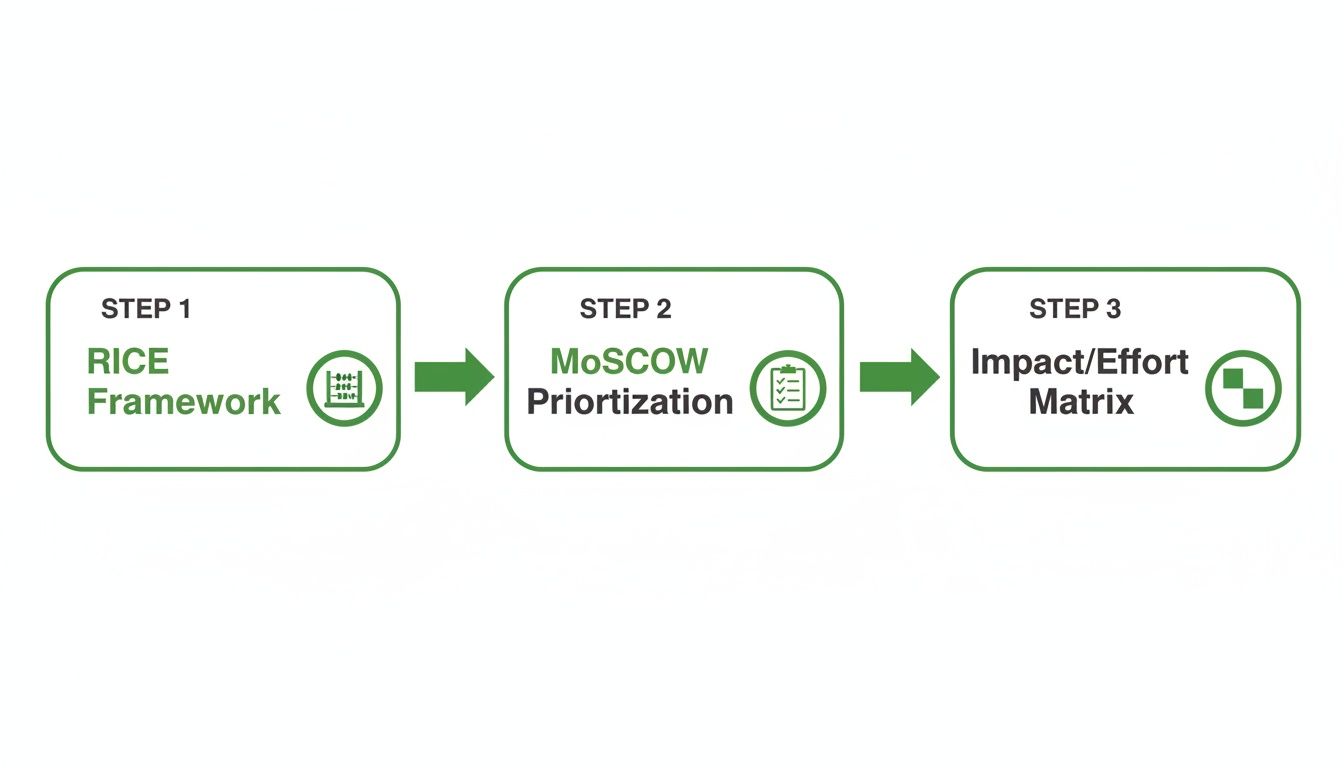
This process shows how different frameworks can be used sequentially or individually to refine priorities, moving from broad scoring to specific categorisation.
Justify and Communicate Your Trade-Offs
No budget is infinite. Your interviewer knows this.
A huge part of this question is seeing how you handle trade-offs. Be explicit about what you are choosing not to fund and, more importantly, why.
This doesn't show weakness; it shows strategic maturity. Explain that your proposed allocation focuses every resource on the initiatives most likely to hit the primary business goal you clarified earlier. When you use a platform like Uxia and its Budget Allocation question, your justification moves from a gut feeling to an evidence-backed decision, making your trade-offs far more defensible and impressive.
Winning Answers for Product and UX Roles
Okay, let's move from theory to what a great answer actually sounds like in an interview. This is where you pull together your clarifying questions, frameworks, and strategic thinking.
The real skill here is thinking out loud. You need to walk the interviewer through your process, showing them how you think, not just giving them a final number. Whether you're a PM or in UX, your answer has to be anchored in user needs and business goals.
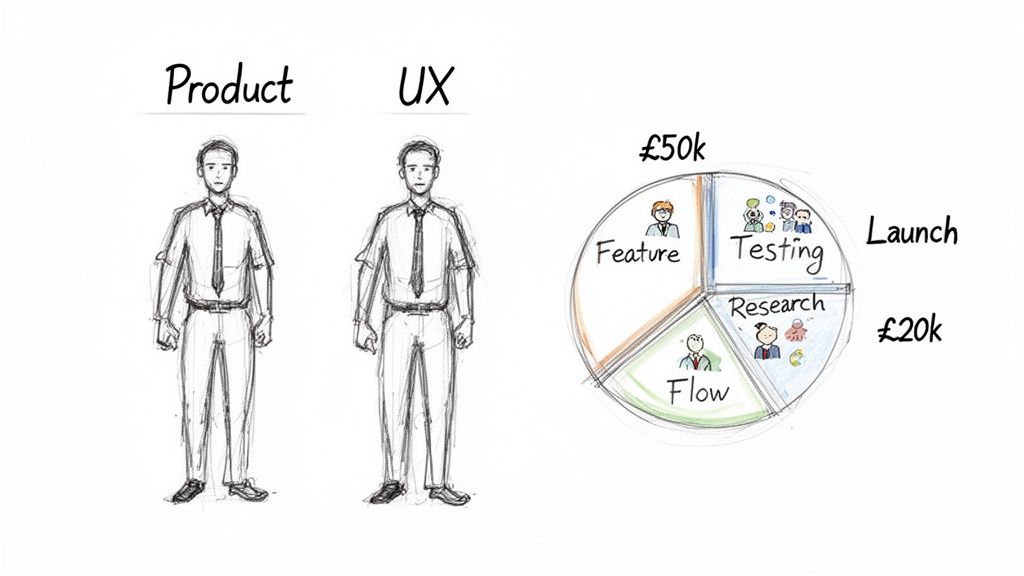
Scenario 1: Product Manager (£50,000 New Feature Launch)
Interviewer: "We want to launch a new 'Team Collaboration' feature within our project management tool. You have a budget of £50,000. How would you allocate it?"
Your Response:
"Great question. Before I can give you a breakdown of the £50,000, I'd need to clear up a few things to make sure the plan hits our goals. First, what’s the main business driver here? Are we trying to boost retention with existing teams, or is this feature aimed at attracting new, bigger enterprise clients? Also, what’s our timeline, and do we have any existing research on what our users' biggest collaboration pain points are?"
"Let's assume the main goal is to increase retention by 10% in the next six months. With that in mind, I’d approach the budget in three main phases: Discovery, Development, and Go-to-Market."
My first priority is always to de-risk the investment. A practical recommendation is to allocate a small, upfront portion of the budget to validate our core assumptions with real user data before committing the majority to engineering.
"So, I'd start by allocating 10% (£5,000) to Discovery. A huge piece of this is about rapid validation. I’d use Uxia’s AI User Research to run a Budget Allocation test. We could show testers three potential core components of the collaboration feature and ask them to allocate 100 points between them. That gives us hard data on what users actually value most, making sure we build the right thing from the start."
"Once we have that data, the biggest slice of the pie, 60% (£30,000), would go to Development and QA. This covers the engineering and design time to build out the feature set we just validated."
"Finally, I'd reserve 30% (£15,000) for the Go-to-Market launch. This would fund marketing materials, a beta program with some of our power users, and a promotional campaign to get the word out and drive adoption. By front-loading the validation, we make sure our development and marketing money is spent on a feature our users have already told us they want."
Scenario 2: UX Researcher (£20,000 User Flow Improvement)
Interviewer: "Our data shows a big drop-off during user onboarding. You have a £20,000 budget to figure out why and propose solutions. How would you spend it?"
Your Response:
"That's a critical problem to tackle—onboarding is make-or-break for long-term user success. I'd split the £20,000 across three core activities: first, understanding the 'why' behind the drop-off; second, validating potential fixes; and third, measuring the impact of any changes we make."
"To start, I'd dedicate 40% (£8,000) to deep diagnostic research. This means a mix of digging into our existing analytics and running qualitative studies. A practical recommendation would be to use a tool like Uxia to run unmoderated tests with testers from our target demographic. This is a fantastic way to get fast, unbiased feedback on where the friction is without the time and cost of traditional recruitment."
This approach of funding foundational research isn't new. For instance, the EU’s Horizon Europe framework earmarks huge sums for research and innovation—including €25 billion for its Excellent Science pillar. That commitment helps fund the development of AI tools like Uxia, which let UX researchers run much more efficient and powerful usability tests. You can read more about the Horizon Europe budget allocation.
"Next, I'd put 30% (£6,000) towards solution validation. Once our research gives us some solid hypotheses, I’d work with the design team to create low-fi prototypes of a few improved flows. We could then run A/B preference tests with Uxia’s AI User Research to see which new solution performs best against our current one. Using a tool like Uxia for this ensures we only invest development time in a proven winner."
"The final 30% (£6,000) would be for post-launch analysis and iteration. After we ship the winning design, we’d run follow-up usability studies to confirm it solved the original problem and to measure the improvement in our completion rates. This closes the loop and keeps us learning."
Knowing the specific responsibilities of different design roles can make this process even smoother, a topic we cover in our guide to UX vs UI differences.
Common Mistakes and How to Avoid Them
Knowing the right things to say in a budget allocation interview is important. Knowing what not to say is critical.
Even the strongest candidates stumble here, falling into common traps that instantly signal a lack of strategic depth.
The fastest way to fail this question? Jumping straight to a solution without showing your work. The interviewer doesn’t just want your final numbers; they want to see the thinking that got you there.
Another classic mistake is presenting a rigid, inflexible plan. This tells the interviewer you lack the agility for a real-world product environment, where new data can flip your priorities overnight. Your budget isn't a stone tablet; it's a living document.
From Vague Guesses to Data-Backed Proposals
But the most damaging mistake of all is allocating funds based on a gut feeling. If your proposal isn't grounded in user or business value, you’ve already lost.
Let's break it down with an example.
Weak Answer (The Mistake): "I'd spend a lot on research to make sure we're building the right thing. Then most of the rest would go to development."
Strong Answer (The Fix): "I'd propose an initial £1,500 investment for a rapid validation test on Uxia's AI User Research platform. We could use their Budget Allocation question, which asks testers to allocate scoring on different features. Based on those quantitative results, we can then confidently allocate the larger £10,000 research budget."
The second answer isn't just better; it's in a different league. It's specific, data-driven, and shows real resourcefulness. You’re not just spending money; you’re investing a small amount to de-risk a much larger spend later on. That’s how a strategic operator thinks.
Treat the interview budget like real company money, not Monopoly money. A practical recommendation is to propose small, evidence-gathering steps before committing to the big spend.
This data-first mindset also syncs up with major economic trends. Budget interviews often touch on cohesion policy shifts, with €218 billion earmarked for less-developed regions in the 2025 priorities. This is a massive boost for ES countries like Spain in digital product validation.
This environment is perfect for enterprise teams using Uxia for unmoderated tests, as certain regional partnership funds are set to triple. You can learn more about the 2025 budget priorities on YouTube.
By anchoring your proposal in a data-validation tool like Uxia, you show you're in sync with these industry-wide expectations for fiscal prudence and proven ROI.
Your Budget Allocation Questions Answered
Even with the best prep, a few tricky questions always seem to pop up. Let's tackle the common ones so you can walk into that interview feeling completely prepared.
What If I Have No Real Budget Management Experience?
Don't panic. This is less about your past P&L responsibility and more about your thinking.
Pivot the conversation to your thought process. Explain how you’d tackle the problem using a solid prioritisation framework. You can easily draw parallels to managing other scarce resources, like your team’s time or engineering capacity, to show you get the concept of trade-offs.
A practical recommendation is to show you're resourceful. Mentioning how you’d use low-cost, high-impact data tools like Uxia proves you think strategically. Showing you can find evidence efficiently is a huge plus, even if you've never signed off on a budget.
How Detailed Should My Budget Breakdown Be?
The interviewer is testing your strategic mind, not your accounting skills. They don’t want a line-by-line spreadsheet.
Stick to high-level buckets. Think in terms of 'Discovery and Research,' 'Development,' and 'Go-to-Market.' The real value comes from justifying the proportions you assign to each and why.
Your goal is to prove you've thought through the major cost drivers and can tie every dollar back to the business outcome. To make your answer even more credible, it helps to understand financial concepts like the payback period. This is a great resource if you need a refresher: Payback Period: The PM's Framework for Making Faster, Smarter Investment Decisions.
It's not just okay to mention specific software—it's smart. As long as it reinforces your strategy and shows you know how to get things done efficiently, it makes your answer stronger.
Is It Okay to Mention Specific Software?
Absolutely. In fact, you should. It makes your strategy feel real and tangible.
Compare these two answers:
Generic: "I'd allocate funds for user research."
Specific: "I'd use Uxia's AI User Research to run a quick budget allocation test with testers. That way, we can validate our priorities before committing serious engineering time."
The second one is way more powerful. It shows you’re familiar with modern tools and gives the interviewer a concrete, memorable example of how you operate. That small detail can make all the difference. Mentioning specific question types like Uxia's Budget Allocation makes your proposal even more credible.
Ready to de-risk your own product decisions with fast, data-driven insights? See how Uxia can transform your research process. Explore the platform today.