Best Diary Study Tools: 10 Options for UX Research
Compare the Best Diary Study Tools for logging, media capture, reminders, analysis, pricing, and practical use cases, including Uxia.

Most advice on the best diary study tools gets one thing wrong. It treats the category like a feature contest, when diary study quality usually rises or falls on operational details. A tool can offer rich media, AI summaries, and polished dashboards, then still fail because reminders arrive at the wrong time, participants stop responding, exports are messy, or the setup creates more admin work than the study can support.
The right diary tool depends on the study design. If you need in-the-moment behavior, mobile capture and reliable prompts matter more than presentation polish. If you're running a multi-market program, participant management, governance, and analysis workflows matter more than novelty. If you're comparing remote-only studies, it's worth remembering that diary research is longitudinal by nature. Common guidance places many studies in the 1 to 4 week range with around 15 to 30 participants for remote work, which means the tooling has to support sustained compliance, not just first-day engagement.
That also separates diary research from rapid prototype validation. A diary platform helps you observe habits and context over time. A tool like Uxia fits earlier or in between those studies, when a team needs fast synthetic UX validation on flows, screens, or concepts without recruiting participants first.
The comparison below focuses on what affects outcomes: logging formats, photo and video capture, reminders, participant management, longitudinal compliance, analysis effort, export quality, pricing visibility, and setup burden.
1. dscout

dscout is one of the most purpose-built options in this category. If the job is mobile diary research with repeated prompts, rich media capture, and a workflow researchers can hand to participants without much explanation, it fits well. It's especially strong when the study depends on capturing behavior close to the moment it happens rather than reconstructing it later.
That matters because diary tools aren't just note collectors. They support intensive longitudinal work, often framed as experience sampling or ecological momentary assessment, where repeated prompts, event logging, and structured exports are part of the core method, not extras. A practical benchmark for these deployments is 4 to 8 prompts per day across 7 to 21 days, which is exactly the kind of operational load a platform like dscout is built to handle.
Where dscout works best
dscout is a strong fit when you need:
Mobile-first capture: Video, photo, text, and other in-context entries work well for field behavior.
Researcher workflow support: Templates, scheduling, and prompt logic reduce setup friction.
Recruitment support: Its participant network can simplify mainstream consumer recruiting.
The trade-off is pricing transparency. dscout doesn't publish a public rate card, so budgeting usually starts with a sales conversation. Multi-week studies also need active moderation. Even with good tooling, diary studies are time-consuming and depend heavily on entry quality, as noted earlier in broader diary-study guidance.
Practical rule: Use dscout when you need a turnkey longitudinal workflow, not when you just need a quick concept reaction. For that earlier stage, Uxia is often the cleaner complement because it lets teams validate flows before they commit to a longer human study.
For teams comparing the best diary study tools, dscout is near the top when in-the-moment multimedia capture is the main requirement. It's less attractive when you need clear upfront pricing or a very lightweight setup.
Explore the platform at dscout.
2. Indeemo

Indeemo is a strong option when the main risk in your diary study is participant drop-off or low-effort entries. Some platforms feel like extended surveys with media attached. Indeemo is better suited to studies where participants need to show what happened in kitchens, cars, stores, or on the move, with enough context for researchers to interpret behavior later.
That difference matters because diary-study quality usually breaks at the operational level, not the method level. Teams lose signal when prompts arrive at the wrong time, tasks feel repetitive, or participants have to work too hard to document a moment. Indeemo's value is tied to compliance and in-the-moment capture more than to feature breadth.
A practical way to judge it is by study shape:
Naturalistic context studies: Good for in-home routines, daily product use, and service experiences that need visual proof.
Journey-based fieldwork: Useful for shop-alongs, transit, travel, and retail assignments where location and timing affect what gets captured.
Distributed international projects: Often a better fit than lighter tools when teams need a more controlled mobile ethnography workflow across markets.
The trade-off shows up after capture. Rich video and photo submissions improve entry quality, but they also increase review and synthesis time. If the research team is small, Indeemo can create more analysis work than a simpler diary setup. Budget is another filter. Pricing is sales-led, and teams with limited scope should confirm moderation needs, storage expectations, and study volume early.
One practical rule helps here: use Indeemo when seeing the moment matters more than counting the moment.
It also works well in a staged workflow with Uxia. Run a fast synthetic UX check in Uxia before fielding a multi-day human study, then use Indeemo once the flow is stable enough to observe in daily life. That reduces the chance of spending a week collecting videos about problems that should have been caught in an earlier validation pass.
Visit Indeemo.
3. EthOS
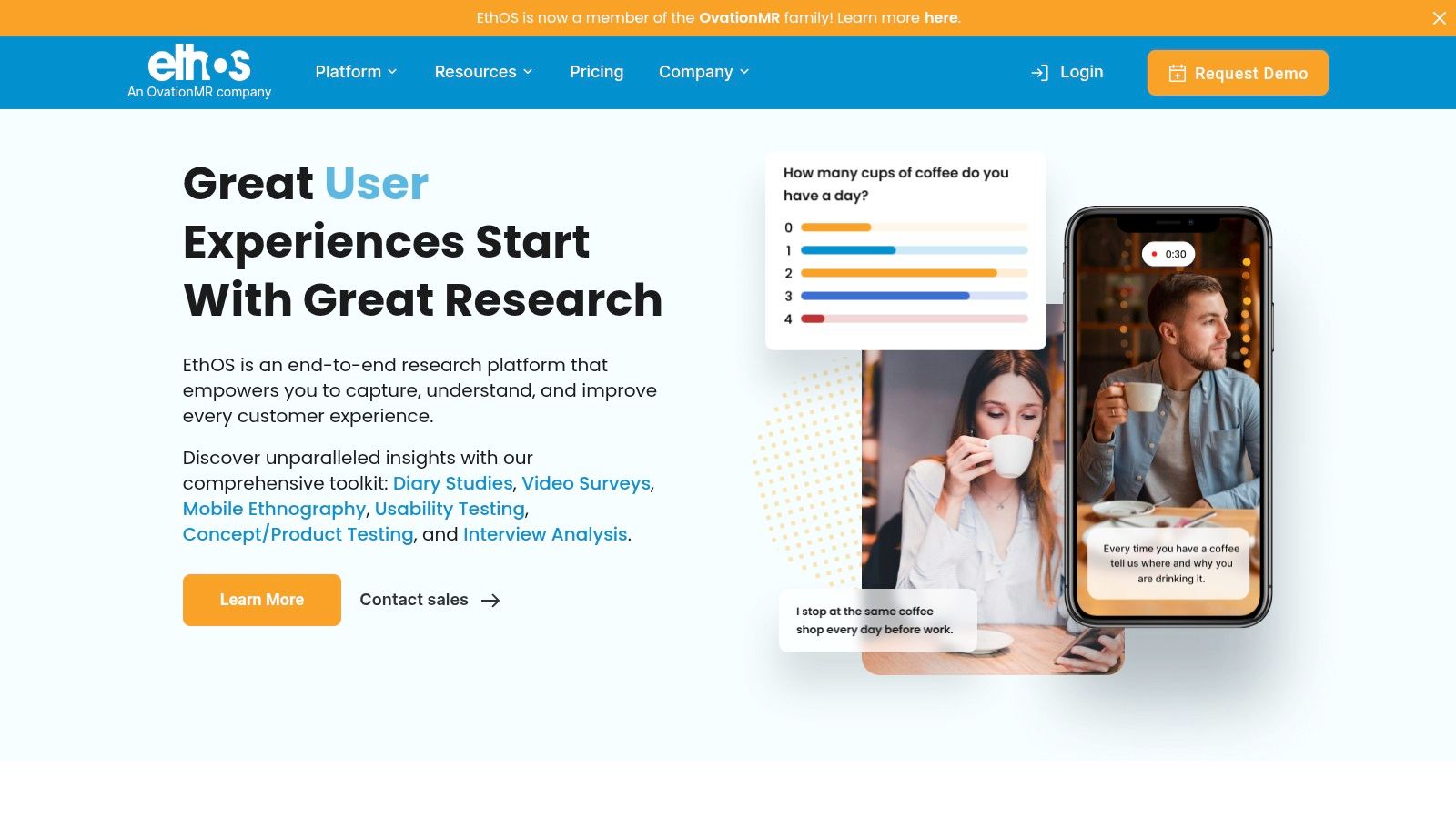
EthOS is a strong fit when diary-study quality depends on fast participant response, mobile-first task completion, and clean capture from the field. That matters more than feature count. In practice, a diary platform fails when participants ignore prompts, postpone entries until the end of the day, or struggle to upload what happened in the moment. EthOS is built around reducing that friction on phones.
The best fit is event-based or experience-sampling work. If a team needs users to react after a commute, during a store visit, or right after a service interaction, native mobile delivery and prompt timing do real operational work. They help protect recall quality, which is often the first thing to slip in longitudinal research.
A simpler way to assess EthOS is to look at the workload it creates and the study types it handles well.
Strong for in-the-moment capture: App-based assignments, push prompts, and multimedia submissions support studies where timing affects data quality.
Useful for structured field programs: It works well when researchers need participants to complete repeatable tasks across several days or weeks.
Less compelling for low-intensity diaries: A weekly check-in study or light reflection project may not need a dedicated mobile app at all.
The trade-off shows up in administration and buying friction. EthOS is easier to justify when the research question depends on prompt compliance and contextual evidence. If the study is simple, the setup and custom pricing can feel heavy relative to the job. Teams should confirm what study management, participant support, and export workflows look like before committing, because those details often determine whether analysis stays manageable.
There is also a team-size question. Larger research groups can absorb richer media review and more formal study setup. Small teams should be honest about synthesis capacity, especially if every participant entry includes video or photos.
Uxia fits earlier in the workflow. Use it for rapid synthetic UX validation when the flow itself is still changing, then run EthOS once the experience is stable enough to observe in real life over time.
See EthOS.
4. Forsta Digital Diaries
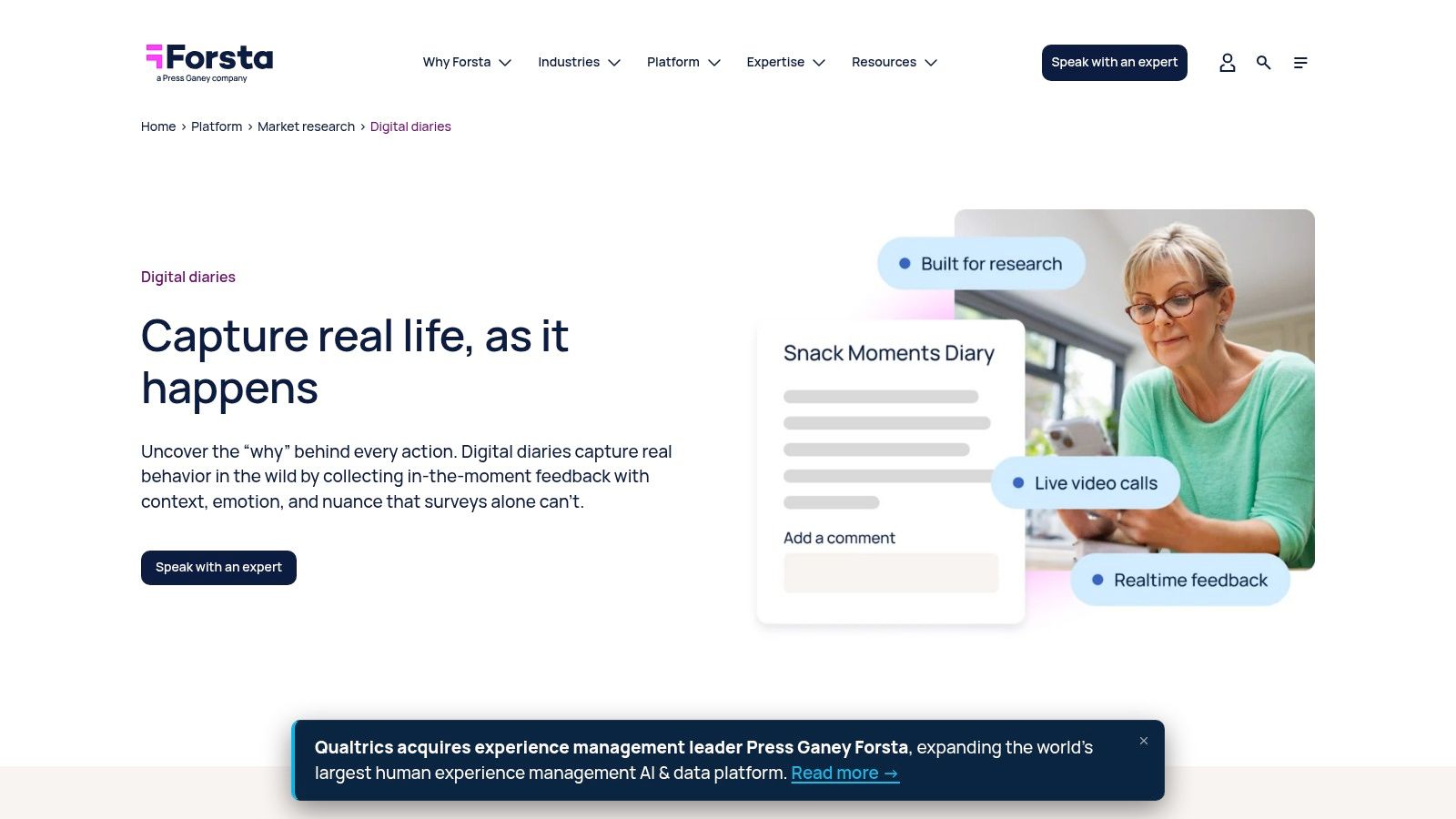
Forsta Digital Diaries suits organizations that already run research through shared systems, approvals, and cross-functional reporting. The diary tool matters, but the bigger question is whether the study has to fit existing governance, participant databases, and enterprise workflows.
That changes the evaluation criteria.
For a centralized insights team, Forsta can reduce operational friction after procurement. Study templates, structured activity flows, device support, and discussion features help standardize how longitudinal work is run across regions or business units. That consistency matters when multiple teams need comparable outputs, not just raw diary entries.
The trade-off shows up before launch and during analysis. Teams usually need more planning around permissions, setup, stakeholder access, and handoff rules than they would with a lighter diary platform. If the research team is small, that overhead can outweigh the benefit, especially for a short study with a narrow question.
A practical way to judge Forsta is to ask who owns study administration:
If research ops or an enterprise insights function is involved, Forsta is easier to justify.
If a single researcher needs to launch fast, it may feel heavy for the job.
If procurement needs pricing clarity early, the sales-led buying process will slow comparison.
Forsta also makes more sense when diary work is part of a broader program rather than a one-off field study. Teams that combine longitudinal capture with concept feedback, discussion threads, or ongoing audience research may get more value from the platform than teams running simple mobile journals.
CleverX's overview of diary-study tools and platform trends points to the same split in the category, between simpler capture tools and larger systems built for program management: CleverX's overview of diary-study tools and platform trends.
Uxia fits earlier in the workflow. Use it for rapid synthetic UX validation when flows are still changing or when you need a quick check between human longitudinal studies. Forsta is the better fit once the organization has already decided the diary program needs formal administration and wider stakeholder visibility.
Learn more at Forsta Digital Diaries.
5. Recollective
Recollective suits teams that expect a diary study to spill into broader qualitative work. The platform handles journals, threaded discussion, activities, and community-style engagement in one place, which matters when the workflow includes follow-up probing instead of one-way entry collection.
Its strongest operational advantage is not capture alone. It is the combination of study administration and pricing visibility. Buyers usually get a clearer sense of packaging earlier than they do with more sales-led enterprise platforms, and that makes shortlisting faster.
The trade-off is weight. Recollective makes more sense when the team needs to manage participant engagement over time, moderate asynchronously, and keep analysis organized across multiple activity types. For a short mobile diary with simple recurring prompts, that setup can be more platform than the study needs.
A practical test is to look at where the workload will land after fieldwork starts:
If participant compliance needs active moderation, Recollective gives researchers more room to prompt, follow up, and sustain engagement over several waves.
If analysis effort is the bottleneck, built-in organization and AI-supported workflows are more useful than they sound in vendor copy. Diary studies create a lot of messy, uneven submissions.
If the study may expand into a standing community or mixed async qual program, Recollective is easier to justify than a diary-only tool.
That last point matters because diary quality often breaks down in operations, not in study design. Entry volume builds quickly, participant effort drifts, and synthesis gets expensive if the tool treats every submission as an isolated artifact. Teams comparing platforms should examine the downstream analysis workflow as closely as the entry experience. This guide to qualitative data analysis tools for UX research is a useful companion if analysis capacity is the constraint.
Recollective is a better fit for mid-sized and larger research teams than for solo researchers trying to launch quickly on a tight budget. It supports richer longitudinal programs, but that flexibility brings setup and moderation overhead.
Uxia fits earlier and between studies. Use it for rapid synthetic UX validation when a flow is still changing, when you need to check assumptions before launching a longitudinal study, or when you want directional feedback between human diary rounds. Recollective is stronger once the priority shifts to managing real participant submissions over time and connecting those entries to broader asynchronous research.
Visit Recollective.
6. QualSights

QualSights works best in studies where the research team needs more than recurring diary prompts. It is built for programs that combine longitudinal capture with mobile ethnography, in-home product use, screen recording, and self-guided tasks in the same participant flow. That changes the operational trade-off. The benefit is fewer handoffs between tools. The cost is a heavier setup than a diary-first platform.
A practical example is mobile commerce or fintech research where behavior happens on-screen and in context. Asking for a written recap later often misses the point. QualSights can capture the screen session alongside the participant's in-the-moment response, which gives moderators better evidence when they need to separate recall bias from actual task friction. In real projects, that usually improves analysis quality more than adding another open-ended question.
The downside shows up in administration. Studies with simple daily or weekly check-ins can feel overbuilt here, and participant compliance may drop if every activity asks for richer media than the question really needs. Teams need to be selective. Use the screen and self-moderated components for moments where sequence, environment, or product handling matter. Keep the rest lightweight.
QualSights is a strong fit for teams running:
product diaries tied to real-world usage or unboxing
self-moderated mobile tasks where context matters as much as the answer
mixed-method studies that need diary entries, screen capture, and concept feedback in one place
It is less convincing for a small team that mainly needs clean reminder cadence, fast review of short entries, and straightforward exports for synthesis. In that situation, a narrower diary tool often creates less moderator overhead.
Uxia fits earlier in the workflow. Use it to validate flows or concepts before the longitudinal study starts, or between diary rounds when the team needs fast synthetic UX feedback without recruiting another human cohort.
Explore QualSights.
7. Fuel Cycle
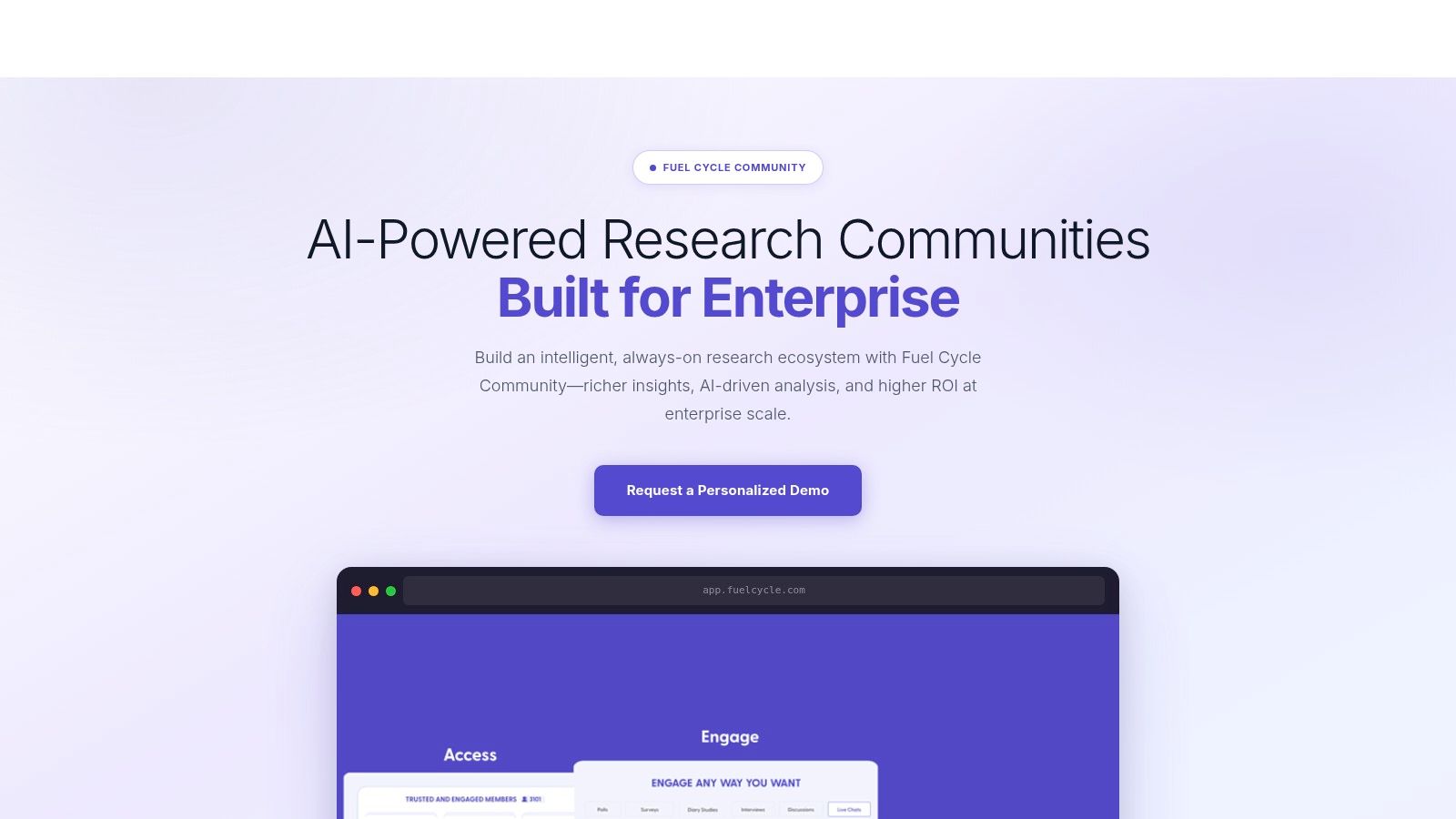
Fuel Cycle makes more sense as a research community platform with a diary capability than as a dedicated diary tool. That difference affects almost every operational decision, from participant management to analysis workload to budget approval.
For established insight teams, that can be a strength. If the plan is to run recurring diary studies with the same audience, layer in quick polls and discussions between rounds, and keep a standing panel warm over time, Fuel Cycle supports that model well. The trade-off is setup effort. Teams have to configure the community, define engagement rules, and manage participation beyond the diary itself.
The practical question is not feature count. It is whether your study quality depends on having an ongoing member base.
Fuel Cycle tends to fit three situations especially well:
a central insights or CX team running repeated longitudinal studies across product lines
organizations that need diary work to sit inside a broader community and feedback program
teams willing to accept more admin overhead in exchange for repeat access to known participants
That overhead is real. Diary studies often succeed or fail on compliance, and compliance drops when the participant experience carries extra community steps that do not help the research task. Fuel Cycle works better when those added layers serve a purpose, such as maintaining a long-term cohort or combining diary entries with other engagement formats.
Recruitment also needs careful planning. Diary research usually does not require a massive sample, but it does require participants who match the use case and will keep responding over time. If that part is slowing the study down, this guide to user research recruitment platforms for longitudinal studies is a useful companion.
Analysis is another consideration. Fuel Cycle can help teams administer studies at program scale, but researchers still need a clear synthesis plan before launch. Without one, repeated entries pile up quickly and the efficiency gains on the ops side get lost in downstream coding and review.
For smaller UX teams running a single product diary, Fuel Cycle can feel like too much platform for the job. In those cases, a lighter diary-first tool usually creates less moderator overhead. Uxia fits earlier in the workflow, especially when a team wants rapid synthetic UX validation on a flow or concept before committing to a longer human diary study, or between diary rounds when new design questions appear.
See Fuel Cycle.
8. Field Notes
Field Notes is a narrower tool, and that focus helps in the right study. If the research depends on participants showing what happened in the moment through selfie video, environment clips, or screen recordings, a lighter mobile workflow often produces better entries than a broader platform with extra steps.
The practical question is not feature count. It is whether participants will respond consistently for the length of the study.
Field Notes fits teams that care more about capture quality than back-office complexity. It is well suited to app journeys, retail visits, service experiences, and other studies where context is easier to see than describe. Small research teams can usually get a study live without much configuration overhead, which matters when the bottleneck is time to launch and moderator bandwidth.
A few trade-offs stand out:
Strong fit for in-the-moment evidence: Video and screen capture are useful when recall would flatten the experience.
Lower admin burden: Simpler studies are easier to set up and easier for participants to follow.
More manual synthesis: Teams should expect to spend real time reviewing footage, tagging patterns, and pulling clips.
Less suited to enterprise research ops: If you need heavy governance, broad integrations, or large multi-study programs, this can feel limited.
Field Notes makes the most sense for a focused diary study with clear prompts and a defined review plan. Without that plan, video-heavy research creates analysis drag quickly.
It also pairs well with adjacent contextual methods. Teams that are blending diary prompts with observational work can use this guide to field studies in UX research to decide where each method adds signal.
Uxia belongs earlier in the workflow. It helps teams test likely UX friction in a flow before launching a longitudinal study, or between diary rounds when new hypotheses appear and a full human study would be slow.
Visit Field Notes.
9. Over The Shoulder (Sago)
Over The Shoulder is less of a self-serve diary tool and more of a managed mobile ethnography setup. That distinction matters. Teams evaluating it should look past the capture features and ask a harder question: who is going to recruit, localize, schedule, support participants, and keep compliance from dropping in week two?
A concrete example helps. Say a team is studying medication routines across three countries. Day one asks for a morning check-in video. If a participant says they missed a dose, the next prompt branches into a short explanation, a photo of where the medication was stored, and a follow-up later that evening. If they completed the routine, they get a lighter path. In practice, that kind of branching reduces irrelevant prompts and improves completion quality, especially in multilingual studies where fatigue shows up fast.
The platform is a stronger fit when study quality depends on operational support as much as on software.
What stands out in real workflows:
Branching missions help protect compliance: Participants see prompts tied to what they already reported, instead of a flat sequence that becomes repetitive.
Good fit for routine-based behavior: Health, finance, home, retail, and caregiving studies often benefit from repeated capture over several days or weeks.
Service support can offset thin internal ops: Teams without dedicated coordinators may get more value from Sago than from a cheaper self-serve tool.
The trade-off is clarity before purchase. Public documentation is lighter than with several competitors, so it is harder to judge study setup, admin controls, and analysis workflow without a demo. Pricing is usually project-based too, which can work for high-stakes studies but makes side-by-side budgeting harder for smaller teams.
I would shortlist Over The Shoulder when the main risk is field execution, not prompt authoring. If the team first needs to pressure-test a flow, message, or task path before committing to a longitudinal human study, Uxia is the more useful complement. It helps validate likely UX friction between diary rounds or before recruitment starts. Once the study requires multilingual participant management and hands-on delivery support, Sago becomes easier to justify.
See Sago.
10. FlexMR InsightHub
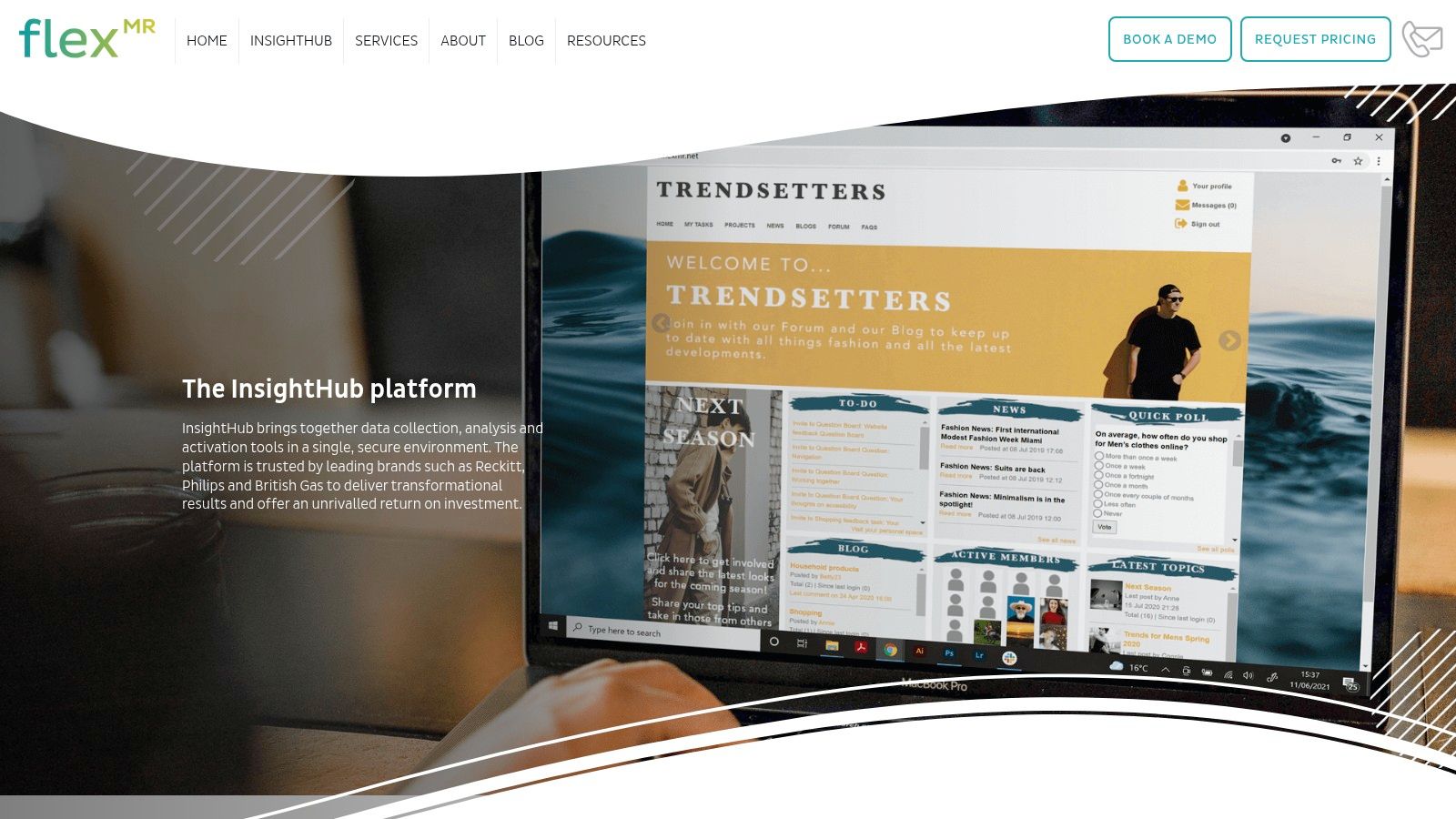
FlexMR InsightHub makes sense for teams that run diary studies as part of a broader research program, not as a one-off exercise. The practical advantage is operational. Diaries, surveys, follow-up tasks, and external links can sit inside one study flow, which reduces manual handoffs and gives researchers a cleaner admin setup.
That matters most when the study design mixes repeated check-ins with other methods. A participant can complete a diary entry, get routed to a concept review or survey, and continue in the same environment. For lean teams, that usually saves more time in fieldwork management than another long list of capture formats.
The fit is narrower than the feature set suggests.
FlexMR works best for structured recurring studies where compliance depends on cadence, reminders, and clear task logic more than on highly polished mobile ethnography. If the goal is rich in-the-moment storytelling with low participant friction, some mobile-first tools are stronger. If the goal is keeping a multi-step longitudinal study organized without adopting a heavier enterprise community platform, InsightHub is easier to justify.
Three operational questions help decide whether it belongs on your shortlist:
Will participants tolerate the study cadence?
FlexMR supports recurring diary tasks and reminder workflows well, which helps with weekly or daily reporting. That is useful for habit tracking, service use, or routine decision-making. It is less persuasive for studies that depend on spontaneous capture in messy real-world moments.
How much admin work will the team absorb?
The platform is more appealing when one researcher would otherwise stitch together diary prompts, survey tools, and follow-up tasks manually. Consolidation helps. Teams should still test the participant journey carefully, because diary quality drops fast when the flow feels procedural rather than timely.
How clear is the buying process?
Pricing is not transparent, and the product naming in documentation can take some sorting out before a team understands what is included. That is manageable for established research programs. It is a bigger issue for smaller teams comparing tools side by side on budget and setup effort.
I would consider FlexMR when the main need is study orchestration. Use Uxia earlier in the process if the team still needs to validate flows, prompts, or likely friction points before committing to a longitudinal human study. That split works well in practice. Synthetic testing helps narrow what is worth observing over time, then InsightHub can run the actual diary workflow with fewer assumptions.
Visit FlexMR InsightHub.
Top 10 Diary Study Tools, Feature Comparison
Platform | Core features | UX & Quality (★) | Value & Pricing (💰) | Target audience (👥) | Unique selling points (✨ / 🏆) |
|---|---|---|---|---|---|
dscout | Mobile-first diary; video/photo/screen/text; templates & recruiting; AI-assisted analysis | ★★★★☆ Mature workflows, high compliance | 💰 Sales‑guided; enterprise-ready | 👥 Teams needing longitudinal, in‑the‑moment capture | ✨ Turnkey multimedia diary + participant pool; 🏆 mature researcher workflows |
Indeemo | Asynchronous mobile ethnography; selfie video, images, ratings; guided onboarding | ★★★★☆ Low‑friction UX boosts compliance | 💰 Sales‑guided; perceived premium | 👥 IHUTs, shop‑alongs, in‑context fieldwork teams | ✨ Instagram‑style mobile UX for naturalistic capture |
EthOS | Task-based diaries; native iOS/Android apps; push prompts | ★★★★ Purpose-built mobile diary experience | 💰 Custom pricing via sales | 👥 Mobile/ESM studies and longitudinal researchers | ✨ Native apps + push prompting for onboarding |
Forsta Digital Diaries | Device-agnostic multimedia; community feeds; activity sequencing & governance | ★★★★☆ Enterprise-grade robustness; steeper learning curve | 💰 Enterprise pricing; sales‑guided | 👥 Large enterprises running multi-market programs | ✨ Program-level governance & integrations; 🏆 enterprise scale |
Recollective | Asynchronous diaries + live sessions; AI translation & “Ask AI”; community modules | ★★★★ Clear pricing guidance & strong support | 💰 Public pricing + project estimator | 👥 Teams needing flexible projects or ongoing communities | ✨ Public pricing + AI-assisted synthesis |
QualSights | Diary + mobile ethnography; screen recording; self/moderated options | ★★★★ Broad method coverage for product research | 💰 Sales‑guided; enterprise services | 👥 Product teams running IHUTs and diaries | ✨ End-to-end mobile qual with integrated screen recording |
Fuel Cycle | Community + native Diary module; auto transcription; gamification | ★★★★☆ Strong for always‑on longitudinal engagement | 💰 Enterprise, sales‑guided | 👥 Brands needing continuous customer listening | ✨ Automation (transcripts/AI moderation) & gamified communities |
Field Notes | Video-first diaries; mobile screen recording; fast launch | ★★★★ Simple, candid UX with high compliance | 💰 Smaller vendor; likely cost-efficient | 👥 Teams wanting candid video diaries quickly | ✨ Focused video-first workflow; faster to launch |
Over The Shoulder (Sago) | Diary missions; multimedia + follow-ups; advanced branching; integrations | ★★★★ Deep mobile-ethnography pedigree | 💰 Project-based, sales‑guided | 👥 Researchers tracking routines/habits globally | ✨ Advanced branching + Sago's translation/services |
FlexMR InsightHub | Research community + diary tasks; reminders; branded apps & external tasks | ★★★★ Balanced feature set; enterprise security | 💰 Sales‑guided; add-ons for apps | 👥 Teams needing recurring capture with security needs | ✨ Reminders & external task integration; 🏆 ISO-certified security |
Choose by Study Context, Not Feature Count
The best diary study tools aren't the ones with the longest features page. They're the ones that hold up under real study conditions. That means participants can respond in the moment, reminders are reliable, admins can manage the schedule without chaos, and researchers can export and synthesize entries without drowning in cleanup work.
For startups and lean product teams, setup burden and pricing visibility matter more than enterprise breadth. Field Notes is a practical option when the goal is focused video diaries with low participant friction. Recollective is worth serious consideration when a team wants stronger upfront budgeting guidance and the possibility of expanding into community-based research later.
For enterprise programs, Forsta Digital Diaries and Fuel Cycle make more sense. They carry more overhead, but they also fit governance, scale, and repeated engagement better than lighter tools. If the research function already operates across regions or business units, that trade-off can be justified.
For remote-only longitudinal studies, dscout remains a strong recommendation. It's well aligned with multimedia, mobile-first, in-the-moment capture, and it has mature researcher workflows. Indeemo and EthOS are also strong when the study depends on naturalistic mobile participation and rich contextual evidence. FlexMR sits in a useful middle tier for recurring diary work without necessarily forcing a full enterprise community model.
The operational comparison usually comes down to a few questions:
Media capture: dscout, Indeemo, EthOS, QualSights, and Field Notes are especially strong when photo, video, and mobile context are central.
Reminders and compliance: dscout, EthOS, and FlexMR are appealing when prompt timing and repeated engagement are core to the design.
Participant management: dscout helps when built-in recruiting matters. Fuel Cycle and Forsta help when participant engagement is part of a larger program.
Analysis and export: Recollective stands out when synthesis workflow and budgeting clarity matter. Enterprise tools become more useful as admin and reporting complexity grows.
Pricing transparency: Recollective is better than most in this area. Most other tools on this list require a sales process.
Setup burden: Field Notes is lighter. Forsta and Fuel Cycle are heavier. dscout sits closer to turnkey for diary-specific work.
If I were narrowing this list quickly, I'd recommend dscout for turnkey multimedia longitudinal research, Field Notes for focused video diaries, Forsta Digital Diaries or Fuel Cycle for enterprise-scale programs, and Recollective when clearer pricing guidance matters.
Uxia belongs in a different but complementary slot. When teams need fast synthetic UX validation before committing to a human diary study, Uxia helps test flows, prototypes, and design concepts without waiting on recruitment. That makes it useful before a diary study starts, between longitudinal rounds, or when the team needs to decide whether a question really requires weeks of human observation.
The most practical advice is simple. Pilot the participant workflow before launch. Test reminder timing on a small internal run. Define how analysis and export will work before the first entry arrives. And confirm pricing against the actual study duration and participant volume you plan to run, not the version described in a demo.
Uxia gives product teams a fast way to validate screens, flows, and prototypes before they invest in a longer human diary study. That makes it useful for shaping the mission, identifying likely friction points, and deciding what deserves longitudinal observation next. If you want to add that rapid validation layer to your research workflow, visit Uxia.