As browser agents get better, a tempting question shows up in every product team: why not just ask a general-purpose AI to “test” our product?
Tools like the Claude browser extension can navigate real sites, complete tasks, and write articulate reports. On the surface, it looks a lot like user testing. We put that question to the test. Our research team ran the exact same missions on three live products, side by side, with two different testers: Uxia’s AI synthetic users and the Claude browser extension, prompted to behave like a first-time user thinking aloud.

SUMMARY
Methodology
Product | Flow | Challenge probed | Uxia | Claude |
|---|---|---|---|---|
Helio | Confirm plan → workspace ready | Broken CTA / non-standard interactivity | 5 testers | 1 run |
Magician | Buy 2 tickets for a date | Visual precision, seat maps, domain changes | 5 testers | 1 run |
Tailor CV | Upload CV → tailor → upgrade | File inputs, account walls, multi-step flows | 5 testers | 1 run |
Products and flows
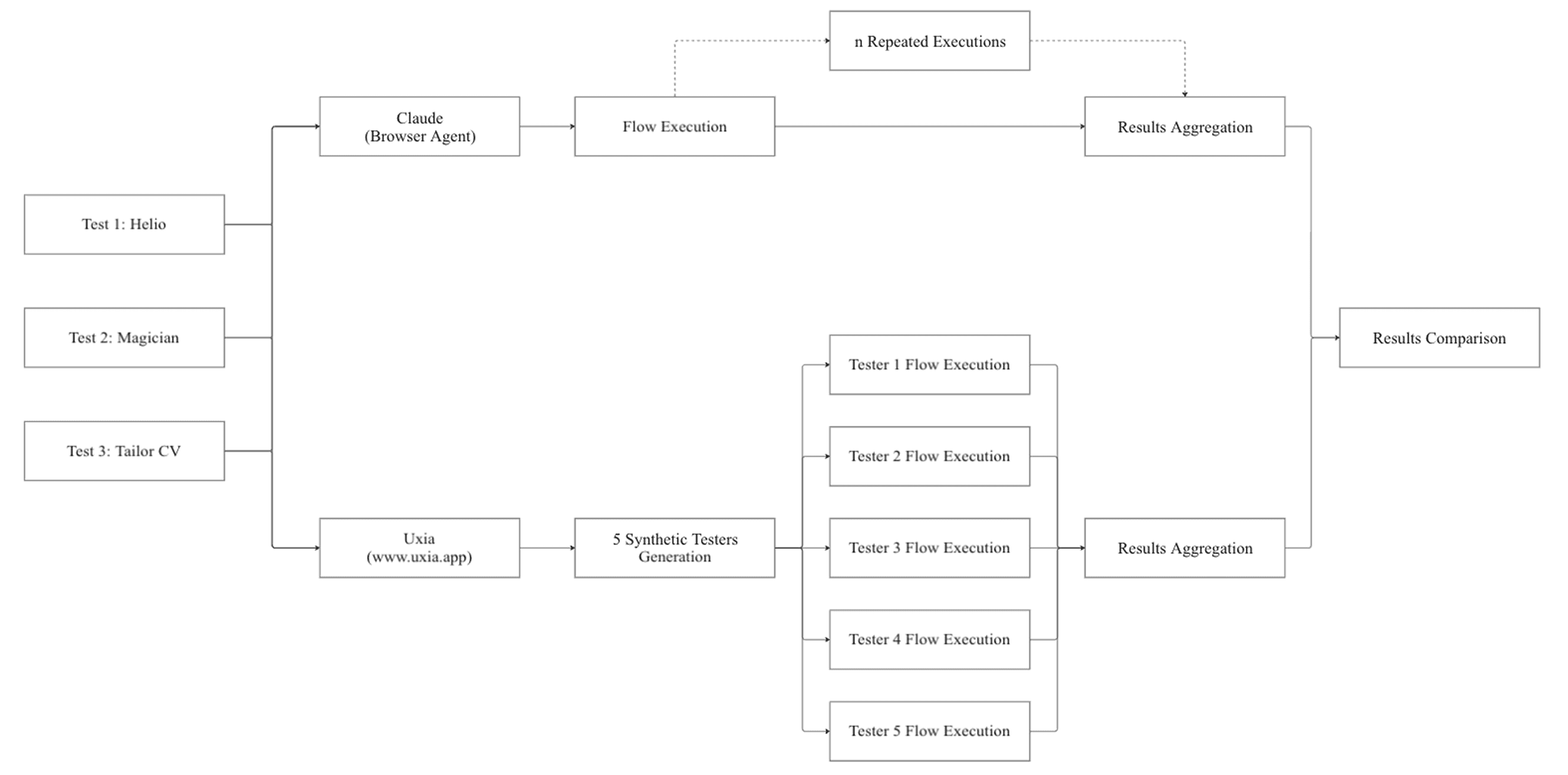
We selected three live-product flows, each probing a distinct interaction challenge:
Helio (SaaS onboarding): confirm plan → workspace ready. Probes a broken CTA / non-standard interactivity.
Magician (El Mago Pop ticketing): purchase two tickets for a specific date. Probes visual precision, seat maps, and domain changes.
Tailor CV (JobWinner.ai): upload a CV, tailor a resume, then upgrade. Probes file inputs, account walls, and multi-step flows.
Tester types
The two approaches were:
Uxia: AI-generated synthetic testers, 5 per test.
Claude: the browser extension agent, a single run per test, prompted to act as a first-time user with think-aloud narration.
Controlled conditions
To keep the comparison fair, every condition was held identical across both approaches: same mission, same live product / URL, same scenario, and same stop condition. The only variable was who performed the test. For each product, the mission, scenario, and stop condition were defined in advance; for example, the Magician mission was “purchase two tickets of the newest Mago Pop show in Barcelona for the 28th of October,” stopping when the tester is asked to input an email address. A separate credential-handling check was run on a login flow.
Why one Claude run per test
In principle, more Claude instances could have been run, but the extension is synchronous and requires upwards of 10 minutes per run, and each output would have to be exported and compared manually after the fact. Uxia’s five testers, by contrast, run in parallel and aggregate automatically.
How results were analyzed
Uxia automatically generates a ready-to-read insights report with severity, cross-tester evidence, and fix suggestions.
The Claude extension produces a free-form narrative report per run and was prompted to deliver its top 5 insights per flow. Because of that instruction, raw insight counts aren’t comparable.
So the analysis focuses on the quality of the insights: how they’re grounded, how actionable they are, and what each approach was structurally able to detect. Results were assessed across five criteria: reliability, behavioral fidelity, insight quality, capabilities, and timing.
Key findings
Reliability
Uxia completed all 3 missions, with every tester finishing end-to-end (15/15 sessions, no manual intervention).
Claude fully completed only 1 of 3 missions on the first execution: one run was blocked at a domain boundary, another was locked out of the product entirely, and both required reruns with manually adjusted permissions. In one case, a blocked run produced a report partly inferred from marketing copy rather than direct observation describing itself as “a hybrid of what was directly observed on the marketing site and what the in-app flow would look like,” with estimated step counts.
Behavioral fidelity
All Uxia testers behaved within the boundaries of human limits. On Helio, where the “Continue to workspace” button was genuinely broken, Uxia’s testers got stuck exactly as a real user would: clicking repeatedly, trying recovery paths, and reporting the dead ends.
The Claude agent instead inspected the DOM, fired the React onClick handler programmatically, and reported the task as completed on a flow no human could finish. The same pattern recurred: zoom tooling and JS-assisted targeting for 5–7px seat dots, scripted checkbox forcing, and a CV upload the extension could not perform at all (a human operator had to attach the file).
Insight quality
Uxia insights are grounded in what multiple testers actually experienced, each scored for severity, backed by cross-tester frequency and evidence quotes, and paired with a fix suggestion.
Claude’s single-run insights are articulate but unscored, single-perspective, and in the worst case describe flows the agent never actually touched. Both approaches caught the obvious friction points (broken Helio CTA, dense seat map, late pricing and fees, registration wall, mid-flow paywall, duplicate CV upload), but several high-impact issues were surfaced only by Uxia:
Product | Issues surfaced only by Uxia |
|---|---|
Helio | Terms checkbox is unstable and can be reset by interacting with the legal links (found by 4 of 5 testers); recovery navigation traps users in a loop; the Enter key does not submit the final confirmation form. |
Magician | No support for selecting two adjacent seats; invalid seat combinations are only rejected at checkout.
|
Tailor CV | The generated resume shows the wrong personal identity with a different person’s name, photo, and NULL-value placeholder artifacts (found by 4 of 5 testers).
|
The identity-leakage finding, arguably the most business-critical issue in the comparison, was only discoverable because Uxia testers each carried a realistic persona and CV through the full flow, something the Claude run could not do.
Claude did contribute some genuine observations Uxia’s panel did not flag, such as a hidden second floor on the seat map, a below-the-fold Terms checkbox on Helio, and marketing-site issues (a broken /pricing URL, inconsistent social-proof numbers) that fell outside the Uxia missions’ scope.
Coverage
Every Uxia test ran with 5 differentiated synthetic testers (10 by default on standard platform plans), producing cross-tester frequency data.
Claude produced one run, one persona, and no frequency data.
Capabilities
Misclick tracking, heatmaps, journey diagrams, and standardized UXIA-Q scoring are available in Uxia and have no equivalent in the Claude extension.
Uxia also supports native file inputs and stores credentials in-platform without passing them through the AI session. Claude handles login credentials correctly (masked and redacted in logs) but must be given them within the agent session.
Execution time
A complete five-tester Uxia panel runs in parallel and aggregates automatically in approximately 15 minutes end-to-end. With the browser agent, the same coverage costs either roughly 50+ minutes of sequential runs, or parallel sessions that the operator must export and aggregate manually.
Conclusion
A general-purpose browser agent can navigate a site, narrate friction articulately, and occasionally spot issues outside the test’s scope. But as a usability instrument it lacks the fidelity, coverage, replication, and instrumentation that make findings trustworthy. Because it is optimized to complete a task by any means available, it can bypass the very failures a usability test is meant to reveal, reporting success on a flow with a 100% human failure rate.
A browser agent can describe a page. A purpose-built synthetic testing platform tells you what real users will actually experience reliably, repeatably, and at scale.