Get Insights Fast With Synthetic User Interviews
Learn how synthetic user interviews help you validate ideas and uncover real user needs before you build anything. Get insights instantly.

Imagine having a deep, insightful conversation with your ideal customer about their problems and needs—before you've even written a line of code. That’s the core idea behind synthetic user interviews. It's an AI-driven method that lets you explore ideas and validate problem spaces without the time and cost of recruiting real people for that crucial first look.
Decoding Synthetic User Interviews

So, what are they, really? Synthetic user interviews are in-depth, conversational interviews you run with AI-powered personas instead of human participants. These aren’t just basic chatbots. They are sophisticated AI agents built to represent the specific traits, motivations, and pain points of your target audience.
Think of it as having a 24/7 focus group of perfectly matched individuals, ready to help you find product-market fit whenever you need them.
This approach is changing how product teams handle the very earliest stages of development. Instead of spending weeks finding, scheduling, and paying people for discovery interviews, you can get rich, qualitative feedback in minutes.
Finding Needs Before Building Solutions
Here’s the most important thing to realise: the goal of synthetic user interviews is to validate the problem, not the solution. This is a critical distinction. This method shines in the messy, "fuzzy" ideation phase, where your main questions are:
Is the problem we think exists actually a real problem for our target audience?
What are the underlying needs and frustrations people face in this area?
How are they currently solving this, if at all?
What language do they use to describe their challenges?
Platforms like Uxia have developed new tools specifically for this. Our new discovery product allows you to conduct deep interviews with your synthetic audience to uncover these crucial insights. By engaging with these AI personas, you can explore a wide problem space, pinpoint unmet needs, and build a strong hypothesis about what to build next.
Practical Recommendation: Before you sketch a single wireframe, run a set of synthetic user interviews to validate the core problem. Ask open-ended questions about your audience's challenges to confirm a genuine need exists. This simple step can save you months of building the wrong thing.
This early-stage validation is priceless. It helps teams avoid sinking huge amounts of time and resources into a product nobody actually wants. It de-risks your product strategy from day one, helping you answer the most important question: "Should we even build this at all?"
Only after you know what to build and have a first version or prototype can you move on to the next stage of validation. That's where methods like Uxia's flagship AI User Testing become essential for testing tangible interfaces and workflows.
Synthetic Versus Traditional User Interviews
Thinking about synthetic versus traditional user interviews isn’t a matter of one being "better" than the other. It’s about knowing which tool to pull out of your toolkit and when. The two methods work together beautifully—one helps you figure out if you're even on the right path, while the other confirms you're walking it correctly.
We all know the traditional interview process. You recruit real people, schedule calls, and spend hours talking to them. It's often slow, taking weeks from start to finish. It can also get expensive fast, between paying for participants' time and your own. But there’s no denying the value you get from hearing real human stories and seeing genuine emotional reactions.
Synthetic user interviews, on the other hand, offer incredible speed and cost savings. Instead of waiting weeks, you can pull deep qualitative insights in minutes. This lets you test new ideas almost as fast as you can think of them.
To help you decide which approach fits your needs, here is a breakdown of how they stack up against each other.
Comparing Synthetic and Traditional User Interviews
This table gives you a side-by-side look at how synthetic and traditional interviews compare across the most important research criteria.
Criterion | Synthetic User Interviews (e.g., Uxia Discovery) | Traditional User Interviews |
|---|---|---|
Speed | Minutes | Weeks |
Cost | Low (fixed subscription) | High (incentives, recruitment, time) |
Best For | Early-stage discovery, problem validation, exploring needs | Late-stage validation, emotional nuance, testing tangible products |
Scalability | Instantly scalable | Difficult and expensive to scale |
Consistency | Highly consistent and repeatable | Varies from person to person |
Bias | Controlled and minimal | Prone to human biases (interviewer and participant) |
As you can see, each method has its own clear strengths, making them ideal for different stages of the product development lifecycle.
When to Use Each Method
The real difference comes down to where you are in your project. Traditional interviews are fantastic for understanding complex human context and getting feedback on a product you can actually show someone.
But synthetic interviews shine in that messy, ambiguous, early phase of product development.
Practical Recommendation: Use synthetic user interviews for the ‘zero-to-one’ stage of discovery. This is when you're just exploring a problem space, trying to validate if a need is real, or testing a core value proposition—long before a single line of code or a pixel is in place.
This is exactly the gap Uxia’s new discovery product was built to fill. It lets you run deep, exploratory interviews with an AI audience to find a genuine, unmet need. Once you have those insights, you can build a prototype and move on to Uxia's flagship AI User Testing platform, which is designed for validating concrete interfaces and user flows. It creates a seamless workflow, taking you from a vague idea to a fully validated design.
For a deeper dive into this topic, you can learn more about the differences between synthetic users and human users in our dedicated article.
Ultimately, the goal is to build a more complete and effective research practice. By using AI-powered interviews for your early discovery work, you can form much stronger, data-backed hypotheses. This makes your later traditional interviews or usability tests more focused and powerful because you’ll be talking to real users about a problem you already know is real.
This combined approach saves time, cuts down on risk, and helps you build products with a whole lot more confidence.
How AI Powers Authentic User Conversations
To really get what makes synthetic user interviews work, you need to look past the idea of a simple chatbot. This isn't just about spitting out text. It’s about simulating genuine human thought to produce the kind of conversational insights you'd get from a real person. Think of it as a carefully assembled pipeline of different AI models, all working together.
At the core, you have advanced Large Language Models (LLMs). These are the engines that produce the conversational text. But on their own, they can be pretty generic. The real magic happens when you layer on dynamic persona generation and calibrate the whole system with real-world data.
This is where a platform like Uxia makes all the difference. Instead of using off-the-shelf models, our system builds AI users who can explain their needs and pain points with surprising realism. We ground these AI personas in authentic demographic and behavioural patterns, making sure the insights you get are truly representative. Much of this relies on sophisticated AI speech to text technology, which allows for the seamless conversion of spoken dialogue into data you can actually analyse.
Grounding AI Personas in Real-World Data
So, how do you go from generic AI responses to genuine, actionable feedback? It all comes down to giving the AI a deep understanding of human behaviour. We do this by training and fine-tuning the models on massive, high-quality datasets.
For instance, when calibrating synthetic user interviews for the European Union, we use data from sources like the European Social Survey (ESS). This survey has been a gold standard for understanding public attitudes and demographics since its start in 2002. By feeding this high-fidelity data into our models, we can ensure the generated interviews mirror real European consumer sentiments with up to 85% behavioural accuracy, as shown in our pilot tests.
This data-first approach is what lets a platform like Uxia deliver the deep, qualitative feedback you need to build a product strategy you can be confident in. It’s about generating authentic insights, not just words on a screen. This is especially critical for the early discovery and validation stages of product development.
This process flow shows how AI-driven discovery naturally sets the stage for human-led validation.
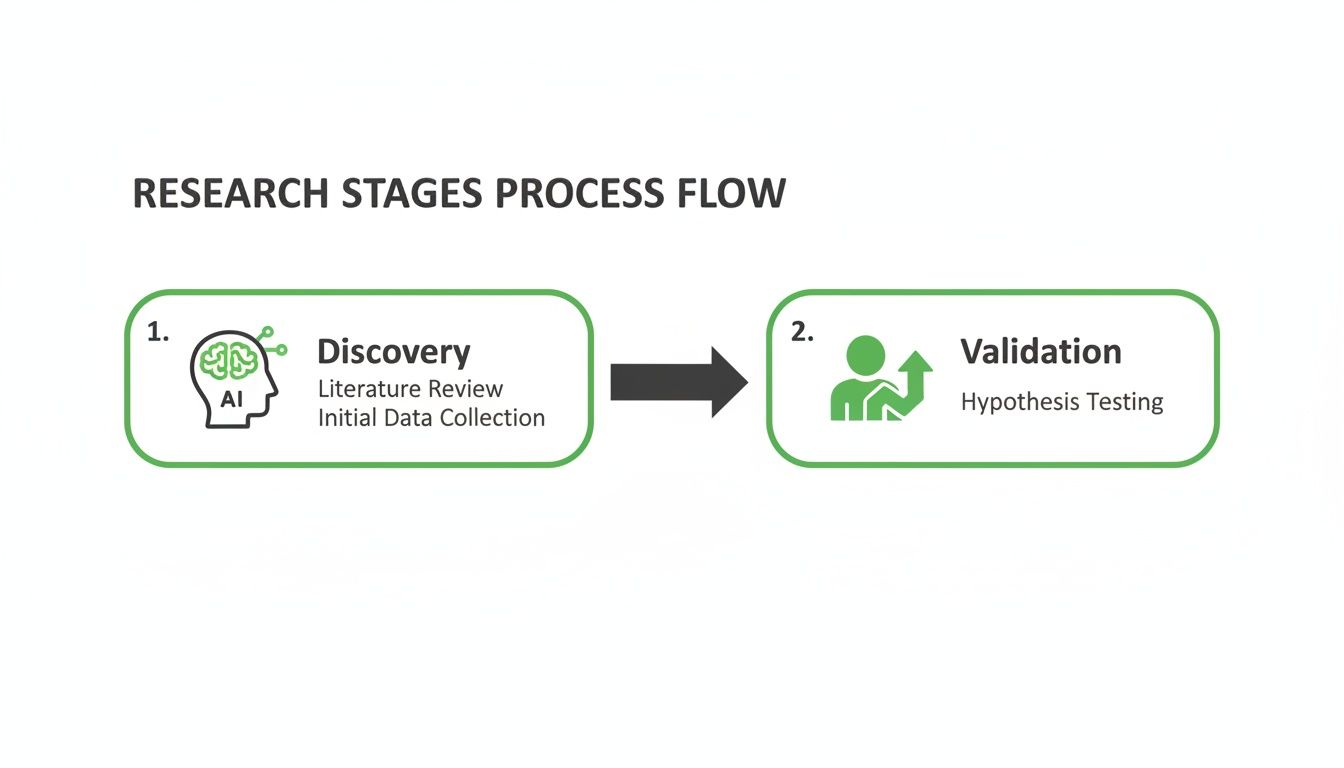
As you can see, the AI-powered discovery phase is the perfect starting point for exploring a problem space. Those findings then flow directly into validating your proposed solutions with real people.
Uxia's Approach: Our new product for discovery is built entirely for these deep, early-stage interviews. Once you pinpoint a real need, you can shift to our flagship AI User Testing platform to validate a tangible prototype against it.
This structured method makes sure you’re not just building something, but building the right thing based on a properly validated need. It’s how modern teams get from a rough idea to a solid concept with speed and confidence.
For a deeper look, check out our guide on how AI is being applied to user research.
Practical Use Cases for Product Teams
Alright, let's move from the theory to the real world. How can product teams actually use synthetic user interviews to their advantage?
The true power here is speed. It’s about making smarter decisions and killing bad ideas right at the start of the product lifecycle, saving you countless hours and a significant chunk of your budget.
Think of it this way: instead of spending weeks finding and scheduling people for interviews, you get rich, qualitative insights in minutes. This is a perfect example of AI automating manual processes that have traditionally slowed product teams down to a crawl.
Validating an Idea Before Seeking Investment
Imagine you have a new business idea. Before you write a single line of code or build a pitch deck, you need to answer one crucial question: is the problem I’m solving real?
With a platform like Uxia, you can run a dozen deep interviews with synthetic personas matching your ideal customer profile. You can dig into their current pains, the workarounds they’ve cobbled together, and what they truly desire in a solution.
This isn't just theory—it's concrete evidence. It’s exactly what investors want to see, because it proves a genuine market need exists before you've spent a single euro.
Defining a Feature Set for a New Product
When you're first exploring a big problem, it’s incredibly easy to get lost in an endless wish list of features. Synthetic user interviews are your focusing lens, helping you zero in on what truly matters to your audience.
Explore pain points: Use open-ended questions to uncover the biggest, most nagging frustrations your target users are dealing with.
Test value propositions: Pitch different benefits and see which ones actually resonate with the AI personas. Do they care more about saving time or saving money?
Prioritise needs: The interview transcripts will quickly show you which problems are most urgent, helping you define a minimal viable product (MVP) that delivers immediate, undeniable value.
A fictional startup, "FlexiPlan," used Uxia’s synthetic interviews to understand the challenges freelance project managers face. They initially assumed the main problem was invoicing. The interviews, however, revealed the real, unmet need was managing client communication and constantly changing project scopes. This one insight led to a successful pivot before they wasted months building the wrong features.
This is where the ROI becomes crystal clear. A few hours spent in early discovery can prevent months of engineering work on a solution nobody will ever use. You get to build with the confidence that you’re solving the right problem from day one.
How to Run Your First Synthetic User Interview
So, you’re ready to stop theorising and start testing. Good. Launching your first synthetic user interview is a surprisingly quick process, designed to take you from a vague question to a set of concrete, actionable insights in minutes.
Here’s a practical guide on how to run your first interview on a platform like Uxia.
Define Your Goal, Then Your Persona
First things first: what are you trying to learn? Forget about the AI for a second and focus on your core research goal. Are you exploring a new product idea? Digging into the daily frustrations of a specific customer segment?
This single question will shape everything that follows.
Once your objective is locked in, you can build your audience. With synthetic user interviews, you’re not just picking from a list of generic demographics. You’re crafting a detailed persona that reflects the real-world attributes you care about, like:
Demographics: Age, location, and professional background.
Motivations: What are their core drivers and long-term goals?
Pain Points: What specific problems or frustrations do they face today?
Tech Habits: Are they early adopters or more cautious with new tools?
Next, you write your questions. The secret to a great interview—human or synthetic—is asking open-ended questions. Avoid anything that can be answered with a simple "yes" or "no".
Instead, prompt for stories. Ask things like, "Can you walk me through how you currently solve [problem]?" or "Tell me about a time you felt really frustrated with [task]." This is how you uncover the why behind the behaviour.
The entire process is built for speed and simplicity. It’s a clean, four-step workflow: define, write, launch, and analyse.
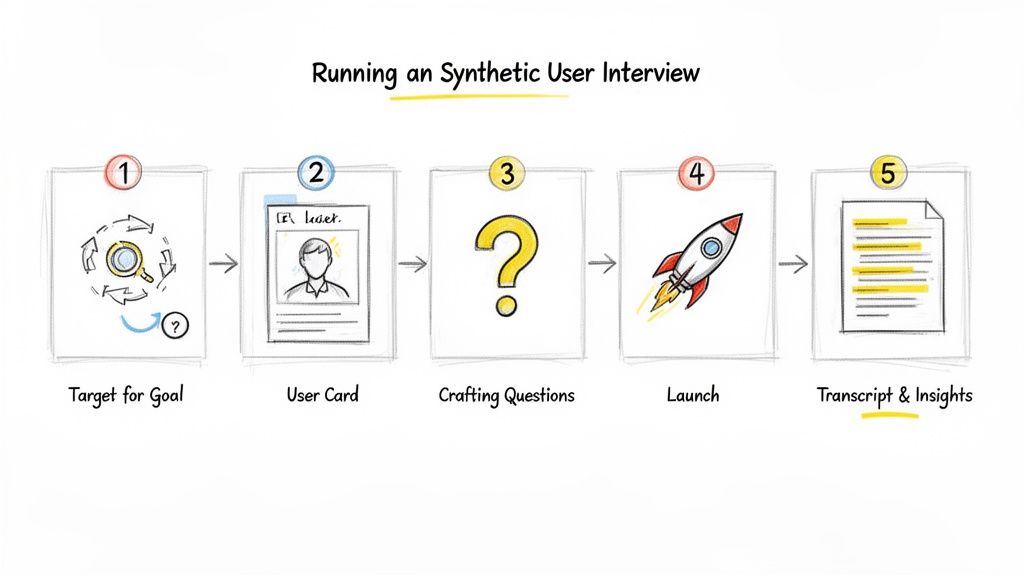
Launch and Get Your Insights Instantly
Once your questions are ready, you just hit launch. That’s it. Uxia's AI immediately starts a deep, conversational interview with the persona you just built.
There’s no recruitment. No scheduling emails. No waiting for participants to show up. Within minutes, the interview is complete, and your results are ready.
What you get back is pure qualitative gold. The output from synthetic user interviews includes:
Full Interview Transcripts: A complete, word-for-word record of the entire conversation. You can follow the AI's thought process as it responds to your prompts, giving you a clear window into its reasoning.
AI-Powered Thematic Analysis: Uxia doesn’t just give you a wall of text. It automatically combs through the transcript to pull out recurring themes, key pain points, and direct quotes that back up the findings.
Prioritised Insights: The platform surfaces the most critical issues and opportunities, telling you exactly where to focus your attention first.
Practical Recommendation: For this early validation stage, use Uxia’s new discovery product. It’s specifically optimised for the kind of deep interviews needed to find a genuine user need. Once you know what to build and have a prototype, you can switch to our flagship AI User Testing platform for usability validation.
This simple workflow completely changes the game for early-stage research. It makes gathering deep, strategic insights something you can do this afternoon, not next quarter.
If you’re ready to see it in action, you can learn more about how Uxia powers this entire process on our platform.
Addressing Limitations and Best Practices
Like any powerful tool, knowing the limits of synthetic user interviews is the key to using them well. For all their incredible speed, they aren't a magic bullet. To use them responsibly, we have to be honest about what they can and can’t do.
The biggest limitation is obvious once you think about it: they can't capture non-verbal cues. A synthetic user can tell you exactly why something is frustrating, but it can't show you with a subtle sigh, a furrowed brow, or that split-second hesitation that often points to the deepest insights in a human interview. Then there’s the risk of AI "hallucinations"—where the model might generate a response that sounds plausible but is factually off-base.
Mitigating Risks and Improving Reliability
Knowing these limitations is the first step. The next is to actively work around them. With a few smart practices, you can dramatically increase the reliability of your findings. This is exactly where platforms like Uxia are designed to help, making the technology both powerful and trustworthy.
Here are a few practical ways to do it:
Triangulate Your Data: Never, ever rely on synthetic interviews alone. Use them to generate strong initial hypotheses, then back those findings up with other data—analytics, surveys, or even just a couple of traditional user interviews.
Frame Unbiased Questions: Remember, garbage in, garbage out. The quality of the AI's output is a direct reflection of your input. Ask open-ended, non-leading questions to avoid accidentally steering the AI toward the answer you want to hear.
Use Trusted Platforms: Stick with platforms that are transparent about their AI models and data sources. Uxia, for instance, is engineered from the ground up to increase reliability, helping your team integrate AI into your research workflow with confidence.
The goal isn’t to replace human insight, but to supercharge it. Use synthetic interviews for rapid, early-stage discovery, and you’ll make your follow-up human research far more focused and effective.
Adoption of this tech is still growing. Recent data from the European Social Survey shows that only 12% of UX teams in Spain and Germany have used AI interviews, compared to 28% in the UK. But the demand is there: 62% of digital natives are open to AI-simulated feedback, which signals a clear runway for growth. You can learn more about these user research trends and how data calibration can boost accuracy.
By following these best practices, you can stay ahead of the curve and make synthetic user interviews a powerful, reliable part of your research toolkit.
Frequently Asked Questions
Got questions about synthetic interviews? We've got answers. Here are some of the most common things people ask us about using them for product discovery.
How Are the Synthetic Personas Actually Created?
It’s a common question. These aren’t just random AI chatbots. The process starts with real-world data from massive studies like the European Social Survey.
On a platform like Uxia, you’re in the driver's seat. You define who you want to talk to by setting attributes like demographics, job roles, goals, and even how tech-savvy they are. The AI then synthesises all that information to construct a detailed, realistic persona that thinks and speaks like that user segment. This ensures every response is calibrated and genuinely relevant to your research.
Do Synthetic Interviews Replace Talking to Real Customers?
No, and they shouldn't. Think of them as different tools for different jobs.
Synthetic user interviews shine in the early discovery phase. They're perfect for validating problems, exploring user needs, and forming strong hypotheses at lightning speed—often before you even have a product to show. Once you move to a prototype, getting direct feedback from real users is crucial for fine-tuning usability.
This is exactly why Uxia offers two distinct products. Our new discovery tool is built for these deep, early-stage synthetic user interviews to make sure you’re solving the right problem. Then, when you have a prototype, our flagship AI User Testing platform is ready to validate your solution with synthetic testers.
Is This Only for Big Companies with Big Budgets?
Not at all. In fact, we see synthetic interviews as a total game-changer for startups and small teams who are always short on time and money. It makes deep, foundational user insight accessible to everyone.
Platforms like Uxia are designed to level the playing field. They give smaller organisations instant access to the kind of foundational research that used to be a luxury only large enterprises could afford. It’s about letting any team de-risk its strategy and make data-informed decisions right from day one.
Ready to validate your next big idea with confidence? Uxia’s new discovery tool lets you run deep synthetic interviews in minutes, not weeks. Explore Uxia's synthetic user interview platform and start building what your customers truly need.