The 8 Best UX Interview Technicques to Master in 2026
Unlock powerful user insights with our roundup of the 8 best ux interview technicques. Learn practical tips, see examples, and scale your research with AI.

In user experience research, the quality of your insights is directly tied to the quality of your conversations. Simply asking users what they want rarely uncovers the real story behind their behaviours, motivations, and pain points. To build products that truly resonate, you need a diverse toolkit of interviewing methods designed to go deeper than surface-level opinions. This guide rounds up the eight best UX interview technicques every researcher should master, from observing users in their natural environment to co-creating solutions together.
For each technique, we will provide a clear breakdown of when to use it, practical templates with sample questions, and actionable advice to avoid common pitfalls. To establish a solid foundation for any UX exploration, it's essential to understand the comprehensive process of how to conduct user research effectively. We will also demonstrate how to amplify your findings and accelerate your research sprints using Uxia's synthetic testers, which allow you to run interviews to validate hypotheses and gather initial feedback with remarkable speed. This approach helps turn qualitative insights into scalable, actionable data faster than ever before, ensuring you make informed, user-centred decisions.
1. Structured & Semi-Structured Interviews
Structured and semi-structured interviews form a foundational part of the UX research toolkit, offering distinct approaches to gathering user insights. They represent two ends of a spectrum, balancing consistency with exploratory depth, making them one of the best UX interview techniques for different research goals.
A structured interview follows a rigid, predetermined script. Every participant is asked the exact same questions in the same order, much like a verbal survey. This method is ideal when you need to collect quantitative data or directly comparable qualitative answers across a large user base. The focus is on standardisation and reducing interviewer bias.
In contrast, a semi-structured interview is built around a core set of guiding questions but allows for flexibility. The researcher can probe deeper into interesting responses, skip irrelevant questions, and adapt the conversation based on the participant's unique experiences. This approach excels at uncovering the "why" behind user behaviours and exploring complex motivations.
When to Use This Technique
Choose Structured Interviews for:
Validating hypotheses across a large sample.
Benchmarking user satisfaction or system usability over time.
Situations where data comparability is the top priority.
Opt for Semi-Structured Interviews for:
Early-stage discovery research to understand a problem space.
Exploring user journeys, pain points, and motivations in detail.
Follow-up sessions after a quantitative survey to add qualitative context.
Actionable Tips for Implementation
Create a Guide, Not a Script: For semi-structured interviews, develop a one or two-page guide with key topics and open-ended questions. This keeps you focused without stifling natural conversation.
Pre-Test Your Questions: Before launching a full study, run your question set with a couple of test participants. This helps identify confusing wording or awkward phrasing.
Validate with Synthetic Users: To refine your interview guide rapidly, consider running it with synthetic testers first. Platforms like Uxia allow you to run interviews with AI-powered synthetic users, helping you check question clarity and flow before investing time and budget in recruiting real participants.
Maintain Core Consistency: Even in a semi-structured format, ensure you cover the same core themes with every participant to allow for effective thematic analysis later.
2. Contextual Inquiry
Contextual inquiry is an immersive research technique where researchers observe and interview users in their own environment. This ethnographic-inspired method helps to uncover the significant gap between what people say they do and what they actually do, revealing workflows, environmental constraints, and workarounds that would never surface in a lab setting.
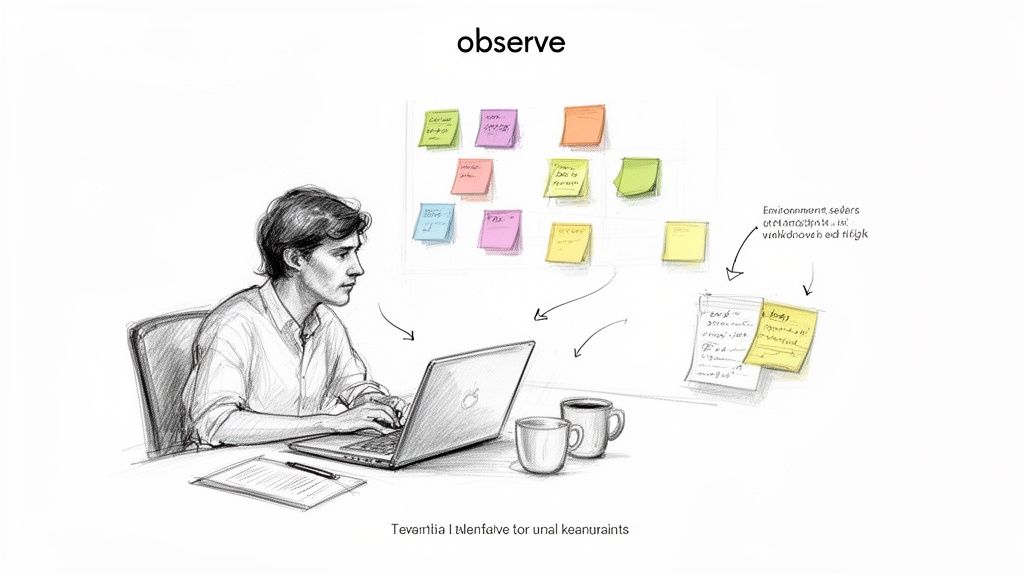
The core principle is partnership. The researcher observes the participant performing natural tasks and asks questions to clarify actions and motivations in real time. For example, observing a doctor using an electronic health record system in their busy clinic reveals interruptions and multitasking pressures that a standard interview would miss. This makes it one of the best UX interview techniques for designing products that fit seamlessly into complex, real-world contexts.
When to Use This Technique
For complex workflows: Use it to understand intricate processes, such as how creative teams collaborate on a project or how financial analysts manage data across multiple screens.
Early-stage discovery: Ideal for exploring a problem space when you know very little about the users' environment, tools, and social dynamics.
Designing for specific environments: Essential for products used in specialised settings like hospitals, factory floors, or retail checkouts, where physical context is critical. This method provides rich, qualitative insights that are fundamental to human-centred design. If you want to dive deeper into its role, you can learn more about qualitative research methods and how they compare to quantitative approaches.
Actionable Tips for Implementation
Observe First, Ask Later: Begin by silently observing to let natural behaviours emerge. Interrupt only to ask clarifying questions like, "Can you tell me why you did that just now?" or "What were you thinking when that happened?"
Establish Rapport: Building trust is key, especially as you are a guest in their space. Start with a friendly introduction, explain your role as an observer, and reassure them that there are no right or wrong answers.
Simulate Observed Contexts: Gaining access to real user environments can be challenging. Platforms like Uxia allow you to run interviews with synthetic testers under specific scenario parameters, letting you simulate and test how a design might perform under certain observed contextual pressures at scale.
Capture Everything: Take detailed notes, photos of the environment (with permission), and short video clips if possible. These artefacts are invaluable for creating detailed journey maps and affinity diagrams that bring the user's world to life for the entire product team.
3. User interviews with Think-Aloud Protocol
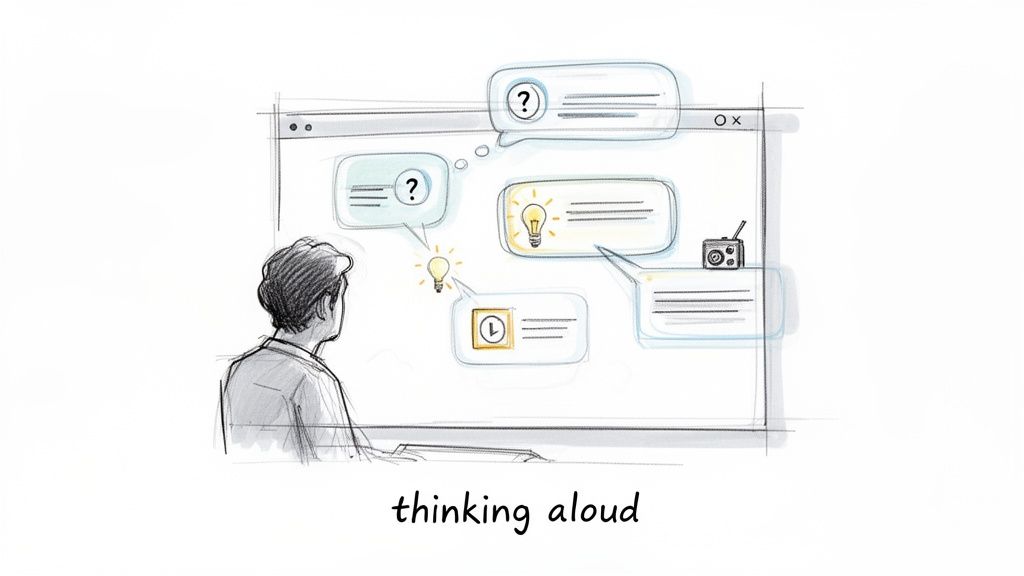
The think-aloud protocol is a powerful method where participants verbalise their thoughts, feelings, and reasoning as they interact with a product or system. Instead of simply observing actions, you gain direct access to their internal monologue, uncovering mental models, decision-making processes, and sources of friction in real time.
This technique bridges the gap between what users do and what they think, revealing usability issues that might otherwise remain hidden. By asking someone to narrate their experience, you can pinpoint the exact moment a user becomes confused, delighted, or frustrated, making it one of the best UX interview techniques for evaluative research.
When to Use This Technique
Usability Testing: Ideal for identifying specific pain points, confusing navigation, or unclear interface copy while users complete set tasks.
Feature Exploration: To understand how users approach and make sense of a new feature or workflow for the first time.
Search Interface Testing: Perfect for observing how users formulate search queries, interpret results, and refine their approach to finding information.
Actionable Tips for Implementation
Normalise the Process: At the start, explain that it might feel strange to speak aloud but that there are no right or wrong answers. Reassure them you are testing the system, not them.
Allow for a Practice Round: Begin with a simple, unrelated task (e.g., “Find today’s weather in London”) to help the participant get comfortable with narrating their thoughts before starting the main tasks.
Use Gentle Prompts: If a participant goes silent, use neutral prompts like, “What are you thinking now?” or “What are you looking at on the screen?” to encourage them to continue verbalising.
Validate Patterns with AI: After identifying key themes from a few sessions, use a platform like Uxia to run the same tasks with synthetic testers. This allows you to check if the observed thought processes and usability hurdles appear at a larger scale before committing to more moderated sessions.
4. Remote/Distributed Interviews
Remote and distributed interviews have become a cornerstone of modern user research, allowing teams to connect with participants regardless of geographical boundaries. By using video conferencing tools, researchers can conduct synchronous sessions in real-time or even asynchronous studies, dramatically expanding the potential pool of participants and making it one of the best UX interview techniques for global product teams.
This method removes the logistical constraints of in-person research, such as travel costs and scheduling difficulties across different time zones. Remote interviews are conducted live via platforms like Zoom or Google Meet, enabling direct interaction and observation of non-verbal cues. In contrast, asynchronous methods might involve participants recording their thoughts or screen interactions on their own time, which can be useful for diary studies or tasks that require more prolonged engagement.
The primary advantage is access. A team in London can gain insights from users in Tokyo or São Paulo with relative ease, ensuring a more diverse and representative sample. This approach is particularly effective for researching products with a global user base or for reaching niche demographics that are not locally available.
When to Use This Technique
For Geographically Dispersed Users: The ideal choice when your target audience is spread across different cities, countries, or continents.
To Reduce Costs and Logistics: Eliminates travel, venue hire, and other expenses associated with in-person research.
When Researching Sensitive Topics: Remote settings can make participants feel more comfortable discussing personal or private matters from their own environment, such as in healthcare or finance research.
For Quick-Turnaround Projects: Scheduling is often faster and more flexible, accelerating the research timeline.
Actionable Tips for Implementation
Prepare Participants Technologically: Send a clear one-pager ahead of the session outlining the software to be used, with download links and instructions. Always have a backup plan, like a phone call, in case of technical failure.
Choose the Right Platform: Use reliable video conferencing software that offers high-quality recording and, ideally, integrates with transcription services to speed up analysis.
Establish Presence Early: Start the call with your camera on and a warm introduction. Share your screen to guide the participant through any prototypes or websites to ensure they are focused on the correct task.
Record Redundantly: Always get explicit permission to record. If possible, use a secondary audio recorder (like a separate app or device) as a backup in case the primary recording fails.
Complement with Synthetic Testing: Before engaging real users, you can run interviews with synthetic testers on platforms like Uxia to refine your interview script and questions. This helps you prepare more effectively for live remote sessions. A deeper look at the differences between synthetic and human users can clarify how to best combine these approaches.
5. Longitudinal Interviews (Diary Studies & Follow-up)
Longitudinal interviews and their associated diary studies move beyond a single point-in-time snapshot of user experience. This technique involves engaging with the same participants across multiple touchpoints over an extended period, from weeks to months, to capture how behaviours, attitudes, and product perceptions evolve. It's one of the best UX interview techniques for understanding long-term engagement.
A diary study component typically asks participants to log specific experiences, feelings, or actions as they happen. This can be done through text, photos, or even voice notes. Follow-up interviews are then scheduled at key moments in the user journey to dive deeper into the diary entries and explore the context behind observed changes, making this a powerful method for studying habit formation and long-term value.
This approach provides rich, contextual data that is impossible to gather in a single session. It reveals how initial impressions hold up over time, how users integrate a product into their daily routines, and what triggers sustained use or eventual churn.
When to Use This Technique
Choose Longitudinal Studies for:
Tracking the adoption and integration of a new product or feature into a user's workflow.
Researching habit formation and understanding what makes a product "sticky."
Observing how user motivations and needs change over the entire customer lifecycle, from onboarding to long-term use.
Opt for this method when you need to:
Understand the long-term impact of design changes.
Capture infrequent but critical user interactions.
Gather authentic, in-the-moment feedback rather than relying on user memory.
Actionable Tips for Implementation
Recruit for Commitment: Be transparent about the time commitment required. Recruit participants who are genuinely motivated and offer meaningful incentives that reflect the extended duration of the study.
Keep Diary Entries Simple: Reduce the friction of logging data. Use tools that allow for quick entries via voice notes, photo uploads, or simple survey forms. The lower the barrier, the more consistent the data.
Schedule Follow-ups Strategically: Plan your interviews around key moments, such as one week after onboarding, after the first major use of a key feature, or at the 30-day mark.
Validate Interim Findings: As patterns emerge from early diary entries, you don't have to wait for the next real user interview. You can run quick interviews with synthetic testers on platforms like Uxia to check your evolving hypotheses and refine questions for your upcoming sessions.
Maintain Question Consistency: While allowing for flexibility, ensure you ask a core set of consistent questions in each follow-up interview. This allows you to track and compare changes in attitudes and behaviours over time.
6. Moderated Usability Testing with Task-Based Scenarios
Moderated usability testing is a cornerstone of user research, designed to observe how real users interact with a product while they attempt to complete specific, goal-oriented tasks. In this method, a trained moderator guides the participant, observes their behaviour, and asks follow-up questions to understand their thought process, making it one of the best UX interview techniques for uncovering critical usability issues.
The core of this technique involves creating realistic scenarios that reflect how a user would naturally engage with the product. For instance, testing a healthcare app might involve a task like, "Imagine you need to book an appointment with a specialist for next Tuesday. Show me how you would do that." The moderator's role is to facilitate the session without leading the participant, creating a controlled environment to identify friction points, confusing UI elements, and breakdowns in the user flow.
This approach provides rich, qualitative data by combining direct observation with real-time feedback. It reveals not just what problems users face, but also why they occur and how they feel about them, offering a direct window into the user experience.
When to Use This Technique
Validating a New Design or Feature: Test prototypes or live features before a full-scale launch to catch major usability problems early.
Diagnosing an Underperforming Flow: Investigate why users are dropping off during key processes, such as a checkout or sign-up flow.
Assessing Accessibility: Conduct tests with users who have diverse abilities to ensure your product is inclusive and compliant.
Benchmarking Usability: Measure task completion rates, time on task, and user satisfaction to set a baseline or compare design iterations.
Actionable Tips for Implementation
Write Realistic, Goal-Focused Tasks: Develop 4–6 clear, non-leading tasks that have a defined goal. Instead of "Click the green button," frame it as "Find a way to save your progress."
Recruit the Right Participants: Aim for 5–8 participants per user segment for each round of testing. This number is typically sufficient to reveal the most significant usability patterns. Ensure your recruitment reflects your target audience's diversity.
Prepare with Synthetic Users: Before recruiting real people, run your task scenarios and script with synthetic testers. Platforms like Uxia allow you to simulate these sessions with AI users, helping you refine task wording and identify confusing instructions without spending your budget.
Allow a Practice Task: Start with a simple, non-critical task to help participants get comfortable with the process and the "think aloud" protocol.
Combine Qualitative and Quantitative Data: Record the screen and user reactions, but also use post-task questions and standardised metrics like the System Usability Scale (SUS) to measure satisfaction objectively.
7. In-Depth One-on-One Interviews (Ethnographic Interviews)
In-depth one-on-one interviews, often called ethnographic interviews, are extended, open-ended conversations designed to uncover the deep-seated motivations, values, and cultural contexts that shape user behaviour. Unlike more structured formats, these interviews (typically 45–90 minutes) are less about direct questions and more about creating a space for participants to share their stories and experiences in their own words.
The primary goal is to move beyond surface-level preferences and understand a person's world view as it relates to a product or service. Researchers focus on listening and gentle probing to explore complex topics like product attachment, frustrations with technology, or the social dynamics of a workplace. This makes it one of the best UX interview techniques for foundational research and complex problem spaces.
When to Use This Technique
Choose In-Depth Interviews for:
Foundational research to understand a new domain or user group, such as the daily routines of healthcare workers.
Exploring emotional connections or significant frustrations users have with existing products.
Investigating how technology is integrated into specific environments, like a classroom or family home.
Avoid This Technique for:
Quick validation of specific UI elements or features.
Situations where you need statistically significant or easily comparable data across many users.
Projects with very tight timelines and limited research budgets.
Actionable Tips for Implementation
Recruit for Rich Experience: Seek participants who have deep, long-term experience with the subject matter. Their detailed stories are the foundation of this method.
Start with Broad Prompts: Begin with rapport-building and open-ended prompts like, “Tell me about a typical day for you…” rather than narrow questions. This encourages narrative storytelling.
Embrace Silence: Don't rush to fill every pause. Allowing for silence gives participants time to reflect and often leads to more profound insights they might not have shared otherwise.
Translate Insights into Personas: After recording, transcribing, and synthesising findings (affinity mapping is great for this), translate the deep insights into detailed personas. These can guide design and even be used to create synthetic users on platforms like Uxia for further, rapid testing.
8. Generative Interviews & Co-Design Sessions
Generative interviews and co-design sessions move beyond observation to active collaboration, transforming users from subjects into design partners. These workshops involve hands-on activities like sketching, journey mapping, and low-fidelity prototyping, allowing participants to produce tangible solution concepts alongside designers and stakeholders. This method is exceptionally powerful for ideation and exploring entirely new product directions.
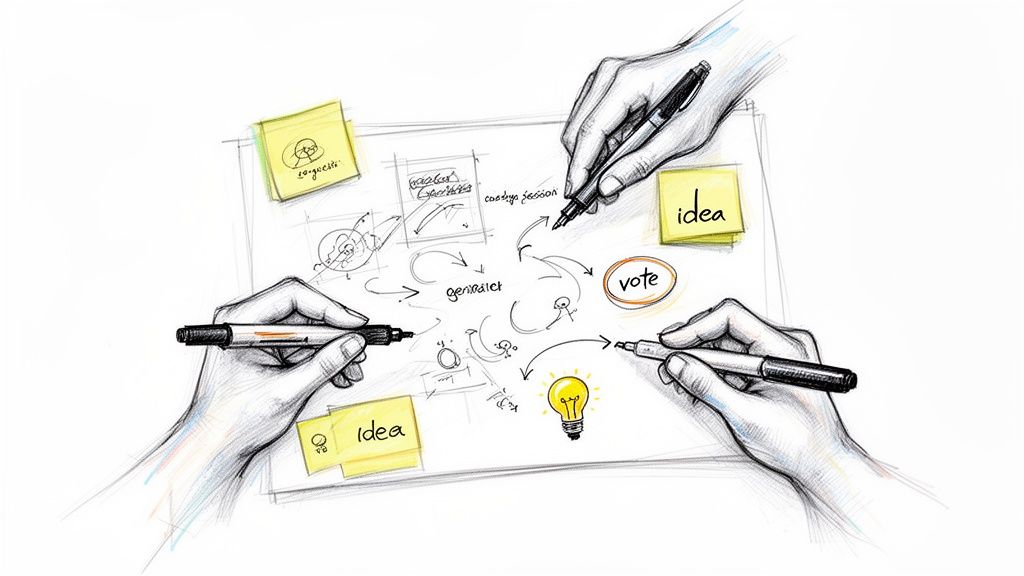
Unlike traditional interviews that focus on past behaviours, co-design sessions are future-oriented. They empower users to express latent needs and creative ideas that might not surface in a standard question-and-answer format. For example, an enterprise team might co-design a new dashboard with its key customer teams, or a startup could run a design sprint with community members to ideate a new feature. The outputs are raw, creative, and grounded in real user perspectives.
When to Use This Technique
Choose Generative Interviews & Co-Design for:
Early-stage "blue-sky" innovation and feature ideation.
Tackling complex, ambiguous problems where no clear solution exists.
Building strong buy-in and a sense of ownership with key user groups or stakeholders.
Designing products for specialised domains where user expertise is critical.
Actionable Tips for Implementation
Prepare Clear Problem Statements: Frame the session around a specific, well-defined user problem, not a proposed solution. This focuses creativity where it matters most.
Provide Low-Fidelity Tools: Equip participants with simple tools like paper, markers, sticky notes, and building blocks. This lowers the barrier to entry and keeps the focus on ideas, not artistic skill.
Establish Psychological Safety: Create a "yes, and..." environment where all ideas are welcomed without judgment. Act as a facilitator, not a director, to encourage open participation from everyone.
Validate Concepts with Synthetic Users: After the workshop, synthesise the strongest ideas into concrete concepts. You can then quickly validate these concepts with AI-powered synthetic users on platforms like Uxia to check their appeal and usability with a representation of your broader user base before committing to further development.
8 UX Interview Techniques Compared
Method | Implementation Complexity 🔄 | Resource Requirements ⚡ | Expected Outcomes 📊 | Ideal Use Cases 💡 | Key Advantages ⭐ |
|---|---|---|---|---|---|
Structured & Semi-Structured Interviews | Moderate — mix of scripted and flexible approaches; needs careful question design | Moderate — interviewer training, recording, transcription | Comparable quantitative signals (structured) + rich qualitative themes (semi-structured) | Scale validation and exploratory motivation research; mixed-method studies | Balances comparability and depth; flexible probing |
Contextual Inquiry | High — field logistics and observational skill required | High — travel/time, access negotiation, recording in situ | Deep contextual insights: real workflows, constraints, workarounds | Field-dependent products (workplace, healthcare, education) | Reveals say‑do gap and environmental edge cases |
User Interviews with Think-Aloud Protocol | Moderate — requires coaching participants and moderating narration | Moderate — recording, skilled moderators, transcription | Maps cognitive processes, points of friction, expectation gaps | Usability testing of task flows and decision-heavy interfaces | Direct access to mental models; rapid qualitative signals |
Remote/Distributed Interviews | Low–Moderate — scheduling and platform setup; fewer logistics | Low — no travel; requires stable tools and participant devices | Broad, diverse perspectives with scalable recordings | Global research, distributed users, quick feedback cycles | Cost-efficient, scalable, participants often in natural context |
Longitudinal Interviews (Diary & Follow-up) | High — long coordination and retention management | High — incentives, ongoing recruitment, complex analysis | Insights on behavior change, habit formation, long-term satisfaction | Adoption studies, churn analysis, long-term product experience | Captures evolution over time and identifies drop‑off points |
Moderated Usability Testing with Task-Based Scenarios | Moderate — scripted tasks and trained moderation | Moderate — lab/remote setup, recruitment, recording | Actionable usability metrics (completion, time, errors, SUS) | Task success evaluation (checkout, accessibility, onboarding) | Clear success/failure metrics and actionable fixes |
In-Depth One-on-One Interviews (Ethnographic) | Very high — extended, unstructured probing and cultural sensitivity | High — long sessions, expert interviewers, transcription | Deep motivations, values, emotional drivers, persona material | Exploratory research, persona development, cultural studies | Uncovers implicit needs and rich narrative insights |
Generative Interviews & Co-Design Sessions | High — skilled facilitation and psychological-safety setup | Moderate–High — materials, facilitators, stakeholder time | Tangible solution concepts, prioritized ideas, prototypes | Ideation, stakeholder alignment, community-driven design | Produces immediate concepts and builds participant buy‑in |
Synthesise, Scale, and Succeed with the Right Mix
Mastering the art of user research is not about finding a single, perfect method. As we have explored, the true strength of an effective research practice comes from building a versatile toolkit. Each of the best UX interview techniques serves a distinct purpose, from the foundational discovery of semi-structured interviews to the detailed behavioural insights gained from contextual inquiry. Your ability to select and blend these approaches is what will ultimately separate superficial findings from deep, actionable understanding.
The real challenge, however, often lies not in the execution of a single interview, but in the synthesis and scaling of insights. A powerful ethnographic interview might reveal a critical pain point, but how do you confirm if this is an isolated incident or a widespread pattern? This is where modern research operations find their momentum. After conducting your initial qualitative sessions, you need a way to validate those hypotheses without losing weeks to recruitment and scheduling.
This is precisely where AI-powered tools can support your human-centred process. For instance, platforms like Uxia allow you to run interviews with synthetic testers that reflect your core user personas. This means you can take a compelling insight from a handful of participants and instantly test it against a much larger, simulated user base, gaining directional confidence in minutes, not weeks. This blend of deep qualitative inquiry and rapid, scalable validation is the key to an agile and impactful research function.
Ultimately, the goal is to create a continuous loop of learning and iteration. By combining classic, human-led methods with the speed and scale of AI, you build a research practice that delivers more profound insights, faster. Your next steps should focus on identifying the most pressing questions your team has and mapping them to the techniques discussed.
Here’s a practical path forward:
Audit Your Current Process: Where are your biggest knowledge gaps? Do you need more generative insights (try co-design) or are you struggling with usability validation (try moderated testing)?
Create a Technique Matrix: For your next project, map out the different research phases and assign the most appropriate interview technique to each one.
Experiment with Scaling: After your next round of interviews, take your key takeaways and run a quick validation test with a synthetic testing tool to see how the findings hold up at a larger scale.
Building this capability allows your team to move with confidence, backed by both rich, qualitative stories and broad, quantitative validation. Furthermore, dedicated applications can streamline the entire UX research process from data collection to synthesis, helping you scale your insights effectively. For teams looking to manage and analyse their research data more efficiently, exploring tools like Lunabloom AI's core application can provide a centralised hub for your findings.
Ready to bridge the gap between deep qualitative insights and rapid, scalable validation? Uxia allows you to run interviews and usability tests with AI-powered synthetic testers, mirroring your target users to give you reliable feedback in minutes. Stop waiting for recruitment and start making confident, data-backed decisions today with Uxia.