Best Mobile Ethnography Tools: 10 Picks for 2026
Compare the Best Mobile Ethnography Tools for diaries, video, sensing, analysis, privacy, scale, and faster UX research, including Uxia.

Your team needs answers from real users this week. Not just a survey, and not another generic usability test. You need diary entries from the commute, a selfie video right after checkout, a screen recording from inside the app, and enough context to understand what people were doing around the moment that mattered.
That's when the shortlisting gets messy. Some teams need a specialist mobile ethnography platform with app-based capture. Others need managed fieldwork because the ops burden is the blocker. Some need a community environment that can run diaries alongside discussions and live sessions. And sometimes the need isn't ethnography at all. It's rapid design validation before anyone spends time recruiting.
That's where Uxia fits well as a complementary option. Uxia lets teams upload image or video prototypes, define a mission and audience, and review synthetic AI participant feedback quickly. It's useful when recruiting and scheduling would slow iterative validation. But it's a different method. Synthetic testing helps you pressure-test flows, copy, trust, and friction in prototypes. It doesn't replace observing real people in their lived environments when context is the research question.
The tools below are the ones I'd compare for mobile ethnography in 2026. I'm looking at capture method, participant workflow, synthesis, scale, pricing transparency, exports, privacy posture, and team fit. The practical question behind all of it is simple: which platform helps you capture authentic behavior without creating so much setup and analysis overhead that the study stalls?
1. dscout

dscout is the tool I'd put on the shortlist first when the study lives or dies on in-the-moment capture. It's built around missions, which makes it a strong fit for longitudinal diary work, video responses, photo uploads, text entries, and screen recordings that happen in context rather than in a lab session.
If your team wants one platform that can cover diary tasks, unmoderated prompts, recruiting support, incentives, and follow-up live sessions, dscout is one of the clearest all-in-one options. That breadth matters when the study starts as ethnography and then turns into interviews after patterns show up.
Where dscout works best
The strongest use case is broad, distributed fieldwork where you need enough operational support to keep the project moving. It's especially practical for teams running recurring customer research and for agencies that need a known workflow for capture and payout handling.
A useful planning lens is to treat dscout as the mobile layer inside a broader field research stack. If your team is still deciding when diary work should sit alongside observational work, this guide to field studies in UX is a good framing reference.
Best fit: Longitudinal video diaries, in-context missions, mixed-method qual programs
Standout strength: Integrated participant workflow, including incentives and multiple method types
Main trade-off: Budgeting takes conversations, not quick self-serve math
Practical rule: If the participant task takes more effort than the payout seems to justify, response quality drops fast. In dscout, write shorter missions than you think you need, then probe in later tasks.
The main downside is that pricing is sales-led, so it's harder to estimate total cost early. Study quality can also vary with how well you balance effort, timing, and incentive structure. The platform can support strong ethnography, but it won't rescue a bloated mission design.
2. Indeemo

Indeemo feels purpose-built for mobile ethnography rather than adapted into it. That difference shows up in studies that cross contexts. In-home tasks, retail visits, app journeys, and social behaviors tend to fit naturally into the workflow.
It's a strong option when you want participant capture and the possibility of managed support on top. Teams doing mixed-context research often need both. The platform can handle the collection side, and managed services can reduce the burden when the internal team doesn't have spare moderation or analysis capacity.
Why researchers choose it
Indeemo is one of the better fits for longitudinal studies where media capture is central, not optional. Video diaries and screen recording are useful here, but they also create analysis load. That's the trade-off. Richer evidence usually means slower synthesis unless the team has a disciplined coding approach.
Mobile ethnography itself is still a relatively recent category shaped by smartphone adoption. One overview notes that since smartphones became widespread in 2009, many qualitative research apps entered the market, and it traces an early mobile ethnography platform to a 2009 collaboration that later evolved into ExperienceFellow in 2014. The same body of work also describes smartphone-based methods as enabling “serendipitous ethnographies,” where researchers can capture ordinary moments instead of relying only on planned visits, as discussed in this overview of smartphone ethnography.
Rich diary capture is only useful if your team has time to review it. If nobody can watch the videos within the sprint, reduce the task count before launch.
Indeemo is usually a premium conversation, not an impulse buy. That's reasonable for enterprise or agency work, but smaller teams should check whether they really need full ethnographic richness or whether Uxia can handle earlier prototype validation first, before real-world diary work begins.
3. EthOS (an OvationMR company)
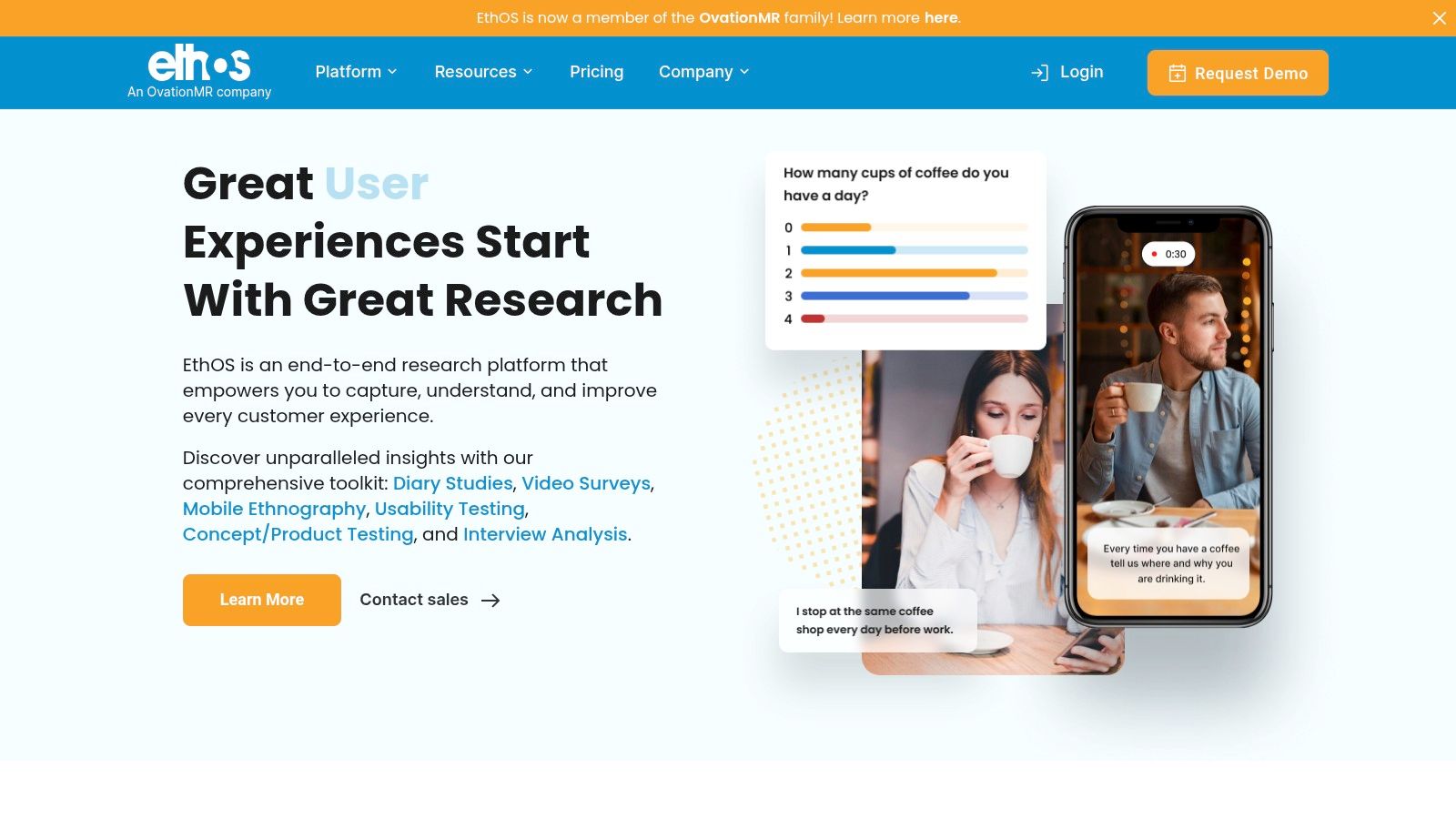
A common brief looks like this: capture what people do across a week, keep tasks short enough that they respond, and avoid giving the team an analysis problem it cannot finish. EthOS fits that kind of study well.
EthOS is one of the cleaner choices for researchers who want genuine in-context capture without buying a larger qual suite than they will use. The native iOS and Android setup helps on the participant side. That matters because diary completion often drops for boring reasons: confusing prompts, upload friction, or tasks that feel harder on the phone than they looked in the research plan.
Where EthOS stands out is restraint. It supports the core mobile ethnography workflow well enough for customer journey work, employee experience studies, and short-to-mid-length diaries, but it does not try to be everything at once. For lean insight teams, that can be a strength. Less system complexity usually means faster setup, cleaner fieldwork, and fewer handoffs to research ops.
The trade-off shows up later, during synthesis and procurement. Public pricing detail is limited, so budgeting usually starts with a sales conversation. Teams should also examine how much analysis support they need before committing. If the study will generate large volumes of video over several weeks, the main question is not whether EthOS can collect it. The question is whether your team can review, code, and report on it fast enough.
Participant trust is another practical filter. Any mobile ethnography platform handling diary entries, photos, and video needs a clear data handling story, especially for workplace or health-adjacent studies. EthOS should be reviewed on that basis during vendor assessment, not after legal gets involved late in the process.
I'd shortlist EthOS when the decision is less about feature breadth and more about execution discipline:
authentic in-context capture through a familiar native app
manageable participant experience for repeat entries over time
enough structure for diary studies without the weight of a broader suite
less pricing visibility than some buyers will want upfront
If the immediate goal is concept screening, message testing, or fast iteration before fielding a real-world diary, Uxia's AI-driven synthetic testing may help reduce what you need to validate with live participants. Once the questions shift from predicted reaction to observed behavior in daily life, EthOS becomes more relevant.
4. QualSights
QualSights is a bigger swing. It's not just a diary tool. It's an end-to-end qualitative environment for teams that want video, photo, audio, text, live interviews, focus groups, and analysis in one place.
That breadth is appealing when stakeholders keep changing the brief. The same project can start with asynchronous capture, then shift into live conversations without moving participants into another tool. For enterprise teams, that continuity can be more valuable than a niche feature advantage.
The real trade-off
QualSights is strongest when the team can use its range. If you only need a lightweight mobile diary, the platform may be heavier than necessary. If you do need video-led qual at scale, the analysis features become more interesting, especially for teams trying to reduce manual review bottlenecks.
What matters most here is less the feature list and more whether your research ops can support onboarding, governance, and synthesis. Advanced AI-assisted analysis sounds attractive, but it still needs good task design and disciplined review.
Don't buy a broad qual suite just because procurement wants vendor consolidation. Buy it if the same participant pool will move across methods and your team will use that flexibility.
For design teams in fast iteration cycles, I'd separate two jobs. Use a mobile ethnography platform like QualSights when you need real-world evidence from real participants. Use Uxia earlier when you want to pressure-test image or video prototypes without waiting on recruitment. Those are adjacent decisions, not identical ones.
5. Recollective
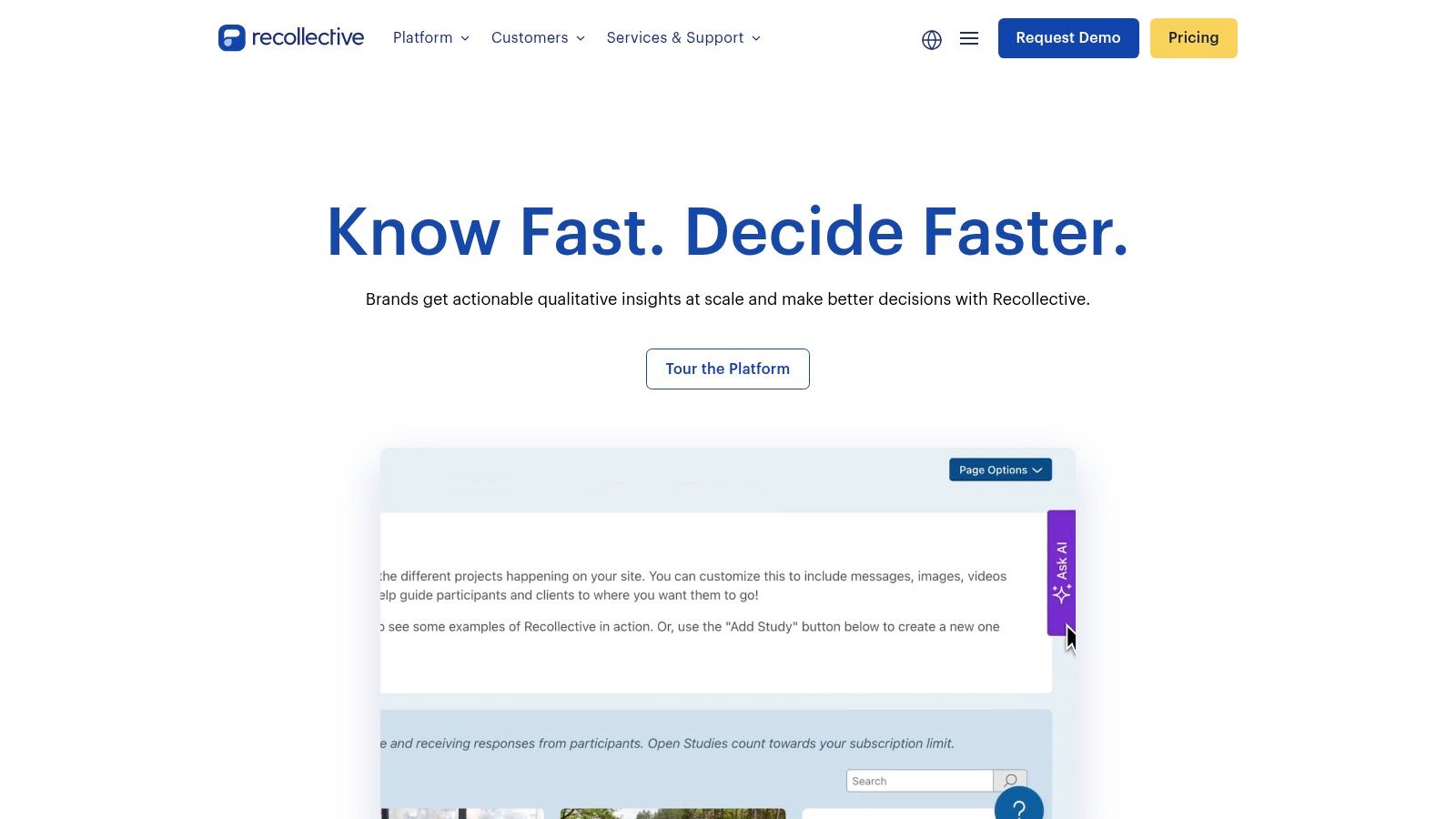
A common decision point looks like this. The team starts with a two-week mobile diary, then realizes the same participants should stay active for follow-up discussions, concept reactions, and a standing insight community. Recollective fits that path better than tools built mainly for single-study capture.
Recollective is strongest when ethnography sits inside a broader qualitative program. It supports longitudinal participation well because participants do not have to be pushed into a new environment every time the method changes. That continuity matters if goal is not just capturing in-context behavior once, but building a usable evidence base across months of work.
The mobile ethnography side is credible. Researchers can collect diary entries, screen recordings, images, video, and markup, then keep collaboration and review inside the same platform. The practical advantage is less about any one capture format and more about reducing handoffs between fieldwork, moderation, and synthesis. Teams comparing platforms for coding and theme development should also review this guide to qualitative data analysis tools for UX research.
Where I'd be careful is study type. Recollective makes more sense for community-led programs, recurring segmentation work, and longitudinal journeys than for a narrow app-first ethnography brief where speed and participant simplicity matter most. A specialist tool can feel lighter in the field.
Pricing visibility is better than many enterprise platforms, which helps during shortlist discussions, though procurement and setup still take work. Data protection and governance will matter more here for larger programs because the platform is often handling repeated participant engagement over time, not just one burst of diary capture.
One more planning point. If the team needs real participants documenting behavior in context, Recollective is a fit. If the question is earlier-stage and evaluative, such as pressure-testing stimulus, messaging, or prototype directions before recruitment, conventional ethnography may be better complemented by Uxia's AI-driven synthetic testing rather than replaced by another community platform.
6. Forsta Digital Diaries
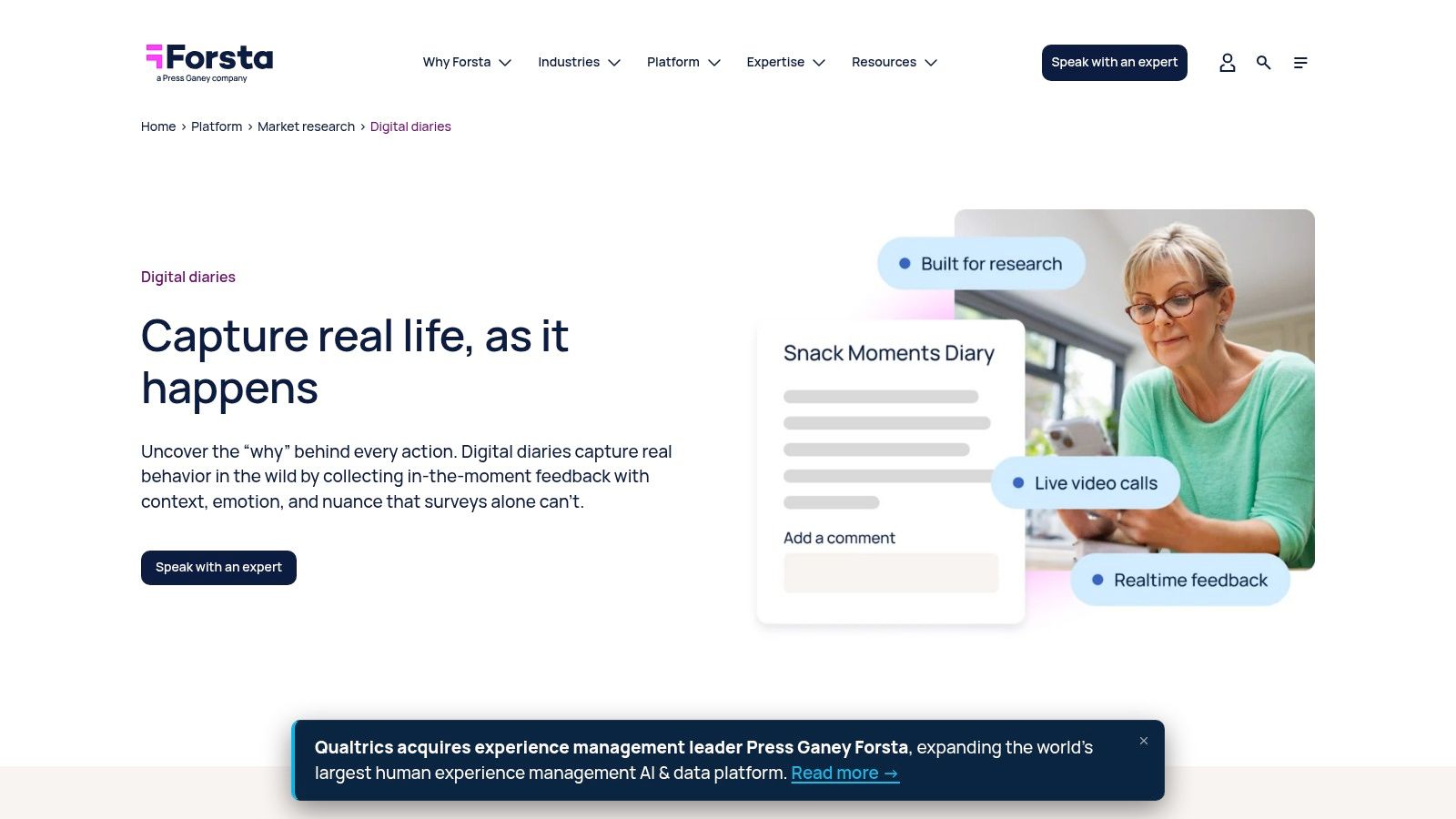
Forsta Digital Diaries is the shortlist option for governed scale. If legal review, enterprise procurement, cross-market coordination, and program-level oversight are central constraints, Forsta deserves attention.
Its native mobile app, offline capture, and broad project support make it useful for complex CX, EX, and UX journeys. This is the kind of platform teams buy when one-off studies are giving way to a standardized research operation.
When governance is the requirement
Forsta is also the only tool in this list with a specific large-scale diary benchmark in the provided source material. The platform is described as supporting projects with up to 2,000 participants per diary on its own product materials. That's a meaningful signal for teams planning broad multi-market programs, though the practical challenge shifts from capture to moderation, review, and governance once studies get that large.
Another reason Forsta stands out is method boundary clarity. Mobile ethnography is strong for context-rich, asynchronous evidence, but it often isn't the right substitute for structured usability workflows, accessibility review, or rapid iterative validation. That distinction shows up repeatedly in independent tool comparisons, including this review of UX testing tool gaps and method coverage.
A useful companion read for that decision is this guide to hybrid AI and human UX research platforms.
Enterprise scale often creates a false sense of method fit. A platform can support huge diary programs and still be the wrong tool for validating a prototype flow this afternoon.
That's where Uxia can complement Forsta well. Use Forsta for governed real-user diary fieldwork. Use Uxia when product teams need fast synthetic prototype testing before launching heavier human research.
7. Sago QualMobile (formerly Over The Shoulder / 20|20/Schlesinger)
A common buyer situation looks like this: the study is already approved, several markets are involved, recruitment is complicated, and the internal team does not have spare hours to build, moderate, chase participants, and clean outputs. In that situation, Sago is less a pure software decision and more an outsourcing decision with a mobile ethnography layer attached.
That changes how I'd evaluate QualMobile.
The core question is not only whether participants can capture in-context behavior through an app. Several tools in this category can do that. The question is whether your team needs day-to-day operational support to keep a longitudinal study on track, especially when drop-off risk, market coordination, and stakeholder deadlines are more pressing than feature depth.
Sago is strongest when fieldwork logistics are the bottleneck. The app, branching, and mobile tasking matter, but the service model is the bigger differentiator. Research teams that need help with setup, moderation, and delivery may get more value here than they would from a cheaper self-serve platform that shifts all execution back onto the client.
There is a trade-off. Teams trying to compare analysis workflow, admin control, participant experience details, or pricing structure before talking to sales will find less public product detail than they get from more self-serve vendors. That slows independent evaluation, especially for buyers who want to pressure-test how well the platform supports coding at scale, media review, or privacy controls before procurement gets involved.
I would shortlist QualMobile in three cases:
Multi-market studies where internal ops capacity is thin
Diary or in-the-moment programs that need active vendor support to sustain participation
Projects where service reliability matters more than deep DIY platform control
I would look elsewhere if the main goal is researcher autonomy. Teams that want to iterate fast, inspect the platform on their own, and build a repeatable internal mobile ethnography workflow may prefer a tool with clearer self-serve boundaries.
There is also a method-fit point worth stating plainly. Sago helps with real participant capture and managed execution. It does not remove the usual limits of conventional ethnography. If the product team needs quick directional feedback on early concepts or prototype flows before funding a heavier field study, Uxia can complement that process with AI-driven synthetic testing. Then QualMobile can handle the later-stage human fieldwork once the team is ready to capture real behavior in context.
8. Incling
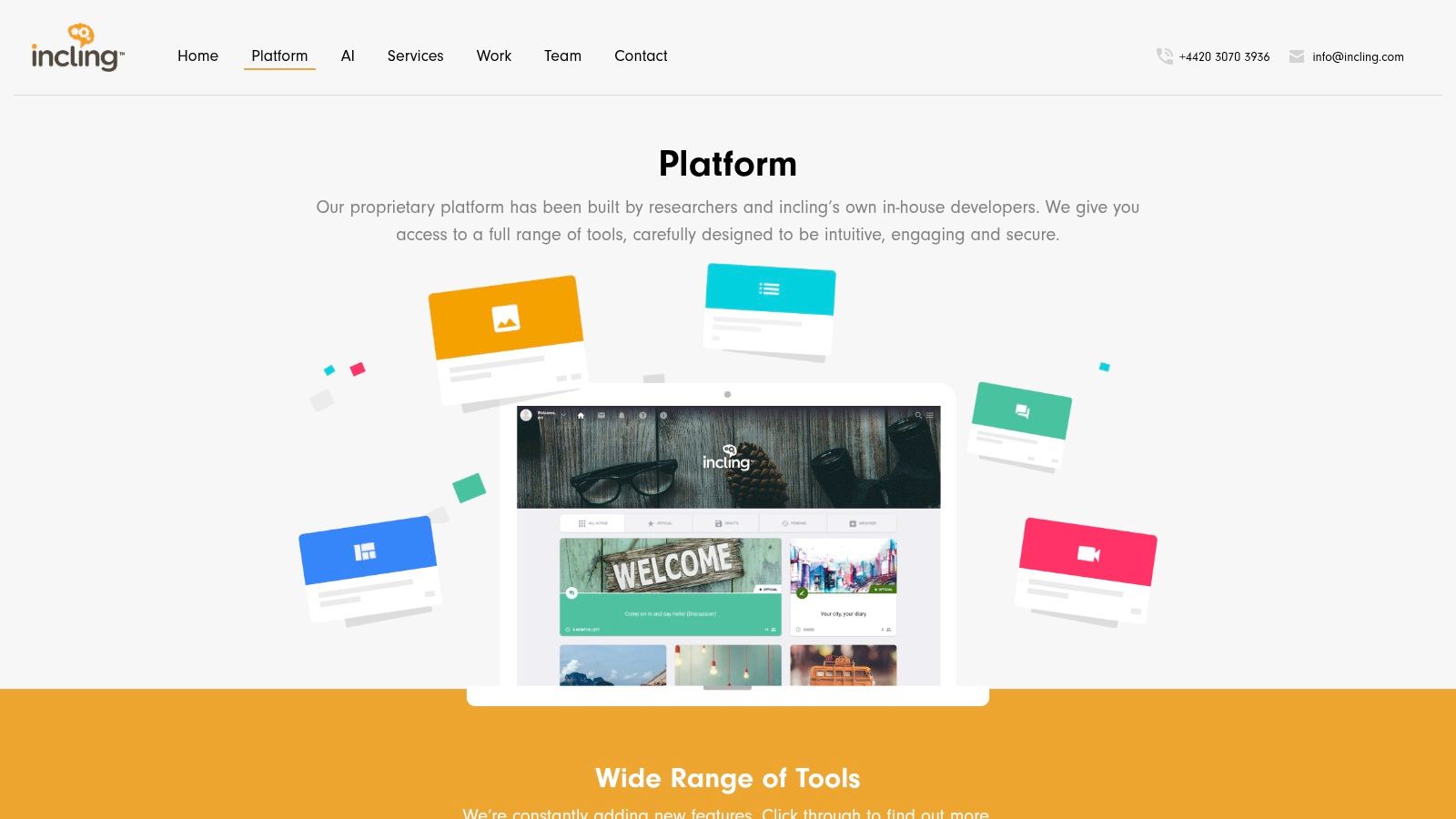
Incling works well for teams that want ethnography capture inside a broader engagement model. Diary spaces, private multimedia entries, screencasts, live chat, and video capabilities give it a flexible shape for continuous discovery programs.
I like platforms like this when the study won't end after one diary sprint. If the same participants may return for follow-up tasks, discussions, or community activities, continuity becomes a real advantage.
Why it's useful for longitudinal engagement
Incling is a practical middle option between a pure mobile ethnography app and a full enterprise community platform. That can be ideal for in-house insight teams that need both DIY control and the option of managed support.
Its privacy and governance posture also matters. Teams dealing with participant-generated media should always check retention, access control, and data ownership before launch. On that front, Incling's ISO27001 and GDPR positioning will matter to buyers with internal compliance review.
Mobile response behavior is another reason to keep task design lean. An AAPOR task force report noted that respondents accessing online surveys through mobile browsers represented a growing and non-ignorable share, with estimates ranging from 8% to 23% depending on the study, and that this group saw higher abandonment rates and potentially more measurement error. For ethnography, that's a reminder to keep prompts short and mobile-native, as summarized in this discussion of mobile response behavior and ethnography UX.
The lesson applies directly to Incling. Use fewer tasks, stronger reminders, and clearer upload instructions than you'd use on desktop-heavy qual programs.
9. Contextmapp
Contextmapp is more specialized than some of the bigger names here, and that's exactly why certain teams will prefer it. If your main output is a documented journey rather than a general archive of diary media, a service-design-oriented platform can be a better fit than a broad qual suite.
Task-based mobile diaries, photo and video capture, co-creation activities, and journey mapping all point in the same direction. This is a good option for design researchers and service designers who need structured evidence tied to steps in an experience.
Best used for journey work
Contextmapp makes the most sense when the team already knows the shape of the journey and wants to capture lived moments across it. It's less compelling if the brief is open-ended exploration without a clear task structure.
That distinction matters because mobile ethnography can drift into over-collection. A focused journey frame helps teams gather evidence that can be synthesized into service decisions.
One undercovered issue in tool selection is regional fit. A comparison focused on global qualitative research argued that the biggest 2026 gap between platforms is often not raw features but whether they match local messaging habits and recruitment realities. It also warned that legacy platforms can see 30 to 60% lower response rates outside their native regions, especially when teams assume a strong US or UK setup will transfer cleanly to places like South Africa or Brazil, as discussed in this analysis of regional fit in qualitative research platforms.
If your participants live in WhatsApp-first or mobile-only environments, test the actual invitation and submission flow before you sign the contract.
That advice matters for Contextmapp as much as any other tool. Journey mapping only works if participants can stay engaged in the channel reality of their market.
10. DELVA
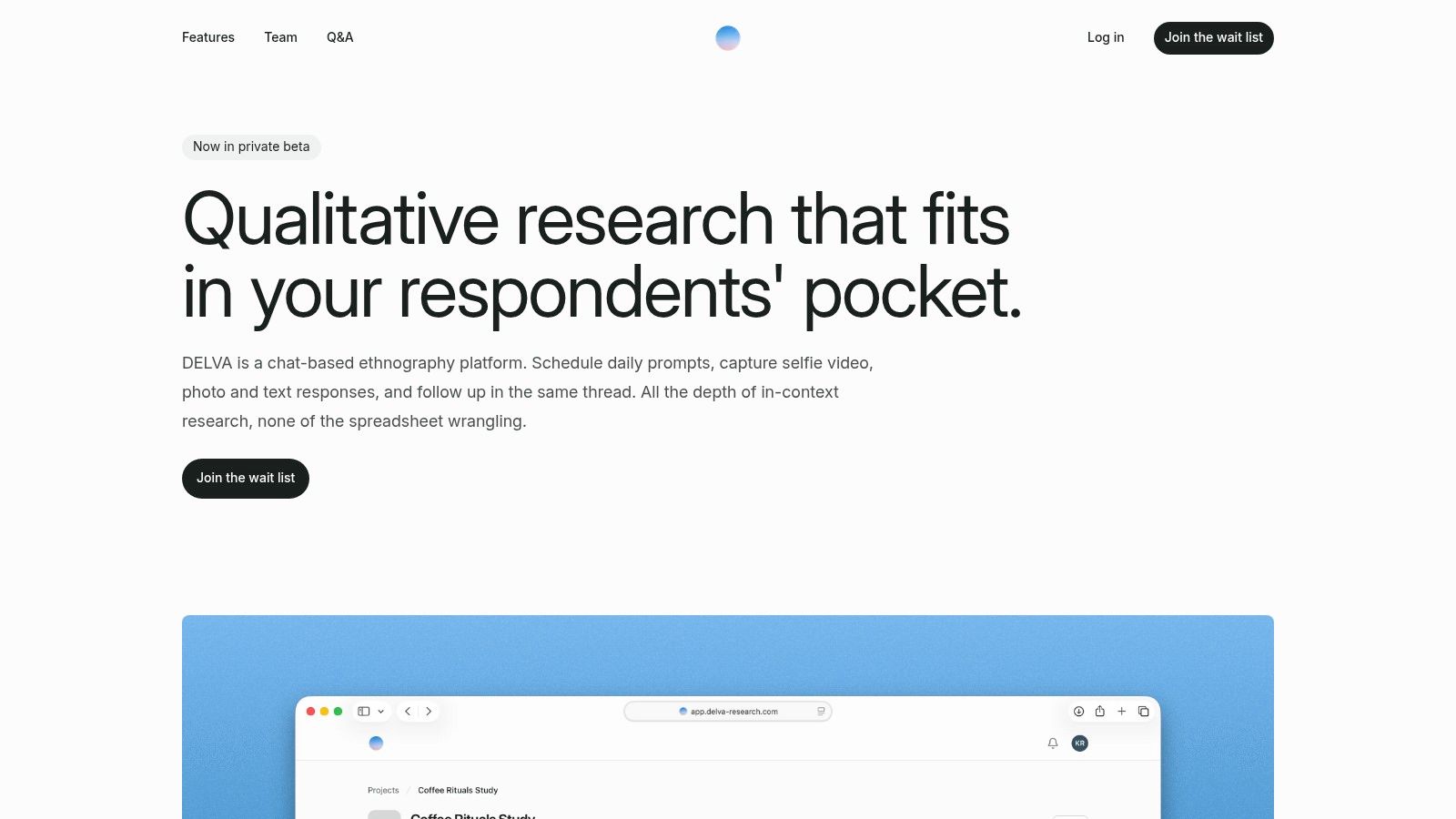
DELVA takes a chat-first approach, and that's more important than it sounds. Many diary studies fail because they ask participants to act like documentarians when those participants naturally communicate in short messages, selfies, photos, and voice notes.
DELVA leans into that behavior. Conversational task design, asynchronous probing, selfie-video, audio, and message-style flows can lower the friction that makes diary compliance collapse after the first few days.
Best for conversational diaries
If your participants are likely to respond better to a messenger-like rhythm than to a formal research app feel, DELVA is worth serious consideration. It's especially useful when you want context and rationale around moments, but you don't need a giant enterprise suite.
The general definition of mobile ethnography is helpful here. It's commonly described as a remote qualitative method that studies people in their natural environments using smartphones or similar devices to capture context-dependent behavior. In practical terms, that makes DELVA a good fit for lightweight, in-the-flow evidence capture, while Uxia is a useful alternative when you want fast in-context feedback on prototypes without recruiting or scheduling overhead, as outlined in this explainer on digital ethnography tools and remote UX research.
A planning benchmark also helps. One source on mobile diary studies states that these studies typically run between 5 and 14 days, which is a sensible window for balancing context capture with participant burden, according to this guide on mobile diary study timing.
For DELVA, that suggests a simple tactic: keep the study short, keep the prompts conversational, and reserve heavier validation work for a separate usability or synthetic testing method when needed.
Top 10 Mobile Ethnography Tools: Feature Comparison
Platform | Core focus / Key features (✨) | UX / Quality (★) | Pricing & Value (💰) | Target audience (👥) | Standout advantage (🏆) |
|---|---|---|---|---|---|
dscout | ✨ Video-first diaries, screen capture, integrated recruiting & payouts | ★★★★ | 💰 Sales-led, quote-based; flexible incentives | 👥 Agencies, product & insights teams | 🏆 Large US participant pool & longitudinal video strength |
Indeemo | ✨ Video diaries, screen recording, managed research services | ★★★★ | 💰 Premium/enterprise, quote-based | 👥 Agencies, enterprise insights teams | 🏆 Managed services + mature mobile apps |
EthOS (OvationMR) | ✨ Task-based multimedia diaries, native iOS/Android apps | ★★★½ | 💰 Flexible subscription (sales-led) | 👥 SMEs, consumer & employee studies | 🏆 Straightforward respondent workflows |
QualSights | ✨ End-to-end video, live groups, AI emotion/object analysis | ★★★★ | 💰 Enterprise, sales-led | 👥 Enterprise qual teams, video-led research | 🏆 AI-driven video analysis at scale |
Recollective | ✨ Digital diaries, community features, AI-moderated tasks | ★★★★ | 💰 Transparent starting guidance + project options | 👥 Researchers, community managers | 🏆 Combines async diaries + live video in one platform |
Forsta Digital Diaries | ✨ Native app, offline capture, large-scale diary support | ★★★★ | 💰 Quote-based, enterprise procurement | 👥 Enterprise CX/EX/UX teams | 🏆 Research-grade governance & multi-market scale |
Sago QualMobile | ✨ Over-the-shoulder app capture, advanced branching logic | ★★★★ | 💰 Services-heavy; sales conversations for pricing | 👥 Full-service research teams, managed projects | 🏆 Long track record with strong services wrap |
Incling | ✨ Diary spaces, screencast, community + AI-assisted analysis | ★★★½ | 💰 Scoped pricing; conversation required | 👥 Continuous discovery, product teams, SMEs | 🏆 Community + diary combo, ISO27001/GDPR posture |
Contextmapp | ✨ Task-based diaries, journey-mapping, co-creation tools | ★★★ | 💰 Contact for pricing | 👥 Service-design & UX teams | 🏆 Purpose-built for journey documentation |
DELVA | ✨ Chat-first diaries, selfie-video, message-style probing | ★★★ | 💰 Quote/scoped pricing; smaller vendor | 👥 Teams needing low-friction mobile capture | 🏆 Chat-style engagement for higher compliance and richness |
Turn the Shortlist Into a Research Decision
The right choice starts with the method, not the vendor. Decide whether the study needs real-world observation, longitudinal diaries, live interaction, ongoing community continuity, or fast prototype validation. Those are different jobs. Teams often create avoidable friction by forcing one platform to do all of them.
If the question is about lived context, routines, workarounds, and behavior in natural environments, use real participant ethnography. If the question is whether an image prototype, video concept, or early flow makes sense before recruitment begins, Uxia is often the faster first step. It helps teams validate direction quickly with synthetic AI participants, but it shouldn't be treated as a substitute for naturalistic observation when real-world context is the core variable.
From there, test the capture flow before you buy. Mobile ethnography succeeds or fails on participant experience. Review the invitation process, consent screens, upload steps, reminder logic, and what happens when somebody skips a task or loses connection. A mobile diary study toolkit recommends small groups of 5 to 10 participants, clear instructions, and active monitoring for hiccups during the study, which is a good reminder that pilot design matters as much as platform choice in early setup, as described in this mobile diary study method card.
Then check the infrastructure questions buyers often leave too late:
Privacy and retention: Verify consent handling, storage rules, retention settings, and access controls before fieldwork starts.
Exports and ownership: Confirm how raw media, transcripts, tags, and final outputs leave the platform.
Integrations and analysis flow: Make sure synthesis fits your existing repository or reporting process.
Total effort: Compare researcher time, moderation needs, participant management, and analysis load, not just license price.
If you need rich longitudinal video, dscout and Indeemo are the strongest starting points. Forsta Digital Diaries is a good fit when governed multi-market scale matters more than simplicity. Recollective and Incling are strong when community continuity matters as much as diary capture. Contextmapp is a natural choice for journey and service design. DELVA fits conversational diary work well. And if fieldwork support is the blocker, managed options like Sago QualMobile deserve a hard look.
Use Uxia at the design-validation stage when you need speed. Upload an image or video prototype, define the mission and audience, and review transcripts, friction findings, heatmaps, metrics, and prioritized reports from synthetic testers in minutes. Then use participant ethnography alongside it when the question shifts from interface reaction to lived behavior in the world.
If you're comparing mobile ethnography tools, it often helps to separate two stages: validating design directions quickly, then observing real users in context. Uxia gives product and research teams a fast way to test image or video prototypes with synthetic AI participants, review transcripts and friction findings, and keep iteration moving before slower fieldwork begins.