
You've got a sprint deadline, a prototype that changed yesterday, and a folder full of useful research from the last round. It feels wasteful not to reuse it. That's exactly where data privacy in research stops being a policy document and becomes a design decision your team makes under time pressure. Handle it well and you can learn quickly without exposing people. Handle it casually and a recording, a profile, or a quote can identify someone long after you've removed their name.
Why Data Privacy in Research Breaks in Practice
Your team is three days from a stakeholder review. Someone suggests pulling last month's screen recordings, transcripts, demographic profiles, and prior-session notes into the new flow test. It sounds efficient. You've already recruited people who match the audience, and their earlier comments explain why the navigation confuses them.
The risk isn't usually a dramatic hack. It's ordinary linkage during routine reuse.
You renamed Participant 12 and deleted her email, so the file looks clean. The transcript still mentions a rare support role, a small city, a screen reader setup, and a story about a specific manager. Separately, each detail looks harmless. Together, a colleague who knows that team, or anyone with a second dataset, could plausibly name the person.
What Quietly Gives Someone Away
UX material is rich by design. That's why it's valuable, and why it's exposed.
Rare combinations: Job title, location, age band, and device or accessibility setup narrow a pool fast.
Voice and screen content: Recordings carry accent, background detail, notifications, and files you didn't mean to capture.
Distinctive language: A verbatim quote about a unique workaround travels further than a participant ID.
Longitudinal notes: Observations stacked across sessions build a profile no single session would reveal.
None of this means participants reject reuse on principle. In a 2018 survey of 771 current and recent clinical-trial participants at three U.S. academic medical centers, nearly half had experienced a breach of personal-data privacy elsewhere, yet fewer than 8% believed the potential downsides of data sharing outweighed its benefits. Support reached 93% for sharing with university scientists and 82% for scientists at for-profit companies, figures reported in that same survey summary.
Read that carefully. People who'd already been burned by a breach still backed controlled sharing. They weren't saying yes to anything. They were saying yes when the recipient, the purpose, and the safeguards made sense to them.
Participants don't need a promise that risk is zero. They need a credible account of who gets access, for what, and what stops misuse.
That's the practical standard for your sprint. Can you explain, in plain language, why you need the old recording, who'll watch it, how long you'll keep it, and what you stripped out before sharing? If you can't, the reuse isn't ready, no matter how tidy the filenames look. The sections that follow turn that test into principles, legal decisions, method choices, utility checks, and a workflow you can run.
Core Principles Behind Research Data Privacy
Think of a labeled sample drawer in a lab. You peel the name off a tube and feel safer. Then you notice the drawer itself is labeled by clinic, the key linking codes to names sits in the same cabinet, and a notebook beside it records who came in on which day. Removing one label accomplished little because the system around the sample still points back to a person.
Research data works the same way. Privacy isn't a field you delete. It's how the whole system of collection, storage, access, and reuse fits together.
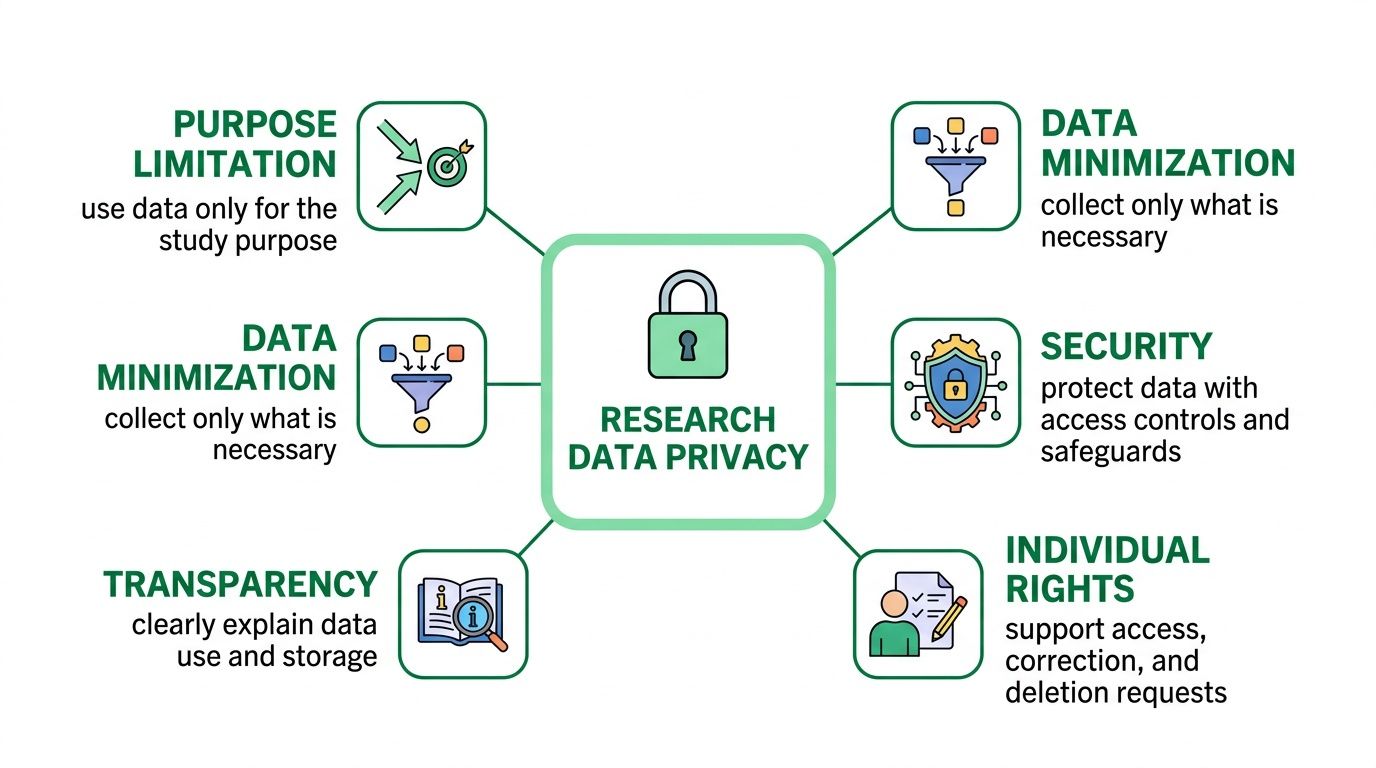
The diagram below maps the five principles that hold that system together.
From Slogans to Design Constraints
Purpose limitation means you collect data for a stated study purpose and you don't repurpose it later without a fresh basis. If participants consented to a checkout usability test, that consent doesn't automatically cover training a model or benchmarking a competitor flow next quarter.
Data minimization is the brake pedal. You gather only what the research question needs, and you can say why each field earns its place. "It might be interesting" isn't a reason. Neither is a recruitment form you copied from a previous study.
Security covers the unglamorous controls, access permissions, encryption, and audit trails, that decide who can reach the data. Transparency means participants learn what you collect, why, how long you'll store it, and who sees it, before they start. Individual rights close the loop. People can request access, correction, or deletion, and your team needs a way to honor that without a frantic search through shared drives. When you're drafting participant-facing explanations, it's worth studying how organizations write their privacy and data use details so your own notice answers those questions in language a non-lawyer can follow.
Privacy Follows the Full Lifecycle
Many teams think about privacy at publication. By then, the exposure already happened. Recruitment records, prototype files, raw recordings, transcripts, demographic tags, issue labels, and exported reports each carry fragments. Linked together across intake, analysis, and sharing, fragments become an identity.
That accumulation is measurable. A 2026 clinical-LLM study on progressive disclosure found that 79.9% of simulated patients fell below a k-anonymity threshold of 5 after progressive disclosure, with a median of seven disclosure steps, and only four when rare attributes came first. Translate that to product research. An unusual user journey here, a free-text comment there, an accessibility note in a third session, and your "anonymous" participant is identifiable, especially once AI summaries stitch the sessions together.
Before you collect anything: Write the analytical question, list the fields that question truly requires, and schedule a re-identification check on what you produce. Deleting names once, on day one, isn't a privacy strategy.
Laws and Consent Models That Govern Studies
Principles tell you what good looks like. Law tells you which decisions you must make before a study starts, and the three frameworks below force different decisions.
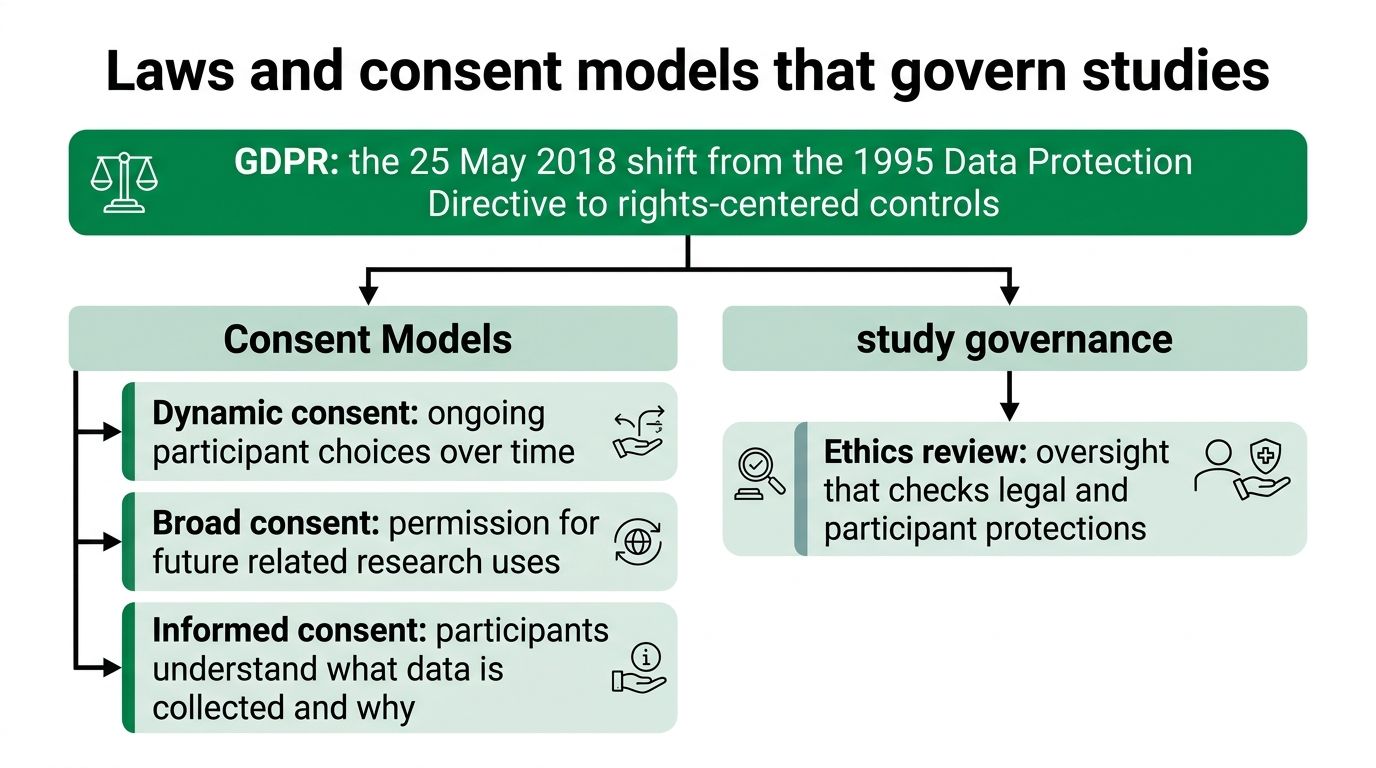
The hierarchy here shows how a governing law sits above consent choices and ethics oversight.
GDPR Sets the Rights-Centered Baseline
The EU's General Data Protection Regulation entered into force on 25 May 2018, replacing the 1995 Data Protection Directive, a shift described in a study of research requests to Croatia's data-protection authority. It reaches universities, hospitals, public agencies, and private companies, and it follows multinational datasets and cross-border transfers, so a team outside Europe still feels it when collaborators or participants sit inside it.
For research specifically, Article 89(1) safeguards for scientific research require appropriate safeguards for individual rights and freedoms, emphasize data minimization, and permit pseudonymisation where the research purpose can still be met. It also pushes you toward data that no longer permits identification whenever that's feasible. Only fully and irreversibly anonymised information falls outside GDPR personal-data obligations. Coded data with a key somewhere on your drive is still regulated.
The Common Rule and HIPAA Ask Sharper Questions
In the United States, the 2018 Common Rule requires institutional review boards to confirm a study has adequate provisions for participant privacy and data confidentiality. Under the Common Rule summary at 45 C.F.R. §46.116(b)(9), information counts as identifiable when identity may readily be ascertained, and consent language about future research must say either that de-identified materials may be reused without additional consent or that they will not be used that way. There's no vague middle option. You have to choose and disclose.
HIPAA gets more mechanical. Its Safe Harbor route requires removing all 18 identifiers listed in 45 C.F.R. §164.514(b)(2) for research repositories, unless you know remaining information could still identify someone alone or in combination. The alternative, Expert Determination, needs a qualified statistician to conclude that re-identification risk is very small for the anticipated recipient.
Consent models sit between these rules and your study. Informed consent covers a specific use. Broad consent permits future related research. Dynamic consent lets participants adjust choices over time. Ethics review checks that whichever model you picked actually protects people.
Draft your notices with that granularity. Separate recording, transcript analysis, future reuse, sharing, and de-identification into distinct explanations rather than one blanket paragraph. Reading a concrete example such as the ProfessionLens privacy policy helps you see how those topics get separated in practice, and you should apply the same discipline to your own study documents and to the Uxia privacy policy page your participants may encounter through a testing platform. Keep synthetic testing clearly distinct from studies involving identifiable people, and book ethics review before recruitment when it applies.
How to Choose a De-Identification Method
Pick a method by what it does to the data and whether your obligations survive the transformation. Teams get into trouble when they treat every technique as a synonym for safe.
Four Methods, Four Different Promises
Anonymization aims for irreversibility. Done properly, nobody, including your own team, can reconnect a record to a person, and GDPR-style personal-data duties fall away. It's the strongest claim and the hardest to defend, because rich UX content resists it.
Pseudonymization swaps names for participant IDs or hashes. It's useful and it reduces casual exposure, but it isn't anonymization. If a separately stored key, linked metadata, or an auxiliary file can reconnect records, you're still handling personal data. The architecture matters. Separate the identity table from transcripts and recordings, restrict the linkage key to a small authorized group, apply least-privilege access, encrypt data at rest and in transit, and log every key access. The NIST guidance on de-identification of government datasets makes a related point. Define the analytical objective first, set measurable disclosure-risk criteria, and run re-identification studies instead of treating deletion as a one-time cleanup.
Differential privacy adds calibrated noise against a privacy budget so aggregate results don't reveal whether any one person was in the dataset. There's no universal setting you can borrow from another team's paper. The right budget depends on your data and your question.
Synthetic data generates artificial records modeled on real patterns, so analysis proceeds without exposing source rows. It isn't automatically anonymous. A generator can memorize rare cases, and outputs still need disclosure testing.
De-Identification Choices for Research Teams
Method | What changes | Still personal data? | Best fit |
|---|---|---|---|
Anonymization | Identifiability removed irreversibly | No, if truly achieved | Public release, long-term archives |
Pseudonymization | Direct identifiers replaced with codes | Yes, while a key exists | Internal analysis needing recontact or linkage |
Differential privacy | Noise added against a privacy budget | Depends on the output and budget | Aggregate statistics shared externally |
Synthetic data | Artificial records replace source rows | Not automatically exempt | Exploration and testing without real participants |
Where Uxia Fits in the Choice
Uxia is a concrete version of the synthetic route for product teams. You upload an image or video prototype, set a mission and audience, and the platform generates synthetic participants aligned to demographic and behavioral profiles. Those testers move through your flow, think aloud, and return transcripts, issue flags, and visual reports. For early iteration you avoid recruiting real people at all, which means no recordings, no consent management, and no linkage keys for that round.
That doesn't retire human research. It reserves it. Run synthetic testers while the design is still moving, then bring in real participants when the question genuinely requires them, with the safeguard from the table that matches your plan for their data.
When Stronger Privacy Changes the Findings
Here's the uncomfortable trade-off nobody puts in a vendor deck. The output that looks safest can be the output you should trust least.
This comparison frames the tension between protecting people and preserving signal.

Protection Has a Measurable Cost
Work on behavioral-health data found that differentially private synthetic data reached a practical balance at privacy parameter ε=5 while retaining important statistical relationships, according to the 2026 differential privacy research paper. Treat that number as a result for one dataset and one task, not as a default you can copy into your own study. A different population or a rarer subgroup could behave very differently at the same setting.
The opposite failure is just as real. In the 2026 medical-data comparison covered in the principles discussion above, stronger anonymization stripped out enough information that parts of the original analysis couldn't be reproduced. The synthetic version looked credible and preserved analytical usefulness at a glance, yet it shifted key risk estimates enough to potentially change how the study should be interpreted.
More privacy protection can reduce reproducibility, and synthetic data can hand you a false sense of evidentiary confidence.
So the honest question isn't "is it de-identified?" It's "what evidence should I demand before I trust findings built on transformed data?" When you're weighing that balance for operational datasets, external guidance on deidentified business data is useful background for framing the utility side of the argument.
This short video walkthrough is worth watching before your next review of a transformed dataset.
Demand an Evidence Pack
Disclosure evidence: Privacy budget used, or the results of attack-based re-identification testing.
Utility evidence: Metrics tied to your actual hypothesis, not generic distributional similarity.
Uncertainty: Intervals that show how much the protection moved the estimate.
Subgroup performance: Whether minority patterns survived, since averages hide erasure.
Replication: Whether the conclusion holds on the protected data, not just the raw data.
Calibrate strictness to stakes. In exploratory UX testing, a dampened friction signal costs you an iteration. In high-stakes research, an altered correlation can redirect a decision. If you compare Uxia synthetic results against real-participant material, state what was calibrated, what was held out, and which claims are directional rather than confirmatory. That honesty is what makes synthetic findings usable.
Building a Privacy-Preserving Research Workflow
Good intentions collapse without a sequence. Walk your data through five stages and assign a control to each one.
The flow below tracks research data from intake to final sharing.

Controls From Intake to Deletion
Start before collection. Threat-model the study. Who might want this data, what else could they combine it with, and which fields create that possibility? Guidance from the National Human Genome Research Institute on protecting third-party information states that investigators must secure identifying data from collection through analysis and publication, and for as long as the data are stored. Your UX repository deserves the same continuity.
At intake, collect only the attributes your research question needs and document why each demographic or behavioral field exists. For studies run in Uxia with uploaded prototypes, transcripts, screen recordings, or participant profiles, set retention periods before testing starts, not after someone asks. Review the platform rules that govern captured content, including the Uxia screen recording terms, so your study plan and the tool's terms don't contradict each other.
During processing, separate recruitment identity from response data. Your analysts rarely need both in the same table. Restrict the re-identification key to named people, encrypt data in storage and transfer, and suppress unnecessary identifiers in transcripts and screenshots as you clean them.
Collaboration is where discipline usually leaks. Use role-based workspace access so a stakeholder who needs findings doesn't inherit raw recordings. Keep an audit trail for downloads and external sharing. If a file leaves the workspace, you should know who took it and when.
Test the Transformation, Then Delete on Schedule
After you de-identify or synthesize, attack your own output. Try to re-identify records using realistic auxiliary information. Limit cross-session linkage where you can, and have a person review AI-generated summaries, because a summary can reassemble details you carefully separated.
Deletion is a control, not housekeeping. Remove raw recordings and linkage keys on the retention schedule you set, before only aggregate findings remain. Synthetic testers reduce exposure to real people, but any genuine participant material you use to calibrate, validate, or compare still goes through this same review.
One hard boundary. If a study touches health-related user journeys or data from a covered entity, don't send protected health information into a testing workflow unless the disclosure and vendor roles are authorized. You need the full Safe Harbor removal or documented expert determination described earlier. Labeling someone an "anonymous participant" is not that analysis.
Governance Steps and Your Next Research Move
A workflow runs the study. Governance proves you ran it properly when a participant, a partner, or a regulator asks six months later.
Keep a Record You Can Actually Produce
Purpose and basis: The research question, plus the lawful basis or consent wording you relied on.
Field justification: Every attribute collected and the reason the question needed it.
Key custody: Who holds the linkage key, who accessed it, and when it's destroyed.
Retention dates: Deletion deadlines for recordings, transcripts, keys, and exports.
Vendor and transfer map: Which platforms processed the data and in which locations.
Utility checks: The disclosure and validity evidence for any transformed dataset you published from.
Tie this record to the commitments you already publish. Your governance file should match what participants read in notices and what your platform states, including the Uxia security policy documentation. Gaps between the public promise and the internal record are where trust breaks.
Plan the Bad Day Before It Arrives
Write a short incident path now. Who gets notified first, and who has authority to halt further sharing? Which workspace copies, downloads, and exported reports need to be located and contained? What do participants and research partners need to hear, and from whom? Then log what you'll change before the next study runs. A one-page plan written calmly beats an improvised one written during a breach.
Your Move This Week
Pick the branch that matches your next question. If it's an early design question that doesn't require identifiable people, run the mission with Uxia synthetic testers on an uploaded prototype, limit audience attributes to what the question needs, and keep real recordings out of the workspace entirely. You'll get directional feedback with far less exposure. If the study genuinely needs people, write the consent notice first, separate identity from responses in your data model, and book ethics review before you recruit anyone.
Privacy and useful research aren't opponents. They coexist when sharing is explained in plain terms, access stays narrow, and your team can show two things at once, how you measured disclosure risk and whether the finding still holds on the protected data. That's the standard worth shipping.
Ready to test your next flow without putting real participants' recordings, transcripts, and profiles at risk? With Uxia, you upload a prototype, set a mission and audience, and get synthetic testers who move through your design, think aloud, and surface prioritized issues in minutes. Start your next study with less personal data in the room and evidence you can defend.