Top 7 UX/UI Events in Europe for 2026
Discover the top 7 UX/UI events in Europe for 2026. A curated guide to conferences and workshops for designers, PMs, and researchers.
Choosing the right ux/ui events in Europe starts with rejecting the usual advice. The most popular recommendation is to attend the biggest conference you can afford, collect inspiration, and trust that value will follow. That sounds reasonable, but it often fails in practice. Teams come back energized, then hit the same bottleneck on Monday: research is still too slow for the pace of product delivery.
That gap shows up in almost every serious product conversation. Designers, PMs, and researchers usually don't need more persuasion that user feedback matters. They need methods that fit sprint timelines, stakeholder pressure, and messy cross-functional delivery. The best events help with that. The weaker ones leave you with polished slides and no operational change.
The European scene is strong enough to support real specialization, not just general design meetups. One market forecast projects the Europe UI/UX market will grow at a 31.8% CAGR from 2025 to 2032, with Germany projected to reach $627.7 million by 2032, which helps explain why major hubs keep attracting serious conferences and vendor activity in cities like Berlin and Munich (KBV Research on the Europe UI/UX market).
Ask one question before you book anything: are you trying to learn a new method, align a cross-functional team, or reset creative direction? That answer matters more than speaker glamour. The events below earn a place because they help teams close the gap between insight and execution, especially when paired with faster validation workflows through tools like Uxia.
1. UXLx User Experience Lisbon
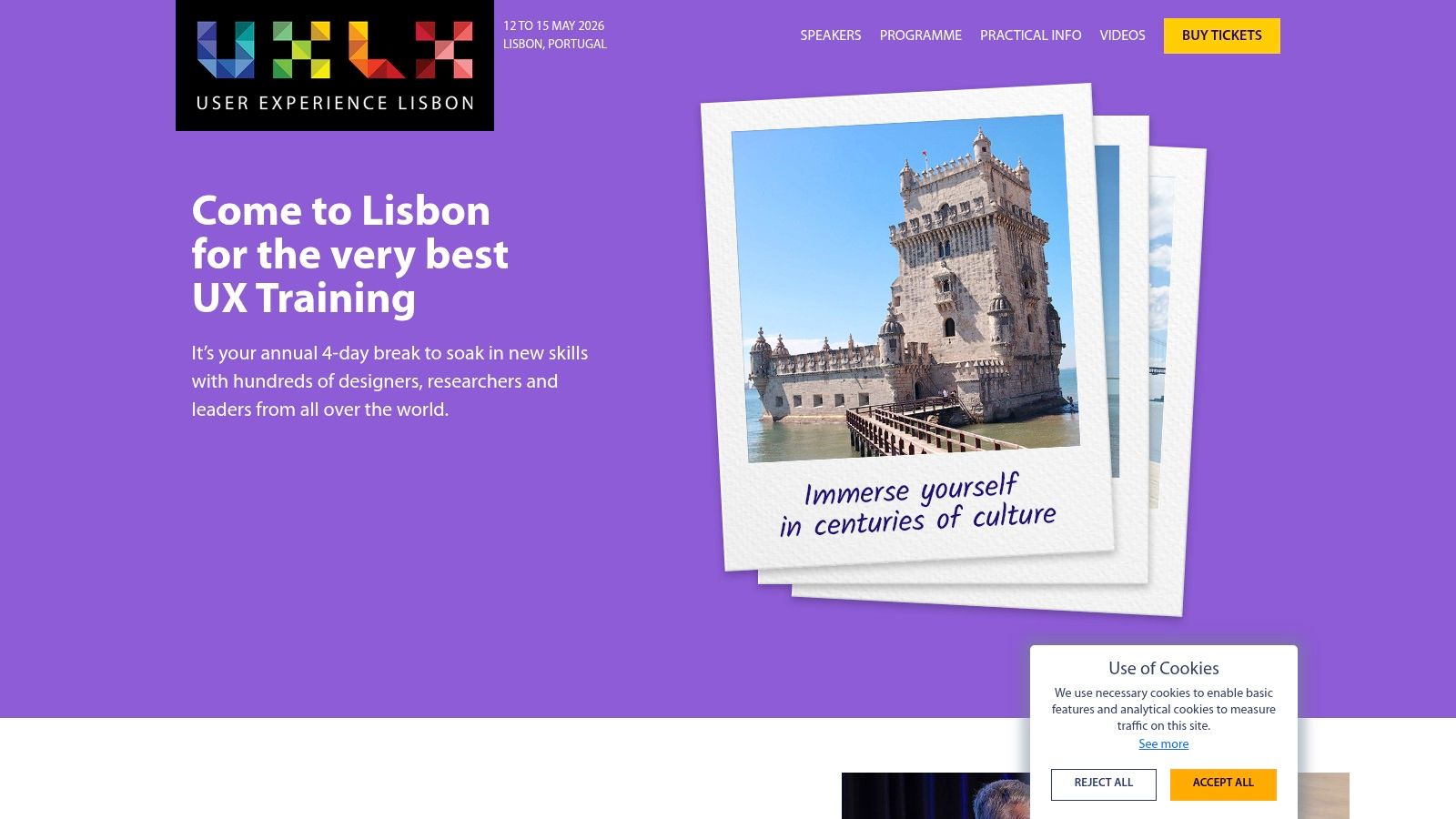
UXLx is the event I point teams toward when they need methods they can apply the next week. Lisbon attracts plenty of global attention, but the format is what matters. A leadership and strategy day, two workshop days, and a final talks day creates a better learning sequence than conferences that try to do everything at once.
That structure works well for teams that already know their weak spot. If your issue is research ops, stakeholder communication, discovery quality, or service design practice, workshop-heavy events usually beat keynote-heavy ones. UXLx tends to reward people who arrive with a real problem in mind.
Best fit
UXLx is strongest for teams that want practical upskilling without giving up peer access. The venue format also makes networking less chaotic than sprawling expo-style events.
Send a mixed team: Designers, researchers, and PMs usually get more value than a single attendee because they can split workshops and compare notes afterward.
Book workshops early: The first-come-first-served model means late registrants often miss the most relevant sessions.
Use it to reset process: This is a good place to move a team from occasional research to repeatable habits.
Practical rule: Don't send people to UXLx without a post-event testing plan. If a workshop gives you a better way to evaluate a flow, run that method immediately in your own product.
The trade-off is simple. UXLx is not the cheapest or most casual option once travel, lodging, and VAT are in the mix. It also punishes late planning more than many other events. But if your team needs depth more than spectacle, it's one of the better ux/ui events in Europe.
For Uxia users, UXLx pairs especially well with prototype validation. Teams can take workshop concepts and translate them into rapid test cycles instead of waiting for the next formal research window.
2. UX London
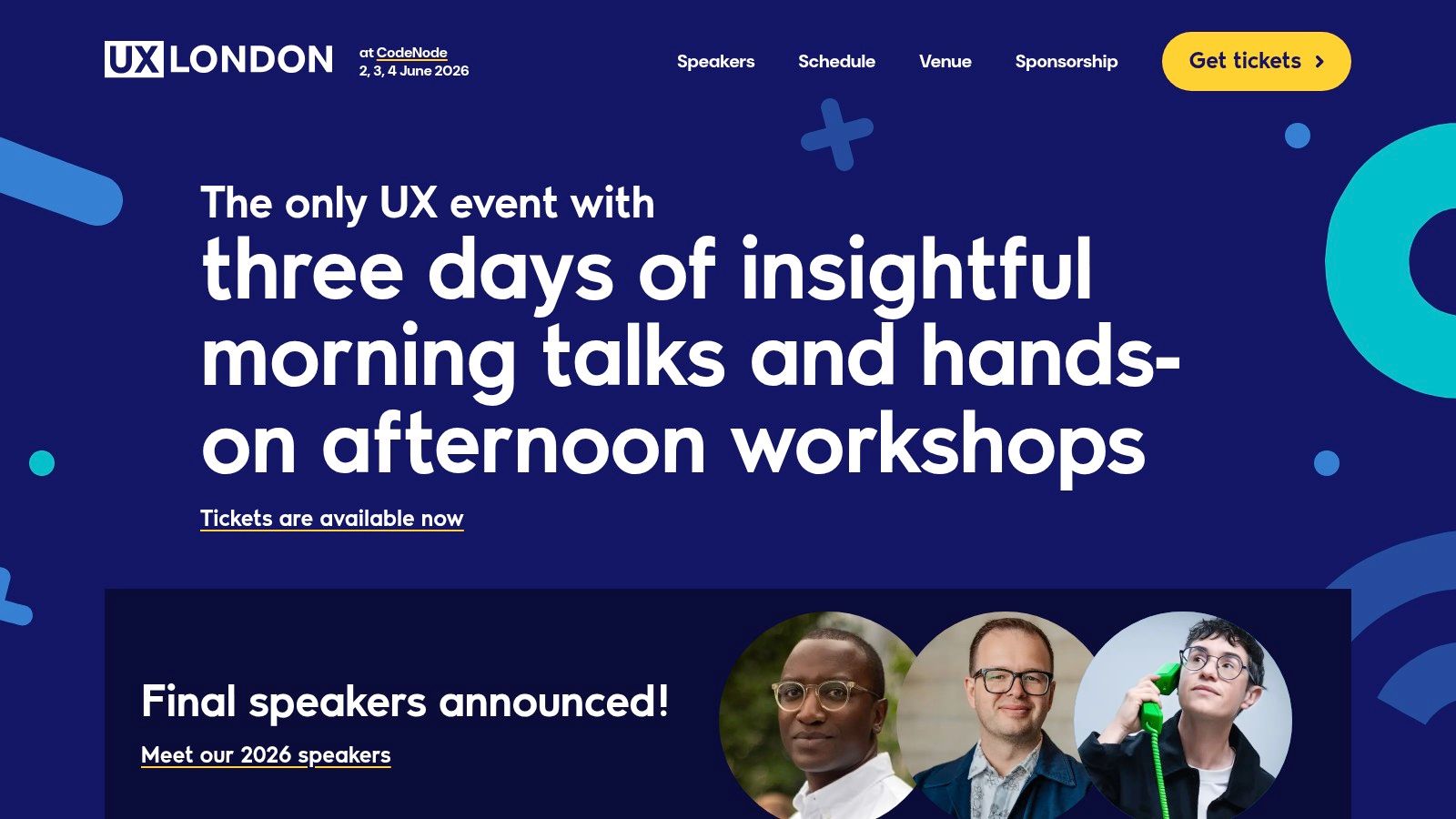
UX London stays useful because it respects how product work happens. The Discovery, Design, and Delivery split gives teams a clean way to choose what they need instead of buying a vague “inspiration package” and hoping relevance appears.
That makes it a strong pick for cross-functional attendance. PMs usually gravitate toward Discovery and Delivery. Designers often split between Design and Delivery. Research and content people can usually find value in Discovery, but the true strength is the shared language the event creates across roles.
Where it delivers
The best use case is a team trying to improve decision-making across the product lifecycle, not just polish screens. If your org has recurring friction between research, design, and shipping, this event helps because the structure itself mirrors those handoffs.
The practical takeaway from events like UX London is rarely a shiny framework. It's the realization that research can't stay trapped as a separate project stream if product teams are shipping continuously.
A few trade-offs matter. London is expensive for non-local teams, and workshop capacity can force hard choices. It also isn't a pure research event, so very specialized researchers may want something narrower.
Still, for a team that needs alignment more than niche depth, UX London is one of the safest bets. It works particularly well if you already know that your bottleneck isn't design taste. It's coordination.
For Uxia, that matters. The platform fits best when teams leave an event with better questions but still need a fast way to test assumptions between releases. UX London gives you the strategic framing. Uxia can handle the rapid validation work that teams often struggle to operationalize.
3. UXDX EMEA Berlin
UXDX EMEA Berlin is for teams that are tired of the old handoff model. If your company still treats product, design, engineering, and research as separate lanes, this conference will feel more relevant than a traditional UX-only event.
Its hybrid format is part of the appeal. That makes it easier to involve people who can't justify travel but still need the content. Hybrid access also helps teams compare notes in real time instead of relying on one delegate's memory and a folder of photos.
Why Berlin suits the format
Berlin is a logical host for this kind of cross-functional conference. A separate market forecast identifies Germany as the largest country market in 2024 within projected European UI/UX growth, with the UK and France also expanding rapidly, and notes cloud as the dominant deployment model in the UK at a 30.7% CAGR (Research and Markets on the Europe UI/UX market). That kind of concentration tends to support events focused on scalable workflows, distributed collaboration, and tool adoption.
What UXDX gets right is its emphasis on validating what to build, not just designing what was already decided. That's a better match for modern teams dealing with AI-assisted workflows, changing stakeholder priorities, and short release cycles.
Bring engineering into the trip: This event is better when design attends with product and engineering rather than alone.
Pick sessions by operating model: Teams scaling dual-track discovery will choose differently than teams still fixing handoff culture.
Use the hybrid option intentionally: Remote attendees should watch with a shared note doc and assigned themes, not passively.
The downside is breadth. Broad events can create schedule conflicts, and not every session will hit the same level of tactical usefulness. But if your pain sits between disciplines, that breadth is exactly why UXDX works.
Uxia fits naturally after this event because UXDX tends to raise the validation standard. Once teams agree they need faster evidence before building, they need a way to run tests continuously instead of waiting on heavier research cycles.
4. SmashingConf Freiburg
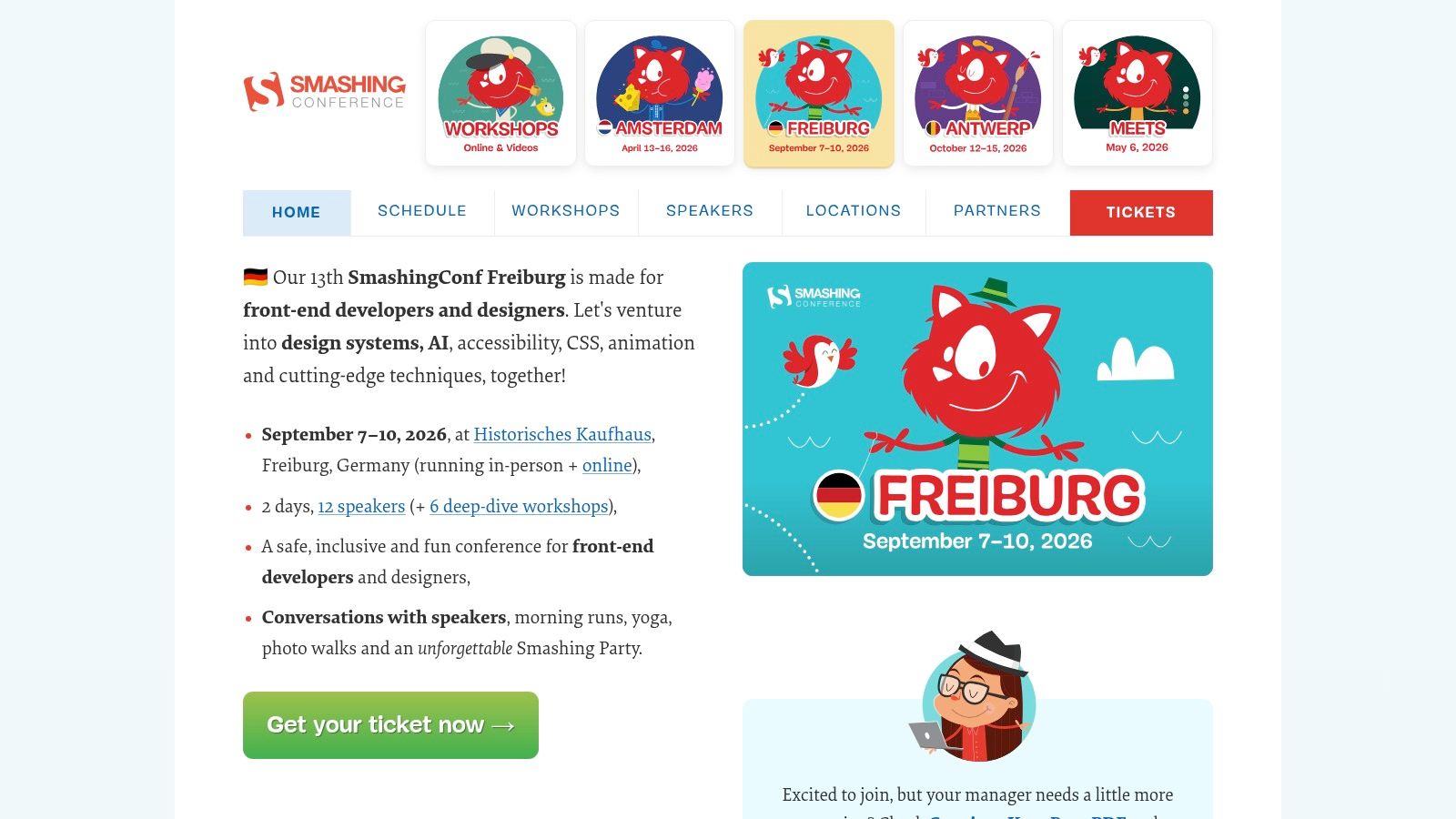
If your UX problems show up in the browser, not just in Figma, SmashingConf Freiburg is one of the better choices on the calendar. At this event, design systems, front-end implementation, accessibility, and practical UI engineering start to connect.
The small scale is the advantage. Large conferences are good for market scanning. Smaller ones are better when you need detailed conversations about component behavior, accessibility debt, or what breaks between design intent and production code.
Best for code-adjacent UX teams
This event works especially well for product designers who sit close to front-end teams, design system owners, and UX professionals who need to understand implementation constraints. The single-track format also reduces the usual conference problem of everyone attending different sessions and learning nothing together.
Smaller practitioner-led rooms often produce the most actionable insights. People stop talking about trends and start talking about what failed in production that week.
SmashingConf is not where I'd send someone looking for a pure user research deep dive. It leans more toward the design-to-code layer. That said, given the European Accessibility Act takes effect in June 2025, accessibility isn't just a craft preference anymore for many digital products sold in the EU (Searchlab on UX/UI design and accessibility statistics). Events with strong accessibility and implementation coverage now have more strategic weight than they used to.
That also explains why tools like Uxia matter in this context. If a team learns better accessibility and interaction patterns at SmashingConf, they still need a fast way to pressure-test those choices in real flows. Uxia's accessibility testing and AI user testing can shorten the gap between “we learned the principle” and “we checked the product.”
5. PUSH UX
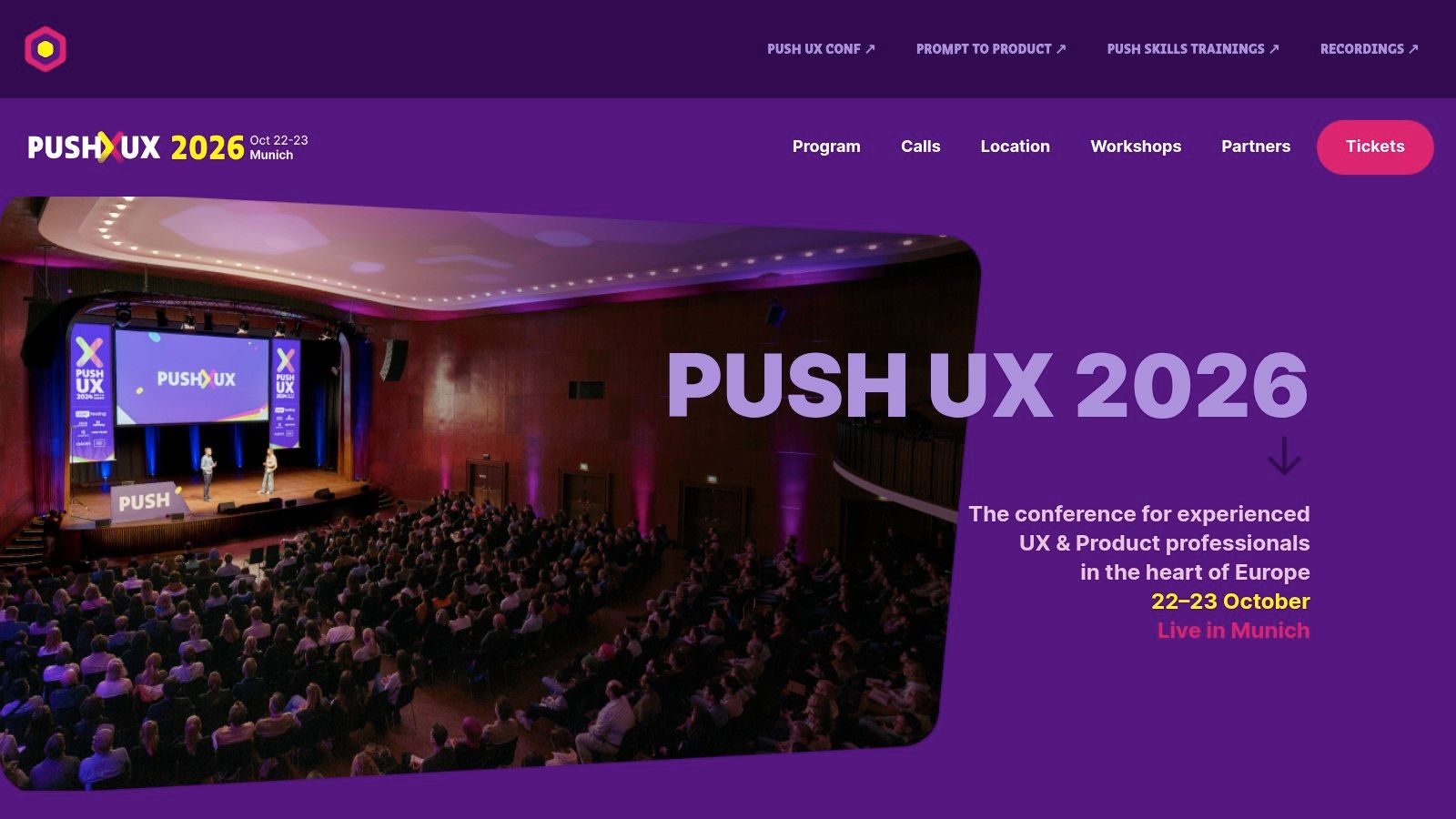
PUSH UX is one of the better senior-practitioner events in Europe because it doesn't over-index on beginner-friendly material. If you're a mid-level designer looking for a broad intro to UX, there are easier starts. If you're already carrying decision-making responsibility, PUSH becomes more interesting.
The Munich location helps. Germany remains a major center of gravity in the regional market, and that tends to show up in the quality of attendees, hiring conversations, and enterprise product discussions. The room is usually full of people thinking about product impact, not just interface craft.
What senior teams get from it
PUSH is useful when your team is wrestling with design impact, AI in design practice, and the business side of UX. That's different from attending for inspiration alone. The value is in practitioner-to-practitioner exchange with people who've had to defend research time, fix broken delivery processes, and make design work visible to leadership.
One 2026 events roundup notes that e.PUSH UX in Munich is expected to draw more than 700 attendees, alongside other specialist European events such as UX360 Europe in Berlin and Future Product Days in Copenhagen (UIUX Trend European UX events calendar). That scale is large enough to matter, but still focused enough to stay practitioner-led.
Send leads, not just ICs: Design managers and senior ICs usually get more from the business-impact conversations.
Prioritize AI sessions carefully: Some conferences treat AI as branding. PUSH is better when sessions stay tied to workflow and delivery.
Use hallway time well: The side conversations are often as useful as the official talks.
The main limitation is audience fit. Junior designers can still learn a lot, but the density can be a mismatch if they don't yet have context for org-level trade-offs.
Uxia belongs in that post-conference stack because senior teams don't just need ideas. They need a way to introduce more frequent testing without slowing delivery. That's where synthetic testing becomes operationally useful rather than theoretical.
6. OFFF Barcelona
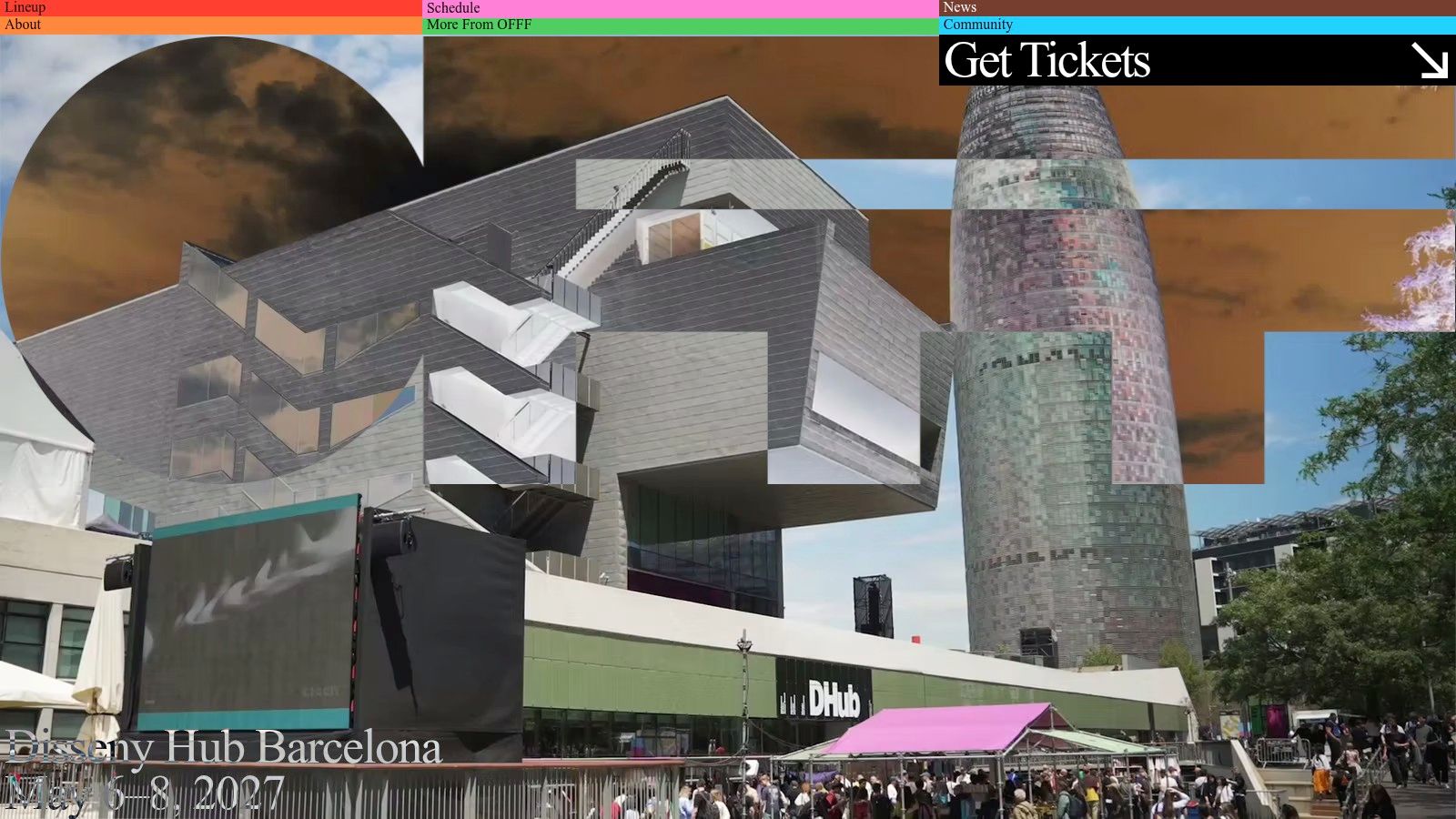
OFFF Barcelona is the outlier on this list, and that's intentional. Not every team attends ux/ui events in Europe for process repair. Sometimes the problem is that the product has become visually safe, interaction-poor, or too internally optimized.
OFFF is broader than classic UX. It leans into creativity, motion, interaction, digital culture, and visual direction. For UI-heavy teams, brand-led product groups, and companies trying to refresh creative quality, that can be exactly the right move.
When inspiration is the right answer
The mistake is sending a research operations team to OFFF and expecting process templates. That's not what it does best. OFFF is for widening the visual and conceptual range of a team that's shipping functional but forgettable experiences.
That said, inspiration without validation creates its own problems. Motion ideas, interaction patterns, and visual bets still need testing before they become product decisions.
Creative direction is valuable. Untested creative direction is expensive.
So the practical recommendation is simple. Use OFFF to refresh taste and spot emerging interaction patterns, then run those ideas through rapid validation. Uxia is useful here because creative concepts often need fast early feedback before anyone commits engineering time. Teams can test flows, copy, trust signals, and navigation implications before a bold visual idea hardens into roadmap debt.
The other trade-off is obvious. OFFF is less useful for people who want dense research content, discovery methods, or accessibility-heavy implementation detail. It earns its place because some teams genuinely need better creative stimulus, and pretending otherwise leads to stale product work.
7. UXcamp Europe
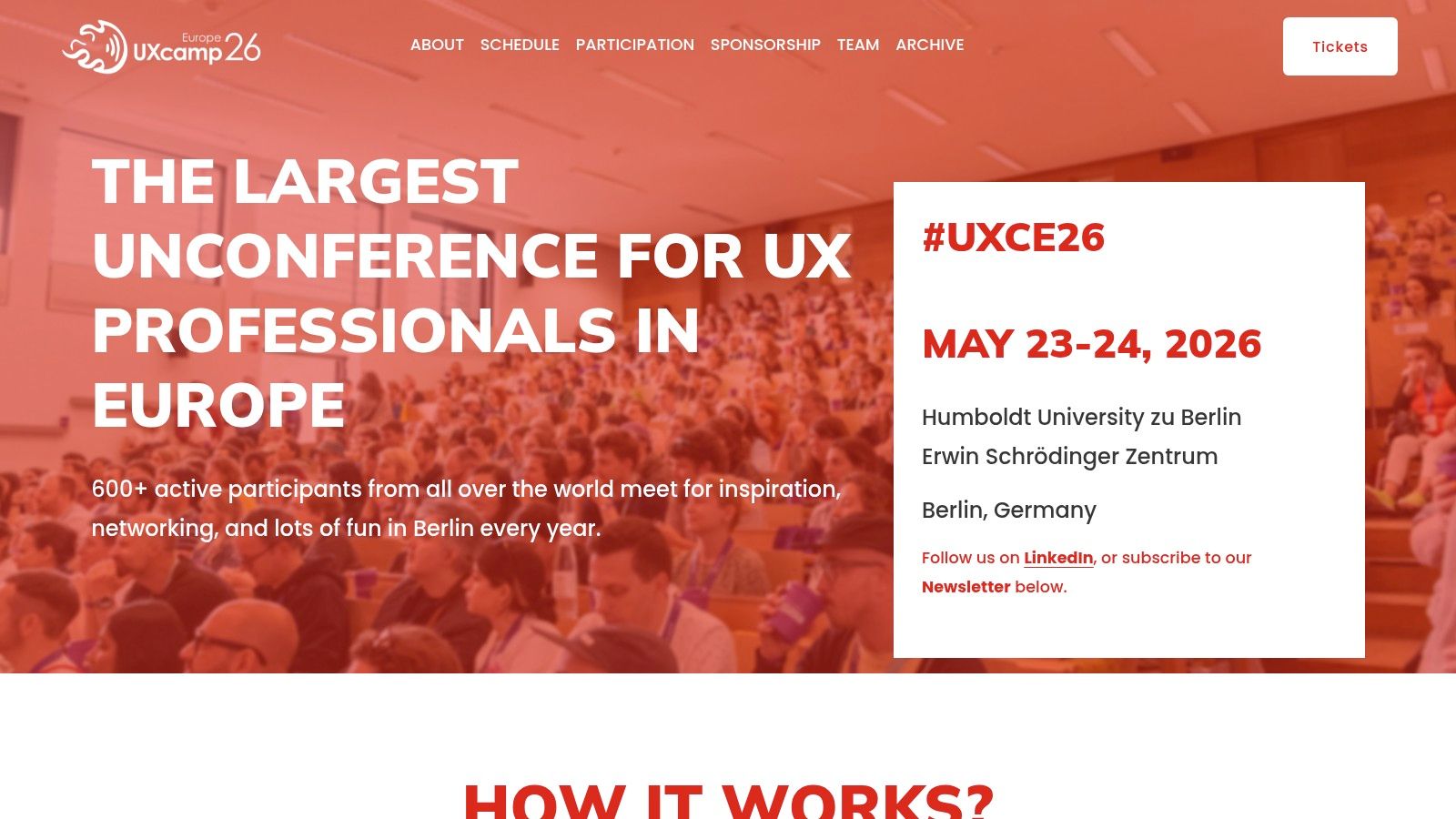
UXcamp Europe is what I recommend when someone says they want less polished content and more honest discussion. The unconference format means you don't get a predetermined agenda. You get whatever the community is willing to bring into the room that day.
That variability is both the strength and the risk. Some sessions will be excellent because they're rooted in immediate practice. Others will be uneven. If you need certainty, book a curated conference. If you want to hear what practitioners are struggling with, UXcamp can be more revealing than a formal event.
Why the format still matters
The big advantage is candor. People show up with live problems around hiring, stakeholder resistance, research speed, accessibility, and AI trust. Those are often the most useful conversations because they haven't been polished into conference theater.
Another industry roundup points out that current event coverage often fails to separate research-heavy conferences from broader design and product events, even though that distinction matters. It also notes that uxcon vienna offers both on-site and online participation, while UX360 Europe positions itself around helping research influence and scale, compared with broader events that mix UX, front-end, design systems, and AI (Hatch Conference guide to European UX and design conferences in 2026).
That same distinction is why UXcamp is useful. It won't replace a specialized event, but it will surface the exact language people use to describe operational pain.
Go if you can contribute: Unconferences reward participation, not passive attendance.
Prepare one session idea: Even a discussion prompt is enough.
Use it for market listening: Agencies, tool teams, and design leads can learn a lot from repeated grassroots themes.
For Uxia, these rooms are especially valuable. Smaller practitioner settings often reveal the bottlenecks that faster testing can solve, especially when teams admit they can't wait weeks for traditional studies every time a flow changes.
Comparison of 7 Major European UX/UI Events
Conference | Implementation complexity 🔄 | Resource requirements ⚡ | Expected outcomes 📊⭐ | Ideal use cases 💡 | Key advantages ⭐ |
|---|---|---|---|---|---|
UXLx: User Experience Lisbon | Medium, 4‑day mix (leadership, 2 workshop days, talks); workshop pre‑booking (🔄🔄) | Moderate, travel to Lisbon, VAT applies; group discounts available (⚡⚡) | High, pragmatic, practice‑oriented methods ready for workplace use (⭐⭐⭐) | Practitioners seeking hands‑on skills to apply immediately | Deep, workshop‑heavy program; strong networking; compact venue |
UX London | Medium, 3 themed days with talks + workshops; per‑day ticketing (🔄) | Moderate‑High, London travel/accommodation costs; automatic 20% team discount (⚡⚡) | High, balanced research → design → delivery skill building (⭐⭐⭐) | Mixed PM/Design/Research teams targeting day‑specific skills | Curated by Clearleft; clear structure for targeted learning |
UXDX EMEA (Berlin) | Medium, cross‑disciplinary agenda; hybrid in‑person + online logistics (🔄🔄) | Flexible, virtual passes reduce travel; tiered pricing for teams (⚡) | High, strong focus on validation and end‑to‑end delivery (⭐⭐⭐) | Cross‑functional teams prioritizing product validation and AI acceleration | Hybrid access; alignment across product, design, engineering |
SmashingConf Freiburg | Low‑Medium, single‑track conference with workshops; small scale (🔄) | Low‑Medium, smaller city travel; limited capacity; member discounts (⚡) | High for front‑end/UX engineers, practical code‑to‑UX takeaways (⭐⭐⭐) | UI engineers, design systems and accessibility practitioners | Intimate scale with high speaker access; curated code/UX crossover |
PUSH UX | Medium, practitioner‑focused tracks for senior topics; denser sessions (🔄🔄) | Moderate, regional travel, early bird options; VAT applies (⚡⚡) | High for senior ICs/leads, actionable on design impact & business outcomes (⭐⭐⭐) | Mid‑senior UX/product leads focused on impact and AI in design | Advanced, practitioner‑to‑practitioner learning; strong regional network |
OFFF Barcelona | Medium, 3‑day creative festival with talks, workshops and evening events (🔄) | Moderate‑High, festival scale, travel; phased ticket releases (⚡⚡) | Medium, strong creative and visual inspiration, less UX process depth (⭐⭐) | Teams seeking cutting‑edge visual, motion and interaction inspiration | World‑class creative lineup; lively side events and community energy |
UXcamp Europe | Low, unconference/BarCamp format; agenda created on‑site (🔄) | Low, free tickets (scarce); travel to Berlin is main cost (⚡) | Variable, high peer exchange but session relevance varies (⭐⭐) | Practitioners wanting to present, test ideas and run grassroots workshops | High interaction and bottom‑up knowledge sharing; budget‑friendly option |
From Insight to Action Making Events Pay Off
The strongest ux/ui events in Europe all point to the same operational truth. Teams aren't stuck because they don't value research. They're stuck because product delivery moves faster than traditional research setups can support.
That's why the most useful event takeaway isn't usually a trend deck or a favorite keynote. It's a process shift. The best teams move from treating research as a project to treating it as a continuous product habit. That means validating assumptions earlier, testing more often, and separating quick directional checks from deeper human inquiry.
Uxia fits well in that gap because it gives teams an operational bridge between event insight and day-to-day execution. In one internal comparison shared by the company, a Uxia test cycle was completed in 25 minutes, while a traditional human-panel process took much longer. The output surfaced practical issues such as ambiguous copy, missing confirmation states, and unclear payment-related options. That's the kind of feedback loop teams need after a conference, when motivation is high but sprint pressure returns immediately.
A good event strategy looks like this:
Match the event to the bottleneck: Choose UXLx for method depth, UX London for team alignment, UXDX for cross-functional delivery, SmashingConf for implementation detail, PUSH UX for senior practice, OFFF for creative reset, and UXcamp for grassroots learning.
Decide implementation before travel: Pick one workflow, one template, or one test practice you'll adopt within days of returning.
Pair inspiration with validation: If a session changes how you think about onboarding, checkout, accessibility, or AI-assisted design, test that change quickly instead of waiting for a large formal study.
Measure event value operationally: The right post-event question isn't “Was it inspiring?” It's whether the team now makes better product decisions faster. If you're refining your framework for measuring trade show ROI, that practical lens matters.
Conferences give teams the strategic why. Tools determine whether the why turns into product improvement. In that sense, Uxia is relevant not as a replacement for all human research, but as a way to validate earlier, catch obvious friction faster, and keep design learning moving at product speed.
If your team is attending ux/ui events in Europe to improve how you validate ideas, Uxia is worth a look. It helps product teams test prototypes and live flows quickly, surface usability and accessibility issues early, and turn conference takeaways into repeatable practice instead of delayed intentions.